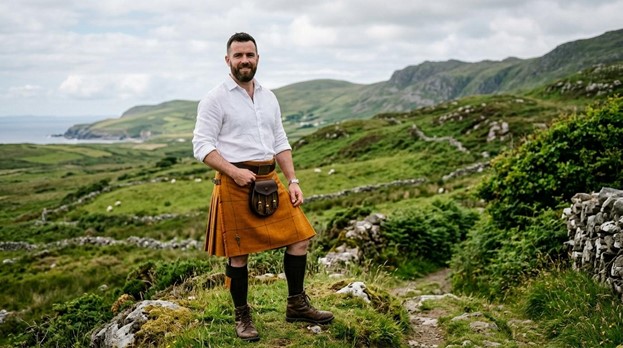
If I asked you to picture an Irish kilt right now, you’d probably imagine a man in a deep emerald green tartan, maybe with a shamrock pin, walking through a misty field. That image is everywhere — in St. Patrick’s Day marketing, on souvenir shop mannequins, in stock photography, and especially in American interpretations of Irish culture.
But here’s the thing nobody tells you on St. Patrick’s Day: the most authentically Irish kilt is not green. It’s a deep golden yellow, almost orange in some lights, and it’s called the saffron kilt. And the story of how it became the traditional Irish kilt — while emerald green tartan became the costume version — is one of the most overlooked threads in Celtic dress history.
If you’re shopping for a real Irish kilt, this is the piece you need to read first.
The Origin: A Kilt That Predates the Scottish One in Spirit
To understand the saffron kilt, you have to go back to a Gaelic garment called the léine — a long, knee-length tunic worn by Irish men from roughly the 11th to the 16th century. Saffron was the prized dye color for these tunics, achieved either with real saffron flowers (rare and expensive) or, more commonly, with substitute plant dyes that produced the same warm yellow-orange shade.
The saffron léine was so iconic in Gaelic Ireland that English colonial authorities banned it under the Statutes of Kilkenny and later the 1539 Act for the English Order, Habit and Language. They specifically called out the saffron color as a marker of Irish cultural resistance.
When the Irish léine eventually gave way to the kilt format — heavily influenced by Scottish Highland dress in the late 19th and early 20th centuries — the saffron color survived. Irish military pipe bands, particularly the Irish Defence Forces and the Royal Irish Regiment, adopted the solid saffron kilt as their official uniform.
That’s the key word: solid. Real Irish kilts have historically been solid-colored. Tartan patterns are a Scottish tradition. The saffron kilt is the Irish answer.
The Green Kilt Myth (And Where It Came From)
So why does almost everyone — even Irish-Americans — picture a green tartan when they think of Irish kilts?
A few reasons, none of them historically accurate:
1. St. Patrick’s Day commercialization. Once the holiday became a global marketing event in the 20th century, “Irish = green” became the laziest possible visual shorthand. Manufacturers responded by producing green tartan kilts and labeling them Irish. The market accepted it. History didn’t.
2. The rise of “Irish national tartan.” A green tartan called the Irish National Tartan was designed in the 1990s as a generic option for Irish-Americans without a specific county tartan. It’s a beautiful pattern, but it’s a modern commercial design ΓÇö not an ancient clan symbol.
3. County tartans. Many Irish counties now have official tartans, most of which feature green prominently. These are real and legitimate, but they’re a 20th-century revival, not an ancient tradition.
4. Confusion with Scottish kilts. Most kilts the average person sees in films, weddings, and parades are Scottish. Tartan registers in your mind as “Celtic.” Combine that with green for “Irish,” and you get the green tartan kilt myth.
None of this means green tartan kilts are wrong to wear. They’re a legitimate modern Irish-heritage choice. But if you want the authentic, historically rooted Irish kilt, you’re looking at the saffron one.
What a Real Saffron Kilt Looks Like
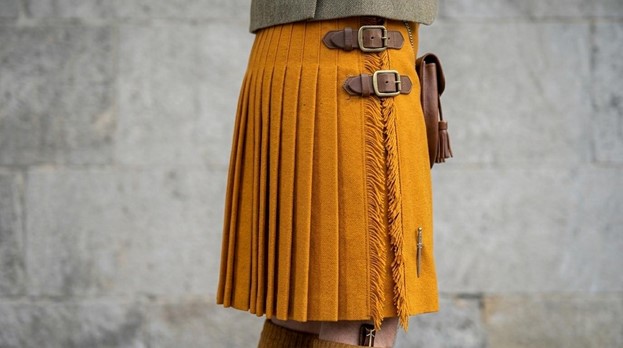
A traditional saffron kilt has a few defining features that separate it from generic colored kilts:
- Solid saffron color — a warm, deep golden-yellow, sometimes leaning slightly toward burnt orange depending on the dye batch. It should never look like neon yellow or pale cream.
- Knife pleats at the back, similar to a Scottish kilt construction
- Fringed apron edge along the front opening
- Buckle and strap closure rather than tartan-style sett matching
- Wool or wool-blend fabric for traditional pieces, though modern poly-viscose versions exist for warm-climate wear
- Length to mid-knee, exactly like Scottish kilts
The saffron color itself has slight variation across makers, which is historically accurate — natural dye batches were never identical, and that variation is part of the garment’s character.
You can see what the modern construction looks like in this traditional saffron kilt example ΓÇö note the solid color, the pleating, and the absence of any tartan pattern. That’s what an authentic Irish kilt is supposed to look like.
When and How to Wear a Saffron Kilt
The saffron kilt fits naturally into specific occasions:
Pipe band performances — This is where the saffron kilt is most visible, especially among Irish military and civilian pipe bands. If you’re joining one, it may be your uniform.
Irish weddings — Particularly weddings with strong Gaelic or traditional Irish themes. The saffron kilt reads as deeply, authentically Irish in a way that green tartan does not.
St. Patrick’s Day events — If you want to actually represent Irish culture rather than the commercialized version, the saffron kilt makes a strong statement. Be prepared to explain it to people who expected green.
Funerals and ceremonial occasions — The saffron kilt has a gravitas that suits formal Irish gatherings.
Heritage events and Celtic festivals — Most Celtic festivals welcome both Scottish and Irish dress, and the saffron kilt distinguishes you immediately.
For full traditional styling, pair it with:
- A white or cream léine-style shirt (long-sleeved, banded collar)
- A brat or short cape for formal events
- Ghillie brogues in black
- Knee-high wool kilt hose in cream, green, or matching saffron
- A sporran in brown or black leather
- A traditional Irish kilt belt with Celtic knotwork
Skip the tartan accessories — they pull the look back toward Scottish dress.
The Cultural Sensitivity Angle
Saffron vs Modern Irish Kilt Options
If you’re shopping for an Irish kilt right now, you have three legitimate routes:
- The saffron kilt — most historically authentic, solid color, deep heritage roots
- The Irish National Tartan kilt — green-based modern tartan, designed for those without specific county affiliation
- A county tartan kilt — if your family is from a specific Irish county, you can wear that county’s official tartan
All three are valid. The saffron kilt is just the one that takes you furthest back in time.
For a broader look at the full range of Irish kilts for men, it’s worth comparing the saffron option side-by-side with the green tartan options before you commit. The visual difference in person is significant — saffron has a warmth and depth that photos rarely capture.
The Practical Bottom Line
If you’ve been searching for “Irish kilts for men” and only finding green tartans, you weren’t searching wrong ΓÇö you were just being shown the commercial version of Irish dress. The saffron kilt is the deeper cut. It’s the kilt Irish soldiers wear in pipe bands. It’s the kilt that traces its color back through 800 years of Gaelic culture. It’s the kilt that gets nods of recognition from people who actually know Irish history.
Buy a green tartan kilt for festive, easy occasions. Buy a saffron kilt when you want to wear something with real weight behind it.
Frequently Asked Questions
Q: Is the saffron kilt a real traditional Irish kilt?
Yes. The saffron color traces back to medieval Gaelic Ireland and the saffron léine, and the modern saffron kilt is the official uniform of multiple Irish military pipe bands.
Q: Why is it called saffron if real saffron isn’t used?
The original medieval léine was sometimes dyed with actual saffron, but more often with cheaper plant-based substitutes that produced the same color. The name stuck.
Q: Can I wear a saffron kilt to St. Patrick’s Day?
Yes — and you’ll probably be one of the only people there in something genuinely traditional. Just be ready for friendly questions from people expecting green.
Q: What sporran goes with a saffron kilt?
A plain brown or black leather day sporran for casual wear, or a dress sporran with Celtic knotwork for formal events. Avoid heavily Scottish-themed sporrans like cantle-style hunting sporrans.
Q: Are there different shades of saffron kilt?
Yes. Authentic saffron ranges from a lighter golden yellow to a deeper burnt-orange shade. Both are historically defensible. Avoid anything that looks pastel or neon — those aren’t traditional.
Q: How much should I expect to pay for a saffron kilt?
Quality wool saffron kilts run $200 to $400. Polyester-viscose blends start around $100. Anything under $80 is usually costume-grade and won’t drape correctly.
The next time someone tells you Irish kilts are green, you’ll know better. The real one is gold — and it has been for centuries.
For more, visit Pure Magazine