The music cuts out halfway through your virtual fitness class. Again. You scramble to restart the track while twenty people on Zoom stare at their screens, momentum broken, energy deflated. Later, you’ll discover the song triggered a copyright claim, and now your carefully edited class recording can’t be posted to your YouTube channel.
This wasn’t a one-time problem for me—it was a recurring nightmare during my first year teaching online fitness classes. I’d spent hours curating playlists from streaming services, only to have them become unusable for recorded content. The “royalty-free” music I found as an alternative was either prohibitively expensive or so generic it felt like teaching aerobics in an elevator.
I teach three live classes weekly and post recorded sessions for members who can’t attend in real-time. That’s roughly 150 hours of fitness content annually, all requiring music that energizes participants, matches workout intensity, and doesn’t create legal headaches. The math was brutal: either invest thousands in music licensing or compromise the quality of my classes.
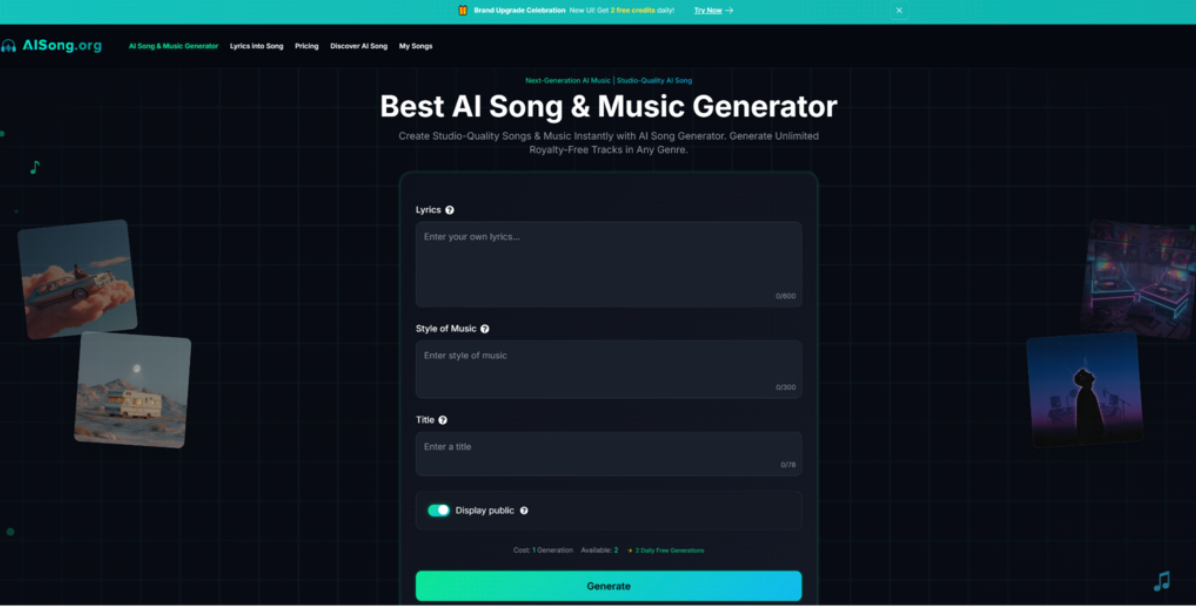
When I first heard about AI Song Generator tools, I was skeptical. Could algorithmically-generated music really capture the energy needed to motivate people through burpees and mountain climbers? After nearly a year of experimentation, I’ve found the answer is more nuanced than I expected—and more useful than I’d imagined.
Why Fitness Instruction Has Unique Music Needs
The Tempo Precision Problem
Fitness music isn’t just background ambiance—it’s a functional tool that directly impacts workout effectiveness. A cycling class needs music at 80-110 BPM to match pedaling cadence. HIIT workouts require distinct tempo shifts between work and recovery intervals. Yoga classes need slower, more meditative tempos around 60-80 BPM.
In my early attempts with stock music, I’d find a track with perfect energy but the wrong tempo, making it useless for the specific workout format I was teaching. Adjusting tempo in editing software often degraded audio quality or created unnatural-sounding results.
The Copyright Minefield
This is where many fitness instructors get burned. Using popular music from streaming services works fine for live, in-person classes. But the moment you record that class for online distribution—even to paying members only—you’re potentially violating copyright.
I know instructors who’ve had entire YouTube channels demonetized or received cease-and-desist letters for using copyrighted music in workout videos. The legal exposure isn’t worth the risk, but finding affordable alternatives that actually energize workouts proved surprisingly difficult.
The Motivation Factor
Here’s something I didn’t fully appreciate until I started teaching: music quality directly impacts participant effort and class retention. Generic, uninspiring music correlates with lower energy, earlier fatigue, and fewer people returning for subsequent classes.
The music doesn’t just fill silence—it actively shapes the psychological experience of the workout. Finding tracks that genuinely motivate people, rather than just providing acceptable background noise, became essential to my teaching effectiveness.
My Experience With AI-Generated Fitness Music
The First Attempts: Mixed Results
I’ll be honest—my initial experiments were disappointing. I generated what I thought would be high-energy workout music, but when I actually used it in a class, something felt off. The tempo was technically correct, but the energy felt flat. Participants completed the workout, but without the usual enthusiasm.
Looking back, I realize I was approaching prompts too simplistically. Requesting “upbeat workout music at 120 BPM” produced technically accurate but emotionally uninspiring results. The AI needed more context about the specific feeling I wanted to create.
Learning to Describe Energy, Not Just Genre
The breakthrough came when I stopped thinking about music genres and started describing the emotional experience I wanted participants to have.
Instead of “electronic dance music for HIIT workout,” I’d write: “Driving, motivational electronic track that builds confidence and pushes through fatigue, tempo 130 BPM, prominent bass and percussion, energizing but not aggressive, makes you feel powerful and capable.”
That shift—from technical description to emotional intent—consistently produced more effective workout music. Though I should note, it still typically took 3-5 generation attempts before finding a track that truly worked in an actual class setting.
Building Workout-Specific Music Libraries
Over several months, I’ve generated distinct music collections for different class formats:
HIIT Classes: High-energy electronic tracks with clear rhythmic patterns, 130-140 BPM, designed to push through discomfort
Strength Training: Steady, empowering music at 100-120 BPM that sustains focus without rushing movements
Cycling Classes: Driving beats at 80-110 BPM with momentum that matches pedaling rhythm
Yoga and Stretching: Calming instrumental tracks at 60-80 BPM that encourage breath awareness and relaxation
Warm-up/Cool-down: Moderate energy tracks that gradually build or decrease intensity
Each category required different prompt strategies and multiple iterations to find tracks that functioned effectively in real teaching situations.
What Works Well in Practice
Tempo Control and Consistency
One advantage I’ve noticed with AI-generated music is tempo consistency. When I specify 125 BPM, the resulting track maintains that tempo throughout, which is genuinely useful for workouts requiring steady pacing.
In contrast, many commercial tracks have tempo variations that work beautifully for listening but create challenges for structured fitness programming. A song that starts at 120 BPM but builds to 135 BPM might sound exciting, but it disrupts workout timing.
Copyright Clarity
This has been the most significant practical benefit. Every track I generate comes with clear commercial usage rights—no attribution requirements, no platform restrictions, no surprise claims months later.
I now post class recordings to YouTube, Instagram, and my membership platform without worrying about copyright issues. That peace of mind alone has been worth the learning curve of working with AI generation tools.
Customization for Class Themes
I occasionally teach themed classes—80s night, Latin-inspired cardio, chill acoustic yoga. Previously, I’d spend hours searching for appropriately licensed music in specific styles.
Now I can generate themed music relatively quickly. For an 80s-themed HIIT class, I generated several synthwave tracks at appropriate tempos. Were they identical to actual 80s music? No, but they captured enough of the aesthetic to create the intended atmosphere while maintaining the functional tempo requirements I needed.
The Limitations I’ve Encountered
The Energy Ceiling
I’ve noticed that AI-generated music sometimes struggles to capture the raw, visceral energy that makes certain commercial tracks so effective for intense workouts. There’s a quality—maybe it’s production intensity, maybe it’s something more intangible—that occasionally feels slightly muted compared to professionally produced fitness music.
This isn’t always the case, and I’ve generated plenty of tracks that work brilliantly. But for my most intense interval training classes, I sometimes find myself generating 10-15 variations before finding one that truly delivers the motivational punch I’m looking for.
The Predictability Problem
After using AI-generated music for several months, I’ve started noticing certain patterns and structures that repeat across different tracks. It’s subtle—most participants don’t consciously notice—but as someone listening to these tracks repeatedly during class preparation and teaching, the formulaic elements occasionally become apparent.
This hasn’t been a dealbreaker, but it’s worth acknowledging. The music is functional and legally safe, but it doesn’t always have the creative unpredictability of human-composed tracks.
Vocal Track Limitations
I’ve experimented with generating music that includes vocals, thinking it might add variety to my playlists. The results have been inconsistent. Some tracks feature surprisingly clear, motivating vocal elements. Others have awkward phrasing or pronunciation issues that become distracting during workouts.
I’ve mostly stuck with instrumental tracks, which seem to produce more reliably usable results for fitness applications.
Comparing Options for Fitness Music
| Consideration | AI Music Generation | Fitness Music Services | Commercial Streaming |
| Monthly Cost | $0-30 | $20-50 | $10-15 (but not licensed for commercial use) |
| Copyright Safety | Full commercial rights | Licensed for fitness instruction | Illegal for recorded classes |
| Tempo Customization | Specify exact BPM | Limited selection per tempo | No control |
| Music Quality | Good, occasionally great | Consistently professional | Excellent |
| Selection Variety | Unlimited generation | Large but finite catalog | Massive catalog |
| Learning Curve | Moderate—requires prompt experimentation | Low—browse and download | None—just play |
| Workout Specificity | Can tailor to exact needs | Designed for fitness | Generic music |
Practical Implementation Strategies
Start With Low-Stakes Classes
I didn’t immediately switch all my classes to AI-generated music. I started by using it for warm-ups and cool-downs—sections where music is important but not critical to the core workout experience.
This allowed me to gauge participant reactions and refine my music selection process without risking the energy of entire classes. Once I’d built confidence in identifying effective tracks, I gradually expanded to using AI-generated music throughout full sessions.
Generate in Batches, Test in Practice
Rather than generating music immediately before classes, I’ve found it more effective to have dedicated “music generation sessions” where I create 15-20 tracks at once.
I then audition these tracks during my own workouts or practice sessions, noting which ones genuinely motivate me and which ones fall flat. Only the tracks that pass this real-world testing make it into my teaching rotation.
This approach removes the pressure of needing perfect results from each generation attempt and helps build a reliable library over time.
Mix AI-Generated and Licensed Music
I know several instructors who use a hybrid approach—AI-generated music for most of their classes, with a subscription to a fitness music service for occasional variety or specific high-intensity sections.
This strategy maximizes cost-effectiveness while ensuring access to professional fitness music when needed. It’s a pragmatic middle ground that acknowledges both the capabilities and limitations of AI generation.
The Unexpected Benefits
Creative Experimentation
Because generating new music costs essentially nothing, I’ve become more willing to experiment with different musical approaches for various workout formats.
I recently tried teaching a strength class with ambient electronic music rather than the typical high-energy tracks I’d always used. Some participants loved the change of pace; others preferred the traditional approach. But the ability to experiment without financial risk has made my teaching more creative and responsive to participant preferences.
Personalized Member Experiences
For private training clients, I’ve started creating personalized workout playlists that match their specific musical preferences and workout styles. This level of customization would never have been financially viable with licensed music, but with AI generation, it’s a value-added service that costs me only time.
Reduced Music Preparation Time
Ironically, while learning to use AI music generation required significant upfront time investment, it’s ultimately reduced my ongoing music preparation time.
I no longer spend hours browsing music libraries, checking licensing terms, or worrying about copyright compliance. I generate what I need, test it quickly, and move on to actual class preparation.
A Balanced Perspective
After nearly a year of using AI Song in fitness instruction, I view it as a genuinely useful tool that’s solved specific problems I was facing—primarily copyright concerns and budget limitations—while introducing new creative possibilities I hadn’t anticipated.
Is it perfect? No. I still occasionally use licensed fitness music for special classes or when I need a specific energy that I haven’t been able to generate artificially. The technology has limitations, and pretending otherwise would be dishonest.
But for fitness instructors teaching multiple classes weekly, creating recorded content, or operating on tight budgets, AI music generation has matured into a practical solution worth exploring. It requires patience during the learning phase and realistic expectations about results, but it ultimately expands what’s possible for independent instructors who can’t afford premium music licensing.
The key is approaching it not as a magic solution, but as a tool that—when used thoughtfully—can enhance your teaching practice while eliminating the legal and financial headaches that music licensing creates for fitness professionals.
For more, visit Pure Magazine