Search “Tenerife fuel tax tourists surcharge,” and you’ll wade through a mix of panic, half-truths, and articles written before the system went live.
Here’s what’s actually happening in 2026:
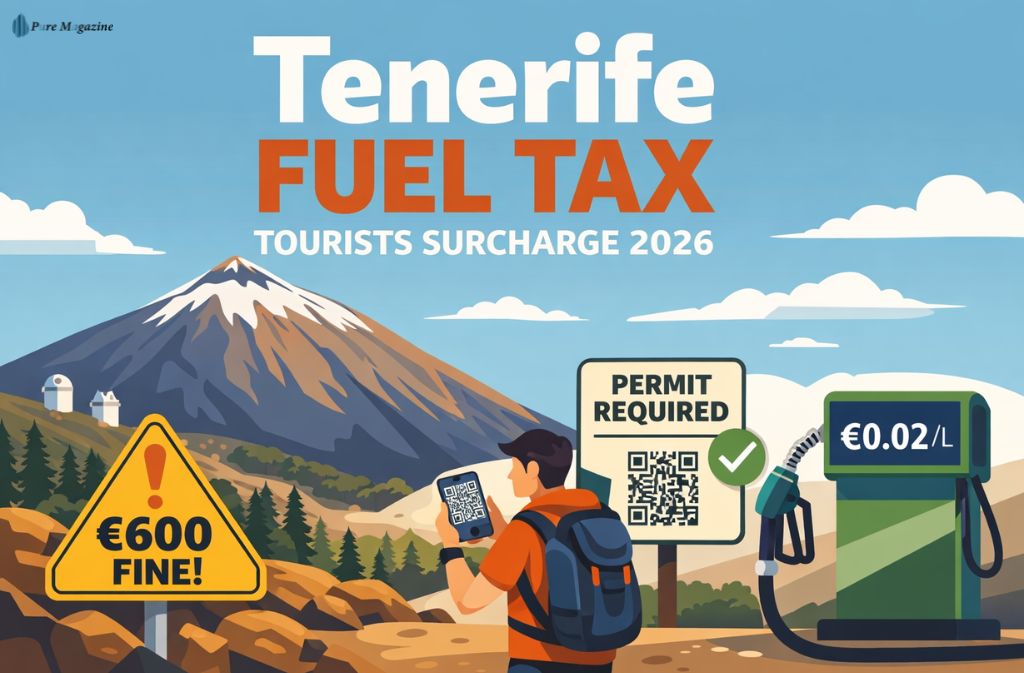
There is no blanket tourist tax in Tenerife. But there are new eco-fees in specific high-pressure locations. And tourists are being fined up to €600 for getting it wrong.
Most confusion comes from colliding two separate things: a small, indirect fuel-based levy that barely affects your budget, and a new eco-tax system at Mount Teide that is direct, enforced, and catches unprepared visitors every week. Most people searching for a “fuel tax” are actually trying to understand the second one.
This guide gives you the real 2026 picture — including the cable car catch nobody mentions, the Monday morning booking crash, the gear check that turns people away at the trailhead, and the Section-style ranger checkpoints that appeared on the TF-21 and TF-38 in February 2026.
The Big Update: The Teide Eco-Tax Is Live
From 19 January 2026, fees went live on Tenerife’s most iconic hiking routes. As the Cabildo de Tenerife’s official eco-tax announcement confirms, the system is part of the new Master Plan for Use and Management (PRUG) — the result of years of pressure over visitor numbers that exceeded 5 million in 2024, up from 3.5 million in 2020.
As Tenerife president Rosa Dávila put it: “El Teide is not only a symbol of our identity but also a natural heritage we must protect responsibly.”
2026 Eco-Tax Rates
| Visitor Type | Trail 10 (Summit) | Trail 7 |
|---|---|---|
| Non-residents (tourists) | €15 (09:00–17:00 slots) | €6 weekdays / €10 weekends |
| Guided hike | €10 | — |
| Canary Islands residents | €6 | €3 |
| Tenerife residents | FREE | FREE |
| Children under 14 | FREE | FREE |
The fee structure is why people call it a tourist surcharge — in practice, visitors from outside the Canary Islands pay the most. The system is projected to generate approximately €650,000 annually, ring-fenced exclusively for park maintenance and conservation.
The Mandatory Booking System: Tenerife ON
Walk-in access ended in 2026. All permits for Trails 10 and 7 — plus connecting routes PNT 09, PNT 23, and sections of Trail 28 — must be booked through the official Tenerife ON platform.
How it works:
- Create an account the night before you plan to book (not the morning — the site struggles under traffic)
- Slots release every Monday at 07:00 Canary Islands time, covering the next three weeks
- Book up to 21 days in advance
- Download or screenshot your QR permit before leaving the hotel
- Carry a valid ID alongside the permit — rangers check both
Daily capacity on Trail 10 is capped at 300 people across set time slots of 50 per window. Sunrise slots (06:00–09:00) and sunset slots (18:00–22:00) exist for Trail 10. 80% of early sunrise permits are reserved for hikers staying overnight at the Altavista Refuge — if catching sunrise at the crater matters to you, booking a night at the refuge is the most reliable route.
The Monday 07:00 Gold Rush
Because slots release weekly, demand spikes every Monday morning. The Tenerife ON website regularly crashes or slows significantly in the first minutes after 07:00. The workaround: create your profile and log in fully on Sunday night before. When 07:00 arrives, you’re already authenticated and can move straight to selection rather than fighting the login screen.
Signal warning: mobile coverage around Teide is unreliable at altitude. Screenshot your QR code and save it to your phone wallet or photos before you leave. If you can’t display it at the checkpoint, you won’t pass.
The €600 Fine: What Triggers It
Ranger presence increased significantly in 2026. Eight new forest rangers with full sanctioning authority were added to the park’s 30 digital trail counters and nine surveillance cameras were installed at the four main road access points.
As Eco Tours Tenerife’s January 2026 regulations update confirms, fines of up to €600 apply for:
- Hiking without a valid permit
- Entering outside your booked time slot
- Ignoring restricted trail rules
- Not carrying mandatory safety gear
- Pets on restricted trails (guide dogs excepted)
Paying on the spot doesn’t cancel a fine — it adds to it.
The Cable Car Catch Nobody Tells You
This is the most expensive misunderstanding of 2026.
Buying a Teleférico (cable car) ticket takes you from the base station at 2,356m up to La Rambleta in eight minutes. From La Rambleta, you can walk freely to nearby viewpoints — La Fortaleza and Pico Viejo lookout — without any permit.
But the moment you step from La Rambleta onto the summit path toward Pico del Teide, you are on Trail 10. That requires the €15 eco-tax permit booked in advance through Tenerife ON.
Cable car ticket + no Tenerife ON QR code = €600 fine if a ranger catches you past the boundary.
The cable car and the summit permit are entirely separate purchases. Many visitors assume the cable car ticket — which itself costs around €30+ — covers the summit access. It doesn’t. Book both independently before your trip.
Mandatory Gear: Rangers Now Check
This is no longer a casual hike. Rangers at the Montaña Blanca trailhead began actively turning people away from early 2026 for inadequate footwear and missing equipment.
Required gear per the official PRUG regulations:
- Mountain boots with ankle support and lug soles (deep grip tread)
- Long trousers
- Warm jacket, gloves, and hat
- Sun protection
- Water and energy snacks (minimum 2 litres recommended)
- Flashlight or headlamp
- Fully charged mobile phone
Real-world observation: Don’t be the tourist in fashion trainers. In early 2026, rangers at Montaña Blanca began turning people away for wearing footwear without deep lugs. Even if you paid your €15 eco-tax and hold a valid Tenerife ON permit, no suitable boots means no hike — and no refund. Gear requirements aren’t advisory; they’re a condition of access.
The TF-21 and TF-38 Ranger Checkpoints (February 2026)
One detail missing from most tourist guides: in February 2026, dedicated ranger checkpoints were established at the TF-21 and TF-38 road entry points into the restricted zone. Vehicles are stopped and permits checked before reaching the trailhead. This checkpoint system — modelled on the Masca Gorge access control that generates €600,000 annually through a similar tiered pricing structure — means there’s no longer any realistic way to access restricted areas without a valid permit. Turning up and hoping to blend in with a guided group doesn’t work. The checkpoints are staffed, and QR codes are scanned individually.
The Actual “Fuel Tax”: Céntimo Forestal
The fuel-based charge you may have read about is real but minor.
The Céntimo Forestal adds approximately €0.02 per litre at petrol stations across Tenerife to fund wildfire prevention. On a standard 50-litre rental car tank, that’s exactly €1.00 extra. A full week’s driving with two fill-ups costs you roughly €2–3 in additional fuel costs.
Compared to a €600 fine, the fuel levy is background noise. It applies to everyone, including locals, and it won’t register in your budget planning.
The Manifesto 20-A Context
These changes didn’t emerge from bureaucratic planning alone. In April 2026, the long-running anti-overtourism movement — known in the Canary Islands as the Manifesto 20-A for the April 20th coordinated island-wide protests — reached its most visible point yet. Tens of thousands marched across Tenerife, Gran Canaria, Lanzarote, and Fuerteventura, demanding limits on tourist numbers, restrictions on short-term rentals, and greater investment in housing for local residents.
The Teide eco-tax and the Tenerife ON booking system are a direct policy response to that pressure. Rather than taxing every visitor, the island chose controlled access at the most stressed locations — a targeted model that Tenerife president Rosa Dávila has explicitly framed as the alternative to blanket tourism restriction.
Who Actually Pays Nothing Extra
Most visitors to Tenerife won’t encounter the eco-tax at all.
You pay nothing if you:
- Visit any Teide viewpoint by car or on foot
- Take the cable car and stay at La Rambleta viewpoints
- Drive the TF-21 through the park
- Visit any beach, town, or attraction outside the restricted zone
Only Trails 10 (summit) and Trail 7 carry fees. Hotel stays carry no tourist tax. Restaurants carry no cover charge. Tenerife remains free of the nightly accommodation taxes applied in Majorca (€1–€4 per night) and Barcelona (€5–€7 per night).
Tenerife vs Other Tourist Taxes (2026)
| Destination | Tax Type | Typical Cost |
|---|---|---|
| Tenerife | Eco-tax (specific hikes only) | €10–€15 |
| Majorca | Nightly tourist tax | €1–€4 per night |
| Barcelona | City + regional tax | €5–€7 per night |
| Venice | Daily entry fee | €5–€10 per day |
For most Tenerife trips, the total additional cost is lower than any of these alternatives — unless you’re hiking the summit without booking ahead.
Realistic Budget Impact
| Cost Type | Amount |
|---|---|
| Fuel surcharge (full week) | €2–€5 |
| Teide eco-tax (if hiking the summit) | €15 |
| Teide eco-tax (if not hiking) | €0 |
| Hotel tourist tax | €0 |
The worst-case scenario for a hiker who planned properly: €20 total. The worst-case scenario for someone who turned up without a permit: €600 fine plus being turned away.
Is the Summit Worth It?
Yes — if you want Spain’s highest point, the sunrise experience from 3,718m, and a genuinely managed natural environment. The crowds are controlled now, which has actually improved the experience for permitted visitors.
No — if you prefer spontaneous travel, hate booking, or would rather take in the same volcanic landscape from the free viewpoints without gear requirements or time slots.
For most visitors, the cable car to La Rambleta plus the free Pico Viejo and La Fortaleza viewpoints delivers roughly 90% of the visual experience without any of the booking complexity.
2026 Travel Checklist
- ✔ Book Tenerife ON permit up to 21 days ahead — don’t leave it to the week before
- ✔ Create your account Sunday night before the Monday 07:00 slot release
- ✔ Book cable car and summit permit separately if using both
- ✔ Screenshot your QR code — mobile signal at altitude is unreliable
- ✔ Pack boots with lug soles and all mandatory gear before reaching the checkpoint
- ✔ Budget a small fuel buffer for the Céntimo Forestal
Will Tenerife Add a Full Tourist Tax?
Almost certainly — eventually. The Manifesto 20-A has created political momentum for broader accommodation-linked charges similar to Majorca’s model. Nothing is confirmed or legislated for the near term, but the direction of travel is clear: more eco-based fees, more digital booking systems, more controlled access to natural sites.
Teide is the template. Watch for similar systems at other high-pressure Canary Islands sites in 2027 and beyond.
FAQs
Q. Is there a tourist tax in Tenerife in 2026?
No—Tenerife does not have a general accommodation or per-night tourist tax in 2026. However, site-specific eco-fees apply at places like Mount Teide National Park, and only if you access restricted hiking trails.
Q. What is the Tenerife eco-tax?
The Tenerife eco-tax is a per-person fee (€6–€15) charged for accessing restricted trails—specifically Trail 7 and Trail 10—inside Mount Teide National Park. The exact price depends on the day, route, and residency status, and must be paid when booking via the Tenerife ON platform.
Q. Do I need to book Mount Teide in advance?
Yes—booking is mandatory. You must reserve your permit through the official Tenerife ON system. Walk-ins are not allowed, and slots typically open every Monday at 07:00 (Canary Islands time) for upcoming dates.
Q. What happens if I hike Mount Teide without a permit?
Hiking without a valid permit can result in fines of up to €600. Enforcement takes place at road checkpoints (TF-21 and TF-38) and at trailhead ranger stations in Mount Teide National Park.
Q. Does the cable car ticket include the Teide eco-tax?
No, the cable car ticket and eco-tax are separate. The cable car takes you to La Rambleta, but accessing the summit trail from there requires a separate paid permit via Tenerife ON.
Q. Is the Tenerife fuel tax real?
Yes. Tenerife applies a small fuel surcharge known as the Céntimo Forestal, adding about €0.02 per litre at petrol stations. For most tourists, this equals roughly €1 per 50-litre tank, making it a minor cost overall.
Conclusion
“Tenerife fuel tax tourists surcharge” sounds alarming. The reality in 2026 is more targeted: a €1-per-tank fuel levy nobody notices, a €15 eco-tax on specific summit hikes that most visitors will never encounter, and a €600 fine waiting for anyone who walks past a TF-21 or TF-38 checkpoint without the right QR code.
Plan for Teide properly — Tenerife ON permit, right gear, boots with grip, QR saved offline before departure — and the island remains one of Europe’s most affordable and spectacular destinations. Arrive assuming it’s still open access, and 2026 will correct that assumption quickly.
For reliable, plain-English guidance on UK tax and personal finance in 2026, Pure Magazine is the resource worth bookmarking.