You know the feeling — you’re sitting somewhere quiet, maybe on a train or in a café, and a total stranger starts opening up to you like you’ve known each other for years. You didn’t ask. You weren’t particularly warm that day. But something about your presence made them feel safe enough to say what they’d been holding for months.
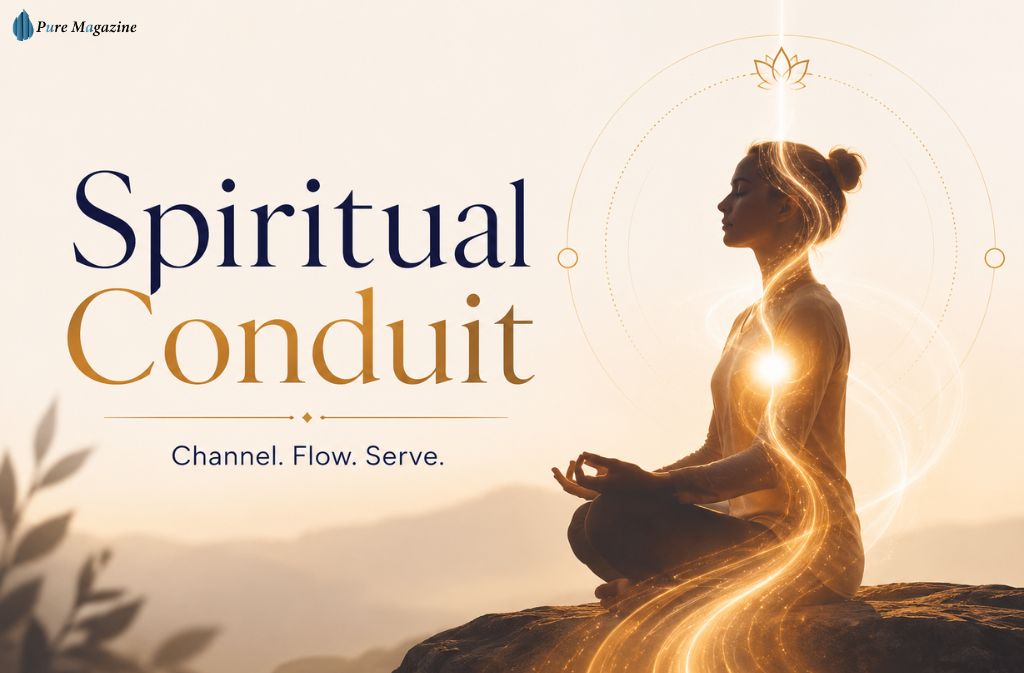
That’s not a coincidence. That’s a spiritual conduit at work.
The concept isn’t reserved for mystics or monks. It shows up in everyday life more than most people realize — and in 2026, as collective burnout and a hunger for meaning keep rising, understanding it feels more relevant than ever.
What Does “Spiritual Conduit” Actually Mean?
A spiritual conduit is a person, practice, or object that acts as an open channel to transmit divine energy, spiritual guidance, or healing from a higher source into the physical world. Unlike a source that generates its own power, a conduit acts as a living bridge — receiving energy and passing it along without letting personal ego or bias filter the message.
The word itself comes from the Latin conductus, meaning “to lead” or “to pipe.” Simple enough. But spiritually, the implications run deep.
Think of a fiber-optic cable. The cable doesn’t create light — it transmits it. The moment you stop being the source and become the channel, something shifts. That’s the conduit experience.
This idea appears across nearly every spiritual tradition. In Christianity, prophets and intercessors channel God’s word. In Eastern traditions, Reiki healers and Qi Gong practitioners work with universal life force — prana, chi — as a transmittable energy. However, in Indigenous practices, shamans serve as bridges between the physical and spirit worlds. Different language. Same architecture.
Conduit vs. Emotional Sponge — A Crucial Difference
This is probably the most misunderstood thing about being a spiritual conduit, and it’s worth pausing on.
A lot of deeply empathic people think they’re conduits when they’re actually functioning as sponges. The difference matters — for your health, your relationships, and how effectively you serve others.
| Feature | A Spiritual Conduit | An Emotional Sponge |
|---|---|---|
| Energy Dynamic | Flow-through: energy enters, serves its purpose, and leaves | Absorption: energy enters and gets trapped in the body |
| After Interactions | Feels peaceful, aligned, or clear | Feels heavy, anxious, or physically drained |
| Primary Mechanism | Intentional detachment and strong boundaries | Unconscious open absorption of environmental stress |
| Core Focus | Serving as a clean, objective instrument | Resolving or “fixing” the immediate emotional pain |
A sponge absorbs. A conduit flows. If you consistently leave conversations feeling depleted, wrung out, or like you’re carrying someone else’s weight home with you — that’s sponge territory, not conduit territory. And it’s fixable.
Signs You Might Be a Spiritual Conduit
Not everyone who is spiritually sensitive is a conduit — but there are patterns worth noticing:
- People confide in you easily, even when they barely know you
- You often say things you didn’t consciously plan, and they land exactly right
- You feel pulled toward healing, service, or creative expression in ways that feel less like choice and more like calling
- Time in nature, prayer, or meditation fills you up rather than just relaxing you
- You sometimes feel like a messenger — like a thought or insight came through you, not from you
- You’re drawn to suffering — not out of ego, but with a genuine, almost reflexive desire to help
Researchers studying mirror neurons — the brain cells that fire both when we act and when we observe someone else doing it — have found that highly empathic individuals show unusually strong activation in these areas. What gets called “clairsentience” in spiritual communities maps surprisingly well onto this neurological reality. The experience of feeling what others feel isn’t imagined. It’s physiological.
The Three Main Types of Conduits
Conduits don’t all work the same way. Most people channel in one or two dominant modes:
- The Empathic Conduit — channels through emotional connection and healing presence; naturally drawn to counseling, energy work, or simply holding space
- The Creative Conduit — channels through art, music, or writing; their work often moves people in ways they can’t fully explain
- The Intellectual Conduit — channels through ideas, philosophy, or teaching; what they say seems to arrive from somewhere deeper than analysis alone
Most people recognize themselves in more than one of these, but usually one feels most natural.
The Biblical Meaning of Conduit
In scripture, a conduit is explicitly a channel for life. The Old Testament references actual water conduits — channels that carried water into besieged cities, literally sustaining life. Spiritually, this imagery maps directly onto human vessels: people through whom God’s grace, healing, or prophetic word flows to others.
Moses, Isaiah, the apostles in Acts — none of them claimed to be the source of what moved through them. That humility is the consistent theme. The conduit doesn’t own what passes through. It simply stays open.
In modern Christian contexts, intercessory prayer and prophetic ministry operate on exactly this framework — the practitioner as a yielded vessel rather than an originator.
How to Become a Clearer Spiritual Conduit
Becoming a stronger conduit is less about adding things and more about clearing the static.
1. Work on inner clarity first. Unresolved emotional patterns, ego, and chronic fear act like interference. The cleaner your internal state, the cleaner the transmission.
2. Build a regular practice. Prayer, meditation, breathwork — the form matters less than the consistency. You’re training yourself to receive, not perform.
3. Detach from outcomes. A conduit trusts. Grasping at results — needing to be the one who “fixed” something — clogs the channel fast.
4. Protect your energy deliberately. This matters more than most people think.
Grounding in a Distracted World
In 2026, one underappreciated source of spiritual static is digital overload. Constant algorithmic input — news cycles, social media, notifications — keeps the nervous system in a low-grade reactive state that makes clean channeling nearly impossible.
Practical approaches that actually help:
- The 5-4-3-2-1 Grounding Method — name five things you can see, four you can touch, three you can hear, two you can smell, one you can taste. It sounds simple because it is. It works because it forces present-moment sensory awareness, interrupting the loop.
- Digital sabbaticals — even a few hours offline daily- create surprising clarity. Think of it less as “unplugging” and more as clearing the signal.
5. Develop discernment. Not everything that “comes through” is worth passing on. Learning to tell the difference between genuine transmission and personal projection is a skill — one that takes time, and matters enormously.
The Shadow Side: Conduit Burnout
Conduit work, done without care, leads to exhaustion that ordinary rest doesn’t fix. The spiritual literature calls it many things. Therapists call it compassion fatigue. Whatever the label, the pattern is the same: you give and give, and eventually there’s nothing left to give from.
The correction isn’t to stop being a conduit. It’s to stop confusing service with self-erasure. Boundaries aren’t walls that block the energy — they’re the banks that let the river flow with direction rather than flooding everything indiscriminately.
If you’re running on empty, the channel isn’t open. It’s collapsed.
FAQs
Q. Can a spiritual conduit block their own gifts?
Yes. Chronic stress, unresolved trauma, ego-driven motives, and energetic burnout all interrupt the channel. The good news is that most blockages are temporary and respond well to grounding practices, inner work, and intentional rest.
Q. What’s the difference between a medium and a spiritual conduit?
A medium specifically communicates with distinct spirit entities or deceased individuals. A conduit channels broader energies — divine guidance, healing forces, universal wisdom — without necessarily working with specific personalities or spirits. All mediums function as conduits, but not all conduits are mediums.
Q. Is being a spiritual conduit the same as being an empath?
Related, but not identical. Empathy is a capacity for emotional resonance. Conduit work involves actively channeling energy or guidance in service of others. Many empaths are conduits — but empathy without direction or boundaries often leads to the sponge pattern rather than the conduit pattern.
Q. Do you have to be religious to be a spiritual conduit?
No. The framework appears across secular, spiritual, and religious contexts. What matters is openness, clarity of intention, and a willingness to serve something beyond personal ego — not any particular belief system.
Q. How do I know if what I’m channeling is genuine?
The most reliable test is fruit — what does it produce? Genuine spiritual transmission tends to be grounding, clarifying, and empowering for the person receiving it. It doesn’t create dependency, fear, or confusion. Discernment develops with practice, and working with a trusted mentor or community helps enormously in the early stages.
Bottom Line
The concept of a spiritual conduit resonates because it names something many people have felt but never had language for. You don’t have to be extraordinary to be one. You just have to be willing to stay open, stay grounded, and get out of the way.
For more, visit Pure Magazine