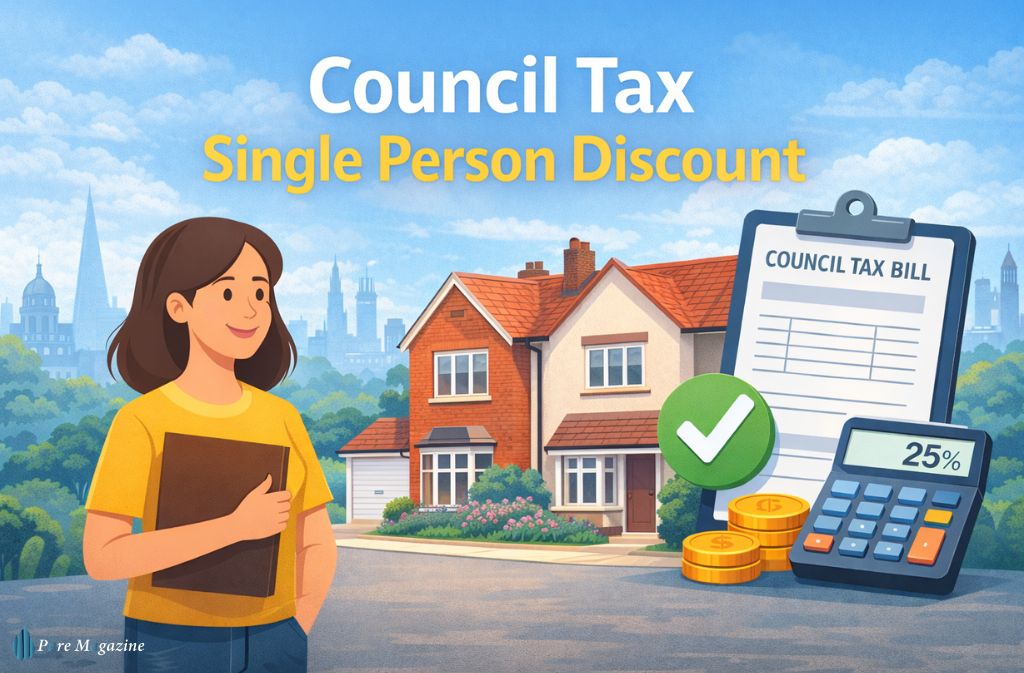
Council tax went up again in April 2026, and most people felt it. With the average Band D bill now around £2,392 — up approximately 4.9% — that 25% single person discount suddenly means saving nearly £600 a year.
The problem is that many people either don’t claim it or they claim the wrong discount entirely. Some are entitled to more than 25%. Others are accidentally claiming when they shouldn’t — something councils now actively check through automated data matching.
This goes beyond the basics. It covers the overlooked “double-discount” SMI rules, a 2026 audit warning most guides ignore, the apprentice threshold trap that catches people out, and a backdating opportunity most people never hear about.
What Is the Council Tax Single Person Discount?
The single person discount reduces your council tax bill by 25% when only one eligible adult lives in a property.
The simple rule: one counted adult means 25% off. Two or more counted adults means no discount. But the word “counted” is where most people get confused — and where the real savings often hide.
Who Counts as an Adult? (The Disregarded Persons Rule)
Not everyone in your home counts for council tax purposes. HMRC and councils refer to certain residents as “disregarded persons” — they live in the property, but legally they’re ignored when counting adults.
Disregarded persons include:
- Full-time students
- Apprentices earning under the weekly disregard threshold
- Student nurses (including Level 3 training)
- People with Severe Mental Impairment (SMI) — the formal Class U Exemption category
- Live-in carers providing care for someone other than a partner or child
This is where most confusion and missed savings happen. You can live with someone and still be treated as living alone for council tax purposes.
Example: You plus a full-time student still qualify for the 25% discount.
The 2026 Apprentice Threshold Trap
This nuance separates genuine expertise from surface-level guidance.
The minimum wage for apprentices rose to £8.00 per hour in April 2026. But the council tax disregard threshold often lags behind wage uprating. An apprentice working more than 24 hours a week at the new minimum wage may now earn enough to “age out” of the disregard — meaning they start counting as an adult for council tax purposes.
If you live with an apprentice, check their current earnings against your council’s disregard threshold before assuming they’re still disregarded. Getting this wrong — in either direction — can mean an incorrect bill running for months before anyone catches it.
The Overlooked “Double Discount” (Class U Exemption and SMI Rules)
This is where things get serious, and where most articles fall short.
The formal name is the Class U Exemption. It covers residents with Severe Mental Impairment — including advanced dementia, Alzheimer’s disease, and other severe cognitive conditions. A person qualifies for SMI disregard when they have a severe impairment of intelligence and social functioning that appears to be permanent, and they receive at least one qualifying benefit (such as Disability Living Allowance, PIP, or Attendance Allowance).
Here’s how the discount scales:
- You + one SMI person: The SMI person is disregarded. You get the 25% single person discount.
- All occupants are disregarded (for example, one SMI person and one full-time student): The property qualifies for a 50% discount.
- Only one SMI person in the property, no other occupants: The property may qualify for 100% exemption under Class U.
Many households are under-claiming. They assume the limit is 25%, but they may qualify for far more. The discount can also be backdated to when the qualifying benefit started — some councils allow backdating with no time limit if you can show when the condition began.
If someone in your household might qualify, the SMI application requires both a form from your council and a certificate from the person’s GP confirming the diagnosis. Both are free.
Understanding how this interacts with other exemptions is covered in more depth in the council tax exemption rules, where the Class U mechanics and qualification routes are explained alongside other disregard categories.
How Much Can You Actually Save in 2026?
The single person discount saves approximately £598 per year on the 2026 average Band D bill of £2,392.
| Household Type | Annual Bill | Discount | Final Cost |
|---|---|---|---|
| Two adults | £2,392 | £0 | £2,392 |
| One adult | £2,392 | £598 | £1,794 |
| One adult + SMI person | £2,392 | £598 | £1,794 |
| All residents disregarded | £2,392 | £1,196 (50%) | £1,196 |
Quick Eligibility Check
Use this logic before applying:
- One adult, no one else → 25% off
- One adult + one student → 25% off
- One adult + one SMI person → 25% off (minimum)
- All occupants disregarded → Up to 50% discount or 100% exemption
- Two working adults → No discount
How to Apply (With a Realistic Tip)
- Go to your local council website
- Search for “single person discount council tax.”
- Fill in your address, council tax account number, and occupancy details
- Submit any requested evidence (student certificate, SMI GP letter, etc.).
- Wait for written confirmation
Practical tip: April is the busiest period for council tax teams, immediately following the new billing year. If you submit in April and don’t hear back within 10–14 days, skip the phone lines — live chat or the council’s email form is usually faster at that time of year.
The Backdating Opportunity Most People Miss
Many people don’t realise they can backdate this discount — sometimes for years.
If you’ve lived alone for an extended period but never claimed, you could be owed a significant refund. A three-year backdate on a Band D property amounts to roughly £1,700. Most councils will backdate as long as you provide evidence of when your sole occupancy began — a sole tenancy agreement, a mortgage statement showing only your name, or utility bills at the same address.
There’s no statutory time limit in legislation that prevents backdating. In practice, councils vary in their internal policies, but if you request backdating explicitly in writing when applying, and back it up with documentation, many councils will honour it.
The same principle applies to the SMI disregard — backdating is allowed to the date the qualifying benefit started.
The 2026 Audit Warning (NFI Data Matching)
This is one of the biggest operational changes in 2026, and almost no guide covers it properly.
Councils use the National Fraud Initiative (NFI), a Cabinet Office programme that matches electronic data across public and private sector bodies to detect fraud and error. For single-person discounts specifically, the NFI cross-references:
- Electoral roll data
- Credit applications
- Tenancy records
- Payroll information
False claims are now easier to detect than ever. Reviews run regularly. Backdated penalties are common — and they apply to honest mistakes, like forgetting to report a new housemate, just as much as to deliberate fraud.
The 2026 “invisible” audit layer: Beyond NFI, councils are increasingly deploying AI-driven life event matching. Changes that might seem unrelated to your housing — applying for a joint credit card, updating a shared streaming account, or appearing on a joint financial application — can generate a flag in council systems. In 2026, “living alone” is harder to misrepresent than at any point in the history of council tax.
The 21-day rule: If your circumstances change and you’re no longer entitled to the discount, you have a legal duty to notify the council within 21 days. Missing this window is what typically turns an honest oversight into a formal overpayment demand.
The “Sole or Main Residence” Trap
You can only claim the single-person discount on your sole or main residence.
Risk scenarios include working away during the week and returning at weekends, owning two properties, and renting one address while keeping another. Councils check where you’re registered to vote, utility usage patterns, and financial records. If there’s ambiguity, they will investigate — and the burden of proof rests with you.
Empty Homes: A Different Story in 2026
From 1 April 2026, the Long-Term Empty Premium now applies after just one year of a property being empty — halved from the previous two-year threshold. This means people who move out but haven’t yet sold or let their property face a 100% premium on top of the full council tax rate after twelve months, not twenty-four.
If you’re managing a vacant property, this significantly tightens the window before the premium kicks in.
Single Person Discount vs Council Tax Reduction
These two routes address different situations and can stack.
| Feature | Single Person Discount | Council Tax Reduction |
|---|---|---|
| Based on | Number of adults | Income level |
| Typical saving | 25% | Up to 100% |
| Who qualifies | Single occupants | Low-income households |
| Can combine? | Yes | Yes |
A single adult on a low income can claim both — the 25% discount reduces the full bill first, and then CTR applies to the already-reduced amount. The council tax reduction scheme determines how much additional support applies based on income and savings.
Common Mistakes
- Assuming “living alone” means physically alone. Disregarded people don’t count — you can have occupants and still qualify.
- Forgetting to update your status. This is the number one trigger for audit reviews. The 21-day notification window is a legal requirement, not a courtesy deadline.
- Claiming a second home. This leads to repayment demands once NFI matching picks it up.
- Not checking SMI eligibility. This is where the biggest savings sit — and the most common area of under-claiming.
FAQs
Q. How much is the single-person council tax discount in 2026?
The council tax single person discount is 25% off your bill if you are the only eligible adult in the property. In 2026, this typically saves £500–£600 per year, depending on your council tax band.
Q. Can I get a single-person discount if I live with a student?
Yes. Full-time students are disregarded for council tax purposes, so you can still qualify for the single person council tax discount if you are the only counted adult in the household.
Q. What is the Class U exemption (Severe Mental Impairment discount)?
The Class U exemption applies when all occupants are considered severely mentally impaired (SMI). People with SMI are disregarded, meaning households may qualify for:
- 25% discount (one eligible adult + one SMI person)
- 50% discount (limited cases)
- 100% exemption (if all occupants are disregarded)
Q. Can councils check if I live alone for council tax?
Yes. Councils verify claims using the National Fraud Initiative, which cross-checks:
- Electoral roll data
- Credit records
- Tenancy and residency data
This helps detect incorrect single-person discount claims.
Q. Can I claim the single person council tax discount on a second home?
No. The discount only applies to your sole or main residence. Second homes do not qualify and may be charged full council tax or additional premiums.
Q.What happens if I don’t report a change in circumstances?
If your situation changes (for example, someone moves in), you must inform your council within 21 days. Failure to do so may result in:
- Backdated council tax charges
- Financial penalties
- Possible investigation
Q. Do empty homes get council tax discounts in 2026?
No. As of April 2026, many councils charge a 100% premium on properties left empty for more than one year. This means you could pay double the standard council tax rate.
Conclusion
The council tax single person discount is simple on the surface—but in 2026, the real value comes from understanding the details.
Key takeaways:
- Standard saving = 25% (≈ £598/year)
- Some households qualify for 50%–100% reductions
- Councils are now actively auditing claims
- Small mistakes can cost you—but correct claims can save thousands
👉 Next step:
Run the quick eligibility check above and apply through your council—it’s one of the fastest ways to reduce your fixed expenses.
For more on council tax rates, exemptions, and support across the UK, visit Pure Magazine.