TL;DR – What Changed for 2026
|
Self Employed Tax Just Got More Digital
If you’re self-employed in the UK, 2026 is not just about tax rates. It’s about systems.
Yes, you still pay Income Tax and National Insurance through HM Revenue & Customs via Self Assessment.
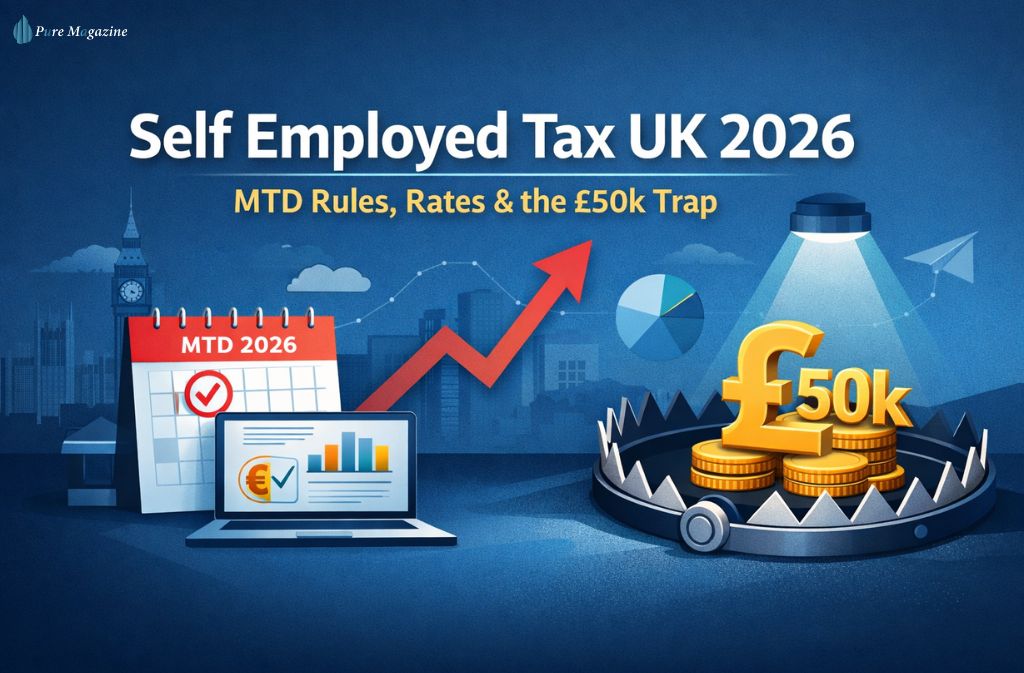
But from April 2026, something bigger happens: if your business or property income exceeds £50,000, you must comply with Making Tax Digital for Income Tax Self Assessment (MTD for ITSA).
That means quarterly digital reporting. Not just one January deadline.
And this is where most guides are behind. Let’s break it down properly.
Who Must Send a Tax Return in 2026?
Quick context: if you earn over £1,000 from self-employment, you must register for Self Assessment.
You must file if you earned more than £1,000 from self-employment, are a sole trader or partnership member, have untaxed income (rent, dividends, crypto gains), or need to claim reliefs.
Register by 5 October following the end of the tax year. Understanding exactly when the tax year ends clarifies which income belongs to which return — a distinction that catches many people out when income spans two tax years.
The 2026 MTD Roadmap (Critical Update)
This is the part competitors are now ranking for.
| Self-Employed / Property Income | MTD Requirement |
|---|---|
| Over £50,000 | Mandatory MTD from April 2026 |
| Over £30,000 | Mandatory from April 2027 |
| Under £30,000 | Traditional Self Assessment (for now) |
As confirmed in GOV.UK’s official MTD for Income Tax eligibility guidance, HMRC will review your Self Assessment tax return and check your qualifying income each tax year — if your income is above the relevant threshold, HMRC will write to you confirming you need to start using MTD by the start of the upcoming tax year. However, it remains your responsibility to check your eligibility even if you don’t receive a letter.
MTD means: keep digital records, use compatible software, submit 4 quarterly updates, submit an End of Period Statement, and submit a Final Declaration.
The £50k MTD Trap (The Real Transition Point)
Most guides obsess over the 40% tax threshold.
But here’s what actually changes your life: hitting £50,000 profit.
Why? Because at that point, you may enter a higher-rate tax, AND you trigger mandatory quarterly digital reporting, AND you likely need paid accounting software, AND admin time increases significantly.
As confirmed by GOV.UK’s official MTD sign-up guidance, those required to use MTD from 6 April 2026 should sign up before that date — and crucially, HMRC will not apply penalty points for late quarterly updates for the first tax year (2026 to 2027) only. Penalties will still apply for late tax returns or late payment.
I’ve seen sole traders celebrate crossing £50k — then panic when they realise they’ve quadrupled their reporting obligations.
This is the new planning threshold in 2026. Not £50,270 (tax band). But £50,000 (MTD trigger). That’s the strategic insight.
How Much Tax Do You Pay If Self-Employed?
Let’s keep this simple.
First, your Personal Allowance: £12,570 tax-free (if eligible). Understanding how much you can earn before paying tax — including what reduces or removes the personal allowance — is the foundation of any self-employed tax calculation.
Then Income Tax bands:
| Taxable Income | Rate |
|---|---|
| £12,571–£50,270 | 20% |
| £50,271–£125,140 | 40% |
| £125,140+ | 45% |
For a full breakdown of current UK tax brackets and how each band applies to self-employed profit, that covers the details most sole traders need when projecting their annual bill.
National Insurance (Updated 2026 Position)
This changed.
Class 2 NIC
Now voluntary. £3.45 per week (2025/26 rate, rising slightly for 2026/27). Paid to protect your State Pension record.
Class 4 NIC
Percentage-based on profits. Still mandatory above threshold.
As confirmed on GOV.UK’s self-employed National Insurance rates page, most people pay Class 2 and Class 4 National Insurance through Self Assessment, and some self-employed people who don’t pay NI through Self Assessment may still want to pay voluntary contributions to protect their benefit entitlements.
Many articles still present Class 2 as a compulsory bill. It isn’t anymore — but skipping it can impact your pension entitlement. That nuance matters.
Why Does It Feel Like I’m Paying 25% Tax?
Because of three combined elements: 20% Income Tax, Class 4 National Insurance, and Payments on Account (prepaying next year).
Your first January bill includes this year’s tax PLUS 50% of next year’s estimated tax. It’s a cash-flow shock — not a higher tax rate. An after-tax calculator can help you model your likely bill well ahead of January so the payment on account figure doesn’t catch you off guard.
Incorporation in 2026: Updated Reality
Outdated belief: “Just form a limited company.”
Not so fast. Dividend tax rates increased: basic rate 10.75%, higher rate 35.75%. Combined with Corporation Tax, accountancy fees, and MTD compliance costs, for many businesses with under £60k profit, a sole trader remains efficient.
Understanding current dividend tax rates is essential before modelling whether incorporation makes financial sense — the gap between sole trader and limited company tax efficiency has narrowed significantly since 2022.
In fact, incorporation may now make sense more for liability or growth strategy — not pure tax savings. That’s a shift.
The 4-Year Rule (And When It’s Actually 6)
Officially, HMRC can go back 4 years for innocent mistakes.
But here’s what catches people: if HMRC believes you were careless, they can go back 6 years. If deliberate, up to 20 years.
I’ve seen “Discovery Assessments” issued years later because records weren’t kept digitally or correctly categorised. As confirmed in GOV.UK’s MTD qualifying income guidance, HMRC assesses gross income — income before you deduct expenses — not net profit, when determining MTD eligibility. This means turnover, not profit, is the threshold test. A sole trader with £55k turnover and £20k expenses still triggers mandatory MTD.
With MTD coming in, digital record-keeping becomes even more critical.
The 2026 Tax Calendar (Visual Planning Aid)
| Date | What Happens |
|---|---|
| 6 April | New tax year starts / MTD phase begins |
| Quarterly | MTD updates (if applicable) |
| 31 January | Final tax payment + filing deadline |
| 31 July | Second payment on account |
Once MTD applies to you, January is no longer your only stress point. For a complete breakdown of all key tax year dates, including quarterly MTD submission windows and the payment on account calendar, that full timeline is worth keeping accessible.
Hybrid Tax Planning (2026 Strategy)
Here’s the advanced play.
Instead of thinking “Sole trader or limited company?” think “When do I cross £50k profit?”
You may: stay a sole trader under £50k, incorporate once growth justifies it, use pension contributions to reduce MTD trigger exposure, and time income strategically.
The transition point is the strategy.
Common 2026 Mistakes
- Ignoring MTD thresholds
- Not budgeting for software
- Forgetting voluntary Class 2 and harming the pension record
- Underestimating payments on account
- Incorporating without modelling dividend tax impact
Those who have previously received a wrong tax code know how quickly HMRC discrepancies compound — under MTD, quarterly submissions create four additional checkpoints per year where errors can surface and escalate.
In 2026, self-employed tax isn’t harder. It’s more administrative. The winners won’t be the ones who memorise rates. They’ll be the ones who monitor profit thresholds, use digital tools early, and plan cash flow monthly. The game shifted from “what’s my tax rate?” to “how do I stay ahead of reporting?” That’s the real change.
FAQs
Q. Do I have to use MTD in 2026?
Yes, if you’re self-employed or your property income exceeds £50,000 from April 2026. Over £30,000 from April 2027. As confirmed by GOV.UK’s official MTD eligibility checker, HMRC assesses gross qualifying income — not profit — so turnover above the threshold triggers the requirement regardless of expenses.
Q. Is Class 2 National Insurance mandatory?
No. It is now voluntary, but it protects your State Pension record. As confirmed on GOV.UK’s self-employed NI rates page, some self-employed people do not pay National Insurance through Self Assessment but may want to pay voluntary contributions to maintain their benefit entitlements.
Q. Why is my January bill so large?
Because it includes payments on account — you’re prepaying next year’s tax. Understanding how income tax bands apply to your profit level helps you calculate both your current year liability and the 50% payment on account that doubles the January shock in your first high-earnings year.
Q. How to avoid 40% tax legally?
Use pension contributions, claim all allowable expenses, and manage profit timing. Understanding what the 40% tax bracket actually triggers — and the exact income level at which it bites — is the starting point for any legitimate planning strategy.
Q. Does incorporation still save tax in 2026?
Not automatically. Higher dividend tax rates and admin costs reduce the previous advantage. The calculation depends heavily on profit level, extraction strategy, and whether MTD compliance costs are factored in.