


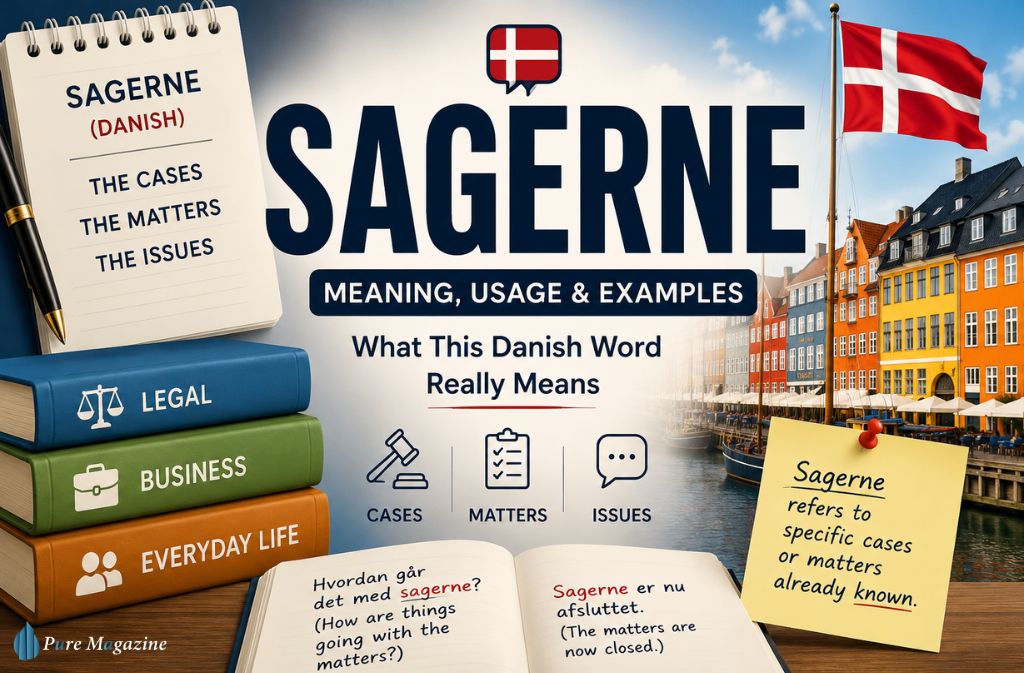
If you’ve searched for Sagerne, you’ve probably seen the same answer repeated across multiple websites: it means “the cases.”
Technically, that’s correct. But it’s also incomplete.
The reality is that sagerne is one of those Danish words that reveals the difference between knowing a translation and understanding a language. Depending on where you encounter it, the word can refer to legal cases, workplace responsibilities, ongoing projects, public controversies, or simply the matters people happen to be discussing.
This distinction matters because many translation tools focus on literal meanings rather than real-world usage. A direct translation may be grammatically accurate while still sounding strange—or even misleading—in English.
In this guide, you’ll learn what sagerne means, how it fits into Danish grammar, where native speakers use it, common mistakes learners make, and why context changes its meaning far more than most dictionaries suggest.
What Does Sagerne Mean?
Sagerne is the definite plural form of the Danish noun “sag.”
In English, it most commonly translates to:
- The cases
- The matters
- The issues
- Those affairs
The exact translation depends on context.
For example:
Sagerne er afsluttet.
This could mean:
The cases are closed.
But in another situation, it might naturally mean:
The matters have been resolved.
The surrounding context determines the best translation.
The Complete Danish Grammar Breakdown
Understanding sagerne becomes much easier when you see where it fits within the Danish noun system.
| Form | Danish | English Translation |
|---|---|---|
| Indefinite Singular | sag | a case, a matter |
| Definite Singular | sagen | the case, the matter |
| Indefinite Plural | sager | cases, matters |
| Definite Plural | sagerne | the cases, the matters |
Example Progression
Sag
Der er en vigtig sag.
“There is an important matter.”
Sagen
Sagen er afsluttet.
“The matter is resolved.”
Sager
Vi har mange sager.
“We have many cases.”
Sagerne
Sagerne er nu afsluttet.
“The specific cases are now closed.”
The ending -ne is what turns the plural noun into a definite plural form.
Pronunciation of Sagerne
The approximate pronunciation is:
SAH-ger-neh
A more detailed linguistic rendering is often represented as:
[ˈsæːɐnə]
For language learners, perfect pronunciation matters less than recognizing the word in conversation and understanding its intended meaning.
Why Translation Apps Often Get Sagerne Wrong
This is where most dictionary-style articles stop.
Suppose a Danish manager sends an email that says:
Hvordan går det med sagerne?
Many translation tools return:
How are the cases going?
While technically correct, most native English speakers would never phrase the question that way.
In a workplace setting, the intended meaning is often closer to:
- How are those projects progressing?
- How are things coming along?
- How is your workload looking?
- Have those matters been handled?
The literal translation is accurate.
The practical meaning is different.
This is one reason language learners sometimes feel confused even when translation software appears correct.
The Hidden Cultural Meaning Most Dictionaries Miss
One of the fascinating things about Danish communication is its tendency toward understatement.
Rather than explicitly listing every project, task, issue, and responsibility, Danish speakers often group them together under broader terms.
That’s where sagerne becomes useful.
In many professional environments, the word acts as a convenient umbrella term for:
- Ongoing responsibilities
- Administrative matters
- Client issues
- Internal projects
- Outstanding tasks
When a colleague asks:
Hvordan går det med sagerne?
They usually aren’t conducting an investigation.
They’re simply asking how things are progressing.
Understanding this nuance makes conversations feel much more natural.
Where Native Speakers Commonly Use Sagerne
Legal Context
This is the meaning many dictionaries focus on first.
Example:
Sagerne behandles i retten næste måned.
Translation:
The cases will be heard in court next month.
In this situation, sagerne refers to legal proceedings.
Workplace Context
A very common business usage.
Example:
Vi gennemgår sagerne på mødet.
Translation:
We’ll review the matters during the meeting.
This could refer to:
- Projects
- Client accounts
- Administrative tasks
- Open issues
News and Media Context
Journalists frequently use the word when discussing public affairs.
Example:
Sagerne har skabt stor debat.
Translation:
The issues have created significant debate.
Everyday Conversation
Friends and family may use it casually.
Example:
Hvordan går det med sagerne?
Translation:
How are things going?
Notice how translating it as “cases” would sound unnatural here.
Important Compound Words Built from Sag
Understanding the root word sag helps expand your Danish vocabulary quickly.
Retssagerne
“The court cases”
Often used in legal reporting.
Straffesagerne
“The criminal cases”
Common in crime and justice discussions.
Personsagerne
“The personnel matters” or “HR cases”
Frequently used in workplace settings.
Klagesagerne
“The complaint cases”
Used in customer service and administration.
These compounds show how productive the root word remains across modern Danish.
Sagerne vs Similar Danish Words
One of the best ways to understand vocabulary is through comparison.
| Word | Typical Meaning |
| sagerne | the matters, the cases |
| tingene | the things |
| problemerne | the problems |
| opgaverne | the tasks |
| projekterne | the projects |
These words overlap occasionally, but they create different impressions.
Sagerne
Neutral and broad.
Problemerne
Specifically suggests difficulties.
Opgaverne
Focuses on assigned work.
Projekterne
Refers to defined projects.
Tingene
Very general and informal.
A native speaker often chooses sagerne when they want a broader, more professional tone.
Common Mistakes Language Learners Make
Assuming It Always Means Court Cases
This is probably the biggest misconception.
While legal usage exists, everyday usage is often much broader.
Translating Too Literally
Context matters.
- Sometimes “the matters” is best.
- Sometimes “the issues.”
- Sometimes simply “things.”
Ignoring the Definite Form
Sager and sagerne are not interchangeable.
Sager refers to cases in general.
Sagerne refers to specific cases already known to the listener.
Missing Professional Context
In business communication, sagerne often refers to workload rather than legal matters.
Why Context Matters More Than Vocabulary
Many learners focus heavily on dictionary definitions.
Native speakers focus on context.
Consider these translations:
Sagerne er afsluttet.
Possible meanings:
- The cases are closed.
- The matters are settled.
- The issues have been resolved.
- Everything has been finalized.
All could be correct depending on the situation.
This flexibility explains why advanced language learning eventually becomes less about memorizing words and more about understanding how people use them.
Why Sagerne Is a Good Example of Modern Language Learning
Words like sagerne demonstrate a challenge faced by both language learners and AI translation systems.
The word itself is simple.
The context is not.
As machine translation improves, the biggest remaining challenge is often not vocabulary but nuance. Knowing whether sagerne means “cases,” “matters,” “issues,” or simply “things” requires understanding the situation in which the word appears.
That is something dictionaries alone cannot teach.
Frequently Asked Questions
Final Thoughts
At first glance, sagerne looks like a straightforward vocabulary word. Most dictionaries define it as “the cases” and move on.
But real language is rarely that simple.
Depending on the context, sagerne may refer to legal proceedings, workplace responsibilities, public issues, ongoing projects, or everyday matters. Understanding that flexibility is what separates literal translation from genuine language comprehension.
For learners of Danish, the word offers a useful reminder: vocabulary is important, but context is what creates meaning.
For more, visit Pure Magazine
