Every January, millions of people scramble to meet the Self Assessment midnight deadline. Most of them circle back to the same starting point: the SA100 form.
If you’ve recently gone freelance, taken on rental property, started pulling dividends from a limited company, or picked up a side income through Etsy or Airbnb — the SA100 is the document HMRC needs from you. And it will keep needing it every year.
At first glance the form looks intimidating. Multiple sections, supplementary pages, hard deadlines. But once you understand what each part does — and how 2026’s digital changes fit in — the whole thing becomes much more manageable.
This guide explains what the SA100 is, who files one, how the process works end-to-end, and what Making Tax Digital means for the traditional annual return cycle. Deadlines, common mistakes, and the side hustle rules are all covered too.
Quick Facts
| Item | Details |
|---|---|
| Form Name | SA100 – Main Self Assessment Tax Return |
| Regulator | HMRC |
| Tax Year | 6 April – 5 April |
| Paper Deadline | 31 October |
| Online Deadline | 31 January |
| Key 2026 Change | MTD mandatory for income over £50,000 |
| Submission | HMRC Government Gateway or approved software |
What Is an SA100?
As GOV.UK’s official Self Assessment overview confirms, Self Assessment is the system HMRC uses to collect Income Tax on income not automatically deducted from wages and pensions — and anyone with other income must report it through a tax return.
The SA100 is that return. It acts as a central summary of your financial year — income earned, expenses claimed, reliefs applied — and HMRC uses it to calculate what you owe or whether you’ve overpaid. As MoneyHelper’s SA100 guide confirms, the main SA100 section deals with taxed and untaxed income including dividends and interest, while additional supplementary pages cover company directors, foreign nationals, self-employment, property, capital gains, and foreign income.
For a full breakdown of how Self Assessment works — including what registering involves and how HMRC communicates with you once you’re in the system — that covers the wider process the SA100 sits within.
Who Needs to File One?
Most employees whose only income flows through PAYE never touch an SA100. Everyone else usually does.
As GOV.UK’s SA100 completion guidance confirms, you may need to file additional supplementary pages along with the main SA100 depending on your income sources — and 97% of people already file online rather than on paper.
The groups who typically file:
Sole traders and freelancers — any business income outside PAYE needs reporting. Landlords — UK and overseas rental income both require declaration. Company directors — dividends on top of salary almost always trigger Self Assessment. High earners — income above £100,000 requires a return to address the personal allowance taper. Investors — the dividend allowance dropped to £500, pulling many more investors into the system. Anyone with foreign income — overseas earnings, property, and employment all need reporting.
As GOV.UK confirms, you must tell HMRC by 5 October if you need to complete a return for the previous year — and you could face a fine if you miss that registration deadline.
Your UTR: The Number That Unlocks Everything
Every SA100 filer needs a Unique Taxpayer Reference — a ten-digit number HMRC issues when you register for Self Assessment.
As GoSimpleTax’s SA100 guide confirms, you need to apply for your UTR at least 6 weeks before the tax deadline — without one you cannot submit a return, and this will result in a penalty regardless of whether tax is owed.
Your UTR appears on previous returns, official HMRC correspondence, and inside your Government Gateway dashboard. Losing it close to January is a fast route to a stressful evening — store it somewhere secure now.
What the SA100 Actually Contains
| Section | What It Covers |
|---|---|
| Personal Details | Name, address, National Insurance number |
| Employment Income | Salary, benefits, pensions |
| Self-Employment | Business income and expenses |
| Property Income | Rental profits or losses |
| Capital Gains | Profit from selling assets |
| Foreign Income | Overseas earnings |
| Tax Reliefs | Pension contributions and charitable donations |
When the main form isn’t enough, supplementary pages fill the gaps:
- SA103 — self-employment detail
- SA105 — property income
- SA106 — foreign income
- SA108 — capital gains
As GOV.UK’s official supplementary pages guidance confirms, there are also special forms for business partnerships, non-resident companies, and trustees — and you should check which supplementary pages apply to your situation before sending a paper return.
The Big 2026 Change: Making Tax Digital
The traditional once-a-year SA100 submission is giving way to quarterly digital reporting for a growing group of taxpayers.
As MoneyHelper confirms, if you’re a sole trader or landlord registered for Self Assessment with combined income from self-employment or property above £50,000, you must file via Making Tax Digital from April 2026 — if your income is under £50,000 but over £20,000, you’ll join in future years but not yet.
Under MTD, the process shifts from one January deadline to: keep digital records throughout the year, submit quarterly updates via compatible software, file an End of Period Statement, then complete a Final Declaration by 31 January. The Final Declaration replaces the traditional SA100 submission — the same information, in a new format.
For a full breakdown of how the MTD deadlines interact with existing Self Assessment obligations, including what happens if you miss a quarterly update, that covers the timeline in detail.
2026 Thresholds That Affect SA100 Filers
| Allowance | 2026 Limit | What It Means |
|---|---|---|
| Personal Allowance | £12,570 | Frozen until 2028 — more earners pulled into tax |
| Dividend Allowance | £500 | Modest investors now cross the reporting threshold |
| Capital Gains Allowance | £3,000 | More disposals trigger SA108 requirements |
| Trading Allowance | £1,000 | Side income above this must be declared |
The dividend allowance reduction from £2,000 to £500 is particularly sharp. Someone receiving £600 in dividends from a straightforward Stocks and Shares ISA held outside the ISA wrapper now needs to file. Understanding how the dividend tax rates apply at each income level helps investors work out their exposure before the January deadline.
The Side Hustle Tax Reality
The days of casual online selling sitting beneath HMRC’s radar are over.
As Taxd confirms, HMRC now receives income data directly from digital platforms — meaning missing the deadline can result in automatic fines even for people who didn’t realise they had a reporting obligation.
The £1,000 trading allowance sets the boundary. Cross it in gross revenue — not profit — and Self Assessment registration may be required. Someone selling £1,200 of second-hand clothes on Vinted at a genuine loss still has a potential reporting obligation. That distinction catches a lot of people out.
Paper vs Online: What the Numbers Say
| Method | Deadline | Notes |
|---|---|---|
| Paper Return | 31 October | Must reach HMRC by post |
| Online Return | 31 January | Filed via Government Gateway |
As HMRC’s official SA100 form confirms, if HMRC receives the paper return by 31 October or if you file online, they’ll calculate the tax for you and communicate how much to pay before 31 January — otherwise you need to calculate it yourself using the tax calculation summary pages.
Paper forms no longer arrive automatically. As GOV.UK’s forms ordering page confirms, you need to call HMRC to order a paper SA100 — HMRC does not supply blank forms to agents, and if you cannot use the phone, someone you trust can order on your behalf.
How to File: Step by Step
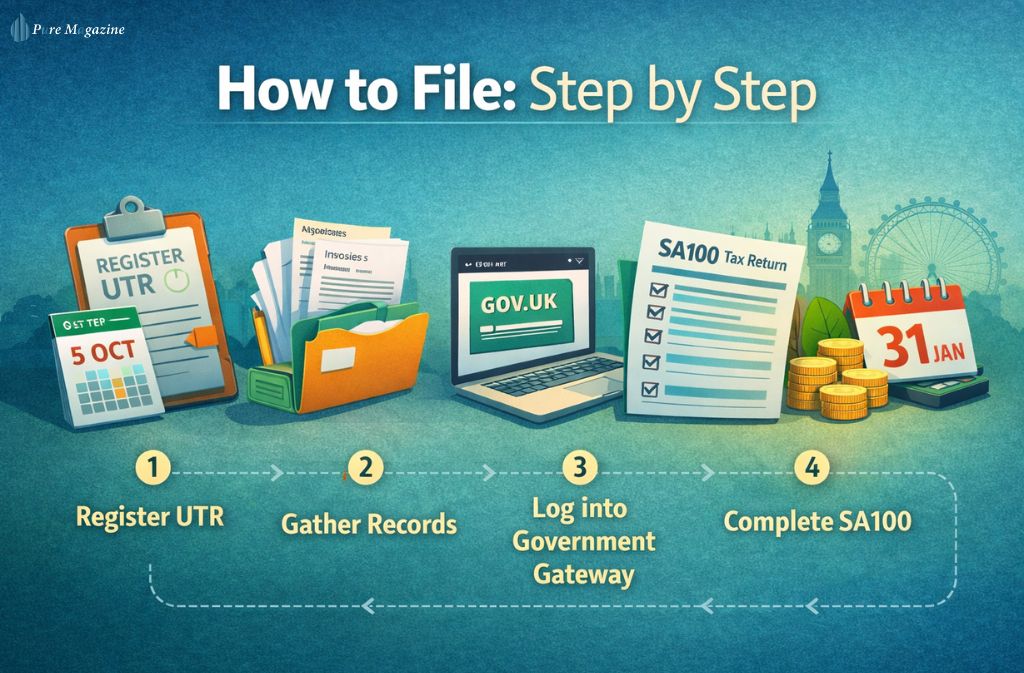
- Step 1 — Register and get your UTR Do this by 5 October following the tax year in which you earned the income. Registering late is itself a finable offence.
- Step 2 — Gather your records Invoices, bank interest statements, dividend vouchers, expense receipts, rental income summaries.
- Step 3 — Log into Government Gateway As GOV.UK’s SA100 guide confirms, you can file your tax return online — guidance notes are available to help you understand and fill in each section, and you can also access notes directly while completing the form.
- Step 4 — Complete the SA100 and attach supplementary pages The system prompts you when additional pages are needed.
- Step 5 — Review and submit Check the tax calculation HMRC generates before confirming. Pay any tax owed by 31 January.
SA100 vs SA302: Two Different Documents
| Feature | SA100 | SA302 |
|---|---|---|
| Purpose | Tax return — you file this | Tax calculation — HMRC generates this |
| Who creates it | Taxpayer | HMRC |
| Contents | All income and relief details | Final tax liability summary |
| Typical use | Filing Self Assessment | Mortgage proof of income |
Mortgage lenders request an SA302 to verify self-employed income. You can’t produce one yourself — it comes from HMRC after your SA100 processes. For a full explanation of what the SA302 is and how to get one for a mortgage application, that covers the steps lenders expect.
Key Deadlines
| Deadline | Action |
|---|---|
| 5 October | Register for Self Assessment |
| 31 October | Paper return submission |
| 31 January | Online return + tax payment |
| 31 July | Second payment on account |
As MoneyHelper confirms, if your last Self Assessment tax bill was over £1,000 and you haven’t already paid more than 80% of what you owe, HMRC requires payments on account — two payments, each half of your previous year’s bill, due in January and July.
That payment on account structure is why a £6,000 tax bill turns into a £9,000 January payment in your first high-earnings year. Understanding what the tax return dates mean for your cash flow throughout the year — including when HMRC opens the system for early filing — helps you avoid that shock.
Common Mistakes
Missing the 5 October registration deadline — by the time January arrives, the penalty clock has already started.
Attaching the wrong supplementary pages — omitting an SA105 for rental income or an SA108 for capital gains creates an incomplete return, which HMRC can later challenge.
Overclaiming expenses — HMRC requests evidence, and inflated claims trigger compliance checks that take months to resolve.
Forgetting small income sources — bank interest above the Personal Savings Allowance, small foreign dividend payments, and peer-to-peer lending returns all need declaring.
Leaving it to the last week of January — as HMRC’s own SA100 notes confirm, if your return is late you face a £100 penalty, and if it’s more than 3 months late, daily charges begin accumulating on top. The HMRC portal slows under January traffic. December filing removes that risk entirely.
If HMRC has been applying an incorrect tax code through PAYE alongside your self-employed income, the SA100 is where that gets corrected — but only if you notice it. Check your code before filing, not after.
FAQs
What is an SA100 form used for?
It’s the main Self Assessment return — reporting income not taxed through PAYE so HMRC can calculate what you owe. As GOV.UK confirms, HMRC calculates what you owe based on what you report, and payment is due by 31 January.
Who needs to complete an SA100?
Sole traders, landlords, company directors, high earners, investors with dividend or capital gains income above the current allowances, and anyone with foreign income.
Where can I download the SA100 form?
From GOV.UK’s Self Assessment forms page or by completing the return directly online through Government Gateway. As GOV.UK confirms, you cannot download the short SA200 form — HMRC sends that to specific taxpayers only.
What is the deadline for filing an SA100?
31 October for paper returns, 31 January for online. Both follow the end of the tax year to which they relate.
What is the difference between SA100 and SA302?
The SA100 is what you file. The SA302 is what HMRC generates from it — a tax calculation summary most commonly requested by mortgage lenders as proof of self-employed income.
Can you submit an SA100 online?
Yes — and most people do. As GoSimpleTax confirms, 95% of taxpayers file their SA100 online, either via GOV.UK directly or through filing software, with some taxpayers excluded from GOV.UK filing and therefore required to use approved third-party software
Conclusion
The SA100 is the form that keeps the UK’s non-PAYE tax system honest. Freelancers, landlords, directors, investors, and side hustlers all feed their numbers into it — and HMRC uses those numbers to calculate what’s owed or refunded.
In 2026, MTD is pulling high-income filers away from the once-a-year cycle toward quarterly digital reporting. The underlying information is the same. The cadence and tools change.
Start early, keep clean records, and don’t wait for January. File your SA100 through the HMRC Government Gateway well before the deadline — the system is faster, quieter, and far less stressful in October or December than it ever is at 11pm on 31 January.