Healthcare is often the last thing people think about when moving abroad—until it becomes the most urgent.
If you’re a UK national living in, moving to, or planning a long-term stay in an EU country, you’ve likely encountered the S1 form. It’s referenced across government sites and expat forums, yet rarely explained in a way that reflects how it works in practice.
Here’s the key point many guides miss: the S1 isn’t just a piece of paper. It’s a funding agreement between the UK and your country of residence. And like most cross-border systems, it only works once it’s recognised by both sides.
This guide explains the S1 form in plain English, using 2026-relevant rules, real examples, and practical warnings. You’ll learn who qualifies, how the two-step registration process works, how it interacts with EHIC/GHIC, and what can quietly invalidate your cover.
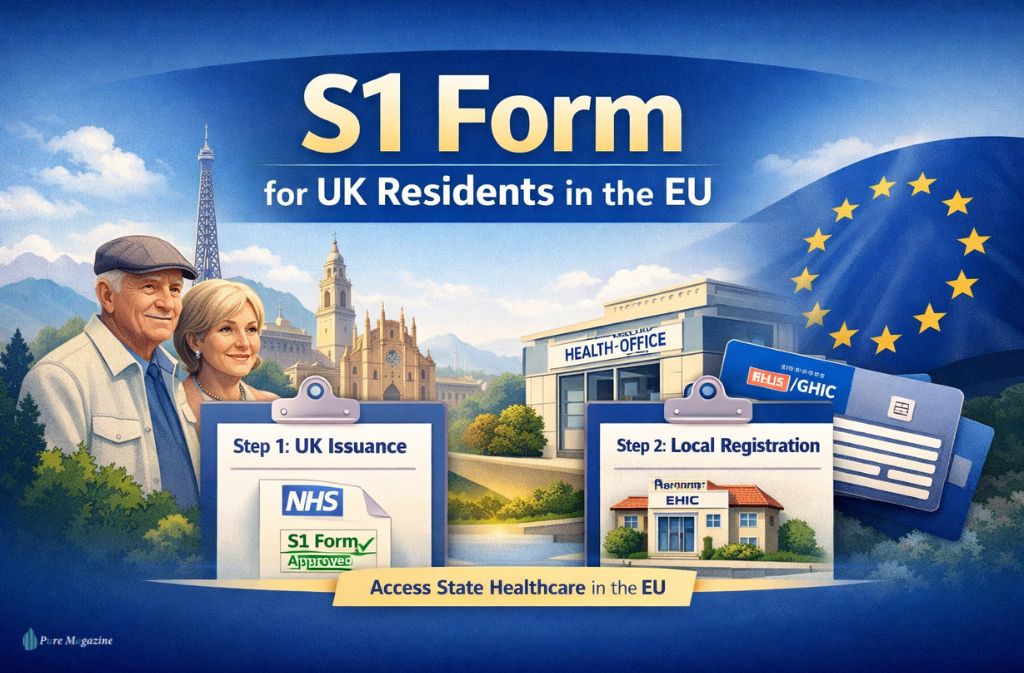
Quick Answer: An S1 form allows eligible UK nationals to access state healthcare in an EU/EEA country or Switzerland while the UK covers the costs. It only becomes valid after a two-step process: (1) the UK issues the S1, and (2) it is registered with the local health authority in your country of residence. It mainly applies to UK state pensioners, posted workers, and certain benefit recipients—not most digital nomads. |
What Is an S1 Form?
An S1 form is a UK‑issued healthcare funding certificate that allows certain people to access state healthcare in an EU/EEA country or Switzerland while the UK reimburses the cost.
It does not provide healthcare by itself. Instead, it confirms:
- Which country pays for your healthcare (the UK)
- Which country provides the treatment (your EU country of residence)
Once properly registered, you receive healthcare on the same basis as residents of that country.
The Crucial Thing to Understand: The Two‑Step Registration
This is where most problems arise.
The S1 only works after TWO registrations:
Step 1: UK Registration (Issuance)
- You apply through Overseas Healthcare Services (NHSBSA)
- As of late 2025 / early 2026, UK State Pensioners can apply fully online via the NHSBSA S1 online portal
- Once approved, the UK agrees to fund your healthcare
Step 2: Local EU Registration (Activation)
- You must register the S1 with the local health authority (e.g., CPAM in France, INSS in Spain)
- Only after this step does healthcare become accessible
Important: Until the local authority accepts and activates your S1, you may not be fully covered.
Who Is Eligible for an S1 Form in 2026?
You may qualify if you:
- Receive a UK State Pension and live in an EU country
- Are you a posted worker temporarily working abroad
- Receive certain exportable UK benefits
- Are a dependent family member of a qualifying person
Is nationality relevant?
No. Eligibility is based on social security responsibility, not citizenship.
Who usually does not qualify
- Digital nomads
- Self‑sufficient residents without exportable UK benefits
Costs & What the S1 Does Not Cover
Is the S1 free?
Yes. There is no cost to apply for or hold an S1.
What it covers
- State healthcare is under the local public system
What it does not cover
- Private healthcare
- Dental/optical, unless included locally
- Prescription co‑payments
Q. Is eligibility based on nationality? No. Eligibility depends on which country is responsible for your social security contributions, not your passport. |
Who Generally Does Not Qualify
- Self-sufficient residents without UK exportable benefits
- Most digital nomads
- People relying only on travel insurance or private cover
You may qualify if you:
- Receive a UK State Pension and live in an EU country
- Are you a posted worker temporarily working abroad (usually up to 2 years)
- Receive certain exportable UK benefits
- Are you a dependent family member of someone who qualifies
Who Generally Does Not Qualify
- Self‑sufficient residents without UK exportable benefits
- Most digital nomads
- People relying only on travel insurance or private cover
Eligibility depends on which country is responsible for your social security contributions—not your nationality.
S1 Form and Digital Nomad Visas (2026 Reality Check)
This is a growing point of confusion.
Most Digital Nomad Visa holders do not qualify for an S1 form because:
- They are not UK‑insured for social security
- They are expected to hold private health insurance
If you later begin receiving a UK State Pension, eligibility may change—but the visa healthcare requirements still apply.
Clarifying this upfront avoids costly application mistakes.
Step‑by‑Step: How to Apply for an S1 Form

1. Apply via NHSBSA
- Use the NHSBSA S1 online portal (State Pensioners)
- Or apply by phone/post where applicable
You’ll typically need:
- National Insurance number
- Proof of UK benefit or pension
- Address in your country of residence
2. Receive Your UK‑Issued S1
- Issued digitally or on paper
- Confirms UK funding responsibility
3. Register Locally (Critical Step)
- Register with your country’s health authority
- Processing times vary widely
4. Access State Healthcare
- GP registration
- Health card
- Reimbursements where applicable
The “Hidden” Step: The Legislation Letter
In some countries—especially Spain—local offices may request additional proof if they are unsure why you do not hold an S1.
You can request a Legislation or Non‑Exportation Letter from Overseas Healthcare Services:
- +44 191 218 1999
This confirms which country is responsible for your healthcare and can resolve registration deadlocks.
Country-Specific Registration (Quick Guides)
France (CPAM)
- Registration often takes 3–6 months
- Keep temporary private insurance
Spain (INSS)
- Residency is usually required first
- Registration is generally quicker than in France
Portugal (Segurança Social)
- Often smoother once residency is finalised
Country Variations You Should Know
France
- Register S1 with CPAM
- Registration can take 3–6 months
- S1 holders are usually exempt from certain social charges (prélèvements sociaux) on pension income
Spain
- Register with INSS
- Posted workers are strictly limited to the coordination rules
- Legislation letters are commonly requested
Portugal
- Register with Segurança Social
- Often smoother once residency is finalised
Germany
- Registration through a statutory Krankenkasse
- Documentation requirements can be strict
S1 Form vs EHIC vs GHIC
| Feature | S1 Form | EHIC / GHIC |
|---|---|---|
| Long‑term healthcare | Yes | No |
| Covers residency | Yes | No |
| Emergency care while travelling | No | Yes |
| Requires local registration | Yes | No |
| Issued by the UK | Yes | Yes |
Important: S1 holders are entitled to a UK‑issued GHIC specifically for travel outside their country of residence.
Also Read: HMRC Inheritance Tax Changes 2027: How to Protect Your Pension & Family Wealth
NHS Access When You Return to the UK
If your S1 is registered:
- You retain access to necessary NHS treatment during UK visits
- You are not ordinarily resident
- Planned treatment is not automatically covered
The Registration Gap Warning (Very Important)
Local registration can take weeks or months, particularly in France.
During this gap:
- Healthcare costs may not be reimbursed
- You may be asked to pay upfront
Many people use temporary private health insurance to cover this transition period.
Real‑World Examples
Example: UK pensioner moving to France (2026)
Apply via NHSBSA → receive S1 → submit to CPAM → use private insurance during processing → access French state healthcare once approved.
Example: Posted worker in Spain (18 months)
Employer confirms posting → S1 issued → register with INSS → coverage ends with posting.
Troubleshooting & Common Problems
S1 rejected locally
Often due to missing residency documents or a misunderstanding of entitlement. A legislative letter can help.
Delays in registration
Common in France (CPAM). Use temporary private insurance during the gap.
Lost or incorrect S1
Contact Overseas Healthcare Services to reissue or correct details.
Dependants not recognised
Ensure family members are registered at the same time as the main S1 holder.
Common Mistakes That Invalidate Cover
- Failing to register the S1 locally
- Assuming EHIC replaces S1
- Not registering dependants
- Letting private coverage lapse too early
- Not updating the address or status changes
Documents Checklist
You’ll usually need:
- UK State Pension or benefit confirmation
- National Insurance number
- Proof of residence abroad
- Passport or national ID
- Local residency or social security number (where applicable)
Registration Gap Warning
In some countries, especially France, S1 activation can take 3–6 months.
Consider temporary private insurance during this period.
Moving regions
If you move to another region within the same country, you often must re‑register your S1 locally.
Also Check: Pension Tax-Free Lump Sum To Be Scrapped? 2026 Update & Facts
Decision Scenarios (Quick Clarity)
UK pensioner moving to Spain: Eligible → Apply online → Register with INSS → Use GHIC for travel
Posted worker on 18‑month contract: Eligible → Employer coordination required → Time-limited S1
Spouse moving with pensioner: Eligible if registered as a dependant locally
Digital nomad: Generally not eligible → Private insurance required
FAQs
Q. What does an S1 form do?
An S1 form lets eligible UK nationals living in an EU/EEA country or Switzerland access state healthcare there, with the UK government covering the cost.
To activate it, the S1 must be registered with the local health authority in your country of residence.
Q. Who is eligible for an S1 form online?
You can apply for an S1 form online if you are:
- A UK State Pensioner living in the EU
- Receiving certain UK exportable benefits
- A posted worker temporarily working in the EU
- A dependent of someone who qualifies
Self-sufficient residents without UK benefit entitlement generally do not qualify.
Q. Is the S1 the same as EHIC or GHIC?
No. An S1 form is not the same as an EHIC or GHIC.
- S1 covers long-term residents in another country
- EHIC/GHIC covers temporary healthcare during short visits
If you hold an S1, you may also be entitled to a UK-issued GHIC for travel outside your country of residence.
Q. Do digital nomads qualify for an S1?
Usually no. Most digital nomads do not qualify for an S1 form because they are not receiving UK exportable benefits or a UK State Pension. Digital nomads typically need private health insurance to meet visa and residency requirements.
Q. Does the S1 form expire?
An S1 form does not usually have a fixed expiry date, but it can be reviewed, suspended, or withdrawn if your circumstances change.
Common triggers include:
- Moving country or returning to the UK
- Stopping qualifying benefits
- Employment status changes
You must keep your details up to date with NHS Overseas Healthcare Services.
Conclusion
The S1 form is not just a document—it’s a cross‑border healthcare funding agreement. When applied for and registered correctly, it provides full access to state healthcare in your EU country of residence, with the UK covering the cost.
The key is understanding the two‑step process, planning for registration delays, and avoiding assumptions—especially around EHIC, visas, or private insurance.
Handled properly, the S1 form can simplify healthcare abroad and prevent expensive mistakes.
Related: Why UK Pensioners in France Are Getting Tax Bills (2026 Guide)