


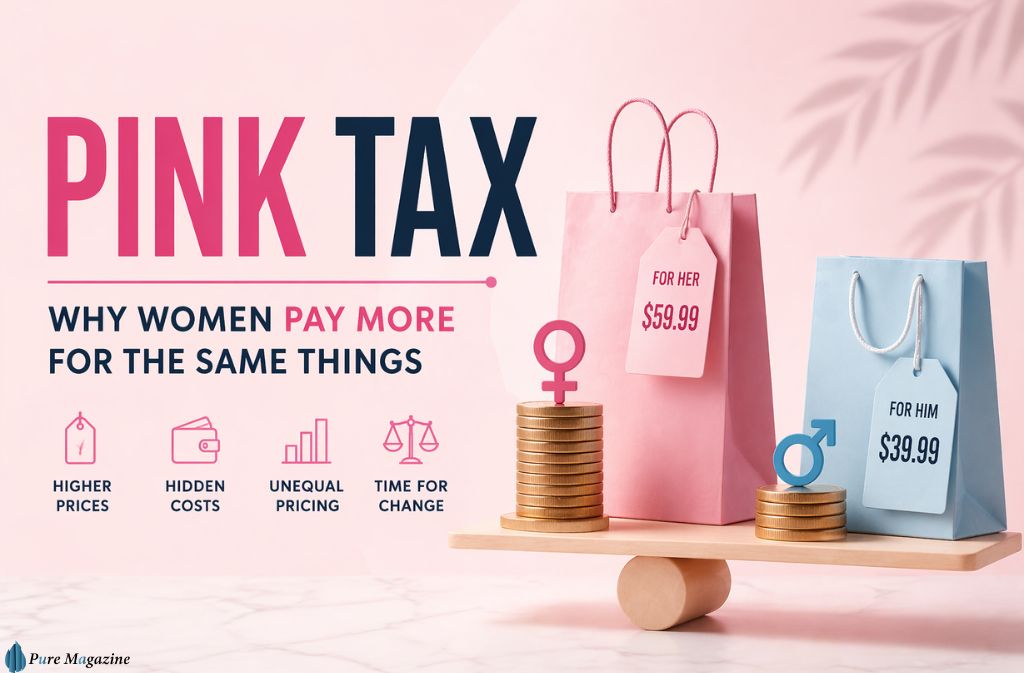
The pink tax isn’t a line item on your receipt — it’s an invisible markup.
Last month, a standard shopping run made it impossible to ignore. Two razors sat side by side on the same shelf. Men’s: $8.99 for a two-pack. Women’s: $11.49. Same blade count, same handle design, same packaging dimensions — different pink stripe on the box. That $2.50 gap isn’t a coincidence. It’s a pricing decision built on one assumption: that women won’t stop to compare unit prices.
That assumption is largely correct. And retailers know it.
This guide goes beyond the surface-level “women pay more” narrative. It’s a technical audit of gender-based pricing in 2026, covering the economics, the behavioural psychology, and the algorithmic systems quietly making the problem worse.
What Is the Pink Tax?
The pink tax is a market-driven pricing disparity where products targeted at women cost more than comparable alternatives for men, despite similar production costs.
It operates as a gender-based price premium — built through branding, positioning, and demand modelling — not through legislation or formal taxation.
The keyword is comparable. Not identical. Comparable. That distinction matters when building an accurate audit.
Methodology
This analysis draws on:
- 2026 unit price comparisons across major retailers (Amazon, Boots, Walmart)
- Cost per ml/gram rather than shelf price
- Category benchmarking across personal care, apparel, and services
Stripping shelf price in favour of unit pricing removes branding bias and isolates the actual cost variance. It’s the only honest way to measure this.
The Price Variance Formula
Quantifying the pink tax requires a consistent measurement approach. The correct formula — using the men’s price as the baseline — is:
Price Variance (%)=(Pw−PmPm)×100\text{Price Variance (\%)} = \left( \frac{P_w – P_m}{P_m} \right) \times 100
Where:
- PwP_w = price of the women’s product
- PmP_m = price of the men’s equivalent (the baseline)
Using the men’s price as the denominator matters. It measures the markup over the cheaper product, which is the right frame for auditing whether women pay a premium, and by how much.
Threshold: A variance above 10–15% on functionally identical products signals likely pink tax territory.
Real-World Benchmarking (2026)
Unit Price Comparison
| Product | Men’s (per 100ml) | Women’s (per 100ml) | Variance |
|---|---|---|---|
| Shampoo | $1.20 | $1.75 | +45.8% |
| Body Wash | $0.90 | $1.30 | +44.4% |
| Lotion | $2.10 | $2.80 | +33.3% |
These numbers look dramatic at first. But unit pricing does that — it cuts through the visual anchoring effect of shelf price and shows the actual cost structure.
Razor Subscription Models
Billie (women-focused) and Dollar Shave Club (men-focused) offer a useful direct comparison. Similar blade counts, similar materials, similar durability ratings. Observed price variance: roughly 15–25%, depending on the subscription tier.
The product engineering is comparable. The pricing strategy is not.
Why the Pink Tax Exists: The Economics
1. Price Elasticity of Demand
Women’s personal care products sit in a low-elasticity category. Consumers in low-elasticity markets are less sensitive to price increases — they keep buying even when prices rise. Brands use this to extract higher margins without triggering significant customer loss.
This isn’t unique to gender-based pricing. It’s standard margin optimisation. The issue is that the elasticity gap between men’s and women’s equivalents creates a consistent opportunity to charge more for one group.
2. Market Segmentation and Identity Pricing
Companies don’t just sell products — they sell identities. Gendered branding creates separate pricing tiers, reduces direct product comparison, and allows brands to position women’s products as a distinct (and implicitly superior) category.
The separation is the point. Once a consumer stops mentally comparing “women’s shampoo” to “shampoo,” the price anchor shifts.
3. The Behavioural Economics Layer: Choice Architecture
Retailers design shopping environments — physical and digital — to exploit predictable cognitive patterns. Relevant to gender pricing:
Brand loyalty asymmetry. Research consistently shows women demonstrate higher brand loyalty in personal care categories than men. Higher loyalty means lower switching behaviour. Lower switching behaviour means higher price inelasticity. Brands that understand this structure price their products accordingly.
Default bias. Most shoppers buy what they bought last time. Changing brands requires a conscious decision. The mental cost of switching — even to a cheaper, functionally identical product — acts as an invisible barrier that keeps margins high.
Choice architecture is the deliberate organisation of options to guide decisions without restricting them. When the men’s razor appears on the bottom shelf and the women’s version at eye level, that’s not neutral placement — it’s a nudge toward the higher-margin product.
Understanding this shifts the framing from “discrimination” to “systematic exploitation of predictable behaviour.” Both are true. The second is more accurate.
4. Algorithmic Pricing in 2026
This is where the pink tax has evolved beyond the physical shelf.
In 2026, the problem isn’t just on the shelf — it’s in the code. E-commerce recommendation engines build “lifestyle-matching” profiles using browsing history, purchase behaviour, and demographic signals. These systems actively steer users toward higher-margin product variants — not through explicit gender targeting, but through pattern recognition that achieves the same result.
A user whose browsing history skews toward skincare, women’s apparel, and home goods gets served premium-tier products first. The algorithm didn’t decide to charge women more. It learned that this profile converts at higher price points and optimised accordingly.
The effect is a pink tax that operates invisibly, personalised in real time, and nearly impossible to audit without access to the underlying model.
The Legislative Landscape (2026)
United States
California’s AB 1287 (the Gender Tax Repeal Act) prohibits businesses from charging different prices based on gender for substantially similar products and services. Several other states have introduced comparable legislation, though enforcement and scope vary significantly.
At the federal level, the Pink Tax Repeal Act remains under debate. It targets discriminatory pricing in consumer goods but has not yet been passed into law. Progress has been slow — partly because the bill must navigate the distinction between pricing discrimination and legitimate product differentiation.
UK and Europe
The UK removed VAT on menstrual products in 2021. Broader regulation on gender-based product pricing doesn’t yet exist. The EU’s focus has similarly centred on tax policy rather than market pricing behaviour.
The core problem with legislation: Regulation targets tax policy and service pricing. It does not — and largely cannot — mandate price parity across privately marketed consumer goods. The pink tax in personal care and retail persists precisely because it operates in that unregulated space.
The Luxury Nuance: When the Gap Is Justified
Not every price difference reflects discrimination. Some products marketed to women cost more for legitimate reasons:
- Complex fabrics (lace versus cotton; silk versus synthetic)
- Smaller production runs create higher per-unit manufacturing costs
- Greater design variation is driving up pattern and tooling costs
- Textile tariffs that affect women’s apparel imports more than men’s
A tailored women’s jacket with structural boning, varied seam lines, and seasonal design variation genuinely costs more to produce than a standard men’s cut. The same logic applies to extended sizing and specialist materials.
The honest audit question isn’t “is there a difference?” — it’s “is the difference proportional to the cost?”
When Men Pay More: The Counterexamples
A complete audit requires looking in both directions.
- Premium grooming kits: High-end beard care and men’s skincare have created their own premium tier, with some products priced above equivalent women’s lines
- Car insurance: Men under 25 pay significantly more in most markets due to actuarial risk data
- Extended shoe sizing: Larger men’s sizes often carry a premium that women’s sizing does not
Price discrimination isn’t one-directional. It tracks wherever demand inelasticity or perceived identity value allows a margin to be extracted. Gender is one vector. It isn’t the only one.
The Pink Tax Detection Framework
Apply this as a quick audit before buying:
Step 1 — Strip the branding. Ignore colour, packaging, and gender labels entirely. Look at what the product physically is.
Step 2 — Compare functionality: Same active ingredients? Same purpose? Same use pattern?
Step 3 — Check unit price. Always compare per ml or per gram — never total shelf price.
Step 4 — Apply the formula. Calculate the percentage variance using the men’s price as the baseline.
Step 5 — Decide rationally, is the difference above 15%? Is it justified by a real cost difference? If not, you’re looking at a branding premium, not a product difference.
The Gender-Neutral Shift: Progress With a Catch
Several major brands have moved toward gender-neutral packaging, minimalist labelling, and “universal” product lines. On the surface, this looks like progress.
The catch: in most cases, prices don’t drop. They standardise upward. The women’s premium doesn’t disappear — the men’s price rises to meet it, and the new “neutral” product launches at the higher tier.
Margins stay intact. The packaging just changes colour.
The Future of Gendered Pricing: 2027 and Beyond
Two forces are pulling in opposite directions.
On one side: growing consumer awareness, unit pricing tools, browser extensions that flag gender price gaps in real time, and regulatory pressure building in multiple markets. Transparency is increasing. The gap is harder to hide when unit price comparison is one click away.
On the other side, AI-driven personalised pricing is becoming more sophisticated. As recommendation engines build finer-grained behavioural profiles, price variance can be delivered at the individual level rather than the category level. Instead of “women’s products cost more,” the system learns that this specific user converts at a higher price point and adjusts accordingly — across every session, every platform, every category.
The shelf-level pink tax is becoming more visible. The algorithmic version is becoming less so. Whether net transparency wins depends almost entirely on how aggressively regulators choose to treat dynamic pricing as a consumer protection issue — which, in 2026, they largely haven’t.
How to Avoid the Pink Tax
- Compare unit pricing, not shelf labels
- Try men’s or gender-neutral alternatives — particularly in shampoo, body wash, and basic skincare
- Avoid “premium aesthetic” traps: frosted glass, rose gold, minimalist fonts add margin, not value
- Use price comparison browser extensions that display unit cost
- Buy in bulk where unit price advantages are significant
Common Mistakes
- Assuming every price gap represents discrimination, some differences reflect genuine cost variation
- Ignoring product quality differences that justify a premium
- Overvaluing branding signals when assessing value
- Comparing the shelf price instead of the unit price
FAQs
Q. What is the pink tax in simple terms?
The pink tax is a pricing difference where products marketed to women cost more than similar or identical products marketed to men. The difference is usually not due to production costs but branding, packaging, and marketing strategies.
Q. Does the pink tax still exist in 2026?
Yes, the pink tax still exists in 2026, especially in personal care, cosmetics, and retail products. While awareness has increased and some brands have introduced gender-neutral pricing, algorithmic and personalised pricing systems can still create hidden price gaps.
Q. Is the pink tax illegal?
In most countries, the pink tax is not illegal. It is generally considered a result of market pricing rather than direct discrimination. However, some regions, such as parts of the United States (e.g., California’s AB 1287), restrict gender-based pricing in specific services. There is no broad federal ban in the US or UK on gender-based product pricing.
Q. Why do women’s products cost more?
Women’s products often cost more due to market segmentation, branding strategies, and consumer behaviour patterns. Companies may also rely on price elasticity differences, where certain products targeted at women can be priced higher. In 2026, personalised algorithmic pricing in e-commerce can also contribute to hidden price differences.
Q. How do you calculate the pink tax?
To calculate the pink tax, compare two similar products and measure the price difference using this formula:
((Women’s price − Men’s price) ÷ Men’s price) × 100
If the result is above roughly 10–15% for functionally similar products, it may indicate a pink tax premium driven by branding rather than cost differences.
Conclusion
The pink tax isn’t a myth. It also isn’t universal or monolithic.
It exists most clearly in personal care — shampoo, razors, body wash, lotion — where product parity is high, and price variance is hardest to justify. It’s driven by market behaviour: elasticity gaps, brand loyalty asymmetry, choice architecture, and increasingly, algorithmic personalisation.
Some pricing gaps are real and justified. Many aren’t. The difference usually shows up in the unit price.
The smartest move in 2026 isn’t outrage — it’s auditing. Strip the branding. Check the unit price. Run the formula. Decide with the numbers, not the packaging.
For more guides on gender pricing, consumer costs, and personal finance tips, visit Pure Magazine.