I started woodworking the same year I bought my first house. That was 1996. Most of the tools I use now I have owned since the early 2000s. Most of the aprons I have owned since then are in the trash. The current one has been on the same hook in my shop for nine years. It is the only piece of clothing I own that I expect to outlive me.
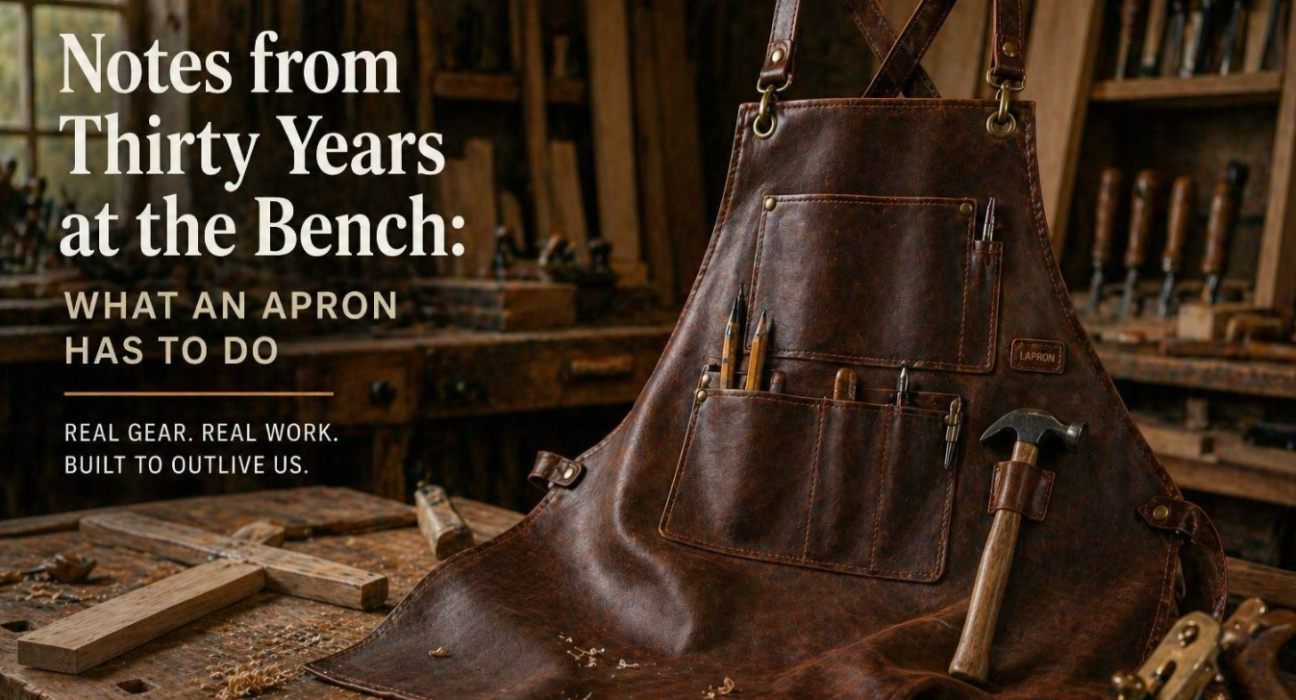
That apron is leather. Mine is a Lapron. I will get to why that material matters in a minute, but the short version is that almost everything I will tell you in this article is about why most aprons fail and why a small number of them — the ones built right — last for decades.
If you are at the point of asking whether a leather work apron is worth the money, the honest answer depends on whether you actually use the shop. For weekend hobbyists who fire up the bench five times a year, no. For anyone who works with wood seriously — every weekend, or every day — the math is different from what most people realize, and most of this article is about that math.
What Aprons Are For
The reason most people get aprons wrong is that they think of them as clothing. They are not. They are shop equipment. The same way a bench dog is shop equipment, or a marking gauge, or a sharpening stone. You do not think about the price of a bench dog. You think about whether it works.
An apron has three jobs. It protects your body from sharp things. It protects your clothes from finishes. It carries the small tools you reach for constantly. That is the whole job description. The aprons that do all three jobs well are rare. The aprons that do all three jobs for thirty years are rarer.
How Aprons Fail
I have watched a lot of aprons fail. The failure modes are predictable:
The straps stretch. Cotton webbing under the tool weight stretches within months. The apron sags lower and lower until it is hanging at the knees and is useless.
The pockets blow out. Cheap aprons have stitch pockets on the body with single-thread runs. The first time you put a 16-ounce hammer in one, the seam starts to go. Within a year, the pocket is hanging by a thread.
The fabric punctures. Cotton, even canvas, does not stop a chisel slip. I have a small scar on my left thigh from learning this in 2003.
The finish soaks through. Polyurethane, BLO, lacquer thinner, and shellac — they all go through cotton. They do not go through leather. Ask anyone who has ruined a pair of jeans with a stain.
The hardware breaks. Plastic snap fasteners are the first thing to fail on cheap aprons. Once a snap goes, you are tying knots in straps.
Why Leather, Specifically
I will be honest: I tried not to like leather aprons for years. They felt fussy. Too “craftsman cosplay.” My mental image of a real woodworker was someone in a flannel shirt and jeans, not someone in a vest like an 1880s blacksmith.
Then I broke a $90 chisel by dropping it on concrete in 2014, and a friend of mine — a working cabinetmaker who had been at it longer than I had — looked at me and said, “You know, if you’d been wearing a leather apron, you could have caught that with your hand.”
He was joking. Sort of. But the point landed. The apron a serious tradesman wears is not decoration. It is a working surface, a tool holder, and a backstop for the inevitable accidents.
What a Leather Apron Actually Does Differently
Here is the practical case, after a decade in one:
It Stops Things
A 3 mm full-grain cowhide front stops a chisel slip cold. It stops a card scraper edge. It stops the corner of a freshly-jointed board. None of those things is individually catastrophic if they do not make contact. All of them are why I have one fewer scar than I might otherwise.
It Wipes Clean
Wood glue dries on leather in beads. You scrape it off with a fingernail. On canvas, it absorbs, and getting it out without damaging the fabric is its own project. Same story for finishes. Same story for the random oil drips that happen when you are cleaning hand tools.
It Distributes Tool Weight
With proper cross-back straps and reinforced pockets, you can carry a marking knife, a small ruler, a pencil, a square, a chisel, and a tape measure all day without the apron sagging an inch. With cotton, you would be readjusting the straps every hour.
It Develops Character
This sounds soft, but it is real. After nine years, my apron has stains from specific projects. The dark spot on the front is from leaning against my workbench five days a week. There is a small burn mark from the time I tried wood-burning a sign. Each mark is a memory. Cotton aprons do not do this. They just look worse and worse until you throw them away.
Choosing Right
If you are shopping for what might be your apron for the next twenty years, here is the buying logic. The aprons I have seen consistently hold up tend to come from specialist makers who only do aprons — not generalists who make aprons among other workwear. A 2 from a specialist will be built around shop-use specifications: the right pocket sizes, cross-back strap geometry, leather thickness rated for daily bench work, and reinforced stitch points where the load actually sits.
The criteria I would give a younger version of myself, in priority order:
1. Material Specification
Full-grain cowhide. Listed thickness in millimeters — anywhere from 2.5 to 3.5 mm is the working sweet spot. If a maker will not tell you the thickness, they are hiding something.
2. Strap Configuration
Cross-back leather straps. Adjustable. Brass hardware on the buckles. Skip anything with a neck-loop-only design — the ergonomics are bad, and the long-term effect on your neck is not worth the savings. Skip anything with plastic buckles.
3. Pocket Layout
Most experienced woodworkers want 4 to 6 pockets, sized practically: two chest-level for pencils and small tools, two waist-level for hand tools, and optionally one thigh-level for a measuring tape. More pockets are not better. Most workshop aprons with twelve pockets are designed by people who do not actually wear aprons.
4. Hammer Loop
If you do trim work, finish carpentry, or framing, a hammer loop on the side is non-negotiable. The loop should be reinforced and positioned where the hammer hangs naturally without swinging into your leg as you walk.
5. Length
Chest to knee, minimum. A short apron rides up when you bend over a workbench, exposing the very area it is supposed to be protecting.
A Note on Cheap Aprons
There is a reasonable argument for buying a $40 canvas apron when you are starting. You do not yet know if woodworking is going to stick. You do not want to drop $200 on gear for a hobby that might be a passing phase.
If you are still thinking through what an apron actually does in a working shop — the tool storage, the debris protection, the long-day comfort questions — this practical breakdown of the uses of a carpenter apron walks through the everyday functions in more detail, and is a useful companion piece to the leather-specific case I have made here.
I would push back on this for a specific reason. The canvas apron will fail within two years. By the time it fails, you will know whether woodworking has stuck or not. If it has, you will buy the leather one anyway. The $40 was just the entrance fee for postponing the decision.
The honest path, if you can afford it, is to buy the leather one at the start. If woodworking does not stick, you still have a piece of gear that holds its value, can be sold, or repurposed for other work. If it does stick, you have saved yourself the $40 entrance fee, and you have an apron that will outlast your first table saw.
Conclusion
A working tradesman gets a small number of decisions over the course of their career that compound. The decision to buy quality hand tools instead of replacing cheap ones every five years is one. The decision to invest in a real workbench is another. The decision about which apron you spend the next twenty years in belongs in the same category.
Most of us, myself included, did not make that decision well the first time. Or the second. Or the fifth. Eventually, you do, and the only regret is not getting there sooner.
There is an old workshop saying: “Buy nice or buy twice.” The math works the same way for aprons as it does for chisels and bench planes. Buy once, buy right, and put your attention where it belongs — on the work, not on replacing the gear that is supposed to be holding up under it.
For more, visit Pure Magazine