
Rental property looks simple from the outside — buy a house, collect rent, build wealth. Then the first tax bill lands.
Mortgage interest restrictions, stacking income bands, and MTD deadlines catch landlords off guard every year. A landlord tax calculator helps you see the numbers before HMRC does — and plan accordingly.
But most online calculators just spit out a figure. They don’t explain how they got there.
This guide does both. You’ll understand how UK rental income tax actually works, what a calculator is doing behind the scenes, which expenses genuinely reduce your bill, how Section 24 changes the math for mortgage holders, and what Making Tax Digital means for landlords from April 2026.
If you own rental property — or plan to — understanding this calculation is the difference between running a profitable business and getting a nasty surprise every January.
What Is a Landlord Tax Calculator?
A landlord tax calculator estimates the income tax your rental profits will attract.
The core formula:
Rental Income – Allowable Expenses = Taxable Rental Profit
That profit then gets taxed at your personal income tax rate. Most calculators ask for annual rental income, mortgage interest, repairs and maintenance costs, letting agent fees, property insurance, service charges, and your income tax band. They return estimated rental profit, mortgage interest tax credit, and tax owed.
As GOV.UK’s official rental income guidance confirms, if you rent out more than one property, the profits and losses from those properties are added together to arrive at one overall figure — and if your allowable expenses exceed your rental income, you make a loss that can normally only offset future profits from the same rental business.
Simple in theory. Section 24 makes it considerably messier in practice.
How Rental Income Gets Taxed
Rental income stacks on top of everything else you earn — salary, self-employment income, dividends, pension. HMRC adds it all together before calculating your band.
For 2026, the standard income tax bands apply:
| Income Band | Tax Rate |
|---|---|
| Basic Rate | 20% |
| Higher Rate | 40% |
| Additional Rate | 45% |
A modest rental profit can push a salaried landlord from 20% into 40% territory without them realising. Understanding how the UK income tax bands work — and where the thresholds sit — is the foundation of any accurate landlord tax calculation.
Section 24: The Mortgage Interest Restriction
This is the change that reshaped landlord tax and still trips people up.
Before 2017, landlords deducted 100% of mortgage interest from rental income. That route closed. As GOV.UK’s official Section 24 guidance confirms, from April 2020 the tax reduction works as follows: the basic rate value (20%) of the lower of finance costs, property business profits, or adjusted total income — and crucially, the tax reduction cannot be used to create a tax refund.
As AXA’s Section 24 guide explains, landlords now pay tax on their full rental income before finance costs are deducted — mortgage interest and similar charges no longer reduce taxable income, although other allowable expenses such as maintenance, insurance, and letting agent fees can still be deducted as before.
The 20% credit doesn’t fully compensate higher-rate taxpayers. A landlord paying 40% tax on rental income only recovers 20% on their interest — the gap widens the more leveraged the portfolio.
How the Calculation Actually Works (Step-by-Step)
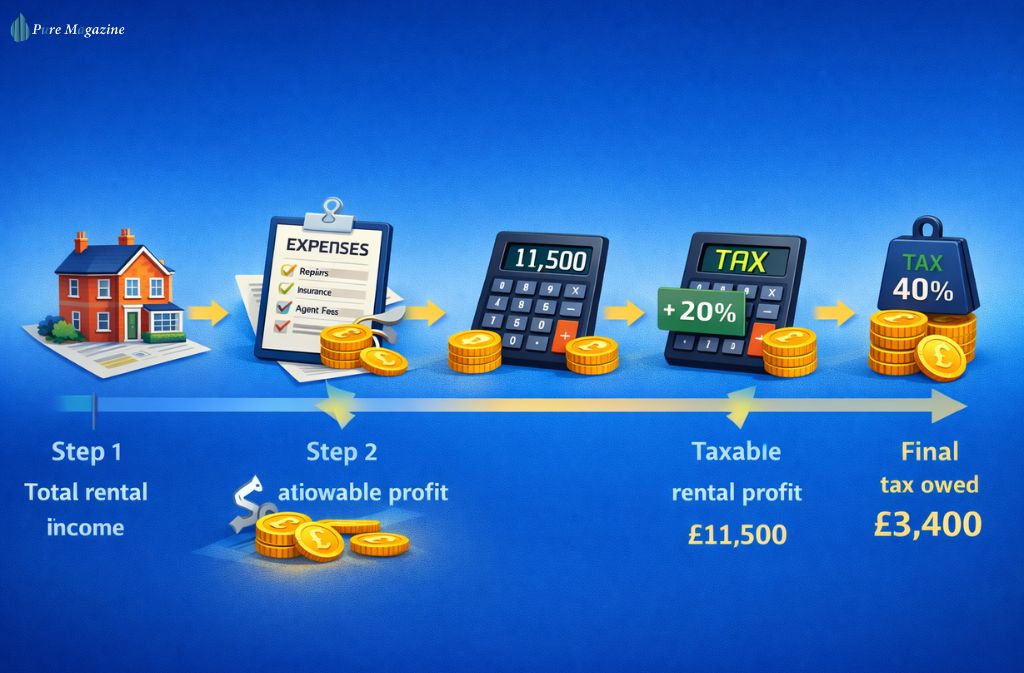
Step 1: Total rental income
| Source | Amount |
|---|---|
| Monthly rent | £1,200 |
| Annual rent | £14,400 |
Step 2: Subtract allowable expenses
| Expense | Amount |
|---|---|
| Repairs | £1,200 |
| Insurance | £300 |
| Agent fees | £1,400 |
| Total | £2,900 |
Step 3: Taxable rental profit
£14,400 – £2,900 = £11,500
Step 4: Mortgage interest tax credit
Suppose mortgage interest is £6,000.
£6,000 × 20% = £1,200 credit
Step 5: Apply income tax rate
Landlord in the 40% band:
£11,500 × 40% = £4,600
£4,600 – £1,200 = £3,400 tax owed
Full example summary:
| Item | Amount |
|---|---|
| Annual rental income | £14,400 |
| Allowable expenses | £2,900 |
| Taxable profit | £11,500 |
| Mortgage interest | £6,000 |
| Tax rate | 40% |
| Tax before credit | £4,600 |
| Interest credit | £1,200 |
| Final tax owed | £3,400 |
A landlord tax calculator runs these steps automatically. The value is seeing the answer before January — not after.
Why 2026 Makes Accurate Forecasting More Critical
Making Tax Digital for Landlords
From 6 April 2026, MTD for Income Tax Self Assessment becomes mandatory for landlords whose combined rental and self-employment income exceeds £50,000. As the MTD ITSA rules confirm, this threshold is based on gross income before expenses — not profit — and affected landlords must maintain digital records and submit quarterly updates using compatible software.
As Landlord Studio’s tax guide confirms, the MTD rollout continues beyond 2026: April 2027 extends the requirement to those earning over £30,000, and April 2028 brings in those over £20,000 — with income thresholds based on gross income and joint property owners splitting income for threshold purposes.
For a full breakdown of how the MTD deadlines interact with Self Assessment filing obligations, that covers the quarterly and annual submission calendar landlords need to plan around.
Digital Compliance Checklist
✔ Use MTD-compatible accounting software ✔ Record rental income digitally from day one ✔ Track allowable expenses in real time ✔ Submit quarterly reports to HMRC ✔ Complete an End of Period Statement (EOPS) ✔ File the final annual tax declaration
Allowable Expenses Landlords Can Deduct
As GOV.UK’s rental income guidance confirms, HMRC allows landlords to deduct expenses that are wholly and exclusively for the rental business — and records must be kept for at least 5 years after the 31 January tax return deadline, with penalties applying for inaccurate or missing records.
Property Management
- Letting agent fees
- Advertising for tenants
- Legal fees for tenancy agreements
Property Maintenance
- Repairs and maintenance (not improvements)
- Replacement of appliances
- Plumbing and electrical repairs
Safety and Compliance
- Gas safety certificates
- Electrical installation condition reports (EICR)
- Smoke and carbon monoxide alarms
Administrative Costs
- Accountant fees
- Bookkeeping software
- MTD-compatible accounting tools
Correctly claiming every legitimate expense reduces taxable profit directly. For a full guide to what expenses sole traders and landlords can claim, the principles overlap significantly — the “wholly and exclusively” test applies in both cases.
The £100k–£125k Personal Allowance Trap
High-earning landlords hit a problem most calculators don’t flag.
Once total income crosses £100,000, the personal allowance starts disappearing. For every £2 earned above £100,000, you lose £1 of tax-free allowance. Between £100,000 and £125,140, the effective marginal rate hits 60%.
Rental income pushes people into this band faster than expected. Understanding the full implications of the 40% tax bracket — and the taper above it — helps landlords identify this risk before it materialises.
Multiple Property Example
| Property | Rent | Expenses | Mortgage Interest |
|---|---|---|---|
| Property A | £12,000 | £2,000 | £5,000 |
| Property B | £10,800 | £1,800 | £4,000 |
Totals: Rental income £22,800 / Expenses £3,800 / Taxable profit £19,000
Mortgage interest credit: £9,000 × 20% = £1,800
Tax at 40%: £7,600 – £1,800 = £5,800 tax owed
As GOV.UK confirms, profits and losses from all UK rental properties combine into a single figure — but overseas properties must stay separate from UK properties in the calculation.
Common Mistakes Landlords Make
Still deducting mortgage interest from profit
As ARB Accountants confirm, Section 24 restricts relief on most finance costs — mortgage interest and similar charges do not reduce taxable rental profits but instead generate a basic-rate 20% tax credit on the tax bill. The result: higher-rate taxpayers and highly leveraged landlords typically pay more tax than under the old system.
Missing allowable expenses
Every unclaimed legitimate expense inflates taxable profit unnecessarily. Keep receipts for everything.
Ignoring payments on account
If your tax bill exceeds £1,000, HMRC requires advance payments — 50% in January, 50% in July. An after-tax calculator helps model the January figure before it arrives.
Missing MTD thresholds
Landlords whose gross income crosses £50,000 must act before April 2026 — not after.
What Calculators Can’t Tell You
Even the best online tools have blind spots. They rarely account for capital gains tax on disposal, limited company ownership structures, non-resident landlord taxation, joint ownership income splits, or complex multi-property planning.
For portfolios with any of these factors, a specialist property accountant adds more value than any calculator.
FAQs
Q. How do landlords calculate tax on rental income?
Subtract allowable expenses from rental income. Tax the remaining profit at your income tax band. Apply the 20% mortgage interest credit separately. As GOV.UK confirms, you must tell HMRC about taxable profits via Self Assessment — registering by 5 October following the tax year you first had rental profits.
Q. Does a landlord tax calculator include mortgage interest?
Yes — it applies a 20% tax credit rather than deducting interest from profit, reflecting the Section 24 rules now fully in force.
Q. Do I pay tax if rental income is my only income?
You may pay nothing if total income stays below the personal allowance. Understanding how much you can earn before paying tax clarifies exactly where that threshold sits and what counts toward it.
Q. What expenses can landlords deduct?
Repairs, letting agent fees, insurance, legal costs related to tenancies, accountancy fees, and safety compliance costs. These reduce taxable profit. Mortgage interest no longer reduces profit — it generates a 20% credit instead.
Q. Do landlords have to use Making Tax Digital in 2026?
Yes, if gross rental and self-employment income exceeds £50,000 from April 2026. The GOV.UK MTD eligibility checker confirms whether the threshold applies to you.
Conclusion
The formula for rental tax hasn’t changed. What changed is the mortgage interest rule — and that one shift reshaped the economics of property investment for millions of landlords.
A reliable landlord tax calculator helps you see your real liability ahead of time. But the calculator only works properly when you understand what’s going into it: allowable expenses claimed correctly, Section 24 applied correctly, and MTD thresholds tracked before they trigger.
For 2026, use the tools. Know the rules. And if the portfolio is complex, get specialist advice — the cost is itself an allowable expense.