


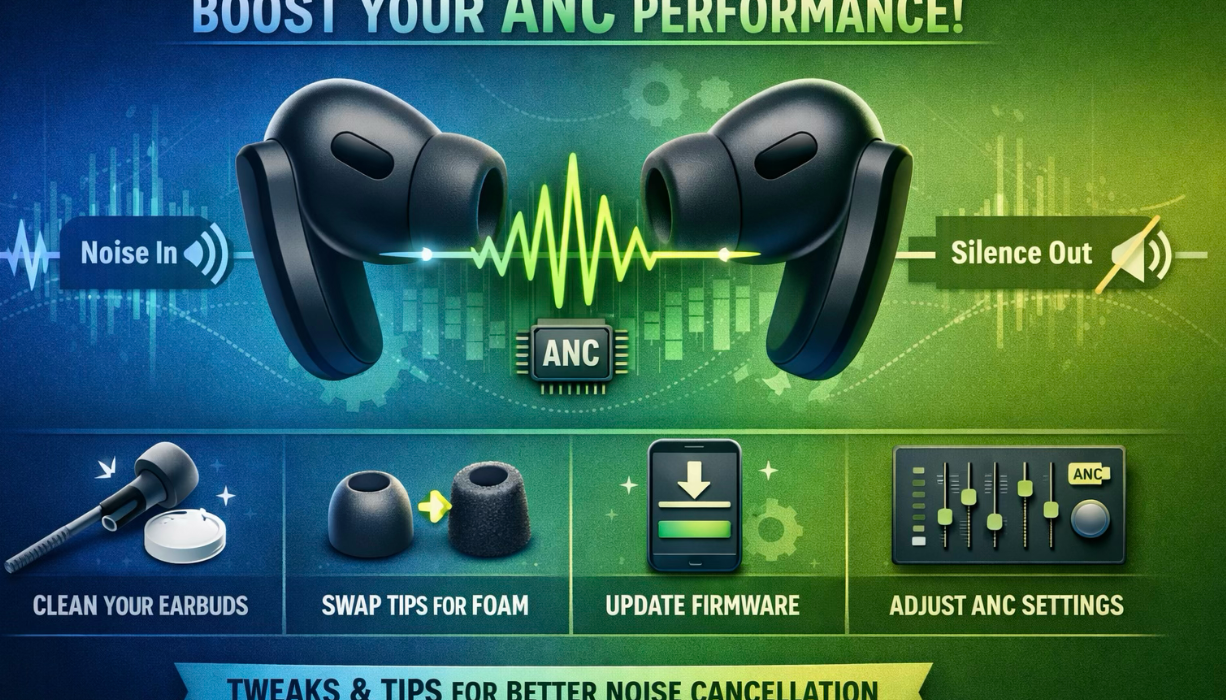
Active noise cancellation is one of those features you love or hate. If your noise-cancelling earbuds, best noise cancelling earbuds or ANC headphones suddenly feel weak in comparison, you do not need to go and get a new set of hardware necessarily. After a decade of writing about audio and testing hands-on, I’ve discovered reliable, repeatable tweaks that nudge the performance of ANC closer to where we expect it to be, often at no cost.
Why ANC Sometimes Feels Weak
ANC is based on microphones, algorithms and a good physical seal. If one of those three blinks, cancellation falls away. Typical reasons include a poor seal, old firmware, the wrong ANC setting or user expectations driven by marketing. It also depends on the environment: rumbling low-frequency noise in a car acts differently from human voices inside a café. Once you know which problem you have, the solution narrows.
Quick Adjustments That Usually Work
Clean the earbuds and mic ports
Start with the basics. Clean the earbuds and the mic ports because wax and dust will degrade the mics that ANC uses.
Swap silicone tips for foam ones
Exchange silicone tips with foam ones. Foam construction can often make for a deeper, more stable seal and enhance passive isolation to relieve some of the burden from ANC.
Check fit and left and right orientation
Lots of folks wear earbuds slightly rotated or not all the way in, which negates ANC. Perform any preinstalled fit test in the companion app where available. If your earbuds aren’t part of an app ecosystem, you can experiment with the sizes of tips and minor placement adjustments using a consistent test audio track.
Try different ANC and ambient modes
Turn the ANC to max but also try ambient or transparency modes. Some earbuds employ hybrid ANC, combining feedforward and feedback microphones, and that approach can be most effective in one specific mode. If your environment is steady-state noise, airplane or train for example, boosted ANC does most of the work. For variable noise such as talking or building sounds, you may be better off with a hybrid or adaptive mode.
Advanced Tweaks: Firmware, EQ and App Settings
You will find helpful options in companion apps, which are also where you can update firmware and fine-tune equalization.
Update firmware regularly
Firmware updates will deliver massive improvements in ANC for the major brands; I have seen older models jump significantly once updated. Open the companion app and install the latest firmware whenever you are prompted to do so.
Limit use of earbud EQ to help ANC
If there are problematic frequencies between 500 Hz and 2 kHz where you could cut, the noise floor may seem lower even if the ANC itself is not cancelling more. If your app features an adaptive EQ or sound profile, try presets such as Quiet or Commute. Steer clear of heavy bass boosts. Turning up lower frequencies makes ANC work harder and might make it seem less effective.
Calibrate ANC and noise profiles
If an adjustable ANC strength setting or a custom noise profile is available, calibrate it. A few apps have guided calibration using either your phone’s mic or the buds themselves. Do calibration in one silent room and then in another noisy space so the algorithm can learn from both environments.
Factor in latency and codec settings for multimedia
Latency and codec settings matter when using ANC for multimedia. Low-latency codecs improve the relationship between audio signal and ANC processing times, even if it only slightly affects the perception of tightness in sound and canceling. Change to SBC, AAC, or low-latency custom codecs when needed.
Physical Fixes Worth Trying
Replace ear tips
Foam tips are fairly cheap and can sometimes change the game on both comfort and noise isolation. Replace worn silicone tips that have lost elasticity. If foam compresses in your earbud and does not rebound, the seal is weak.
Clean the mesh and mic holes
You can clean a blocked mesh with a soft, dry brush or a single-use earbud cleaning tool. Be careful; you do not want any substances to reach your drivers or microphones. If you find physical damage to a mic port and do not want to void your warranty by disassembling the unit, seek professional service.
When to Consider New Earbuds
At times, hardware is the limiting factor. If you have cleaned the earbuds, updated firmware, tried new tips and run calibrations and the ANC is still lackluster, transducers or microphones may have aged or failed. ANC performance can also be compromised by battery degradation because aggressive cancellation requires power and processing. In those scenarios, looking for the best noise cancelling earbuds for your money and specific use case is a good next step.
Conclusion: Incremental Gains Add Up
You can greatly improve the performance of your ANC, Active Noise Cancellation, without purchasing a whole new pair of earbuds with the right fit, cleanliness, firmware and smart app hacks. These solutions are cheap, quick and often overlooked. From my experience, the largest win is switching to a proper foam tip and doing any fit or calibration tests in the companion app.
FAQs
How frequently should I be updating the firmware to improve ANC?
Keep firmware up to date. Whenever there is a new version from the manufacturer, update it because most updates include improvements in ANC algorithms and bug fixes.
Will foam tips always be the best choice for ANC over silicone?
Foam tips generally offer a more effective seal and passive isolation that enables ANC to do less work. They are not universally comfortable, so experiment with different shapes and sizes.
Do EQ settings make ANC feel stronger?
Yes. Trimming annoying mids and upper frequencies can reduce perceived noise without altering ANC itself. Avoid adding heavy low-frequency boosts.
My earbuds were working perfectly and now the ANC is not functioning well. Is that fixable?
Begin by cleaning, replacing tips and checking firmware. If those do not work, internal mic failure or a degraded battery could be the culprit and may need repair or replacement.
Are app-based calibrations worth running?
Absolutely. Adjustments customize ANC and EQ for your ear shape and surrounding space, and the majority of users report perceptible enhancements.
For more, visit Pure Magazine