


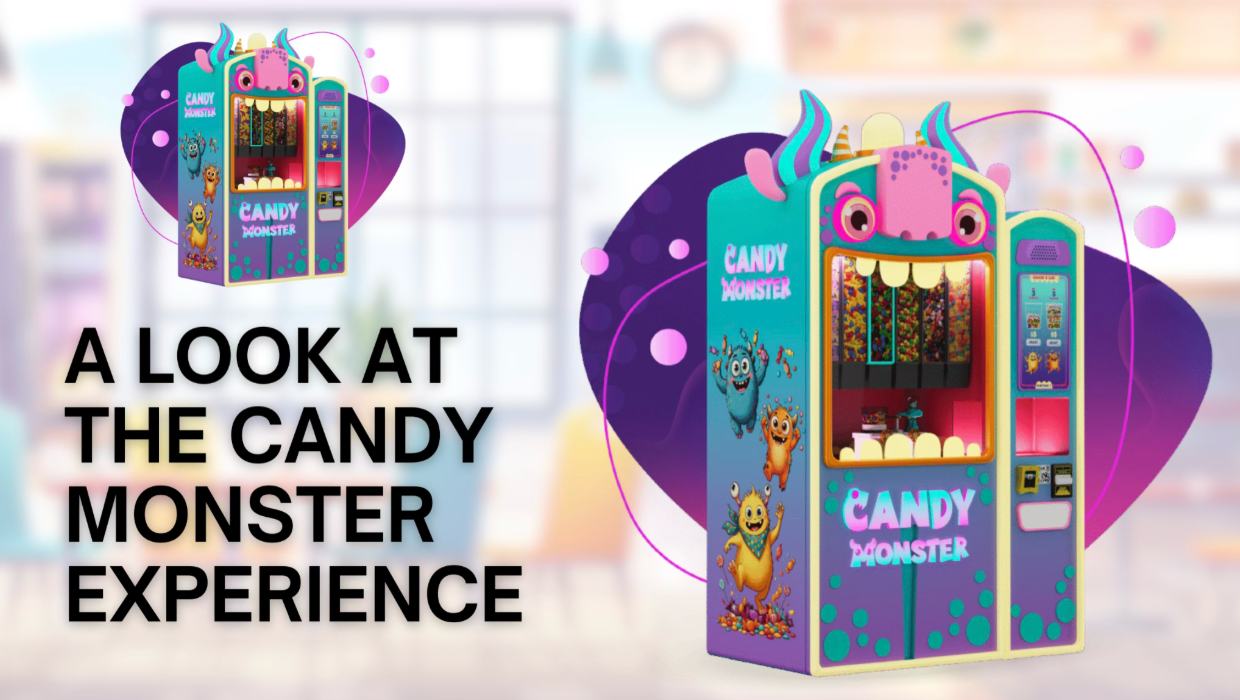
In the modern economic landscape, the quest for a reliable secondary revenue stream has led many to explore the world of automated retail. Among the most promising entries in this space, Candy Monster vending machines offer a streamlined entry point for individuals looking to secure financial independence without the time commitment of a traditional brick-and-mortar business. Unlike complex franchises that require heavy staffing and massive overhead, these specialized units capitalize on the simplicity of impulse purchases and high-traffic placement. By focusing on a “Done-For-You” model, the platform removes the traditional barriers to entry that often discourage new entrepreneurs from entering the vending industry.
The Evolution of Passive Income
For decades, the concept of passive income was largely limited to real estate or stock market dividends. However, the rise of specialized automated retail has shifted the paradigm. Today’s “side-hustler” is looking for something more tangible than a digital asset but less demanding than a rental property. The candy vending sector has emerged as a frontrunner in this category because it addresses the three biggest pain points of small business ownership: initial complexity, maintenance labor, and profit consistency.
The Candy Monster system is designed specifically to address these challenges. By leveraging a high-margin product—confectionery—and combining it with a robust, American-made hardware solution, it creates a self-sustaining ecosystem. For the aspiring entrepreneur, this means the focus shifts from “How do I build a business?” to “How do I scale my portfolio?”
The Power of “Done-For-You” (DFY)
The most significant hurdle for any new vending operator is not buying the machine; it is finding a profitable home for it. A machine sitting in a garage or a low-traffic hallway is a liability, not an asset. This is where the DFY model provides its greatest value. Instead of forcing owners to cold-call local businesses or negotiate complex contracts with property managers, the system provides professional location placement support.
By securing high-traffic venues such as shopping centers, professional offices, and community hubs, the DFY approach ensures that the machines are positioned in front of the right demographic from day one. This turnkey strategy allows investors to bypass the “learning curve” phase where most small businesses fail. When the logistics of delivery, installation, and location scouting are handled by experts, the owner can focus entirely on the high-level management of their new income stream.

American-Made Reliability
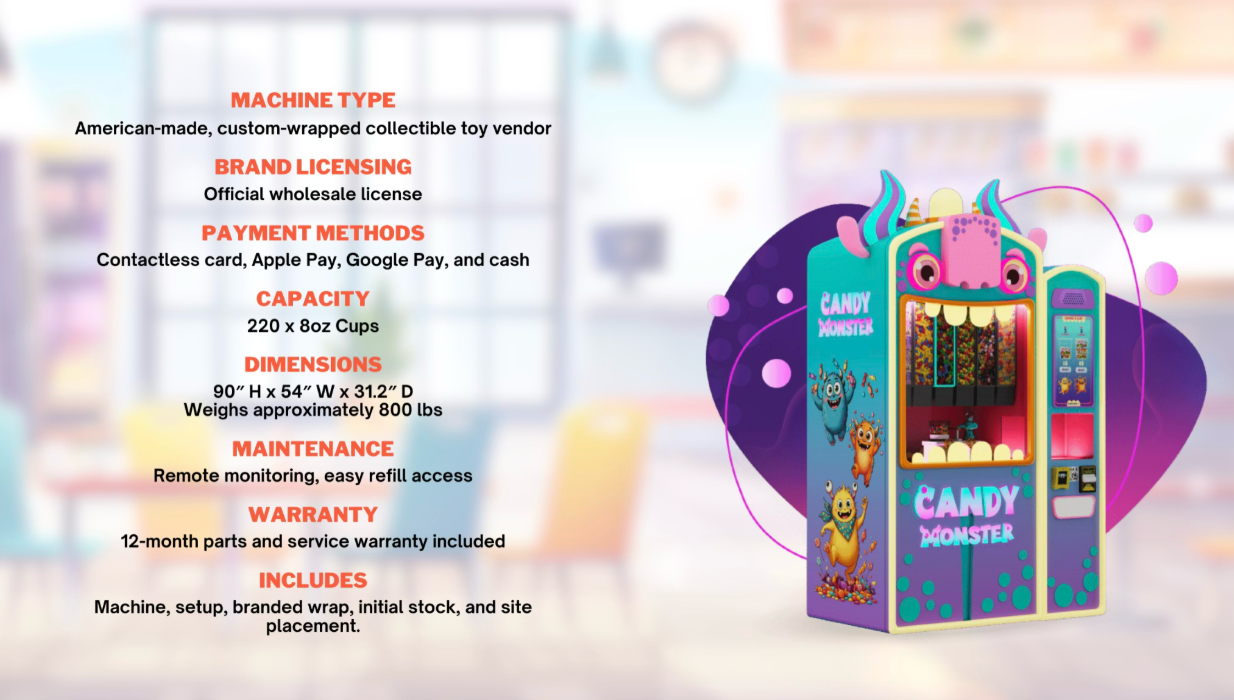
In an era of disposable goods and cheap imports, the physical build of a vending machine determines its long-term ROI. A machine that is constantly out of order is a machine that is losing money. Candy Monster units are built with American-made craftsmanship, focusing on mechanical reliability and physical durability.
These machines are engineered to withstand the rigors of high-traffic environments. From reinforced cabinets to precision dispensing mechanisms, the hardware is designed to operate 24/7 with minimal intervention. For the investor, this reliability translates to lower repair costs and fewer “emergency” trips to the site. When you are looking for a low-maintenance opportunity, the quality of the hardware is your greatest insurance policy.
Why Candy? Understanding the Profit Margins
Many new investors mistakenly believe that higher-priced items, like electronics or designer beverages, lead to higher profits. In the vending world, the opposite is often true. Candy remains one of the highest-margin categories in the retail industry. The cost of goods sold for bulk candy or small packaged treats is remarkably low compared to the retail price point.
Furthermore, candy is a “recession-proof” product. Even when consumers pull back on large luxury purchases, small, affordable treats remains a consistent impulse buy. This psychological factor ensures a steady flow of quarters and dollars regardless of broader economic fluctuations. Because the inventory is shelf-stable and requires no refrigeration, the operational costs (electricity and spoilage) are significantly lower than those associated with cold beverage or fresh food vending.
Scalability: From One Machine to a Fleet
The beauty of the vending business lies in its modularity. You do not need a million dollars to start; you only need enough for your first unit. Once the first machine begins generating a surplus, that capital can be reinvested into a second, then a third. This “snowball effect” is the core of successful wealth building.
Because the Candy Monster model is so low-maintenance, a single individual can easily manage a fleet of ten or twenty machines in their spare time. Refilling the units and collecting the revenue can often be done in a few hours a week. This scalability makes it an ideal fit for full-time professionals who want to build a “side-hustle” that has the potential to eventually replace their primary salary.
Low-Maintenance Lifestyle
The primary appeal for the modern entrepreneur is the reclamation of time. True passive income should not feel like a second job. The Candy Monster system is designed around the concept of “intermittent management.” Modern telemetry and simple mechanical designs mean that owners only need to visit their locations when the inventory is low or the cash box is full.
This freedom allows investors to travel, spend time with family, or focus on other business ventures while their “monsters” work on the floor. In a world where everyone is “hustling” to the point of burnout, this model offers a refreshing alternative: a business that works for you, rather than you working for the business.
Strategic Placement: The Secret Sauce
Success in vending is often summarized by three words: location, location, location. The Candy Monster placement program identifies “sweet spots” where foot traffic is high and dwell time is significant. Think of waiting rooms, car dealerships, or break rooms where people are looking for a quick distraction or a small reward.
By analyzing demographic data and footfall patterns, the support team places machines where the “impulse to buy” is at its peak. This strategic advantage is what separates professional operators from hobbyists. Having a team of experts handle the negotiations and contracts ensures that your machines are protected and positioned for maximum visibility.
The Financial Horizon
When evaluating any investment, one must look at the “Time to ROI” (Return on Investment). Because of the low overhead and high-profit margins associated with candy, many operators find that their machines pay for themselves much faster than a traditional franchise or a rental property. Once the initial investment is recouped, the machine becomes a pure profit engine, generating cash flow for years to come.
Furthermore, a vending route is a sellable asset. If an entrepreneur decides to move on to a different industry, a profitable route of well-placed Candy Monster machines can be sold to another investor for a significant multiple of its annual earnings. This provides both an income stream in the short term and an exit strategy in the long term.
Conclusion
The path to financial freedom does not have to be paved with 80-hour work weeks and high-risk gambles. By focusing on a proven niche—candy vending—and utilizing a “Done-For-You” framework that emphasizes American-made quality and professional placement, aspiring entrepreneurs can build a resilient portfolio of income-generating assets. The Candy Monster Vending Machine is more than just a retail unit; it is a vehicle for personal and financial autonomy. For those ready to step away from the traditional grind and into the world of automated retail, the opportunity is as sweet as the product itself.
For more, visit Pure Magazine