Council tax bills aren’t just rising — they’re diverging. Two Band F households in different parts of England can face a gap of over £1,500 per year on the same band, and in 2026 that spread is wider than it’s ever been.
If you’ve searched “how much is council tax band F,” the wildly different numbers you’ve seen aren’t mistakes. They reflect a system where the band tells you your relative position, but your local council’s budget decisions, precept charges, and funding arrangements determine what that actually costs.
This guide cuts through the noise with real 2026/27 costs, the monthly payment reality most people miscalculate, how the 13/9 formula works, and the property sale risk that can quietly move a Band F home into Band G.
What Is Council Tax Band F?
Band F covers properties valued between £120,001 and £160,000 based on their estimated April 1991 market price in England and Scotland, and between £162,001 and £223,000 in Wales based on April 2003 values.
As UKCalculator’s council tax band guide explains, England set these valuation bands when council tax was launched in 1993 and has never updated them. Wales revalued in 2005. Scotland uses 1991 values but sets rates independently with no referendum cap on increases — a distinction with significant practical consequences in 2026.
The Wales/England valuation difference is something most guides skip entirely, but it matters when comparing bills. A Band F home in Cardiff is valued using a completely different framework than one in Reading, even though both show “Band F” on the bill.
For the complete picture of how all eight bands relate to each other nationally, including Scotland’s proposed new Bands I and J, that breakdown covers the full framework.
The 13/9 Formula: Why Band F Costs What It Does
Every band is a fixed multiple of Band D — set nationally, applied by every local authority. Band F is always 13/9 of Band D, approximately 144% of whatever Band D costs in your area.
| Band | Fraction of Band D | At £2,394 England avg 2026/27 |
|---|---|---|
| C | 8/9 (89%) | £2,128 |
| D | 9/9 (100%) | £2,394 |
| E | 11/9 (122%) | £2,921 |
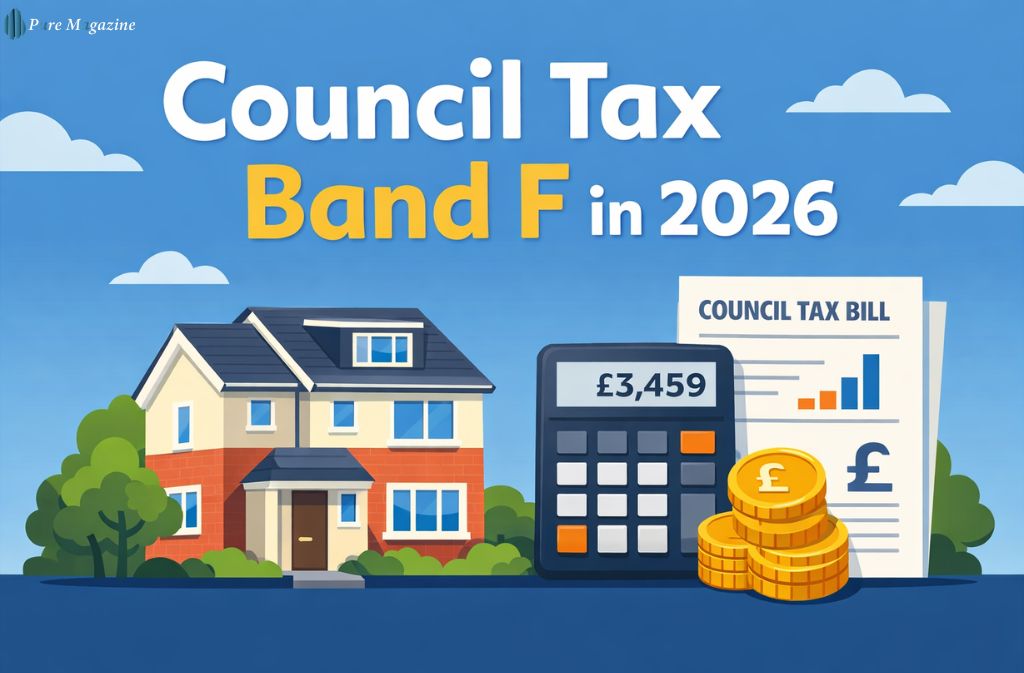
| F | 13/9 (144%) | £3,459 |
| G | 15/9 (167%) | £3,990 |
| H | 18/9 (200%) | £4,788 |
The council only decides the Band D rate. The multiplier is fixed. So if your council sets Band D at £2,500, your Band F bill automatically becomes £3,611 — no local variation in that calculation at all.
How Much Is Band F in 2026/27?
The England-wide average Band D for 2025/26 was £2,280, confirmed by GOV.UK’s official council tax levels publication. With 125 of 153 top-tier English councils applying the maximum 4.99% increase for 2026/27 — adding approximately £114 to the average Band D — the England 2026/27 Band D average sits at approximately £2,394, giving a Band F average of around £3,459.
Real 2026/27 Band F examples:
| Location | Approx Band F Annual | Monthly (10 payments) |
|---|---|---|
| Kensington & Chelsea | ~£1,631 | ~£163 |
| Wandsworth (London) | ~£1,471 | ~£147 |
| England average | ~£3,459 | ~£346 |
| Preston | ~£3,704 | ~£370 |
| Reading | ~£3,774 | ~£377 |
| Manchester | ~£3,988 | ~£399 |
| Nottingham | ~£3,980 | ~£398 |
The gap between Wandsworth and Manchester on Band F alone exceeds £2,500 per year. As Homenicom’s Press Association analysis of 2026/27 council budgets confirms, Wandsworth applied only a 2% increase — leaving it with England’s lowest Band D at £1,020 — while most northern and midlands councils hit the 4.99% maximum.
The 4.99% Cap — And Where Scotland Ignores It
In England, the referendum threshold limits most councils to 4.99% — a 2.99% core increase plus a 2% Adult Social Care precept. As Kensington & Chelsea’s 2026/27 council tax page confirms, the precept is no longer shown separately on bills — the 4.99% total is applied to the previous year’s full council element.
Seven English councils received Exceptional Financial Support permission to exceed the cap — BCP at 6.74%, Shropshire and Worcestershire at 8.99%. For Band F households in those areas, bills are rising at nearly double the national rate.
Scotland operates with no referendum cap at all. As Homenicom’s analysis confirms, Aberdeenshire and Moray both approved 10% increases for 2026/27 — the highest in the UK for a second consecutive year. Several other Scottish authorities are implementing 7%–9.7% rises. Edinburgh held at 4% and Fife at 5%, but the Scottish Band F picture is substantially more volatile than England’s.
The Monthly Reality: The 2-Month Break Most People Forget
Most councils bill over 10 months, not 12 — running April through January, with February and March payment-free. As Manchester City Council’s 2026/27 council tax page confirms, the default payment schedule runs over 10 monthly instalments, though most councils will switch you to 12 monthly payments on request.
| Annual Band F Bill | 10-Month Payment | 12-Month Payment |
|---|---|---|
| £3,000 | £300/month | £250/month |
| £3,459 (England avg) | £346/month | £288/month |
| £3,800 | £380/month | £317/month |
The 10-month default is why bills feel higher than expected mid-year. Neither option changes the annual total — only how it lands in the budget. Contact your council to switch if 12 monthly payments work better for your cash flow.
Scotland’s Band F Explained
At first glance, Scottish Band F looks more expensive — but the comparison isn’t straightforward without understanding what’s included.
Using Edinburgh’s relatively low 4% increase as an example:
| Component | Amount |
|---|---|
| Council tax (Edinburgh Band F) | ~£2,642 |
| Scottish Water (water & sewerage) | ~£500–£942 |
| Total household bill | ~£3,142–£3,584 |
English and Welsh council tax figures exclude water — England bundles it into rates, while Scottish Water bills households in Scotland separately. Comparing Scottish Band F bills to English ones without adding the water charge overstates the difference. For a true comparison, Scottish households should combine their council tax with the Scottish Water charge.
Finding Your Exact Rate
The GOV.UK council tax band checker returns your band and your neighbours’ bands from a single postcode search. That neighbour comparison is the foundation of any band challenge — the Valuation Office Agency needs comparable properties in lower bands as evidence, not assertions about current market value.
For your exact 2026/27 Band F charge, search your council name and “council tax bands 2026/27” — every council publishes the full charge schedule on its website before April each year. The council tax band checker also links through to your council’s billing page.
The Relevant Transaction Risk: When Band F Becomes Band G
This is the most overlooked risk when buying a Band F property.
When a property has been extended, converted, or significantly improved, the VOA doesn’t immediately reassess the band. Instead, it places an Improvement Indicator on the listing. The current owner continues paying Band F rates — but at the next sale, the Listing Officer can reassess the property and move it into Band G or higher.
As BCP Council’s band challenge guidance confirms, this happens when the previous owner added an extension and the change is picked up at the point of sale. A move from Band F (£3,459 England average) to Band G (£3,990) adds over £530 to the annual bill before any future increases.
Before exchanging contracts on any Band F property that has clearly been extended, search the GOV.UK band checker for an Improvement Indicator on the listing. Factor a potential band increase into your cost modelling — it won’t show up in the seller’s current bill.
How to Reduce a Band F Bill
Single Person Discount (25%) — one adult living alone qualifies for a quarter off. On a £3,459 England average Band F bill, that’s over £865 saved annually. It doesn’t apply automatically — notify your council in writing.
Disregarded residents — full-time students, apprentices, live-in carers, and people with Severe Mental Impairment don’t count as occupants. A property where all adults are disregarded receives a 50% discount.
Disability band reduction — properties adapted for a disabled resident may qualify to pay at the rate of the band below — Band E rates on a Band F property.
Council Tax Reduction — for qualifying low-income households, the council-tax-reduction scheme can reduce the bill significantly, in some cases to zero.
Band challenge — if similar nearby properties sit in Band E, a formal proposal to the VOA via GOV.UK’s challenge page costs nothing to submit. A successful challenge backdates savings to when the change took effect. The risk: a thorough review can move the band upward as well as downward, so check the neighbour evidence carefully before submitting.
Quick savings example:
| Scenario | Annual Bill |
|---|---|
| Standard Band F (England avg) | £3,459 |
| With 25% single-person discount | £2,594 |
| Annual saving | £865 |
Empty Property and Second Home Premiums
From April 2026, properties empty for over one year face a 100% premium across most councils — doubling the Band F charge. Properties vacant for over ten years face a 300% premium.
| Scenario | Annual Band F Cost |
|---|---|
| Occupied | £3,459 |
| Empty over 1 year (100% premium) | £6,918 |
| Second home (100% premium) | £6,918 |
The do-you-pay-council-tax-on-an-empty-property guide covers which Class exemptions can pause the premium clock for vacant properties — relevant for probate situations, major renovation projects, and temporarily vacant landlord properties.
Band F Quick Reference (2026/27)
| Feature | Detail |
|---|---|
| England valuation range | £120,001 – £160,000 (April 1991) |
| Wales valuation range | £162,001 – £223,000 (April 2003) |
| Formula | 13/9 of local Band D |
| England’s average annual cost | ~£3,459 |
| Monthly (10-month default) | ~£346 |
| Monthly (12-month option) | ~£288 |
| Single-person discount | 25% (~£865 saving) |
| Relevant transaction risk | Band can rise on sale if improved |
FAQs
Q. How much is Band F council tax per month in 2026?
Around £346 per month on the England average using the standard 10-month billing, ranging from roughly £147 in Wandsworth to over £399 in Manchester.
Q. Why do I pay no council tax in February and March?
Most councils use a 10-month billing schedule running from April through January, creating a 2-month break. You can request 12 monthly payments from your council to even out the cash flow.
Q. Is Band F council tax expensive?
At an England average of around £3,459 per year, it’s above the national average and roughly 44% higher than Band D. Actual costs range significantly by location.
Q. Why is Scotland’s Band F bill higher?
Scottish bills typically include Scottish Water’s water and sewerage charges, which add £500–£942 per year. English bills exclude water — so comparing them directly overstates the gap.
Q. Can my Band F property move to Band G?
Yes — particularly after a sale where the previous owner made improvements. Always check for an Improvement Indicator on the GOV.UK band checker before buying.
Conclusion
Check your local rate on GOV.UK’s band checker. Apply every discount you qualify for. If you’re buying a Band F property with any visible extensions or loft conversions, search for the Improvement Indicator before exchanging contracts.
For reliable, plain-English guidance on UK tax and personal finance in 2026, Pure Magazine is the resource worth bookmarking.