Most people start taking a multivitamin expecting to feel something fast — more energy, sharper focus, fewer cravings. Then nothing happens. No sudden boost, no dramatic shift. Just silence.
That’s exactly where confusion takes root.
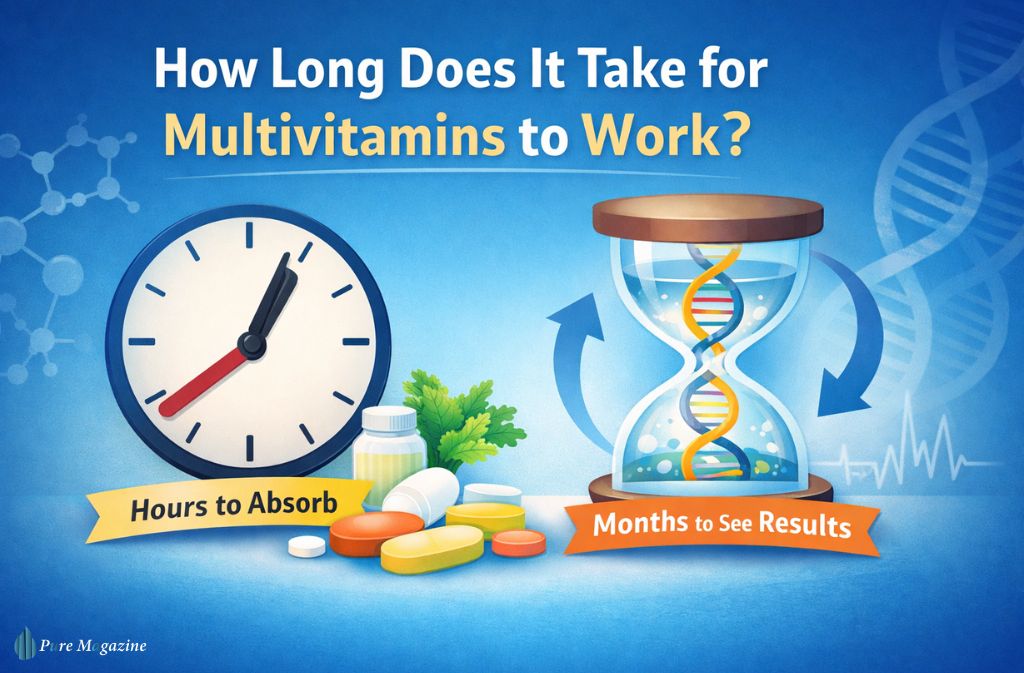
So, how long does it take for multivitamins to work? The honest answer, especially in light of 2026 research, is more layered than most sources admit:
Multivitamins begin working within hours at a cellular level — but noticeable benefits typically take 2 to 8 weeks, and long-term effects can unfold over months or even years.
This guide goes beyond the surface. You’ll get the real timeline, why you may feel nothing at first, how to tell if your vitamins are actually doing something, and what recent science says about cellular health and longevity.
What Does “Multivitamins Working” Actually Mean?
At its core, “multivitamins working” means your body is absorbing nutrients and putting them to use — supporting things like energy production, immune defence, and cellular repair.
The distinction worth understanding:
- Immediate effect → biochemical (invisible to you)
- Short-term effect → symptom relief (noticeable)
- Long-term effect → cellular optimisation (measurable over time)
Most older guides only address the second layer. But current research confirms the process starts much earlier than most people expect.
The Real 2026 Timeline: From Absorption to Results
| Phase | Timeframe | What’s Happening |
|---|---|---|
| Acute Phase | 30 min – 8 hours | Nutrients enter the bloodstream and peak |
| Systemic Phase | 1–2 weeks | Nutrient systems begin balancing |
| Clinical Phase | 4–8 weeks | Noticeable improvements appear |
| Longevity Phase | 12+ months | Cellular ageing slows measurably |
The 8-Hour Absorption Window
Within 30–60 minutes of taking a water-soluble vitamin like B-complex or vitamin C, it’s already in your blood. Peak concentration — what pharmacologists call the plasma spike — happens around 2–4 hours in. By 6–8 hours, those nutrients have either been absorbed into tissue, used in metabolic processes, or excreted.
Even if you feel nothing, your body is already responding. Pharmacokinetic studies have confirmed rapid post-dose increases in folate, zinc, B12, and vitamin C within this window.
Why You Don’t Feel Multivitamins Immediately
Vitamins are not stimulants. They don’t act like caffeine. They work by correcting deficiencies, supporting enzyme systems, and gradually improving biological function — none of which produces a detectable “rush.”
That absence of sensation doesn’t mean absence of effect. The biggest mistake people make is quitting before the clinical phase (4–8 weeks) even begins.
This is especially relevant if you’re also taking something like a protein supplement or a more stimulatory compound alongside — the contrast in how quickly you feel each one can make it seem like the vitamins “aren’t working.”
How Long Specific Vitamins Take to Work
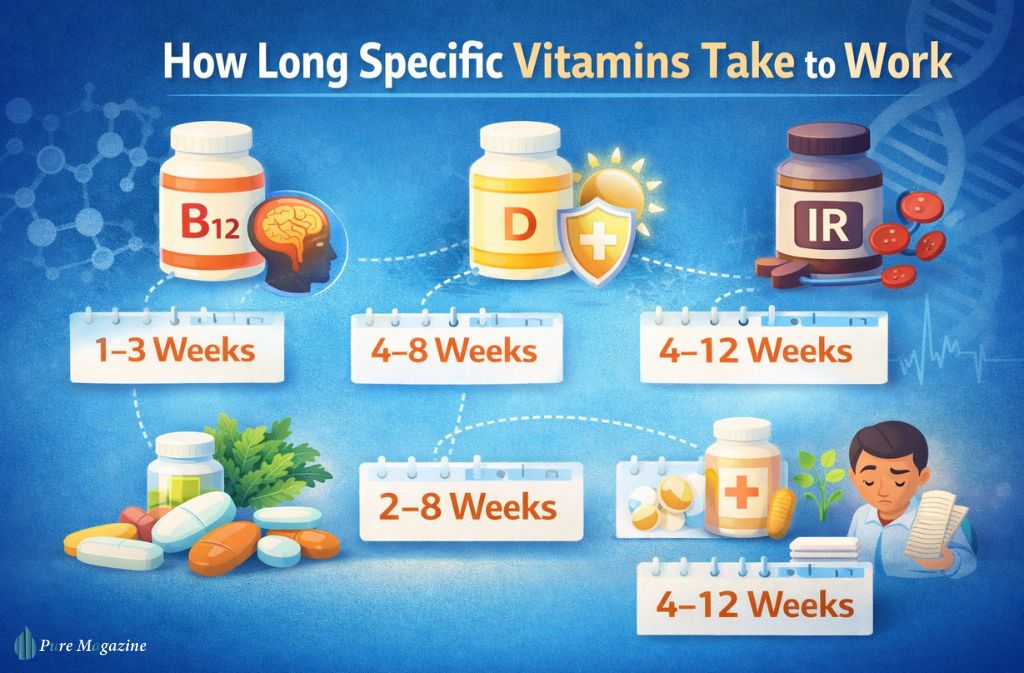
Not all nutrients operate on the same clock:
- Vitamin B12: 1–3 weeks (energy, cognitive function)
- Vitamin D: 4–8 weeks (mood, immune function)
- Iron: 4–12 weeks (fatigue, anaemia correction)
- General multivitamins: 2–8 weeks for noticeable effects
Timelines vary based on your deficiency level, dietary habits, gut health, and supplement quality. Someone who eats a well-rounded diet may notice less change simply because they have fewer gaps to fill.
The 2026 Breakthrough: Multivitamins and Biological Ageing
A March 2026 study published in Nature Medicine found that daily multivitamin use was associated with measurably slower epigenetic ageing — specifically as measured by the PCPhenoAge clock, which tracks biological rather than chronological age. The estimated effect was approximately 2.6 months of slower biological ageing per year of consistent use.
Two types of age matter here:
- Chronological age — your actual birthday to today count
- Biological age — how fast your body’s systems are ageing internally
Multivitamins may support this by reducing oxidative stress, aiding DNA repair mechanisms, and improving cellular resilience over time. You probably won’t feel younger — but the underlying biology may be changing in meaningful ways.
This connects to a broader conversation around supplements that target long-term function rather than immediate symptom relief. Biotin for hair growth is a good parallel — another nutrient where the effects only appear after sustained use and are easy to dismiss before they arrive.
Water-Soluble vs Fat-Soluble Vitamins
This distinction explains a lot of the timeline variation:
| Type | Vitamins | Speed of Effect |
|---|---|---|
| Water-soluble | B-complex, Vitamin C | Relatively fast |
| Fat-soluble | A, D, E, K | Slower, requires dietary fat |
If you take fat-soluble vitamins on an empty stomach or without fat-containing food, absorption drops significantly. This alone can explain why some people report no effect — the vitamins simply aren’t getting in.
Signs Your Multivitamin Is Working
Changes are usually gradual, not dramatic. Here’s a rough progression:
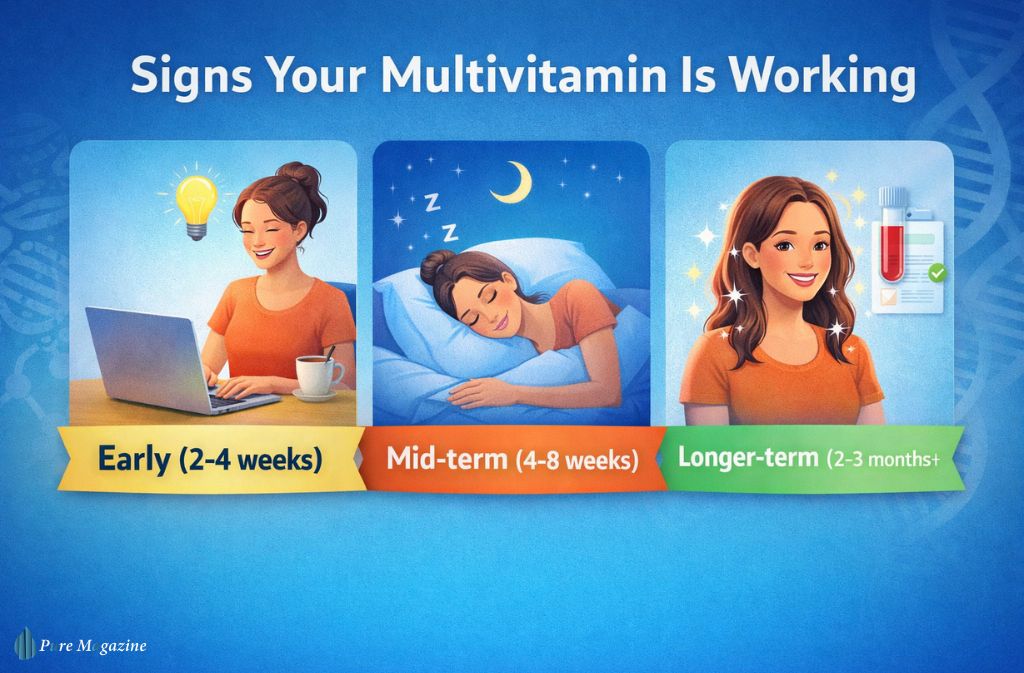
Early (2–4 weeks)
- Marginal energy improvement
- Slightly sharper focus
- Less frequent mental fatigue
Mid-term (4–8 weeks)
- More stable mood day to day
- Better sleep quality
- Fewer minor illnesses
Longer-term (2–3 months+)
- Improved skin and hair condition
- Fewer symptoms tied to prior deficiencies
- Better results on blood panels — which, if you’re tracking progress, is often the clearest confirmation
Bioavailability: Why Some Formulations Work Faster
In 2026, this matters more than raw dosage.
Nutrient form plays a role — some synthetic forms are better absorbed under clinical conditions, while natural forms may offer better synergy within the body. There’s no universal answer, but it’s worth looking at what form of each nutrient you’re getting, not just how much.
Liposomal delivery has become a significant trend. These formulations wrap nutrients in a lipid layer that mimics cell membranes, improving uptake — particularly for fat-soluble vitamins and vitamin C. Research on liposomal vitamin C suggests meaningfully higher plasma concentrations compared to standard oral forms.
Chelated minerals — like magnesium glycinate — are generally gentler on the digestive system and better absorbed than oxide or carbonate forms. If you’ve ever had stomach trouble from a multivitamin, the mineral forms are often the culprit.
The Shift Toward Personalised Multivitamins
Generic one-size-fits-all formulas are increasingly being replaced by targeted stacks designed around specific goals — gut-brain support, hormonal balance, stress and cortisol regulation, sleep quality. This mirrors what’s happening across the supplement space more broadly.
Women, for instance, often have different nutritional needs than a standard formula accounts for — something worth considering if you’ve previously felt like general supplements “do nothing.” There’s a related discussion in the context of women and protein intake that touches on how nutritional needs vary by biology and lifestyle stage.
Personalised formulations tend to produce more noticeable results simply because they’re addressing actual gaps rather than blanketing everything.
Common Mistakes That Slow Results
- Taking vitamins inconsistently (even missing a few days resets some progress)
- Skipping food — particularly fat — with fat-soluble vitamins
- Choosing low-bioavailability forms (especially minerals)
- Expecting stimulant-like effects
- Neglecting sleep and diet, which underpin everything
Quick Reference: How to Get More From Your Multivitamin
- Take it at the same time each day
- Pair with a meal that contains some fat
- Stay hydrated — especially important for B vitamins and vitamin C
- Prioritise sleep quality alongside supplementation
- Track subtle changes week by week
- Commit to at least 8 weeks before concluding.
FAQs
Q.How do I know if my multivitamin is working?
You can tell your multivitamin is working by noticing gradual improvements in energy, focus, immunity, and overall well-being within a few weeks. However, the most reliable way to confirm results is through blood tests—especially for vitamin D, vitamin B12, and iron levels.
Q. How long does it take to feel better after starting a multivitamin?
Most people start to feel subtle improvements within 2 to 4 weeks, particularly if they had a nutrient deficiency. If your baseline nutrition is already good, you may not notice obvious changes, even though the vitamins are still working internally.
Q. How long does vitamin B12 take to work?
Vitamin B12 can start working within a few days to 2 weeks, depending on how deficient you are. People with low B12 levels often notice faster improvements in energy and mental clarity.
Q. How long does vitamin D take to work?
Vitamin D typically takes 4 to 8 weeks to show noticeable effects on mood, energy, and immune function. In cases of severe deficiency, it may take longer to reach optimal levels.
Q. Do gummy multivitamins work faster?
No, gummy multivitamins do not work faster. They follow the same absorption timeline as regular supplements and often contain lower doses of active nutrients due to formulation limitations.
Q. How long do vitamins take to work for hair growth?
Vitamins usually take 6 to 12 weeks to support visible hair growth, as hair follows a natural growth cycle. Nutrients like biotin, iron, and vitamin D may help, but results depend on underlying deficiencies.
Q. Can multivitamins work immediately?
Multivitamins begin working within hours at a biochemical level, as nutrients are absorbed into the bloodstream. However, noticeable effects—such as improved energy or mood—typically take several weeks to appear.
Final Words
Multivitamins don’t fail — you just can’t always feel them working. They start acting biochemically within hours. Perceptible changes tend to arrive between 2 and 8 weeks. The most significant benefits operate on a longer timeline and include things like cellular resilience and, per recent findings, measurably slower biological ageing.
If you stay consistent, you’re not just supplementing — you’re compounding small biological investments over time
Related: Why Does Ozdikenosis Kill You? The Deadly Truth About This Rare Disease