Germany’s Aktivrente is one of the most talked-about tax changes under the Rentenpaket II—and for good reason.
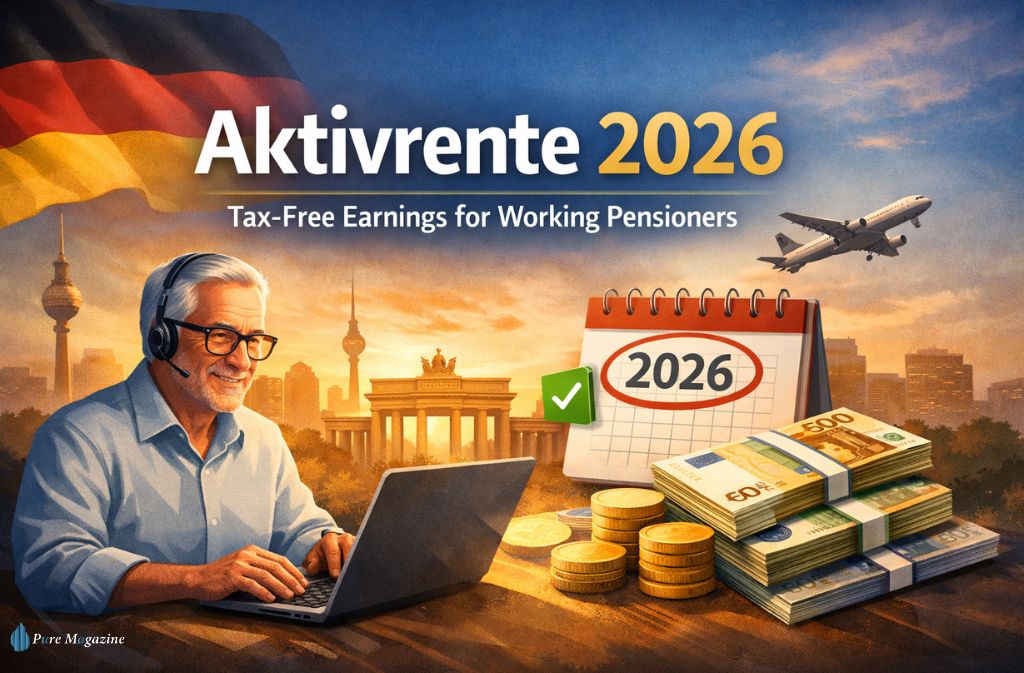
From 2026, pensioners who have reached the Regelaltersgrenze (statutory retirement age) can earn up to €2,000 per month (€24,000 per year) completely free of income tax if they continue working as employees.
It sounds generous. Almost too generous.
And like most things involving German tax law, it’s simple on paper—but unforgiving in practice.
This guide explains how the Aktivrente actually works in 2026, who qualifies, who doesn’t, and where people most often lose the benefit without realizing it.
Short Answer: In 2026, working pensioners in Germany can earn up to €24,000 per year tax-free as employees under the Aktivrente introduced by the Rentenpaket II. |
What Is the Aktivrente?
The Aktivrente is a named tax incentive introduced under Germany’s Rentenpaket II. Its goal is simple: keep skilled older workers in the labor market by removing income tax on a limited amount of post-retirement employment income.
Legally, the exemption is anchored in § 3 No. 21 Einkommensteuergesetz (EStG).
If you meet all conditions, your employer can pay you up to €2,000 per month without withholding income tax.
Miss one requirement, and the benefit vanishes.
Who This Guide Is For
This article is written for:
- Pensioners employed in Germany after reaching the statutory retirement age
- HR and payroll staff implementing the Aktivrente in 2026
- Expats with German tax residency receiving a German pension
- Anyone trying to decide whether working after retirement is still worth it
If you’re a freelancer, Mini-Jobber, or civil servant, read on anyway—because those exclusions matter.
The Aktivrente 2026: How the €2,000 Monthly Tax-Free Allowance Works
To qualify for the Aktivrente in 2026, all of the following must be true:
- You have reached the Regelaltersgrenze
- You are receiving a statutory old-age pension
- You work as an employee (social-security-contributing employment)
- Your income is taxed in Germany (unlimited tax liability)
- Your employer applies the exemption correctly via payroll
The allowance applies only to employment income, not to your pension.
The § 3 No. 21 EStG Exception (Why This Works)
The legal core of the Aktivrente is § 3 No. 21 EStG.
It creates a specific income tax exemption for employment income earned after reaching the statutory retirement age.
That technical detail matters because:
- It is not a general allowance
- It cannot be claimed retroactively via a tax return
- It must be applied at the payroll level
This is why employer implementation is critical.
A Real-World Example (And Where People Get Burned)
Thomas is 67 and lives in Munich. He worked as a nurse for decades and now receives a statutory pension. In 2026, his hospital asks him to stay on part-time.
His gross monthly wage: €2,000
If HR applies the Aktivrente correctly:
- Income tax: €0
- Health & long-term care insurance: still deducted
- Net pay: significantly higher than before 2026
If HR forgets one declaration or applies the wrong tax class:
- Income tax is withheld
- Thomas must fight for a correction later
- And yes, the Finanzamt will take its time
Anyone who has dealt with the Finanzamt knows this feeling:
Six months of waiting, just to be asked for a document you already sent.
The Aktivrente is designed to avoid that—if payroll gets it right.
Also Check: S1 Form Explained (2026) – UK Residents in the EU
Aktivrente vs. Pension Taxation (Progressionsvorbehalt Explained)
A common misunderstanding:
“Tax-free means it doesn’t affect anything else.”
Not quite.
While Aktivrente income is exempt from income tax, your pension income still counts toward your overall tax progression (Progressionsvorbehalt).
What this means in practice:
- The tax-free €2,000 does not get taxed
- But it can push other taxable income into a higher bracket
- The effect is non-linear and depends on total income
This is why two pensioners earning the same amount can see different net outcomes.
Net Savings Illustration (Approximate)
| Total Annual Income | Without Aktivrente | With Aktivrente | Difference |
|---|---|---|---|
| €40,000 | Lower tax relief | Moderate savings | ~€2,500 |
| €55,000 | Higher marginal tax | Strong savings | ~€4,000 |
| €70,000 | High progression | Diminishing effect | ~€3,200 |
Figures vary by Krankenkasse, church tax, and personal situation—but the benefit is real.
Health & Long-Term Care Insurance: The “Arrows” Still Get Through
Think of the Aktivrente as a Social Security Shield.
It protects your first €2,000 from the taxman.
But it does not block the health insurance arrows.
You still pay:
- Statutory health insurance (KV)
- Long-term care insurance (PV)
Rates depend on your Krankenkasse and contribution status.
Who Is Explicitly Excluded (And Why)
Freelancers & the “False Freelance Trap”
Freelancers are excluded because the Aktivrente is tied to social security contributions.
If you relabel freelance work as “employment” without changing how you actually work, you risk Scheinselbstständigkeit (pseudo-self-employment).
That risk alone can wipe out the entire tax benefit.
Mini-Jobs
Income from Mini-Jobs is explicitly excluded from the Aktivrente in 2026.
You cannot stack:
- €2,000 Aktivrente allowance
- €538 Mini-Job income
It’s one or the other.
Civil Servants (Beamte)
Beamte do not pay into the statutory pension system.
The Aktivrente is structurally incompatible with their pension model.
Aktivrente and Multiple Employers
Yes, you can work for more than one employer—but:
- The €2,000 monthly allowance applies only once
- You must declare which employer applies it
- Other employers must withhold tax normally
If you fail to declare this correctly, corrections can get messy fast.
Also Read: Why Dual Citizenship Is Bad: Hidden Risks Most People Ignore (2025–2026)
Tax Class VI Warning (Second Jobs)
If a pensioner has:
- A company pension and
- More than one employment relationship
The Aktivrente must be assigned explicitly.
In 2026, employers are required to keep a written declaration from the employee stating where the allowance is applied.
Without it, payroll defaults can cancel the benefit.
HR departments—this part matters.
How to Apply the Aktivrente via Payroll (Checklist)
For employees:
- Confirm you have reached the Regelaltersgrenze
- Inform your employer in writing
- Declare if you have multiple jobs
For employers / HR:
- Verify pension status
- Apply § 3 No. 21 EStG exemption
- Keep the written declaration on file
- Apply allowance to only one payroll
The Aktivrente is payroll-automated—but only if set up correctly.
Common Mistakes Expat Pensioners Make
- Assuming limited tax liability still qualifies
- Forgetting foreign pensions affects progression
- Not coordinating multiple employers
- Ignoring double taxation agreements
If you’re an expat, details matter even more.
Can I Use the Aktivrente and a Mini-Job Together?
No.
Income from Mini-Jobs is excluded from the Aktivrente regulations in 2026.
Who This Is Not Worth It For
- Very low pension earners with minimal tax exposure
- Mini-Job-only retirees
- Non-residents without unlimited tax liability
- Freelancers are unwilling to switch to proper employment
Sometimes the paperwork outweighs the gain.
2028 Outlook: The Sunset Clause
The Aktivrente is currently under evaluation.
The government has signaled a review after two years, with potential adjustments post-2027 as labor shortages persist.
Mentioning this matters because policy incentives rarely stay static.
FAQs
Q1. Can pensioners work tax-free in Germany in 2026?
Yes. Under the Aktivrente 2026, pensioners who have reached the statutory retirement age and work as employees can earn up to €2,000 per month (€24,000 per year) tax-free. Freelancers, Mini-Job income, and civil servants are excluded, and health and long-term care insurance contributions still apply.
Q2. Who qualifies for the Aktivrente tax break?
Answer: To qualify, you must:
- Be receiving a statutory old-age pension
- Have reached the Regelaltersgrenze (statutory retirement age)
- Work as a social-security-contributing employee in Germany
- Be subject to unlimited tax liability
Your employer must apply the exemption correctly via payroll.
Q3. Can I combine the Aktivrente with a Mini-Job or freelance work?
Answer: No. The Aktivrente only applies to employee income. Mini-Jobs (income up to €538/month) and freelance income are explicitly excluded. Attempting to stack these can trigger payroll issues or tax penalties.
Q4. How much can I save with the Aktivrente 2026?
Answer: Savings depend on total income and tax progression:
- €40,000/year total income: ~€2,500 saved
- €55,000/year: ~€4,000 saved
- €70,000/year: ~€3,200 saved
Health and long-term care contributions still apply, but the first €2,000/month of employment income is tax-free.
Q5. How do I apply the Aktivrente through payroll?
Answer: Employees should inform their employer in writing about Aktivrente eligibility. HR must:
- Verify pension status
- Apply § 3 No. 21 EStG exemption
- Keep a written declaration if multiple jobs exist
- Apply the allowance to only one payroll
Correct payroll setup is essential to benefit immediately.
Final Thoughts
Yes, the Aktivrente sounds almost too good to be true.
And in the right setup, it really is that good.
But it’s also precise, conditional, and brutally literal.
One wrong assumption—“this must apply to me”—has already cost some retirees thousands in back taxes.
Handled correctly, the Aktivrente is one of the most meaningful tax breaks Germany has offered working pensioners in decades.
Handled casually, it becomes another letter from the Finanzamt.
Related: Taxes on Lottery Winnings UK: 2025 Guide for Winners