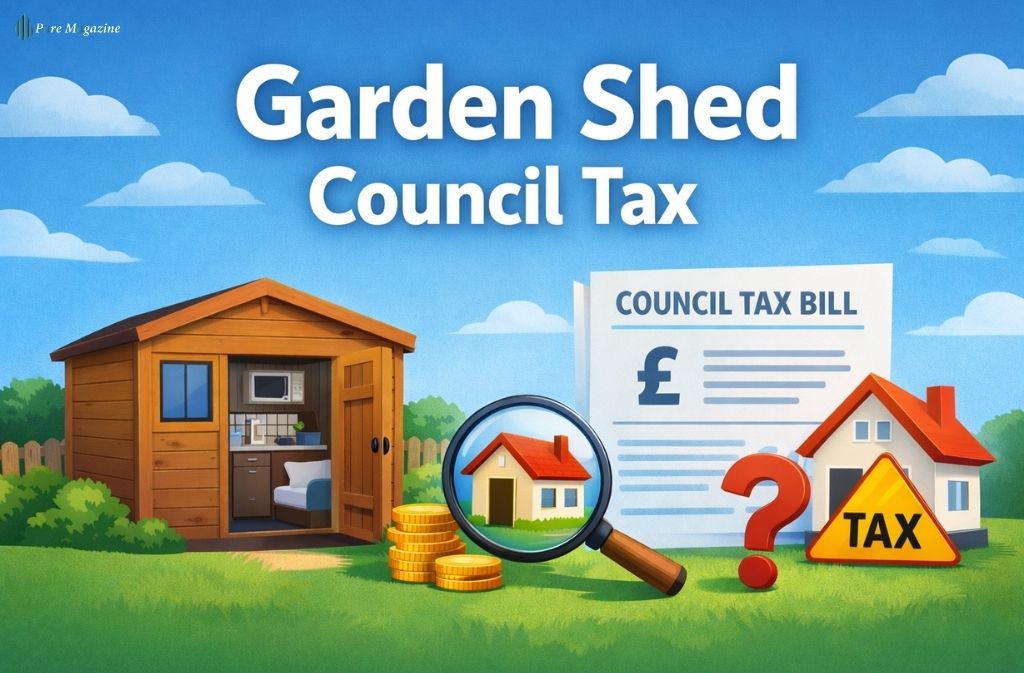
Most garden sheds do not trigger Council Tax in 2026 — unless they are converted into a self-contained living space with facilities for sleeping, cooking, washing, and independent access. If those conditions are met, the Valuation Office Agency (VOA) may treat the shed as a separate dwelling and issue its own Council Tax band.
This guide breaks down exactly when a shed remains “safe,” when it becomes a “red flag,” and what homeowners should know in 2026 as digital enforcement becomes more proactive.
Why Most Garden Sheds Are Council-Tax Safe
The key principle is use, not size or design.
The VOA treats a shed as non-rateable if it is used for:
- Storage
- Hobbies
- A home office
- Art/music studio
- Gym
- Workshop
- Occasional retreat space
These fall under incidental use, meaning the shed supports the main home rather than functioning independently. No council notification is required, and no tax is triggered.
When a Garden Shed Can Be Taxed in 2026
A shed may attract its own Council Tax band if it becomes ancillary or self-contained.
To determine this, the VOA uses what is widely known as the Separate Dwelling Test.
The 4-Point “Separate Dwelling” Test (2026)
For a shed to be taxed, it typically must pass most or all of the following criteria:
1. Sleep — Can someone sleep there regularly?
If the space contains a bed, sofa-bed, or sleeping platform used routinely, the VOA treats it as habitable accommodation.
2. Cook/Wash — Are there cooking or washing facilities?
The biggest “red flag.”
If a shed has:
- A shower or toilet
- Kitchen sink
- Hot/cold water supply
- Drainage connected to sewer or septic
…it may be investigated as a potential separate dwelling.
3. Separate — Does it function independently from the main house?
If someone can live there without routinely entering the main home, it’s considered self-contained.
4. Access — Does it have its own entrance?
A private door or gate increases the likelihood of separate dwelling classification.
If your shed includes plumbing + regular sleeping + its own entrance → a separate Council Tax band is likely.
Plumbing: The Number One Risk Factor (2026 Update)
Under 2026 Building Regulations Part G, installing hot/cold running water, wastewater drainage, or a toilet in an outbuilding often triggers:
- A notification to Building Control
- An inspection
- Automatic referral to the VOA for tax assessment
Even if planning permission was not required, the tax assessment can still happen.
Planning Permission vs. Council Tax (They Are NOT the Same)
This is one of the most common homeowner misunderstandings.
| Issue | Controlled By | What It Means |
|---|---|---|
| Planning Permission | Local planning authority | Whether the structure is allowed to be built or converted |
| Council Tax | Valuation Office Agency | Whether it is counted as a separate dwelling |
You can have:
- No planning permission but still be taxed, or
- Planning permission granted but no Council Tax if not self-contained
The two systems operate independently.
Council Tax Discounts for Annexes (2026 Rules)
If your shed is classified as an annexe or separate dwelling, it may still qualify for reduced tax.
Available Discounts:
✔ 50% Annexe Discount
If a relative lives there (adult child, parent, sibling).
✔ 100% Exemption (Class W)
If the relative is:
- Over 65
- Disabled
- Severely mentally impaired
This exemption applies even if the annexe is fully self-contained.
What About Business Use? (2026 Clarification)
Many guides incorrectly claim that studios or offices are “completely safe.”
This is mostly true, but with an important nuance:
If used exclusively for business, Business Rates could apply.
Examples:
- Photography studio
- Treatment room
- Music production suite
- Dedicated workshop
However, in practice:
✔ Small Business Rate Relief usually reduces the bill to £0.
So while technically rate-able, most homeowners pay nothing.
This clarification strengthens accuracy and prevents misleading assumptions.
Common Scenarios (Explained Clearly)
Scenario 1: A normal shed used for storage
→ No Council Tax
→ No planning
→ No Business Rates
Scenario 2: A garden office with electricity but no plumbing
→ Council Tax unlikely
→ Business Rates only if business-exclusive
Scenario 3: A hobby studio with a sofa but no sleeping facilities
→ Not self-contained
→ No Council Tax
Scenario 4: A shed converted into a mini-flat with bathroom & kitchenette
→ Almost certainly a separate dwelling
→ VOA will band it
→ Council Tax applies unless exempted
Also Check: Council Tax on Unoccupied Property in 2026: What Homeowners Should Know
The 2026 Enforcement Environment
Two major updates matter in 2026:
1. The 10-Year Rule (Planning Enforcement)
The old “4-year rule” no longer applies.
If a shed has been unlawfully used as accommodation, planning enforcement can be taken for up to 10 years.
This does not protect against tax assessment — those remain independent.
2. Digital Monitoring for Airbnb & Short-Lets
Councils now routinely use automated detection tools to cross-match:
- Airbnb/Booking listings
- Property databases
- Valuation lists
- Business registration records
If a shed is listed as short-term accommodation, it is almost guaranteed to trigger:
- A VOA reassessment
- Possible planning enforcement
- Potential Business Rates instead of Council Tax
This is a 2026-specific trend and one of the fastest-growing triggers for enforcement.
Common Mistakes Homeowners Make
These issues frequently lead to surprise tax bills:
❌ Adding a toilet or shower without checking regs
Plumbing is the #1 trigger.
❌ Listing the shed on Airbnb
Digital monitoring almost guarantees detection.
❌ Assuming “I didn’t get planning permission” prevents Council Tax
It doesn’t — the systems are independent.
❌ Confusing business use with residential use
Business Rates ≠ Council Tax.
❌ Thinking it’s fine because it’s “only for family”
Self-contained family annexes still count — though exemptions may apply.
Also Read: Manchester Council Tax 2026: Rates, Bands & How to Pay
FAQs
Q. Do I need to tell the council about my garden shed in 2026?
Generally, no, you do not need to inform the council unless the shed is being used as living accommodation or includes plumbing (toilet, shower, hot/cold water, drainage). If the shed is for storage, hobbies, or a home office with no water connections, you do not need to notify anyone.
Q. What exactly counts as a “self-contained” shed for Council Tax?
A shed is considered self-contained if it includes the facilities required for independent living, specifically:
- A place to sleep
- A way to cook or wash
- Independent access from the main house
If all three are present, the Valuation Office Agency (VOA) may classify it as a separate dwelling and issue a new Council Tax band.
Q. Does running electricity to a shed trigger Council Tax in the UK?
No. Adding electricity alone does not trigger Council Tax because it does not provide independent living facilities.
Lighting, heating, sockets, and internet are all fine as long as the shed is not used as a self-contained residence and has no plumbing.
Q. Can a garden shed be taxed even without planning permission?
Yes.Council Tax and planning permission are handled by different authorities. Even if planning permission was never sought or was not required, the VOA can still classify a fully equipped shed as a separate dwelling and issue a tax band if it meets the self-contained living criteria.
Q. If I use my shed for work, will I have to pay Business Rates?
Possibly — but often not.
A shed used exclusively for business may qualify for Business Rates, but in most cases, Small Business Rate Relief reduces the bill to £0.
If the shed is used for mixed personal and work use, Business Rates are generally not applied.
Final Verdict
A garden shed will not normally attract Council Tax in 2026.
However, once it crosses the line from incidental use to self-contained accommodation, it becomes taxable — regardless of planning status.
To stay tax-safe:
- Avoid plumbing unless necessary
- Do not use it as an independent living space
- Be cautious with short-let listings
If classified as an annexe, explore the 50% discount or 100% exemption options.
Related: Council Tax Band B Explained (2026): Costs, Monthly Payments & What It Means