Most students looking for free N5 apps aren’t short on effort—they’re short on clarity. You download a few apps, try some questions, maybe watch a couple of videos, but it never quite feels like you’re preparing for the actual exam.
That’s because the exam itself has shifted. With the transition from the Scottish Qualifications Authority to Qualifications Scotland in 2026, the National 5 Applications of Mathematics course now leans more heavily into real-world problem solving—finance, data interpretation, and decision-making.
So the goal isn’t just to “study maths.” It’s to practice the kind of thinking the exam expects. In this guide, you’ll find the best free N5 maths apps, how to actually use them, and the small details—like updated tax data and the data booklet—that make a big difference on exam day.
What Are Free N5 Apps?
Free N5 apps are digital tools designed to help you prepare for the National 5 Applications of Mathematics exam through practice questions, worked solutions, and topic explanations. The difference between a useful app and a waste of time usually comes down to one thing: whether it matches the Scottish exam style.
In 2026, that means focusing less on abstract algebra and more on applied maths—things like comparing deals, interpreting data, and solving real-life scenarios.
Top Free N5 Apps & Tools (2026 Refresh)
The best apps right now aren’t necessarily the most popular—they’re the ones that actually reflect how the exam works.
The Clelland Maths App stands out because it feels closest to having a teacher explain things directly to you. Its “Prelim Special 2026” walks through the full course in a structured way, and it does something many apps don’t: it explains how to approach case-study style questions, especially the kind you’ll see in Paper 2. That makes it ideal when you’re learning a topic for the first time or trying to understand where you went wrong.
On the other hand, the National 5 Maths App by Ewan Chelley is built for practice. It’s quick, focused, and surprisingly effective in short bursts. The latest version now includes worked solutions for hundreds of questions, which used to be a limitation. One feature that genuinely helps is the “Random Rush” mode—perfect for squeezing in practice when you’d otherwise just scroll your phone. It’s not flashy, but it builds consistency.
Then there are the official past papers from Qualifications Scotland. These are non-negotiable. Even though the organization has changed from SQA, the structure of the exam remains consistent, and older SQA papers are still completely valid. If anything, they’re one of the most reliable ways to understand how questions are actually asked.
BBC Bitesize still has a role, especially if you’re struggling with basics. It explains concepts clearly and has improved its real-world examples, but on its own, it’s not enough to get you through the exam.
The 2026 Formulae and Data Booklet
One of the biggest mistakes students make is underestimating the formula and data booklet. It’s provided in the exam, so many assume it will think of them—but that’s not how it works.
The booklet gives you formulas and data, but the marks come from how you use them.
Take standard deviation as an example:
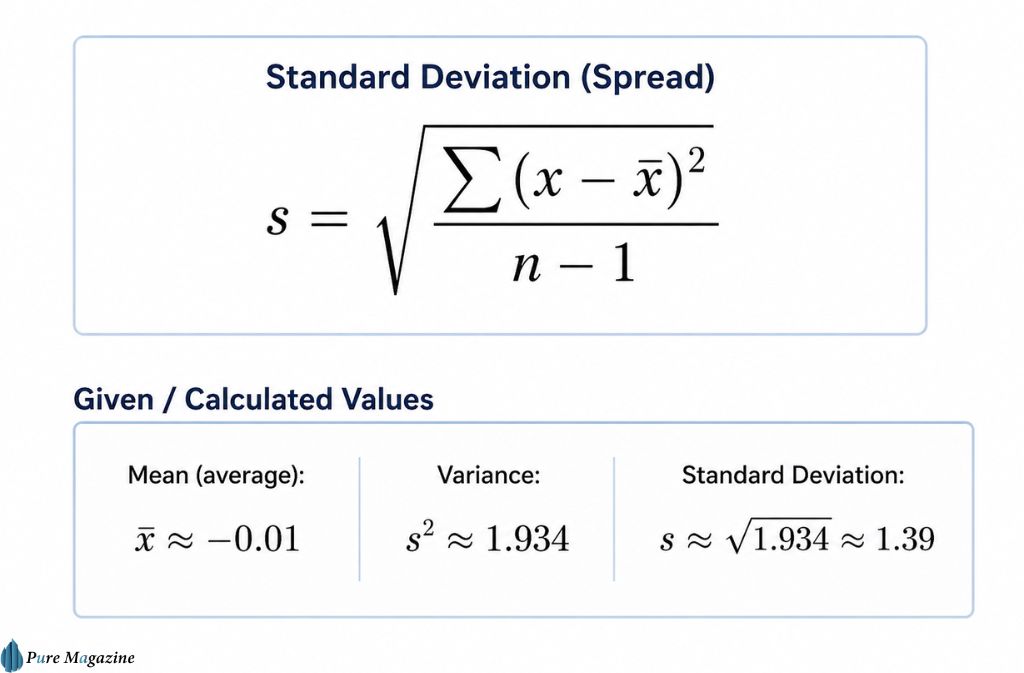
Given / Calculated Values
- Mean (average):
x̄ ≈ 0.01 - Variance:
s² ≈ 2.373
- Standard deviation (optional if needed):
s ≈ √2.373 ≈ 1.54
You don’t need to memorize this, but you do need to understand what it tells you. In 2026, there’s more emphasis on explaining what your result means—comparing datasets, commenting on consistency, and making conclusions.
Why the Data Booklet Matters More in 2026
The data booklet has become much more important, especially for finance and statistics questions. It includes tax rates, National Insurance, and other real-world data that you’ll need to interpret.
For the 2025/26 exam cycle, there are updated figures—like National Insurance sitting around 8% for many earners and revised Scottish tax bands. Some older apps still use outdated numbers, which can quietly hurt your preparation.
What trips students up isn’t the maths—it’s knowing where to look and what to use. The faster you can navigate the booklet, the more time you save during the exam.
The Hidden Shift in the Exam
If you’ve been focusing mostly on solving equations, you might be preparing for the wrong version of the exam.
Recent papers are putting more weight on topics like foreign exchange, precedence tables, and tolerance. These aren’t just calculation-based—they require you to think through a situation and decide on the best outcome.
That’s where many students lose marks. Not because they can’t calculate, but because they don’t fully interpret the question.
How to Study Without Burning Out
A lot of students fall into the trap of long, passive study sessions—watching videos, reading notes, but not actually practicing.
A better approach is something simple: short cycles of focused work.
Spend about 15–20 minutes learning a concept, then switch to 10–15 minutes of solving questions. After that, take a few minutes to review what you got wrong and why.
It sounds basic, but it works because it keeps your brain active. You’re constantly switching between understanding and applying.
Also, a small but important point: if you’re watching a video without writing anything down or solving alongside it, you’re probably not learning much. Maths sticks when you do it, not when you watch it.
Studying Offline (More Important Than You Think)
Not every study session happens at a desk. Sometimes it’s on a bus, between classes, or during short breaks.
That’s where offline access becomes useful. Downloading past papers or using apps that work without internet can turn wasted time into productive revision.
The National 5 Maths App offers some offline functionality, and PDFs of past papers are easy to keep on your phone.
Common Mistakes to Avoid
One of the biggest mistakes is using too many apps at once. It feels productive, but it spreads your focus too thin. A better approach is to stick with one app for learning, one for practice, and past papers for testing.
Another issue is relying on outdated material. With changes in tax rates and exam emphasis, even small inaccuracies can add up.
And finally, passive learning—watching without doing—remains the most common reason students don’t improve.
FAQs
Q. What are the best free N5 apps in 2026?
The best free N5 apps in 2026 include Clelland Maths for video learning, the National 5 Maths App for practice questions, BBC Bitesize for concept explanations, and official past papers from Qualifications Scotland for exam preparation. This combination covers learning, practice, and testing.
Q. Are old SQA past papers still useful in 2026?
Yes, past papers from the Scottish Qualifications Authority (2023–2025) are still fully relevant in 2026. Although Qualifications Scotland has replaced SQA, the exam structure and question style remain unchanged, making older papers reliable for practice.
Q. Do I need the N5 data booklet for the exam?
Yes, the N5 data booklet is essential for the National 5 Applications of Mathematics exam. It includes key information such as tax rates, National Insurance, and financial data used in finance and statistics questions. Students are expected to interpret and apply this data accurately during the exam.
Q. Can I pass N5 maths using only free apps?
Yes, you can pass N5 maths using only free apps if you combine them with consistent practice and official past papers. The most effective approach is to use one app for learning concepts, one for practice questions, and past papers for exam simulation.
Q. What is the best way to study using N5 apps?
The best way to study using N5 apps is to follow a simple cycle: learn a concept, practice questions, and then test yourself with past papers. This method improves understanding, accuracy, and exam performance.
Q. Which N5 apps work offline?
Some N5 apps and resources offer offline access. The National 5 Maths App provides limited offline practice, and downloaded past papers can be used without internet, making them ideal for studying on the go.
Conclusion
The truth about free N5 apps in 2026 is simple: they only work if you use them with the right strategy.
You don’t need ten different tools. You need a small set of reliable resources, used consistently, with a focus on real exam-style thinking.
If you take one step after reading this, make it this:
Pick one learning tool, one practice app, and start a short daily routine.
That alone can make a bigger difference than anything else.
For more, visit Pure Magazine