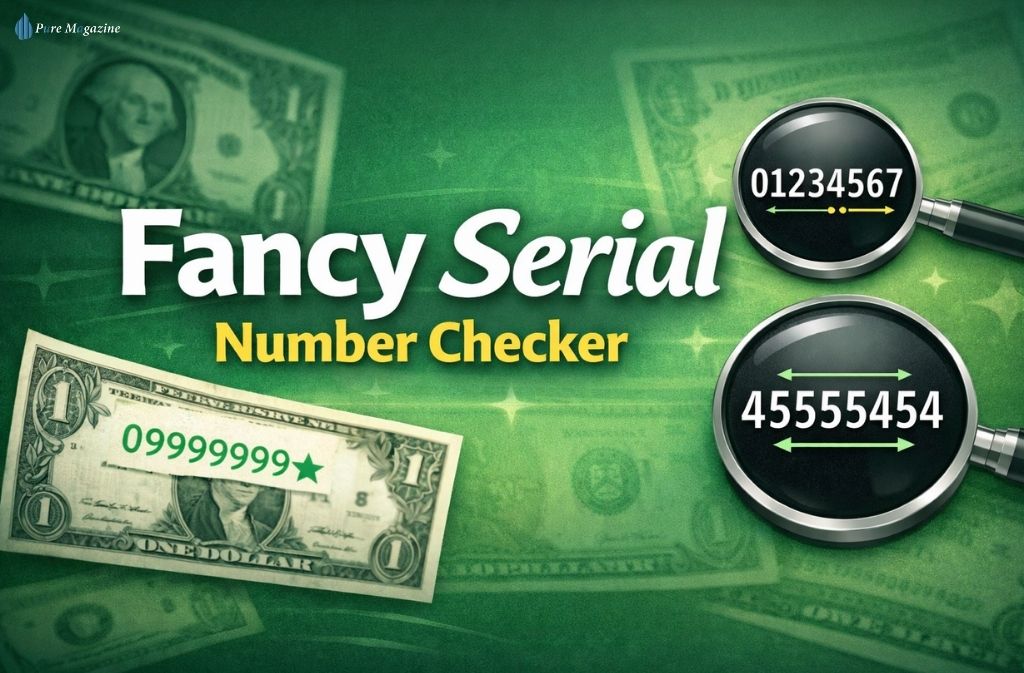
A strange thing happens every day in wallets across the U.S. Someone notices a dollar bill with repeating numbers, a clean pattern, or a small star at the end of the serial — and suddenly that ordinary piece of paper feels… different.
Is it rare? Is it valuable? Or is it just a coincidence?
That moment is exactly why millions of people search for a fancy serial number checker each year. They want a fast answer — but more importantly, they want to know whether the answer actually means money.
This guide goes beyond a basic checker tool. You’ll learn how fancy serial number checkers work, how collectors really judge value in 2025–2026, and how to avoid the most common (and expensive) mistakes beginners make. By the end, you’ll know whether your bill is something to keep, sell, grade, or simply spend.
What Is a Fancy Serial Number?
A fancy serial number is a paper money serial that follows a recognizable pattern rather than appearing random. Because U.S. currency is printed with sequential serial numbers, certain combinations stand out and attract collector interest.
Collectors don’t care about luck or meaning — they care about pattern clarity, rarity, and condition.
Common Fancy Serial Number Types
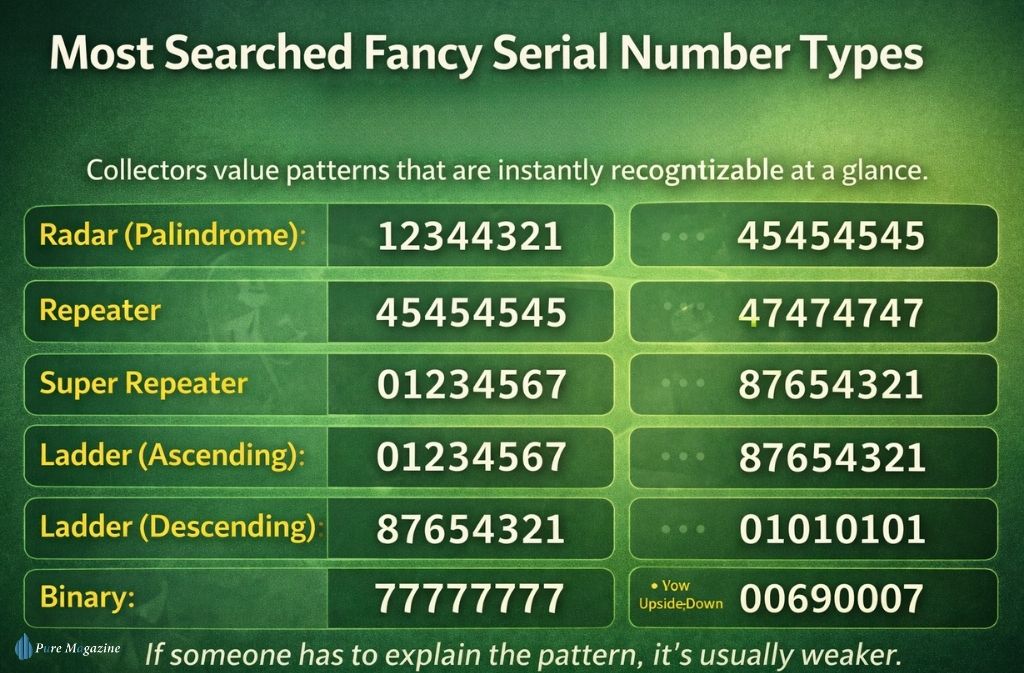
- Repeater: 45454545
- Radar (Palindrome): 12344321
- Ladder (Ascending): 01234567
- Ladder (Descending): 87654321
- Solid: 77777777
- Binary: 01010101
- Super Repeater: 47474747
- Low Serial Number: 00000001–00000100
- High Serial Number: 99999990–99999999
- Flipper (Upside-Down): 00690000
Not all of these are equally valuable — and that distinction matters far more than most people realize.
How a Fancy Serial Number Checker Works
A fancy serial number checker scans your bill’s serial against known collector-recognized patterns. It answers one question only:
Does this serial match a known fancy pattern?
What a Checker Can Do
- Detect repeats, symmetry, and sequences
- Identify low or high serial ranges
- Flag star notes
- Categorize pattern type
What a Checker Cannot Do
- Determine the actual market value
- Judge the condition or wear
- Measure collector demand
- Predict what someone will pay
According to the Bureau of Engraving and Printing (BEP), serial numbers are assigned sequentially during production, and replacement (“star”) notes are issued only to replace defective sheets. The BEP does not classify or value “fancy” serial numbers — that designation exists entirely within the collector market.
This is why no online checker can price your bill accurately on its own.
Star Notes vs Fancy Serial Numbers (Important Difference)
A star note ends with a ★ and indicates the bill replaced a misprint during production.
What Most People Get Wrong
- ❌ Star note = valuable
- ❌ Star note = rare
What’s Actually True
- Many star notes are extremely common
- Value depends on print run size, not the star itself
- A star note becomes more desirable only when combined with a strong fancy serial
Most modern star notes are worth face value unless paired with rarity.
Also Read: How Retailers Can Use Design to Influence Customer Behaviour
The 3-Step Fancy Serial Evaluation Framework (Collector Method)
Before trusting any checker result, collectors evaluate bills using this process.
1: Pattern Strength
- Instantly obvious? → strong
- Subtle or partial? → weak
2: Rarity Tier
| Tier | Example | Demand |
|---|---|---|
| Ultra-rare | Solid, very low serial | Very high |
| High | Radar, true ladder | High |
| Medium | Repeater | Moderate |
| Low | Near-fancy | Minimal |
3: Condition Reality Check
Crisp, uncirculated bills matter more than most beginners expect.
How to Estimate a Fancy Serial Number’s Value (Step-by-Step)
Collectors don’t guess — they score.
1: Pattern Strength (0–4)
- Solid/true radar / true ladder → 4
- Super repeater/binary → 3
- Repeater → 2
- Near-fancy → 0–1
2: Rarity Tier (0–3)
- Ultra-rare → 3
- High → 2
- Medium → 1
3: Condition (0–4)
- Crisp Uncirculated → 4
- XF → 3
- VF → 2
- Circulated → 0–1
4: Star Note Scarcity (+1 optional)
- Small BEP print run → +1
Scoring Guide
- 9–12 points: Strong value ($100+)
- 6–8 points: Modest premium ($10–$75)
- 0–5 points: Face value
Are Fancy Serial Numbers Actually Worth Money?
Sometimes — but far less often than headlines suggest.
Realistic Value Ranges (2025–2026)
- Weak fancy → Face value
- Mid-tier fancy → $10–$75
- High-grade strong fancy → $100–$500+
- Exceptional examples → Four figures
| Condition | Face Value | Collector Value |
|---|---|---|
| Circulated (Fine 15) | $1 | $1–$3 |
| Very Fine (VF 30) | $1 | $10–$20 |
| Choice UNC (64) | $1 | $75–$200+ |
Common Mistakes People Make
- Assuming any repeating number is valuable
- Ignoring condition
- Trusting eBay asking prices instead of sold listings
- Paying to grade low-tier serials
- Confusing novelty with demand
Should You Get a Fancy Serial Number Graded?
Grade only if:
- The serial is high-tier
- The bill is uncirculated
- Expected value exceeds grading fees
Otherwise, grading often destroys profit.
Where Collectors Actually Buy and Sell Fancy Serial Numbers
Best Places to Sell
- eBay (sold listings only)
- Currency auction houses
- Collector forums
Places to Be Cautious
- Pawn shops
- “We buy cash” websites
- Social media DMs
Always price based on sold data.
Also Check: How Retailers Can Use Design to Influence Customer Behaviour
Why 2026 Is a Big Year for Fancy Serial Collectors
The BEP is expected to begin rolling out redesigned U.S. currency starting with the $10 bill in late 2026. Historically, new designs trigger intense collector interest — especially for first-run serials and low numbers.
As new designs enter circulation, everyday cash becomes a hunting ground.
What to Do After Using a Fancy Serial Number Checker
- Keep it if it scores high
- Sell it if demand exists
- Grade it only when justified
- Spend it if the value is purely face
FAQs
Q1. How do I check if my serial number is fancy?
To check if your dollar bill has a fancy serial number, use a fancy serial number checker tool online. After scanning, evaluate the bill’s pattern type, rarity tier, and condition manually. Tools only identify potential fancy patterns—they do not determine real-world value.
Q2. Are star notes always worth more?
No. Most star notes are common replacement bills and only gain extra value if they are paired with a strong fancy serial number or come from a rare print run. Always check collector demand and scarcity before assuming a premium.
Q3. What dollar bills are worth the most?
Dollar bills with the highest collectible value usually include:
- Solid serial numbers (all digits the same)
- Radar/palindrome patterns (reads the same forward and backward)
- Ladders (ascending or descending sequences)
- Very low serial numbers (00000001–00000100) in uncirculated condition
Condition is crucial—an uncirculated radar may be worth hundreds, while a circulated one may sell for face value.
Q4. Is there a free fancy serial number checker?
Yes. Several free online tools let you check if a bill’s serial number matches collector-recognized fancy patterns. Remember, free tools do not provide price estimates; they only classify pattern type and rarity.
Q5. Should I trust eBay prices for fancy serial numbers?
No. Always check completed and sold listings instead of asking prices. Many sellers overstate value. Use sold listings to gauge realized prices for your bill’s pattern, condition, and star note type. This ensures accurate market-based pricing.
Conclusion
A fancy serial number checker is a useful starting point — but it’s not the final answer. Real value comes from understanding pattern strength, rarity, and condition, not from a green checkmark on a tool.
Most fancy-looking bills are worth exactly one dollar. A few are genuinely special. Knowing the difference saves time, money, and disappointment — and occasionally helps you spot something extraordinary hiding in plain sight.
Used correctly, a fancy serial number checker helps you make smarter decisions with the cash already in your pocket.
Related: Insightful Discussions at Exposmall: What They Are & Why They Matter