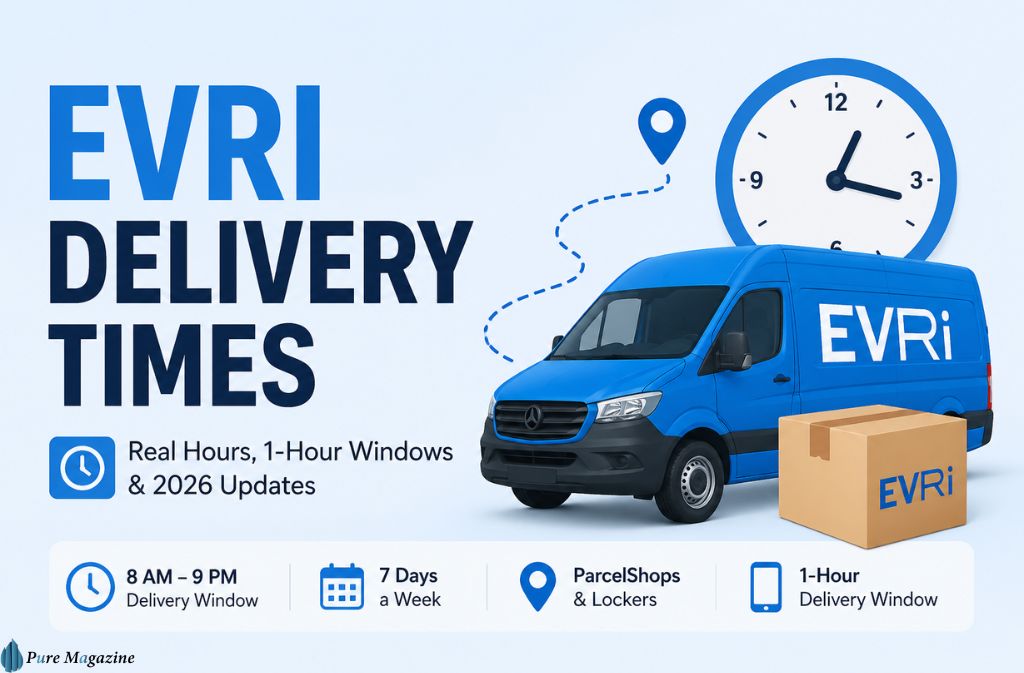
Parcel tracking has improved, but timing still feels unpredictable. With Evri delivery times, the gap between “out for delivery” and the actual arrival can stretch from a couple of hours to most of the day.
Verified for Spring 2026, this guide explains what really happens behind the scenes—how delivery routes work, when parcels typically arrive, and how new features like 1-hour delivery windows affect accuracy. You’ll also learn practical ways to predict your delivery time and even speed it up using lesser-known options like lockers and ParcelShops.
What time does Evri deliver during the day?
Evri deliveries usually happen within a broad operational window, but the actual timing depends heavily on route efficiency rather than fixed schedules.
Most parcels arrive within these time patterns:
| Time Slot | Delivery Likelihood | What Typically Happens |
|---|---|---|
| 8–11 AM | Low | Early drops, business areas |
| 11 AM–3 PM | Medium | First wave of residential deliveries |
| 3–6 PM | Very High | Peak delivery window |
| 6–9 PM | Medium | Overflow and suburban routes |
In practical terms, you’re far more likely to receive your parcel in the afternoon or early evening than in the morning. This is because drivers often start with dense routes or collection tasks before moving into residential zones.
Real-world tracking observations in 2026 show a clear pattern:
- City-center deliveries cluster earlier in the day
- Suburban and rural deliveries are more likely after 5–6 PM
Latest delivery times and why parcels arrive late
Evri deliveries can extend into the evening, sometimes later than people expect.
Most deliveries are completed by 7 PM, but parcels can arrive as late as 8–9 PM, especially during busy periods.
Late deliveries usually happen because:
- Drivers are finishing long routes
- Parcel volumes are higher than usual
- Earlier delivery attempts caused delays
- Routes include spread-out residential areas
Unlike premium couriers, Evri relies heavily on independent drivers, which means flexibility is high—but so is variation.
1-hour delivery window (2026 update)
A major improvement in recent years is the introduction of more precise delivery estimates.
On the day of delivery, many customers now receive a 1-hour delivery window through tracking updates or notifications.
Here’s how it typically unfolds:
- Morning: parcel marked “out for delivery.”
- Midday: estimated time narrows
- Later: a 1-hour slot appears
This window is more reliable than older broad estimates, but it can still shift if the route changes during the day.
What this means for you:
- You no longer have to wait all day blindly
- The 1-hour slot is your most accurate signal
- Delays can still push the window slightly forward
Tracking features and what you can actually see
Evri doesn’t offer a live map showing the driver’s exact location, but tracking has improved in other ways.
You can typically access:
- Status updates like “out for delivery”
- A refined delivery window
- “Share My Delivery” notifications
- Photo confirmation of where the parcel was left
While it’s not real-time tracking in the traditional sense, these features provide enough signals to estimate arrival with reasonable accuracy.
Weekend delivery times (Saturday and Sunday)
Evri now operates seven days a week in many areas, which has significantly improved flexibility.
| Day | Delivery Status | Notes |
|---|---|---|
| Monday–Friday | Full service | Standard operations |
| Saturday | Full service | Often high volume |
| Sunday | Available | Expanding coverage |
Saturday deliveries are almost identical to weekdays. Sunday services are slightly more limited but increasingly common, especially in urban areas.
Postcode delays and rural exceptions
Delivery timing isn’t the same everywhere. Location plays a bigger role than most people realize.
Some regions experience slower delivery times, particularly:
- Scottish Highlands (e.g., AB35–38)
- Northern Ireland (BT postcodes)
- Remote rural areas
In these locations:
- “Next day delivery” can take 2–3 days
- Delivery often happens later in the day
- Tracking updates may be less frequent
If you’re outside major urban zones, it’s worth adjusting expectations accordingly.
When “out for delivery” actually means today
Seeing “out for delivery” is a strong indicator—but not a guarantee.
Most of the time, it means your parcel will arrive that day. However, delays can still happen if:
- The driver runs out of time
- There are route disruptions
- Earlier deliveries caused a backlog
You can increase your confidence by checking:
- What time was the status updated
- Whether a 1-hour window appears
- Past delivery patterns to your address
The locker and ParcelShop shortcut
One of the most effective ways to speed up delivery is often overlooked.
Redirecting your parcel to an Evri ParcelShop or locker can significantly reduce waiting time.
Why this works:
- Drivers drop multiple parcels in one stop
- Lockers are prioritized for efficiency
- No need for door-to-door navigation
Typical impact:
- Home delivery: late afternoon or evening
- Locker delivery: late morning or early afternoon
If timing matters, this option can save several hours.
A simple way to predict your delivery time
Instead of guessing, you can estimate your delivery using a few practical signals.
Focus on these three factors:
- Update timing: Early updates usually mean earlier delivery
- 1-hour window: the most accurate indicator
- Location type: urban areas get earlier slots than suburban ones
When you combine these, patterns start to become predictable rather than random.
Why do delivery times vary so much
A big reason for inconsistency is how the delivery network operates.
Evri drivers are typically independent contractors using their own vehicles. This affects:
- Route structure
- Delivery speed
- Working hours
Some drivers complete routes quickly, while others extend into the evening. That’s why one delivery might arrive at noon and the next at 8 PM—even in the same area.
Common mistakes people make
Many delivery frustrations come from expectations that don’t match how the system works.
Common issues include:
- Expecting exact delivery times
- Ignoring postcode-related delays
- Not using the locker or diversion options
- Misreading “out for delivery” as immediate arrival
- Waiting all day without checking updates
Understanding these points can prevent most delivery-related frustration.
Evri vs other couriers (quick comparison)
| Feature | Evri | Premium Couriers |
|---|---|---|
| 1-hour window | Available | Available |
| Live tracking map | No | Yes |
| Delivery flexibility | High | Medium |
| Locker network | Strong | Growing |
| Cost | Lower | Higher |
Evri prioritizes flexibility and cost-efficiency, which is why timing can feel less precise—but more adaptable.