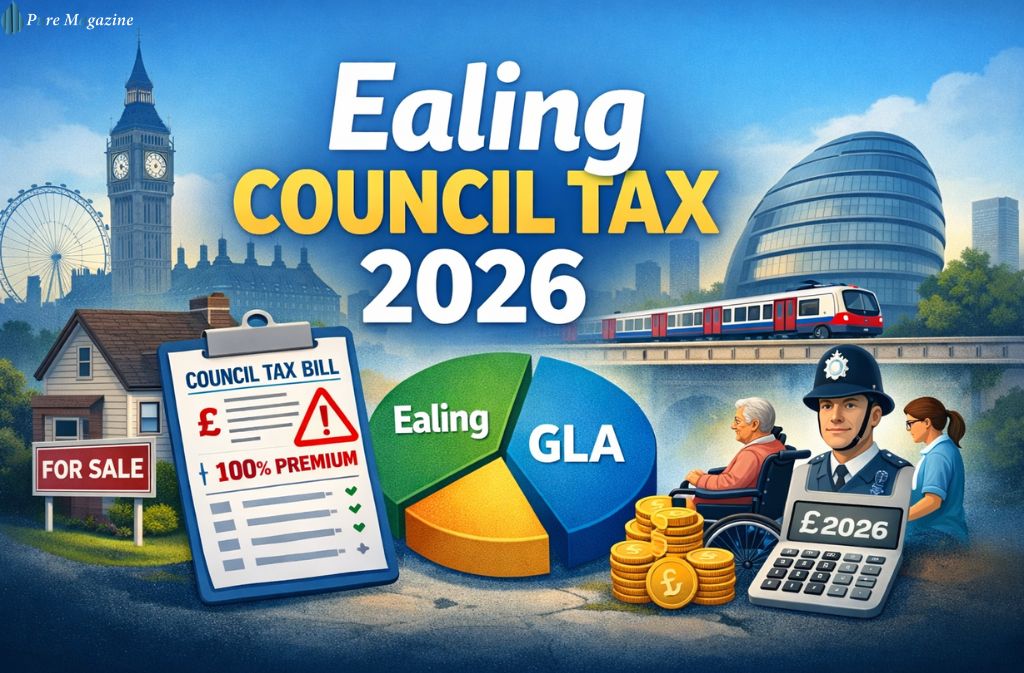
When that brown envelope drops through the letterbox in March, most Ealing residents open it with a familiar sense of dread. This year, for a lot of people, that feeling was justified. The 2026 bill wasn’t just bigger — it came with changes to how empty homes are taxed, a continued squeeze from the Adult Social Care precept, and a GLA charge that keeps climbing regardless of what you think of the Mayor’s priorities.
If you’re trying to make sense of what you owe, why it went up, and whether there’s anything you can do about it, you’re in the right place. This guide covers the actual numbers, the policy shifts that snuck through without much fanfare, and — more importantly — the legitimate ways to reduce what you pay.
What Ealing Council Tax Actually Is (And Where the Money Goes)
Council tax is a mandatory charge on residential properties, billed annually and typically paid in ten monthly instalments. But here’s something a surprising number of residents don’t realise: your Ealing bill isn’t just paying for Ealing services.
It’s split between two distinct layers of local government:
| Component | What It Funds |
|---|---|
| Ealing Council | Rubbish collection, social care, local roads, housing, libraries |
| GLA Precept | Metropolitan Police, Transport for London, London Fire Brigade |
That GLA portion — the Mayor of London’s share — accounts for roughly 25% of a typical Band D bill. It’s gone up every year for the past several years running, and 2026 is no exception. So when people grumble that their council tax keeps rising despite seeing no visible improvement in local services, they’re not wrong — part of the increase is happening at a level entirely outside Ealing Council’s control.
For context on how this compares to other London boroughs, it’s worth looking at how Barnet’s 2026 rates or Lambeth’s council tax break down — the GLA precept is identical across all of them, but local rates vary considerably.
The 2026 Increase: What Changed and Why
Ealing raised council tax by close to the maximum permitted 4.99% in 2026 — the ceiling councils can hit without triggering a local referendum. That ceiling is itself a political choice by the central government, and most London boroughs have gone right up to it this year.
The increase breaks down roughly like this:
| Component | Increase |
|---|---|
| General council tax | ~2.99% |
| Adult Social Care precept | ~2% |
| Total | Up to 4.99% |
The Adult Social Care precept is the part that often gets lost in translation. It’s a ring-fenced addition — councils can only spend it on adult social care, not general services. Demand for care has grown faster than funding for years, and the precept is essentially a sticking plaster over a much bigger structural problem. Whether you think that’s fair or not, it’s a line on your bill that’s been quietly growing since 2016.
If you want a broader picture of how council tax reductions work across England, or you’re curious about what’s driving bills nationally, the pattern in Ealing is pretty representative of what’s happening everywhere.
The Empty Homes Premium: The 2026 Rule Change Landlords Need to Know
This is the change that caught the most people off guard — particularly landlords and second-home owners.
Previously, the 100% council tax premium (i.e., double the standard rate) kicked in after a property had been empty for two years. From 2026, that threshold dropped to just one year. Leave a property vacant for twelve months, and you’re paying twice the normal bill.
To put that in concrete terms: a Band D property with a base bill of around £1,900 becomes a £3,800 liability the moment it crosses that one-year mark. For a lot of landlords sitting on properties between tenancies — especially those dealing with renovation delays or probate complications — this is a genuinely significant hit.
There are some exemptions (properties being actively marketed for sale, those undergoing major structural work, and certain inherited properties), but the burden of proof sits with the owner. You need to apply for the exemption proactively; the council won’t assume it.
If you’re managing multiple properties or dealing with an estate, it’s also worth reading up on how council tax works on unoccupied properties more broadly, and specifically what happens to council tax on empty properties after a death — those rules have their own nuances.
Ealing Council Tax Bands: 2026 Rates at a Glance
Properties across England were valued in 1991 and banded accordingly — a system that hasn’t been updated since, despite house prices in many areas tripling or quadrupling. Your band determines your bill as a proportion of the Band D rate, which is the reference point the government uses.
| Band | Approximate 2026 Annual Bill |
|---|---|
| A | £1,200 – £1,400 |
| B | £1,400 – £1,600 |
| C | £1,600 – £1,800 |
| D | £1,800 – £2,000 |
| E and above | £2,200+ |
These are approximate figures. Your actual bill will depend on which discounts or exemptions apply, plus the exact GLA precept set for the year. For a detailed breakdown of what each band costs in 2026, see our guides to Band A, Band B, Band D, and Band E rates across England.
How to Log Into Your Ealing Council Tax Account
Ealing’s “My Account” portal handles almost everything you’d previously have needed to call or write about. It’s not the flashiest interface, but it works — and using it consistently will save you time when bills, payment schedules, or personal details change.
Through the portal, you can view your current and previous bills, check when each instalment is due, update your bank details or direct debit mandate, switch to paperless correspondence, and download official documents if you need them for housing applications or benefits claims.
One practical note: Ealing has been actively encouraging residents to go paperless, and there’s a reasonable case for doing so. Paper bills in March — when every council in the country sends them simultaneously — have a track record of going missing or arriving late. Paperless puts the document in your account immediately and gives you a clean audit trail. If you haven’t switched yet, it takes about two minutes.
How to Pay Your Council Tax in 2026
Most people either set up a direct debit and forget about it, or pay each month manually and occasionally miss one. The first option is obviously better, but it’s worth knowing what’s available.
| Payment Method | Speed | Best For |
|---|---|---|
| Direct debit | Automatic | Most residents — reliable, spread monthly |
| Online card payment | Instant | One-off payments or catching up |
| Bank transfer | 1–2 days | Those who prefer manual control |
| Phone payment | Same day | When online access isn’t practical |
Direct debit remains the safest default. If you ever want to know the full picture of how council tax payments work — including what happens if you fall behind — it’s worth reading through before a problem develops rather than after.
Council Tax Support in Ealing: Who Qualifies and What’s Changed
Council Tax Support (CTS) is Ealing’s local scheme to help lower-income households with their bill. It’s separate from national benefits — each council designs its own scheme within government guidelines — and Ealing uses an income-banded model.
Rather than calculating your exact discount to the penny based on precise earnings, the income-banded approach puts households into brackets. Your discount is determined by which bracket your income falls into, not a precise calculation. It makes processing faster and outcomes more predictable.
What this means practically: if your income has dropped — even by a relatively small amount — you might have crossed into a bracket that qualifies for more support than you’re currently receiving. It’s worth reapplying if anything significant has changed in your household finances, including a job change, a partner moving in or out, or changes to benefits you receive.
Eligibility is also affected by whether you claim certain other benefits. For a broader overview of how council tax reduction works and what the national framework looks like, the guide covers the foundations before you dig into Ealing-specific rules.
Discounts You Might Be Missing
Single Person Discount
If only one adult lives in your property as their main home, you’re entitled to a 25% reduction. This is one of the most commonly unclaimed discounts — particularly in households where a second adult has moved out, or where someone has a carer living with them who qualifies as disregarded.
Students, apprentices, people with severe mental impairments, and live-in carers can all be “disregarded” for council tax purposes. If your household has any of these situations, you might qualify for the single-person rate even with two people present.
Exempt Properties
Certain properties are fully exempt from council tax — student-only households, properties occupied solely by under-18s, and some others. There’s more detail in the full guide to council tax exemptions if you think one might apply to you.
Months Without Council Tax
Your standard council tax bill is typically spread over ten monthly payments — meaning you don’t pay in February and March. A lot of people aren’t aware of this, or forget which months are payment-free. If you’re budgeting tightly, knowing your council tax-free months can help with cashflow planning.
How to Challenge Your Council Tax Band (And Why It’s Worth Checking)
This is one of the most persistently underused options in the whole council tax system. Your band was set in 1991 based on your property’s estimated value at the time, and errors were common, particularly with new builds and subdivided properties.
If a neighbour in an identical or comparable home is in a lower band, that’s a legitimate basis for a challenge. So is evidence that your property was misbanded at the time of valuation — perhaps because it was a new build with no direct comparators, or because a flat conversion was valued as if it were a full house.
The process goes through the Valuation Office Agency (VOA), which is independent of your council. You can check your current band and compare it to neighbouring properties on the VOA website for free. The challenge itself costs nothing — and if you’re successful, you’re refunded for the years you overpaid.
The catch is that a challenge can occasionally result in your band going up rather than down, so it’s worth doing your research first. Look at what comparable properties around you are banded, not just those in the same street.
New-build developments in Ealing — particularly around Southall, Greenford, and along the Elizabeth line corridor — have had a notable number of provisional banding errors. If you moved into a new development in the past few years and haven’t checked, it’s worth a look. The window for challenging isn’t unlimited, and many residents who moved in at launch and never queried it have simply kept overpaying.
What a Typical 2026 Bill Looks Like
To make this concrete: take a single person living in a Band D property in Ealing in 2026.
| Item | Amount |
|---|---|
| Base Band D charge | ~£1,900 |
| Adult Social Care increases | +£80 |
| Subtotal | ~£1,980 |
| Single person discount (25%) | –£495 |
| Final annual bill | ~£1,485 |
That’s roughly £149 a month across ten instalments. Without claiming the single person discount — which requires you to tell the council, it doesn’t happen automatically — the same person would be paying around £198 a month instead. Nearly £500 a year is left on the table through a single missed step.
Common Mistakes That Cost Residents Money
The single-person discount is the big one, but it’s not the only way residents overpay. Forgetting to notify the council when a second adult leaves the property, failing to reapply for Council Tax Support after a change in circumstances, ignoring band review opportunities, and missing the shift to paperless billing (which occasionally delays notification of revised bills) all contribute to people paying more than they should.
The empty homes premium is becoming an issue for people who inherit properties and don’t move quickly enough. If you’ve inherited a house and it’s sitting empty while you deal with probate, solicitors, or family disagreements, that one-year clock is ticking. It’s one of those situations where knowing the rules before they bite is considerably more useful than finding out after.
Frequently Asked Questions
Q. Why has Ealing council tax gone up in 2026?
The increase reflects a combination of inflation pressures, rising demand for adult social care, reduced central government grant funding, and the annual increase in the GLA precept. Ealing raised its rate by up to 4.99% — the maximum allowed without a local referendum.
Q. What is the GLA precept and why do I pay it?
The GLA (Greater London Authority) precept funds London-wide services — the Metropolitan Police, Transport for London, and the London Fire Brigade. It’s charged to all London residents regardless of borough and makes up roughly a quarter of a typical bill. You have no opt-out.
Q. Do empty properties in Ealing really pay double council tax?
Yes, from 2026. The threshold dropped from two years to one year of vacancy. A property empty for twelve months or more is charged a 100% premium on top of the standard rate. Some exemptions apply, but they must be applied for.
Q. How do I reduce my Ealing council tax bill?
Start by checking whether you’re claiming every discount you’re entitled to — particularly the single person discount if you live alone. Then check your band using the VOA’s online tool and compare it to similar nearby properties. If your income has changed recently, reapply for Council Tax Support. These three steps alone cover the majority of unclaimed savings.
Q. How do I challenge my council tax band?
Use the Valuation Office Agency website to check your current band and compare it to neighbouring properties. If you have a reasonable case, you can submit a formal challenge — it’s free and handled independently of your council. Be aware that outcomes can occasionally go the other way, so do your research before applying.
Q. When are Ealing council tax bills issued?
Bills are typically issued in March, covering the financial year running from April to March the following year. If you’ve opted for paperless billing, your bill will appear in your online account; paper bills occasionally arrive later due to postal volumes at this time of year.
Conclusion
In 2026, Ealing council tax is no longer just a simple local bill—it’s a layered system shaped by London-wide funding, social care pressures, and stricter housing rules.
If you take away three things:
- Your bill includes GLA charges, not just Ealing
- Policy changes (like the empty homes premium) can double costs
- Small actions—like checking your band or claiming discounts—can save hundreds
👉 Next step: Log into your account, review your latest bill, and make sure you’re not paying more than you should.
For reliable, plain-English guidance on UK tax and personal finance in 2026, Pure Magazine is the resource worth bookmarking.