


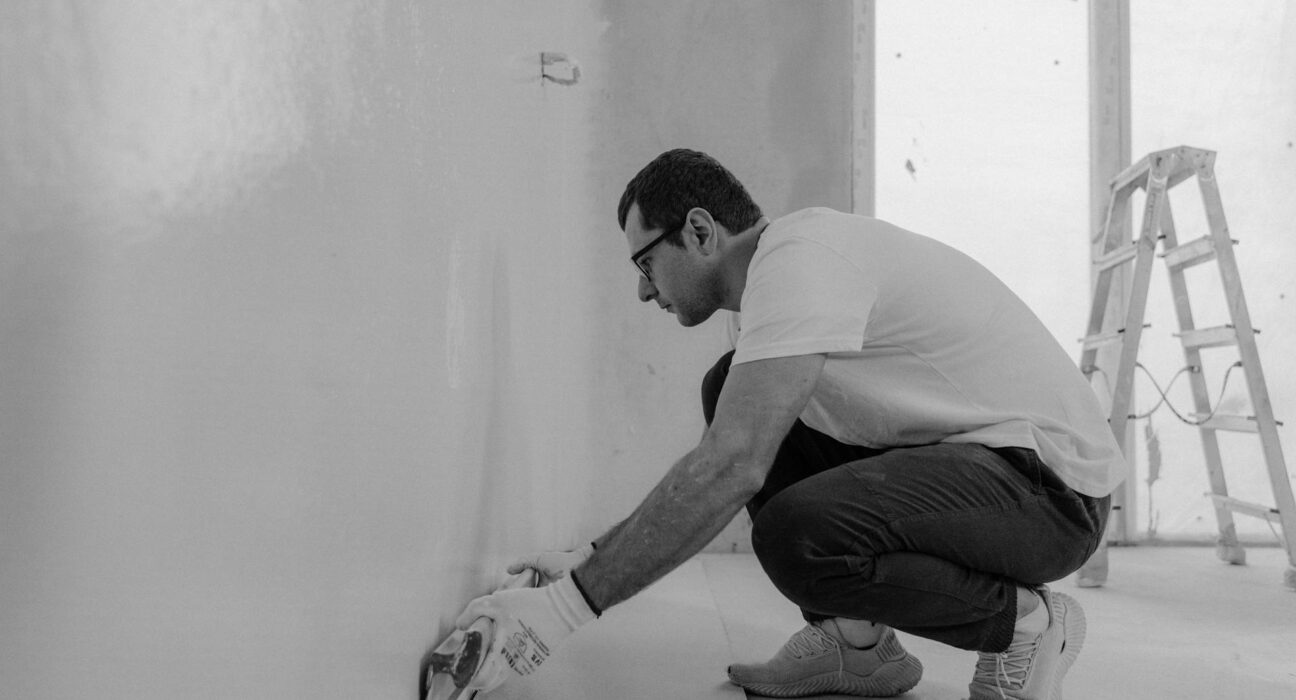
Two plasterers. Two completely different approaches. And a price difference that can run into hundreds of pounds on a single room.
Dot and dab and wet plastering are the two main methods used to finish internal walls in the UK. Both can produce excellent results. Both can also fail badly when used in the wrong situation. The difference lies in understanding what each method actually does — and where each one falls short.
So before you sign off on a quote, it’s worth knowing exactly what you’re agreeing to.
What Is Dot and Dab?
Dot and dab — also called dry lining or drywall adhesive bonding — involves fixing plasterboard directly to a masonry wall using blobs of bonding adhesive. No sand. No cement. Floating coat. The boards go up fast, the joints are taped and filled, and a thin skim coat is applied over the top.
It’s the dominant method in new-build construction. Walk into almost any house built after 1990 and the internal walls will be dot and dabbed.
The process looks straightforward. But there are details that matter enormously — and that are easy to get wrong.
What Is Wet Plastering?
Wet plastering — sometimes called solid plastering or the traditional method — involves applying one or more coats of plaster directly to the wall. On brick or blockwork, a sand and cement scratch coat or a bonding coat is applied first, followed by a finish coat of gypsum plaster.
It’s slower. It requires more skill. It uses more material. And it produces a wall that is genuinely bonded to the structure behind it.
Wet plastering has been used in British homes for centuries. Victorian and Edwardian properties were built with it. Many are still standing with their original plaster intact — more than 100 years later.
That tells you something about the method’s durability.
The Case for Dot and Dab
Speed is the obvious advantage. A skilled dry liner like Point Plastering can board and skim a room in a fraction of the time wet plastering takes. On a tight programme — a full house renovation, for example — that difference matters.
Cost is the other factor. Dot and dab typically comes in cheaper than wet plastering on like-for-like room sizes. Labour time is shorter, and the materials are less complex. For a standard bedroom, the saving over wet plastering might be £150–£300.
There are also practical benefits:
- Plasterboard provides a consistent, flat surface regardless of how uneven the underlying wall is
- It offers a modest improvement in thermal insulation — standard 12.5mm board adds a small but measurable layer
- Acoustic performance can be improved by specifying thicker or specialist board
- Services such as electrical cables can be chased into the void behind the board without cutting into masonry
For new-build properties or modern extensions on a flat, dry substrate, dot and dab is a perfectly sensible choice. It’s used by volume housebuilders precisely because it’s reliable and repeatable in controlled conditions.
The Problems Dot and Dab Creates
Here’s where the conversation gets more complicated.
The gap between the plasterboard and the masonry wall — typically 10–25mm — is not a sealed void. Air can move within it. And in certain conditions, that air movement carries moisture.
In older properties with solid walls and no cavity insulation, thermal bridging can cause the masonry behind the board to stay cold. Warm, moist air from inside the room migrates into the gap and condenses on the cold wall surface. Over time, that condensation builds up. Mould grows in the void — invisible behind the board, but very much present.
The homeowner notices nothing until the plasterboard starts to bow, or a persistent musty smell develops that no amount of cleaning resolves.
Ask yourself: would you want a hidden void behind every wall in your home, with no way to monitor what’s happening inside it?
There are other risks too:
- Hollow walls. Because the board isn’t fully bonded — just spotted with adhesive — the wall has a hollow sound when tapped. It can feel less solid underfoot. Some homeowners find this uncomfortable, particularly in older properties where the character of solid walls is part of the appeal.
- Limited load-bearing capacity. You cannot hang heavy items — large mirrors, kitchen wall cabinets, or radiators — from dot and dabbed walls without locating the adhesive dabs or using specialist fixings. Standard screws will pull straight through the board if placed in the wrong spot.
- Condensation risk at skirting level. If the base of the board is too close to the floor and moisture gets in — from a minor leak, a spill, or rising damp — the board wicks it up. The damage can spread metres before it becomes visible.
- Compromised damp-proof courses. On solid masonry walls, the void created by dot and dab can bridge the existing damp-proof course if the adhesive dabs are placed carelessly. Moisture can then travel upwards past the DPC — causing exactly the kind of damp problem the DPC was designed to prevent.
The Case for Wet Plastering
Wet plastering creates a wall that is structurally part of the building. The plaster bonds chemically and mechanically to the masonry behind it. There is no void. No hidden air gap. No condensation risk within the wall construction.
For older properties — particularly pre-1919 solid-wall construction — this matters enormously. These buildings were designed to breathe. Moisture enters through the walls and needs to exit again. Lime-based finishes allow that movement. Even modern gypsum plaster, applied directly to the masonry, performs better in this context than a boarded void.
Wet plastering also produces a harder, denser surface. You can fix almost anything to it without specialist knowledge. A standard masonry drill and wall plug will hold shelves, radiators, and heavy mirrors without drama.
And for rooms with irregular walls — which describes most of the housing stock in cities like Norwich, Cambridge, or Ipswich, where Victorian terraces dominate — wet plastering can follow the wall’s natural line without the loss of floor area that dot and dab introduces. Even a 25mm board with adhesive takes meaningful space from a small room. Multiply that across every wall in a small Victorian bedroom and you’ve lost several centimetres on each side.
When Each Method Makes Sense
This isn’t a question of one method being universally better. It’s a question of matching the method to the situation.
Dot and dab works well when:
- The property is post-1990 construction with cavity walls and a dry, stable substrate
- Speed and cost are the primary drivers and conditions are suitable
- You’re boarding over an existing wall to improve thermal or acoustic performance in a controlled environment
- The substrate is too irregular or damaged to plaster directly but damp has been fully resolved
Wet plastering is the better choice when:
- The property is pre-1919 solid-wall construction
- There is any history of damp, even if it’s been treated
- You need a breathable finish that won’t trap moisture
- The room is small and you cannot afford to lose wall space
- You want a surface that can take fixings anywhere without specialist hardware
- Long-term durability matters more than short-term cost savings
What About Renovating Older Properties?
This is where the decision carries the most weight — and where the wrong choice causes the most damage.
A significant proportion of the housing stock in places like Norfolk and Suffolk was built before 1919. These are solid-wall properties, often with no cavity, no modern damp-proof course, and original lime plaster that has been performing adequately for over a century.
Introducing dot and dab into these buildings — particularly without a thorough damp survey beforehand — is a genuine risk. The void traps moisture. The non-breathable board and adhesive interrupt the natural drying cycle of the wall. And because the problem develops slowly and invisibly, it can be months or years before the homeowner realises something has gone wrong.
A survey by English Heritage found that inappropriate moisture barriers — including non-breathable modern materials applied to older solid-wall buildings — are among the leading causes of accelerated decay in the historic housing stock.
The cost of remedying damp damage in a single room, once boarding has to come down and masonry treated, easily runs to £1,500–£3,000. That’s before replastering.
Asking the Right Questions Before Work Starts
Whether you’re managing the project yourself or relying on a contractor, these questions are worth putting to anyone who tenders for the work:
- What is the age and construction type of this property?
- Has a moisture meter reading been taken across the walls?
- Is there any evidence of bridging around the damp-proof course?
- What happens if damp is found once the boards go up?
- Will the finished wall be breathable or sealed?
A tradesperson who can answer each of these without hesitation understands the full picture. One who looks blank at the mention of breathability is someone to be cautious about.
The Method That Serves the Building
Every renovation involves trade-offs. Budget, timescale, and disruption all play a role in the decisions made.
But the method used to finish your walls isn’t just a cosmetic choice. It affects the health of the building, the performance of the structure, and the costs you’ll face five or ten years from now.
Dot and dab isn’t a shortcut to be avoided in every case. But it is a method that demands the right conditions. Applied carelessly in the wrong property, it creates problems that are slow to appear and expensive to fix.
Wet plastering takes longer and costs more upfront. In the right building, it’s worth every penny.
The question isn’t which method is cheaper. It’s which one is right for the walls you actually have.
For more, visit Pure Magazine