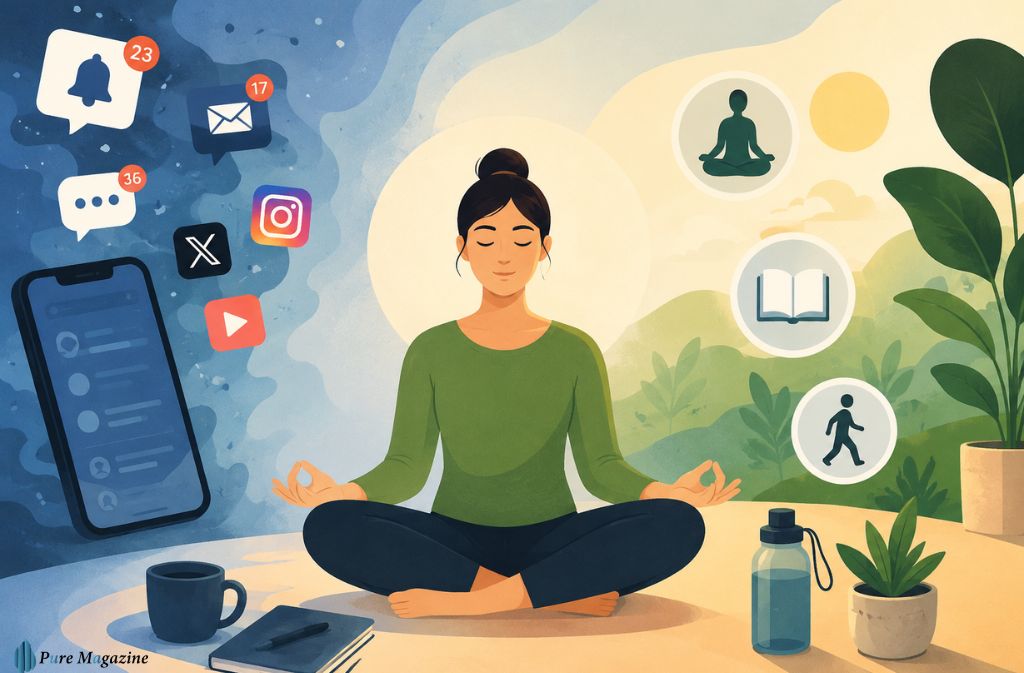
Most digital wellness advice repeats the same three tips: track your screen time, turn off notifications, charge your phone outside the bedroom. None of that is wrong. But it skips the question people actually care about — does any of it work, and for how long?
Recent research gives a more useful answer than “less time, more discipline.” This article works through what the evidence actually supports, where it’s still uncertain, and how to build habits that hold up past the first motivated week.
Is Your Screen Time Actually the Problem?
Total hours on your phone matter less than how compulsively you use it. A 2025 JAMA study, led by researchers at Weill Cornell Medicine, Columbia, and UC Berkeley, tracked nearly 4,300 children starting at age 8.
Kids with rising addictive use patterns — not simply more hours — faced roughly double the risk of suicidal thoughts, anxiety, and behavioral problems. Time spent alone, measured once, wasn’t the predictor.
That’s a genuinely different framing than most screen-time content offers. The question “am I on my phone too much?” is less useful than “do I feel unable to stop, or distressed when I can’t check it?”
Compulsive use shows up as small things: reaching for your phone during a lull without deciding to, feeling irritated when someone interrupts a scroll, using an app specifically to avoid a feeling rather than for the content itself.
This changes what’s worth tracking. A simple hours-per-day number, the kind Screen Time or Digital Wellbeing hands you every Sunday, doesn’t tell you whether your use is compulsive. It’s a starting point, not a diagnosis.
For context: industry-wide adult screen-time averages, tracked by firms like DataReportal, have hovered in the six-and-a-half- to seven-hour range for the past couple of years. That makes this a typical pattern now, not an outlier one.
Do Screen Time Trackers and App Limits Actually Reduce Use?
Yes, modestly. Self-control tools like app timers and lock-out features produce a real but small-to-medium reduction in use, according to a 2023 systematic review in ACM Transactions on Computer-Human Interaction. They’re not a fix on their own.
That review found something worth sitting with: these tools work best as a nudge toward reflection, not as a hard barrier, because most barriers get worked around.
One frequently cited field study tracked an always-on usage display called TIMER. Simply showing people their current session length cut daily screen time by about 38 minutes — roughly 11% of baseline. Adding a gentle attention cue on top of that cut a further 32 minutes.
That’s meaningful, but it’s a fraction of most people’s total use. It also required active, visible feedback, not a one-time limit setting.
Built-in limits like Screen Time and Digital Wellbeing are the most commonly tried intervention — and, by most accounts, the most frequently overridden. A single “Ignore Limit” tap defeats them. Deleting an app outright and moving that activity to desktop-only tends to hold up better, because it adds real friction instead of a dismissible pop-up.
The table below compares how each common tactic actually performs.
| Intervention | Evidence strength | Why it works (or doesn’t) |
|---|---|---|
| Built-in app timers/limits | Small-to-medium effect, easily bypassed | Low friction to override |
| Deleting the app / desktop-only | Moderate, more durable | Adds real friction, not a dismissible prompt |
| Grayscale mode | Weak, short-lived | Easy to reverse; novelty fades |
| Phone outside the bedroom | Consistently strong for sleep outcomes | Removes the habitual bedtime-checking trigger entirely |
| Ambient usage displays (e.g., TIMER-style) | Moderate, evidence-backed | Encourages reflection without a hard block |
What’s the Real Cost of Notifications on Your Focus?
Every meaningful interruption costs you more than the seconds it takes to glance at a screen. Dr. Gloria Mark at UC Irvine has tracked workplace attention for two decades. Her research repeatedly finds it takes roughly 23 minutes to return to the same depth of focus after an interruption.
Her longer-run tracking shows something else: the average time people spend on a single screen before switching has fallen from about two and a half minutes in 2004 to roughly 47 seconds today.
That decline isn’t really about willpower eroding. It’s a description of an environment. Apps got better at pulling focus back the instant it drifts, and the average knowledge worker now fields a steady stream of pings from email, chat platforms, and social apps all day.
Each ping, even ignored, creates what researchers call attention residue — part of your mind stays tethered to the unresolved notification even after you’ve moved on. That quietly degrades whatever you’re doing next.
Eliminating notifications isn’t realistic for most jobs. Batching them is more workable: checking messages in scheduled windows rather than as they arrive means you absorb the 23-minute recovery cost a handful of times a day instead of dozens.
Is Nighttime Screen Use Really Wrecking Your Sleep?
The timing and content of screen use before bed matter more than the light itself. Blue light’s effect on melatonin is real, but it’s probably been overstated relative to a bigger factor: what you’re actually doing on the screen.
A 2025 systematic review in a peer-reviewed sleep journal, drawing on a National Sleep Foundation consensus statement, found that pre-bedtime content — stimulating video, emotionally charged social feeds, anything that raises arousal — disrupts sleep onset more consistently than brightness alone.
That’s a nuance most “turn off blue light” advice skips. A dimmed screen playing an anxiety-inducing news feed at 11 p.m. is probably still a worse setup than a moderately lit screen used for something calm and low-stakes.
Two interventions have the most consistent evidence behind them: removing the phone from the bedroom entirely, and setting specific windows for checking social media rather than leaving the feed available all day. Both produced measurable sleep and wellbeing improvements across multiple studies — more consistently than blue-light filters alone.
Where Does Work Fit Into This?
Digital wellness habits that stop at your personal phone settings miss half the problem. A large share of unwanted device use is job-driven, not habit-driven. The average knowledge worker’s day is now structured around Slack, Teams, and email in a way that treats availability as a default expectation rather than a choice.
This is a live policy question, not just a personal-discipline one. France has had a formal right-to-disconnect law since 2017. Portugal, Belgium, Spain, Ireland, and Australia have adopted versions of their own, generally letting employees ignore after-hours work messages without penalty.
In the United States, no state has yet passed a right-to-disconnect law as of mid-2026, though California and New Jersey have both introduced (and so far stalled) proposals. In the meantime, a growing share of employers have started building their own internal after-hours policies rather than waiting on legislation.
If your organization doesn’t have a stated after-hours policy, the trade-off is worth naming honestly. Pushing for one can improve your own boundaries. But in industries with global teams or client-facing urgency, a rigid policy can create friction that a looser, trust-based norm sometimes handles better. There isn’t a universal right answer — it depends on your role and industry.
Which Habits Actually Hold Up Long-Term?
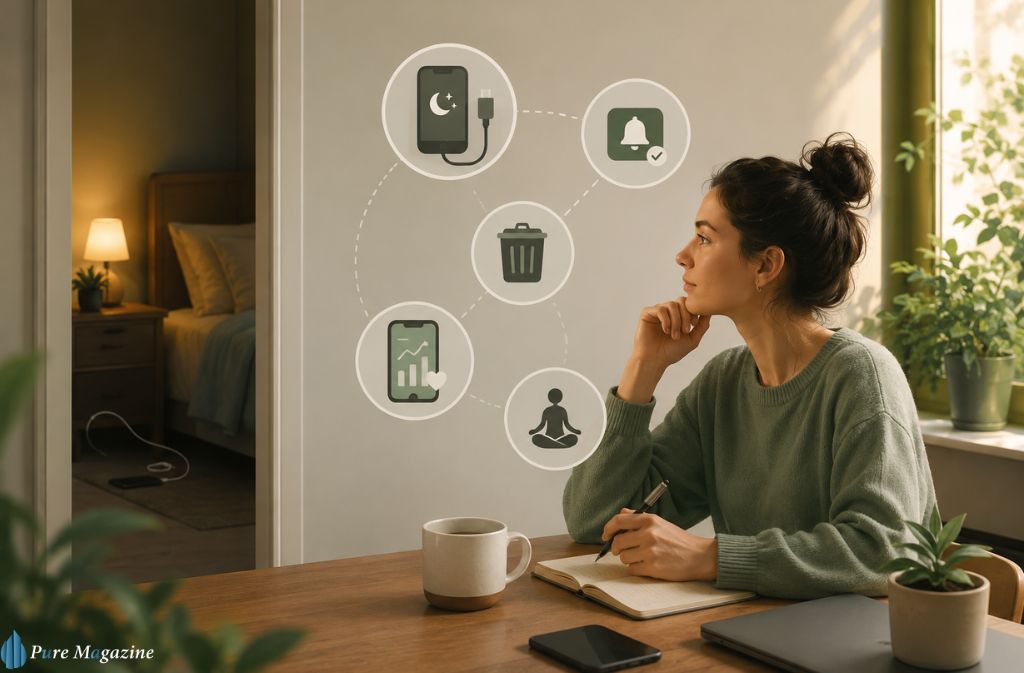
The habits with the best evidence behind them share one thing: they change your environment or default settings rather than relying on you to remember a rule in the moment.
Willpower-based habits — “I’ll just check less” — tend to erode within days. Friction-based and environment-based ones tend to last. That’s the same logic behind the broader shift toward slow living over the reactive pace of a “soft life” aesthetic: structural change outlasts good intentions.
In priority order:
- Move charging out of the bedroom.
- Batch notifications into two or three set windows a day.
- Delete rather than limit — friction beats a dismissible pop-up.
- Track compulsion, not just hours.
- Where you have a choice, pick tools that let you set your own goals over ones that impose limits and guilt-trip you for missing them. Self-determination research consistently favors autonomy over restriction.
If you want a more structured, step-by-step version of this, this digital decluttering checklist breaks the process into 17 smaller, sequential steps rather than one overwhelming reset.
What’s Probably Not Worth Your Time?
Grayscale mode and strict hours-only targets (covered above) both sound useful but underperform in practice. One more to add to that list: apps that shame you for exceeding a limit tend to backfire.
Punitive framing works against the sense of autonomy that makes a habit stick in the first place.
FAQs
Q. Is screen time itself bad for mental health?
Not on its own. The 2025 JAMA study found addictive, compulsive use patterns predict harm — not raw hours.
Q. Do screen time limit apps actually work?
Modestly. A small-to-medium effect, and they’re commonly bypassed with one tap — better as an awareness nudge than a hard barrier.
Q. Does blue light from screens really ruin sleep?
It plays a role, but what you’re watching or reading matters more than the light itself for sleep disruption.
Q. What’s the single most effective digital wellness habit?
Phone out of the bedroom for sleep; batching notification checks for focus. Both have the most consistent evidence behind them.
Q. Is there a legal right to disconnect from work emails in the US?
Not yet, as of mid-2026. California and New Jersey proposals have stalled; France, Portugal, Belgium, Spain, and Australia already have some version in place.
Q. How much screen time is considered “normal” for adults?
Roughly six-and-a-half to seven hours a day globally, per industry tracking like DataReportal — useful context, not a health benchmark.
Q. Why do digital wellness apps that use guilt or shame tend to fail?
They undercut the sense of autonomy that research shows makes behavior change stick.
For more, visit Pure Magazine