If you’ve opened your latest Darlington Council Tax bill and felt that familiar sting — you’re not imagining it.
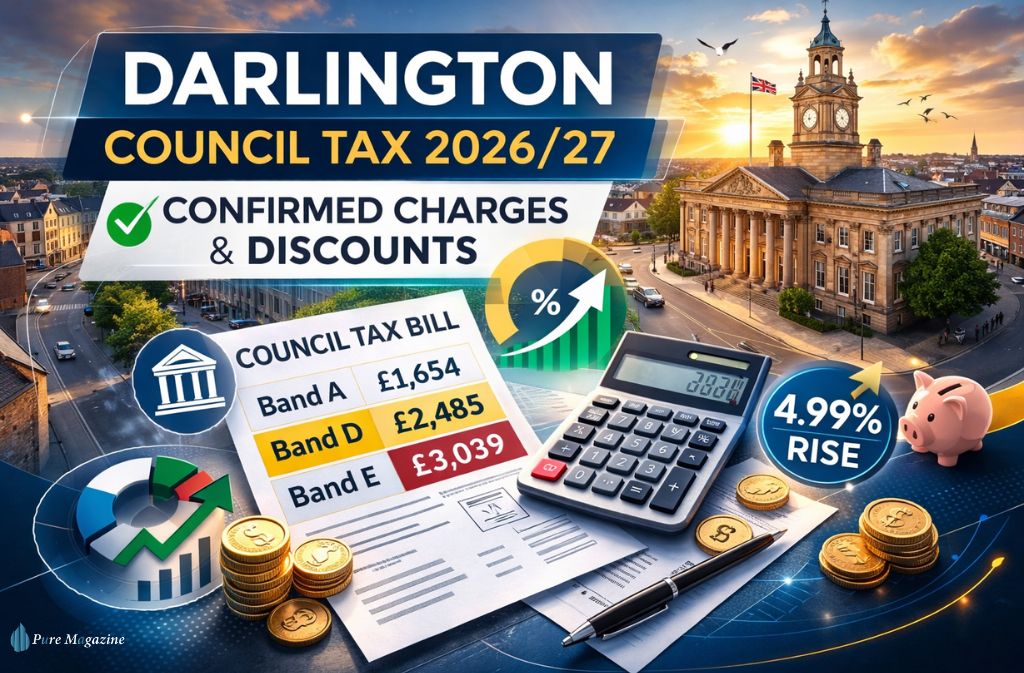
For 2026/27, Darlington Borough Council has officially confirmed a 4.99% increase. That’s made up of:
- 2.99% core council tax rise
- 2% Adult Social Care precept
But here’s the part most articles don’t explain clearly: what that actually means for you in pounds, why it’s happening, and how it fits into Darlington’s longer-term financial plan.
This guide gives you the confirmed 2026/27 figures, explains the Band D vs Band E difference properly, covers local exemptions (including the care leaver exemption), and breaks down what residents in parished areas need to know.
Let’s get into the real numbers.
Confirmed Darlington Council Tax 2026/27 (Non-Parish Areas)
Below are the official 2026/27 annual charges for properties not in a parish area, as confirmed in Darlington Borough Council’s official council tax charges page:
| Band | 2026/27 Annual Charge | Weekly Increase (Approx) |
|---|---|---|
| Band A | £1,654.02 | ~£1.49 |
| Band D | £2,484.81 | ~£2.31 |
| Band E | £3,038.93 | ~£2.86 |
These figures include the council element, Adult Social Care precept, fire and rescue contribution, and the Durham Police precept.
And yes — Band D remains the benchmark.
Band D vs Band E: Which Is More Expensive (and By How Much)?
This is one of the most searched questions about the Darlington Council Tax.
Band E is significantly more expensive than Band D.
For 2026/27:
- Band D: £2,484.81
- Band E: £3,038.93
That’s a difference of £554.12 per year.
Why? Because council tax bands are calculated proportionally using the national 1991 valuation system. Band E is set at 11/9ths of Band D. Understanding how council tax bands work and what each band means helps explain why the gap between adjacent bands isn’t equal — it widens as you move up the scale.
It’s not arbitrary. It’s formula-driven.
And in real life, that jump can feel steep — especially in a rising cost environment.
Why Is Darlington Council Tax Rising in 2026?
There are three major drivers.
1️⃣ Adult Social Care Pressures
The 2% precept is ringfenced for adult social care. With an ageing population across the North East, this cost continues to rise faster than general inflation.
2️⃣ Durham Police Precept Increase
In January 2026, the Durham Police and Crime Commissioner approved a 6% increase in the police precept.
For most households, that equates to roughly 24p–28p extra per week.
It’s a small weekly figure. But across the borough, it adds up.
3️⃣ Medium Term Financial Plan (MTFP) Gap
Darlington is currently facing a projected £13.5 million budget gap over the next four years. As confirmed in Darlington Borough Council’s Budget and Medium Term Financial Plan 2026–30, the 4.99% increase will raise £3.548 million of additional income to help provide vital services, alongside £2.937 million of identified savings for 2026/27.
The 4.99% increase is part of a wider stabilisation strategy under the council’s Medium Term Financial Plan.
That context matters. This isn’t a one-off rise. It’s part of a structured financial response to sustained funding pressures.
A North East Reality Check
Here’s something rarely mentioned.
Despite the near-5% rise, Darlington still has the second-lowest council tax in the North East region.
That doesn’t make your bill feel lighter.
But it does provide perspective.
Parish Areas: Your Bill May Be Higher
If you live in areas such as Hurworth, Heighington, or Bishopton, you will pay an additional parish precept on top of the main Darlington Council Tax charge.
Parish councils set their own budgets. That means two households in Band D could pay different totals depending on location.
Always check whether your bill includes a parish element.
The “Two Months You Don’t Pay” Myth — Explained Clearly
A common question: What two months do you not pay Council Tax?
Most households pay over 10 instalments (April–January). February and March are “payment-free” months because your bill has already been divided across ten payments. Understanding what months you don’t pay council tax and how the instalment system works helps clarify that you’re not exempt — you’ve simply paid earlier.
If you prefer smoother budgeting, you can request to spread payments across 12 months instead.
Single Occupancy Discount in Darlington
If you’re the only adult living in your property, you’re entitled to a 25% discount.
Example:
- Band D (£2,484.81)
- With 25% discount → £1,863.61
That’s a meaningful reduction.
You must apply. It is not automatic.
Council Tax Support (CTS) — The 80% Cap Explained
Council Tax Support is available for low-income residents. But here’s the nuance many miss:
- Working-age residents are capped at 80% maximum support
- Pensioners may qualify for up to 100% support
So even if you qualify as working-age, you’ll still need to contribute at least 20% of the bill.
For a full breakdown of eligibility criteria and how to apply, the council tax reduction guide covers the national framework that Darlington’s local scheme is built on.
In 2026, this distinction matters more than ever.
Care Leaver Exemption (Under 25)
Darlington has introduced a local exemption for care leavers under 25.
If you were previously in local authority care and meet the eligibility criteria, you may be fully exempt from council tax.
This is a locally significant policy — and one worth checking if it applies to you.
Renting in 2026: The HMO Nuance
If you live in a House in Multiple Occupation (HMO), the landlord is usually liable for council tax.
However, some newer “all-inclusive” rental contracts are shifting liability wording due to rising council tax costs.
Always check your tenancy agreement.
If you’re unsure, contact Darlington Borough Council directly before assuming responsibility.
How to Pay Darlington Council Tax (Safely)
The easiest way to pay is via Direct Debit. It’s the only method that ensures you don’t accidentally miss a payment and trigger a reminder notice. For a full breakdown of all available payment methods and what happens if you fall behind, the council tax pay guide covers the step-by-step process.
Other methods include online card payments, bank transfer, and the telephone system.
Missed payments can escalate quickly into reminder notices and, eventually, court costs.
If you’re struggling, contact the council early. They’re more flexible before enforcement begins.
Practical Ways to Reduce Your Bill Legally
Here’s what you can do right now:
✔ Check Your Band
Compare your property to similar neighbouring homes. If yours is clearly misbanded, you can challenge your council tax band through the Valuation Office Agency — the GOV.UK service lets you submit evidence online and is free to use.
✔ Apply for Single Person Discount
Many eligible residents forget.
✔ Apply for Council Tax Support
Especially if income has changed.
✔ Notify Changes Promptly
Moving, separation, tenancy changes — report them immediately.
Risks of Ignoring Council Tax
Council tax is an enforceable debt.
If unpaid, the council can issue reminder notices, apply for a liability order, instruct enforcement agents, and deduct from wages or benefits.
It moves faster than many people expect. Understanding how council tax enforcement works and what paying on time protects you from gives you the full picture before it becomes a problem.
FAQs
Q. How much is Band A council tax in Darlington for 2026/27?
Band A (non-parish areas) is £1,654.02 annually for 2026/27.
Q. How much is Band D council tax in Darlington?
Band D is £2,484.81 per year in 2026/27, before any discounts.
Q. Is Band E much higher than Band D?
Yes. Band E is £3,038.93 — around £554 more per year than Band D.
Q. Do you get two months free from council tax?
No. Most residents pay over 10 months, meaning February and March have no instalments, but the full annual amount is still paid. For more details on how the instalment calendar works.
Q. What is the maximum Council Tax Support in Darlington?
Working-age residents are capped at 80% support. Pensioners may receive up to 100%, depending on eligibility.
The Bigger Picture
Darlington Council Tax in 2026 isn’t just about a 4.99% increase.
It’s about adult social care demand, a £13.5m four-year budget gap, police funding increases, and a structured Medium Term Financial Plan.
And yet, even with these pressures, Darlington remains among the lowest council tax areas in the North East.
That doesn’t remove the pressure on households.
But understanding the numbers — the real ones — gives you clarity.
And clarity gives you control.
Good financial decisions depend on current, accurate information. That’s exactly what Pure Magazine delivers — across tax, savings, income, and beyond.