Every year, thousands of UK households sit on money they don’t know they’re owed.
It happens quietly — after a house move, a billing adjustment, a cancelled Direct Debit that ran a month too long. The overpayment lands as credit on a council tax account and stays there. The council rarely chases you to collect it. Most residents never realise it exists.
That credit belongs to you, and claiming it back is usually straightforward once you know where to look.
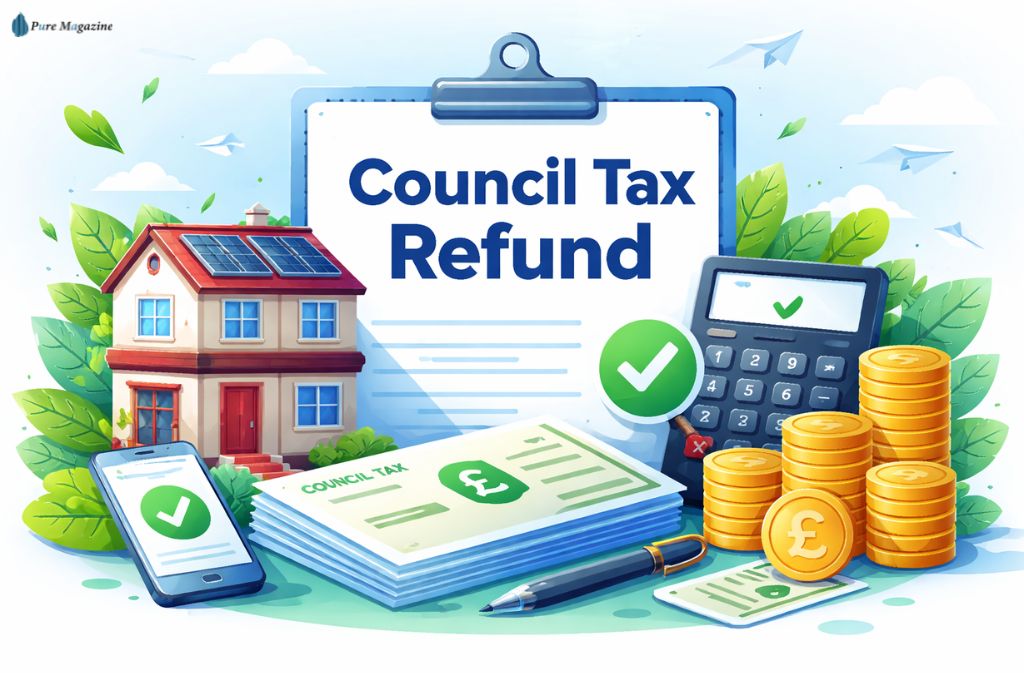
A council tax refund returns any overpaid amount from your local council to your bank account. But unlike an HMRC income tax correction, most councils won’t trigger the payment automatically. You need to ask.
As of 2026, with councils running digital portals and accounts, the request often takes minutes. This guide covers every part of the process — when you qualify, how to check, how to claim, how long it takes, and the pitfalls that delay payments.
What Is a Council Tax Refund?
A council tax refund is the return of money you paid above your actual council tax liability for a given period. When more is added to your council tax account than the billing requires, a credit builds up. The council holds that credit until you either request a refund or it offsets against a future bill.
Common reasons a credit appears:
- You moved out, but payments continued
- Your council tax band was reduced
- You paid twice by mistake
- Your property qualified for a council tax reduction
- You switched payment methods and overpaid
- The council adjusted your bill after a review
- Your property became exempt or empty
As MoneySavingExpert’s January 2026 council tax refund guide explains, councils often close credit accounts without issuing a refund — particularly when residents move away without leaving a forwarding address, or when they paid by standing order rather than Direct Debit. The credit doesn’t disappear; it sits on the closed account until someone claims it.
2026 Policy Alert: New Refund Triggers
Discretionary relief for terminally ill residents
Some councils expanded relief schemes from April 2026 for residents with severe health conditions. In certain circumstances that can mean reduced council tax liability, discretionary relief, or retroactive refunds covering previous billing periods. Carers and family members should contact the council’s discretionary relief team directly to check eligibility.
Energy efficiency incentive refunds
Some councils now offer temporary council tax discounts or one-off refunds for households that have completed major energy upgrades — heat pump installations, solar systems, or whole-home insulation retrofits. These incentives form part of local net-zero initiatives and vary significantly by council. If you’ve recently upgraded your home’s energy efficiency, it’s worth asking your council whether retroactive council tax adjustments apply.
How to Check Whether Your Account Is in Credit
Before requesting anything, confirm the credit exists.
Online portal: Most councils run a digital account where you can view payment history, check your current balance, and see credit amounts. Look for wording like account in credit, balance brought forward, or refund due on your most recent bill or account summary.
Contact the council directly: A call or online enquiry to the council tax department takes a few minutes and confirms exactly where your account stands.
Council apps: Many UK councils now operate mobile apps with real-time payment tracking and automated credit alerts. Some systems automatically prompt you to request a refund when a credit appears — check for any notifications before submitting a manual request.
How to Claim a Council Tax Refund: Step by Step
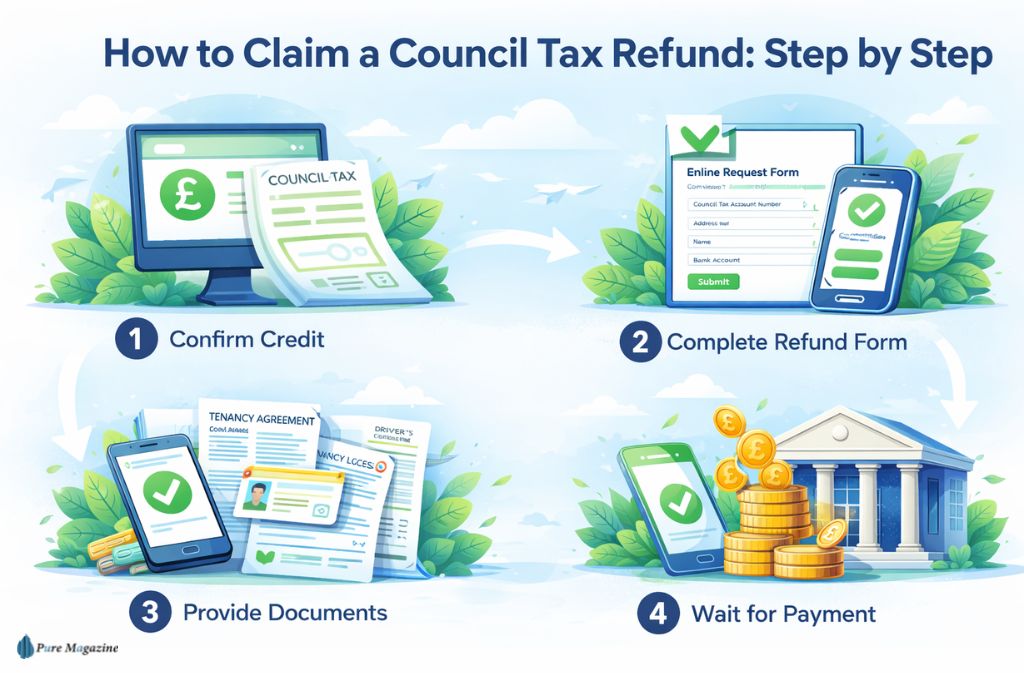
Step 1: Confirm the credit
Log in to your council portal or review your latest bill. The credit balance needs to be confirmed before the council will action a refund request.
Step 2: Complete the refund form
Most councils offer an online refund request form. As MoneySavingExpert’s 2026 guide notes, searching “[your council name] council tax refund form” usually lands you directly on the right page — about half of UK councils have a direct online claims route. You’ll typically need:
- Council tax account number
- Property address
- Name of the liable person
- Bank account details
- Reason for the refund
Step 3: Provide supporting documents
Some councils ask for tenancy agreements, proof of address change, property sale documents, or identity verification, depending on the refund circumstances.
Step 4: Wait for council verification
After submission, the council verifies the account and processes the payment — typically by bank transfer, though some councils have moved away from cheques entirely. As Wirral Council’s refund policy confirms, refunds are now paid exclusively by bank transfer to a UK current account — savings accounts and cheques no longer accepted — and any credit is first checked against outstanding council tax on other accounts you hold with the same authority.
How Long Does a Council Tax Refund Take?
| Refund Method | Estimated Time |
|---|---|
| Online refund request | 7–14 days |
| Standard processing | 14–28 days |
| Complex cases | Up to 6 weeks |
Council workload, verification checks, and any outstanding account disputes all influence the timeline. Submitting online and having bank details ready from the start consistently produces the fastest result.
How Far Back Can You Claim?
There’s no single national rule capping refund claims, but the practical limits depend on why the overpayment occurred.
| Scenario | Possible Backdating |
|---|---|
| Moving house overpayment | Current financial year |
| Billing errors | For several years, where records exist |
| Band reduction | Backdated to the date of the band change |
| Duplicate payments | Usually refundable whenever records confirm |
For band-related refunds, the backdating question involves the VOA. As GOV.UK’s step-by-step council tax band challenge guide explains that there are two challenge types: a formal proposal (available if you’ve been paying for under six months, or if the VOA changed your band recently) and an informal band review (available at any time, though the VOA is only required to act if you provide strong supporting evidence). A successful challenge typically backdates the refund to the date the band changed, not the date you filed the claim — making early challenges considerably more valuable.
The 20-Year Rule Explained
Council tax debt can legally be pursued for up to 20 years in England and Wales. Refund claims work differently. While councils hold that recovery power for decades, refund claims depend on available records, the reason for the overpayment, and administrative policy at each council. Very old cases may require manual investigation, but a claim is always worth submitting — councils can only say no, and they sometimes find credits that residents assumed were long gone.
Real-World Example
A tenant in Birmingham moved out of a rented property but forgot to cancel their Direct Debit. Payments continued for two months after leaving. After contacting the Birmingham City Council tax department:
- The account was recalculated from the leaving date
- A £260 credit appeared
- An online refund request was submitted
- The council issued the refund within 10 working days
This scenario plays out constantly when people move mid-year. The council-tax-pay guide covers how payment methods interact with account credits and how to avoid the Direct Debit gap problem in the first place.
Common Mistakes That Delay Refunds
Requesting before account updates are processed If the council hasn’t yet processed your address change or band revision, the system still shows the old charges. The credit won’t appear until the account catches up.
Incorrect bank details. A single-digit error sends the payment for manual investigation. Double-check sort code and account number before submitting.
Outstanding arrears. If your account carries council tax debt — on this property or another in the same council area — the credit will offset against it first. As Wirral Council’s policy confirms, all credits are checked against other outstanding council tax accounts before any refund is issued.
The Joint Liability Problem
Many council tax accounts list multiple residents as jointly liable. When that’s the case, as Harrow Council’s refund policy confirms, all named parties must sign off before a refund is transferred — councils will not pay one person without confirmation from all liable residents. This creates delays when housemates have moved away, couples have separated, or a co-tenant can’t be contacted. Some councils require a digital “Instruction to Pay” from every named resident. If one person is unreachable, the council may hold the credit or divide it between parties.
HMRC Data Sharing and Refund Pauses
Local councils increasingly share data with HMRC and DWP. If your council tax reduction changes because of Universal Credit updates or income reporting changes, the council may temporarily pause refund processing while the account is recalculated. If your request seems stuck, ask the council directly whether a benefits adjustment or income verification check is holding it up.
Council Mergers and Successor Authorities
Several UK regions are restructuring into unitary or merged councils. If the council that originally billed you no longer exists, refund claims pass to the successor authority. The GOV.UK council finder tool identifies the correct current authority for any postcode.
Why Councils Rarely Refund Automatically
With councils increasing rates by 5–7% across much of England in 2026 due to rising service costs and financial pressures, budgets are tight. Refunds happen when residents ask. The system rarely prompts councils to volunteer payments outward, which is why checking your account balance every April, when new annual bills land, is the simplest and most reliable way to catch overpayments before they age into administrative complexity.
Quick Checklist
- ✔ Your council tax account is in credit
- ✔ You have your council tax account number
- ✔ Your bank details are ready
- ✔ The council has processed any recent address changes
- ✔ You’ve checked for outstanding arrears that might offset the credit
- ✔ All jointly liable residents have been notified if applicable
FAQs
Q. How long does a council tax refund take?
Most councils process within 7–28 days after verifying the account and bank details. Complex cases or joint liability accounts can stretch to six weeks.
Q. How do I request a council tax refund online?
Search “[your council name] council tax refund form” — as MoneySavingExpert’s 2026 guide notes, this lands directly on an online claims form for roughly half of UK councils. You’ll need your account number, bank details, and the reason for the overpayment.
Q. Can I claim a refund if I moved house?
Yes. Where payments continued after you left, the council recalculates liability from the moving date and refunds the difference. The GOV.UK council finder helps locate the right authority if you’re unsure who to contact.
Q. What happens if my council tax account is in credit?
You can request a refund or leave the credit to reduce future instalments. Most councils won’t act without a prompt from you.
Q. Can councils refuse a council tax refund?
Refunds can be delayed by outstanding arrears, joint liability disputes, or account verification issues — but a clean credit balance with no complications is almost always refundable.
Q. Can a council tax band change trigger a backdated refund?
Yes. A successful VOA band challenge typically backdates the refund to the date the band change took effect — making it worth challenging sooner rather than later.
Conclusion
A council tax refund recovers money that’s already yours — sitting dormant on an account most people never think to check.
After a house move, a successful band challenge, or a billing correction, the process in 2026 runs quickly for most people: confirm the credit, submit the online form, and wait one to four weeks. The complication usually isn’t the refund itself — it’s not knowing the credit existed.
Log in to your council portal. If the balance is in credit, request the refund the same day. Set a reminder each April when new bills arrive to do it again. That simple habit returns money most households never realise they’re owed.
For reliable, plain-English guidance on UK tax and personal finance in 2026, Pure Magazine is the resource worth bookmarking.