Moving house is stressful enough. Council Tax is one of those things people assume will sort itself out — and that’s how you end up paying twice, missing a bill, or triggering a reminder notice.
Every year, UK councils issue millions of correction bills because people move home without updating their Council Tax properly. The process isn’t hard, but it is precise — and getting the dates wrong can cost you money.
This guide explains exactly what to do with Council Tax when moving house, step by step. You’ll learn how to cancel Council Tax at your old address, register at your new one, avoid empty property charges, and handle moves across different council areas — all using 2026 rules and best practices.
Unlike generic council pages, this article focuses on real-world situations: overlapping tenancies, delayed completions, empty homes, and common mistakes that trigger fines. If you want a clear, no-nonsense answer to “What do I do about Council Tax when moving house?”, you’re in the right place.
Council Tax Moving House: What You’re Actually Responsible For
When you move home, Council Tax does not transfer automatically. Each property has its own account, bill, and liability period.
You are responsible for:
- Paying Council Tax up to the date you move out
- Registering and paying Council Tax from the date you move in
- Notifying each relevant council separately
If you’re moving between council areas (for example, Vale of White Horse to Oxford, or London to Waverley), you must deal with two different authorities.
Step-by-Step: What to Do About Council Tax When Moving House
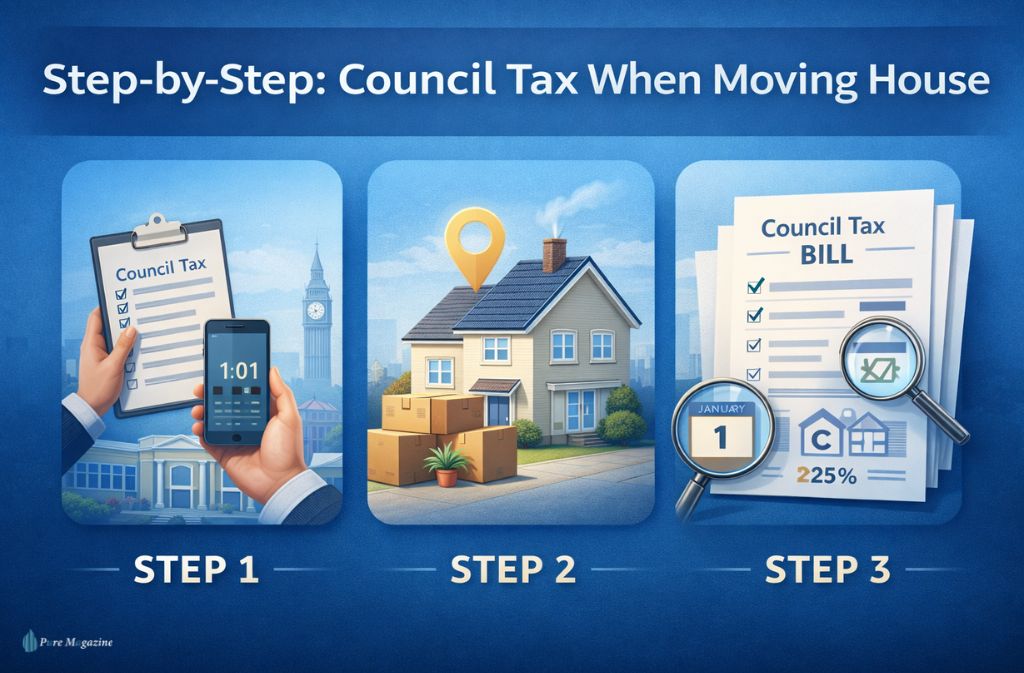
Step 1: Tell Your Old Council You’re Moving Out
You must inform your current council as soon as your move date is confirmed.
Most councils ask for:
- Your Council Tax account number
- Your move-out date
- A forwarding address
- The name of the new occupier (if known)
Once processed, your old Council Tax account is closed, and a final bill is issued.
Tip: If you’re selling, liability usually ends on completion day. If you’re renting, it ends on the last day of your tenancy — not when you hand back the keys.
Step 2: Register for Council Tax at Your New Address
You must register for Council Tax even if:
- The property is empty
- You’re waiting for furniture
- You haven’t received a bill yet
You’ll need:
- Move-in date
- Property address
- Occupants’ names
- Tenancy or ownership status
Each council has its own online form (e.g., Council Tax moving house Peterborough, Elmbridge, Northampton, and London boroughs).
Step 3: Check Your First Bill Carefully
Your first bill should show:
- Correct start date
- Correct Council Tax band
- Any single person discount (25%)
- Correct payment schedule (10 or 12 months)
Mistakes are common when people move mid-month.
Do I Have to Pay Council Tax on Two Properties?
Sometimes — but often only temporarily.
| Situation | Do you pay twice? |
|---|---|
| Overlapping tenancy | Yes |
| Delayed completion | Possibly |
| Empty property (owned) | Yes (usually) |
| Empty rental after tenancy ends | No |
| Second home | Yes (often higher rate) |
Some councils charge 100%–200% premiums on long-term empty homes (as of 2026).
How to Cancel Council Tax When Moving House (UK)
Council Tax is cancelled by:
- Submitting a move-out notification
- Providing the exact date
- Receiving a final bill or refund
You cannot cancel Council Tax by:
- Cancelling Direct Debit alone
- Ignoring the bill
- Assuming the new owner will handle it
Doing so risks arrears and enforcement letters.
What Happens If You Leave a Property Empty?
Empty homes are rarely exempt anymore.
Typical 2026 rules:
- 0–1 month empty: Full charge
- 1–12 months empty: Full charge
- Over 12 months: Premium applies
- Second homes: Often 100%+ charge
Discounts depend entirely on your council area.
How to Legally Not Pay Council Tax (UK)
You can only avoid Council Tax legally if:
- The property qualifies for a statutory exemption
- You’re eligible for a discount
- You’re not the liable person
Common legal reductions:
- Single person discount (25%)
- Student exemption
- Severe mental impairment exemption
- Armed forces accommodation
- Property undergoing major structural repair (limited)
There is no loophole for simply not registering.
Council Tax Moving House by Council Area
The process is the same everywhere, but portals differ.
Popular searches include:
- Council tax moving house Vale of White Horse
- Council tax moving house Breckland
- Council tax moving house Peterborough
- Council tax moving house Elmbridge
- Council tax moving house Northampton
- Council tax moving house Waverley
- Council tax moving house in London
Each council requires its own form, even within the same county.
Related: Harlow Council Tax 2026: Complete Guide to Bands & Payments
Common Council Tax Moving House Mistakes
These mistakes cause most fines and backdated bills:
- ❌ Forgetting to register at the new address
- ❌ Wrong move-in or move-out date
- ❌ Cancelling Direct Debit instead of the account
- ❌ Assuming Council Tax follows you automatically
- ❌ Ignoring empty property rules
- ❌ Not claiming discounts again after moving
Council Tax Moving House Checklist (Save This)
✅ Notify old council
✅ Record exact move-out date
✅ Register with the new council
✅ Apply for discounts again
✅ Check the first bill
✅ Set up payment plan
✅ Keep confirmation emails
FAQs
Q. How do I cancel Council Tax when moving house?
To cancel Council Tax when moving house, you must notify your local council using their official move-out or change-of-address form. Provide your move-out date, forwarding address, and Council Tax account number. The council will close your account and issue a final bill or refund if applicable.
Q. Do I need to tell both councils when moving house?
Yes. You must notify both your old council and your new council. UK councils do not share Council Tax data. Failing to inform one can result in backdated charges, reminder notices, or enforcement action.
Q. What if I move within the same council area?
Even if you move within the same council area, you still need to report the change. Council Tax is property-specific, not person-based. Your old account is closed and a new Council Tax account is created for your new address.
Q. Do I have to pay Council Tax if my house is empty?
Usually yes. Most UK councils no longer offer empty property discounts. Empty homes are typically charged at the full Council Tax rate, and long-term empty properties may incur additional premiums, depending on the council’s 2026 policy.
Q. What happens if I don’t register for Council Tax after moving?
If you don’t register, the council will backdate your Council Tax charge to your move-in date. This can lead to arrears, penalty notices, and enforcement letters. Not receiving a bill does not remove your legal responsibility to register.
Q. Is Council Tax charged daily or monthly?
Council Tax is charged daily, not monthly. Although bills are paid in monthly instalments, liability is calculated per day. This means move-in and move-out dates matter, especially when moving mid-month.
Q. Can I change my Council Tax details online?
Yes. Nearly all UK councils allow you to register, cancel, or change Council Tax online using a digital change-of-address form. Online updates are the fastest way to avoid billing errors and ensure your account is updated correctly.
Final Thoughts
Council Tax moving house isn’t complicated — but it is unforgiving if you get it wrong. Dates matter. Forms matter. And assuming it’ll “sort itself out” is the fastest way to overpay.
Handle it early, keep records, and double-check your first bill. Do that, and Council Tax becomes one less thing to worry about during your move.
Related: What Months Do You Not Pay Council Tax? UK 2026 Guide