Council tax sits among the most unavoidable household bills in the UK — yet managing it online still trips people up every year. The login page looks different on every council’s website. The account number is buried in a drawer. And when something changes — a move, a new housemate, a discount that should be applied — knowing where to make that change without spending twenty minutes on hold isn’t always obvious.
That confusion is why hundreds of thousands of people search each month for phrases like council tax account login, how to find my council tax account number, and my council tax account. The questions are basic. The answers shouldn’t require this much searching.
This guide covers how UK council tax accounts work in 2026, how to register and log in, where to find your account number, what you can actually do inside the portal, and what to do when things go wrong.
What Is a Council Tax Account?
A council tax account is the official record your local authority maintains to track the tax charges, payment history, and billing details for your property. Every residential property in the UK has one, tied to its address and valuation band.
Inside a typical account, residents can view their current balance, download annual bills, track previous payments, set up or update Direct Debit, apply for discounts and exemptions, and report household changes.
Each account carries a unique council tax account number — sometimes called a reference number — that lets the council locate your property record instantly.
As GOV.UK’s council tax payment page confirms that council tax is administered locally, which is why every council runs its own portal, its own login process, and its own interface. There’s no single national system — just a consistent structure most councils follow.
How to Access Your Council Tax Account Online
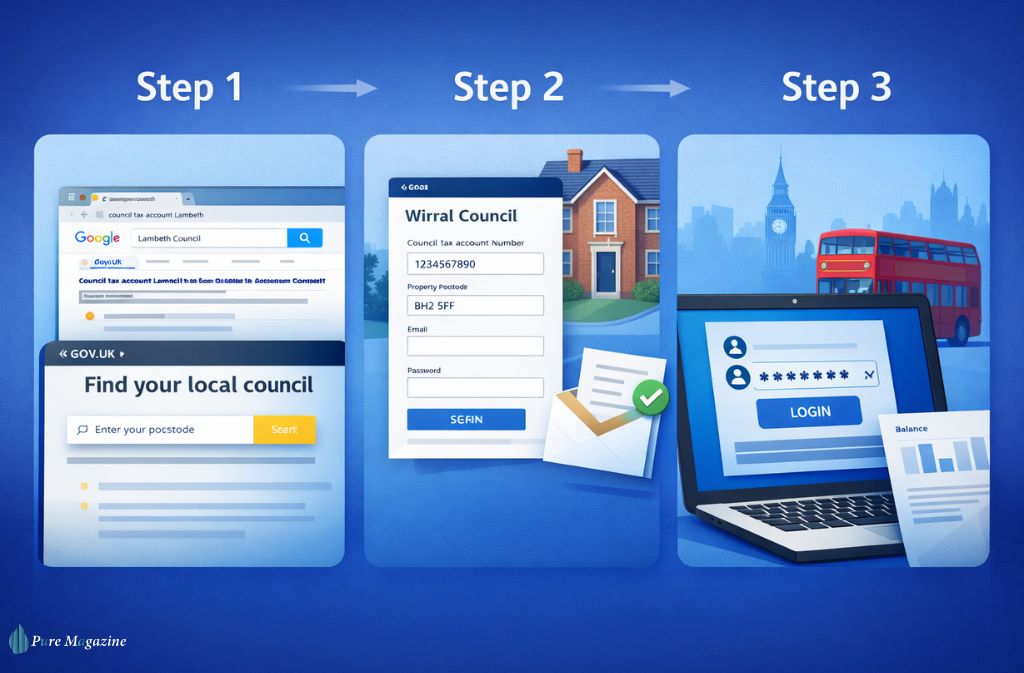
Step 1: Find your council’s website
Search your borough name and “council tax account” — for example, council tax account Lambeth or council tax account Greenwich. On the council’s site, look for sections labelled “Council Tax”, “Manage Your Council Tax”, “My Account”, or “View Your Council Tax Account”. Each leads to the same place: the login portal.
GOV.UK’s find your local council tool locates the correct authority for any postcode in seconds — useful if you’ve moved recently or aren’t sure which council covers your address.
Step 2: Register for online access
First-time users need to register. As Wirral Council’s portal confirms, you’ll need your council tax account number (on your bill), your property postcode, an email address, and a password. Once verified, the account dashboard opens.
Step 3: Log in as a returning user
Email address or username, password, and occasionally the council tax account reference number. After login, the dashboard shows the current balance, payment schedule, and billing history.
How to Find Your Council Tax Account Number
This is the most common stumbling block when registering. The number appears on several official documents:
- Annual council tax bill — issued each March for the upcoming financial year, with the account number displayed prominently near the top.
- Reminder notices — payment reminders and adjustment letters repeat the same reference.
- Direct Debit confirmation — if you pay by Direct Debit, the setup confirmation letter or email typically includes it.
- Inside an existing online account — if you’ve registered previously, the reference often sits within profile or account settings.
Lost your number? Call or email your council with your full property address, postcode, and name. Council staff can locate the record and resend the reference within minutes.
What You Can Do Inside the Account
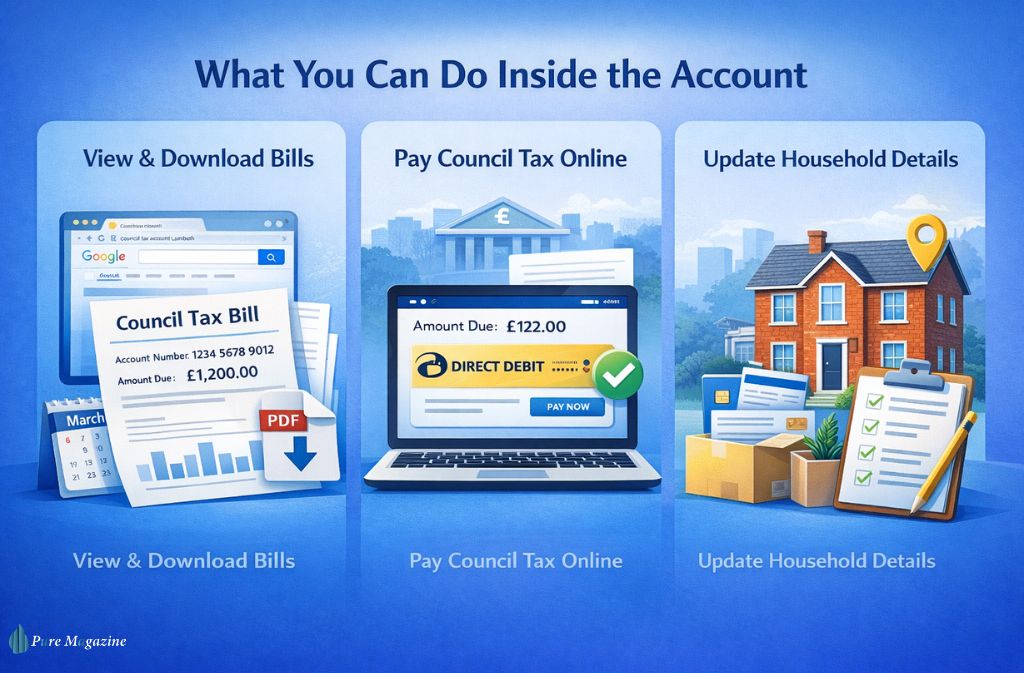
View and download bills
New bills land in accounts from early March for the April start of each financial year. As Milton Keynes City Council confirmed when issuing 2026/27 bills on 6 March 2026, residents who signed up for e-billing receive their bill electronically rather than by post, but must have an active online account to view it. Residents who haven’t yet signed up continue receiving paper bills but miss the ability to access historical statements instantly.
Inside the account, you can view the latest annual bill, download a PDF copy, review previous years’ statements, and confirm the instalment schedule for the year ahead.
Pay council tax online
As confirmed on GOV.UK’s council tax payment guide, Direct Debit, is the council’s recommended method — payments are collected automatically on a date you choose, spreading the cost across ten or twelve monthly instalments without any action required after setup. Other options include one-off card payments through the online portal, online bank transfer, and payments via PayPoint or the Post Office.
Update household details
Report a house move, notify the council that someone has moved in or out, or apply for a discount or exemption — all without calling. The sooner these changes go in, the sooner the bill reflects the correct position.
Council Tax Bill as Proof of Address
One benefit most residents overlook: a council tax bill downloaded from the online account carries significant weight as proof of address in 2026.
Because a government body issues the document, includes your name and full property address, and carries the local authority’s branding, many financial institutions treat it as one of the most trusted verification documents available. Bank account openings, mortgage applications, financial Know Your Customer checks, utility setups, and insurance applications all commonly accept it.
Keeping the most recent annual bill saved as a PDF — downloadable in seconds from the account — removes the delay the next time any identity verification is needed.
Pro Tip: Check Your Account in the Last Week of March
Council tax operates on an April-to-March annual cycle. Updated rates are typically published between February and March, and the new bill for the upcoming year appears in the online account shortly before April.
Reviewing the account in late March takes two minutes. It confirms whether payments will increase, whether the Direct Debit amount has been updated, whether any discounts or exemptions still apply, and whether the annual bill is ready to download for records.
For Direct Debit payers, the new amount usually starts with the first April collection. Checking beforehand prevents unexpected changes from catching you off guard.
Comparison: Ways to Manage Council Tax
| Method | Convenience | Speed | Best For |
|---|---|---|---|
| Online council tax account | Very high | Instant | Most residents |
| Direct Debit payments | High | Automatic monthly | Long-term payment plans |
| Phone payments | Moderate | Immediate | Quick one-off payments |
| Council office visit | Low | Slower | Complex account issues |
Common Problems and How to Fix Them
Forgotten login details — most councils allow password resets through email verification. If the email address has changed, contact the council to update the account’s registered address before attempting a reset.
Missing bills — if a bill isn’t visible online, it may still be processing through the postal system, or the new tax year update hasn’t landed yet. Check again a few days after the expected issue date again; Milton Keynes noted that 2026/27 bills were issued on 6 March with deliveries continuing through the following week.
Duplicate accounts — accidentally creating multiple accounts with different email addresses creates confusion when viewing records. Contact the council to merge or close the duplicate.
When the Account Number Doesn’t Work
Occasionally, a council tax account number returns an error during online registration even when it’s been copied correctly. This can follow property changes — a house divided into flats, separate flats merged back into a single property, or records updated by the council.
When that happens, the account number on an older bill may no longer match the current property record. GOV.UK’s council tax band checker shows the current official band and billing authority reference for any property in England and Wales — useful for confirming whether the record has changed. If the property listing has been updated, the council can issue a new account number linked to the current record.
Checking and Challenging Your Council Tax Band
Your band determines your annual bill, and a significant number of properties are in the wrong one. As MoneySavingExpert’s council tax band challenge guide notes, evidence from similar neighbouring properties is the most effective basis for a challenge — Rightmove, Zoopla, or Nationwide price data cannot be used.
For England and Wales, GOV.UK’s challenge your council tax band page covers both the formal proposal route and the informal review process. For Scotland, challenges go to local assessors through the Scottish Assessors Association. As the VOA confirms, you must continue paying at the current band rate while any challenge is under consideration.
If a successful challenge reduces your band, the council-tax-reduction guide covers how that change interacts with any existing reduction scheme you’re receiving.
Common Mistakes Residents Make
Not registering for the online account at all — without digital access, everything depends on paper bills and phone calls. As Solihull Council noted when relaunching its portal in January 2026, online accounts now offer faster sign-in, enhanced security, and direct update capabilities that phone-based management can’t match.
- Losing the account reference number — required for registration, payments, and verification. Store it somewhere accessible.
- Not updating the account after moving — incorrect billing or delays closing an old account follow automatically when the council doesn’t know you’ve left.
- Missing discounts — single-occupancy 25% reduction, student exemption, and council tax reduction for low-income households — all require an application. None are applied automatically.
Expert Tips
Store your council tax account number in a secure, accessible location — a password manager works well. Enable email notifications if the council offers them. Check the account each March before April bills activate. Set up Direct Debit to eliminate missed payment risk. Download and save the annual bill every year for proof-of-address purposes.
FAQs
Q. What is a council tax account?
The official record your local council maintains tracking council tax charges, payments, and billing history for your property. Managed through your council’s online portal — find the right one via GOV.UK’s local council finder.
Q. How do I log into my council tax account?
Visit your local council’s website and navigate to the council tax section. Enter your email address and password. First-time users must register using the account number on their bill.
Q. How can I find my council tax account number?
On your annual council tax bill, reminder notices, or Direct Debit confirmation letters. Lost it? Contact your council with your address and postcode.
Q. Can I pay council tax without logging in?
Yes — as GOV.UK confirms, one-off card payments and bank transfers don’t require a registered account. But managing payments over time is significantly easier with one.
Q. What happens if I miss a council tax payment?
The council sends a reminder notice. Continued non-payment may result in enforcement action, as GOV.The UK council tax arrears page confirms that contacting the council early about payment difficulties opens options that aren’t available once enforcement begins.
Q. Can a council tax bill be used as proof of address?
Yes — widely accepted by banks, mortgage lenders, and financial services for identity verification.
Q. Can I check my council tax account from my phone?
Most councils now run mobile-friendly portals, and some have dedicated apps. Full account functionality — balance checks, bill downloads, and Direct Debit management — is available on smartphones.
Conclusion
The council tax account is where every billing interaction with your local authority lives. Once registered, it replaces most reasons to call the council — bills, payments, discounts, address changes, and proof-of-address documents are all accessible in minutes.
Register, find your account number, check your band, and make sure any discounts you’re entitled to are actually applied. A straightforward 20-minute exercise at the start of each tax year keeps council tax working the way it should.
For reliable, plain-English guidance on UK tax and personal finance in 2026, Pure Magazine is the resource worth bookmarking.
Related: