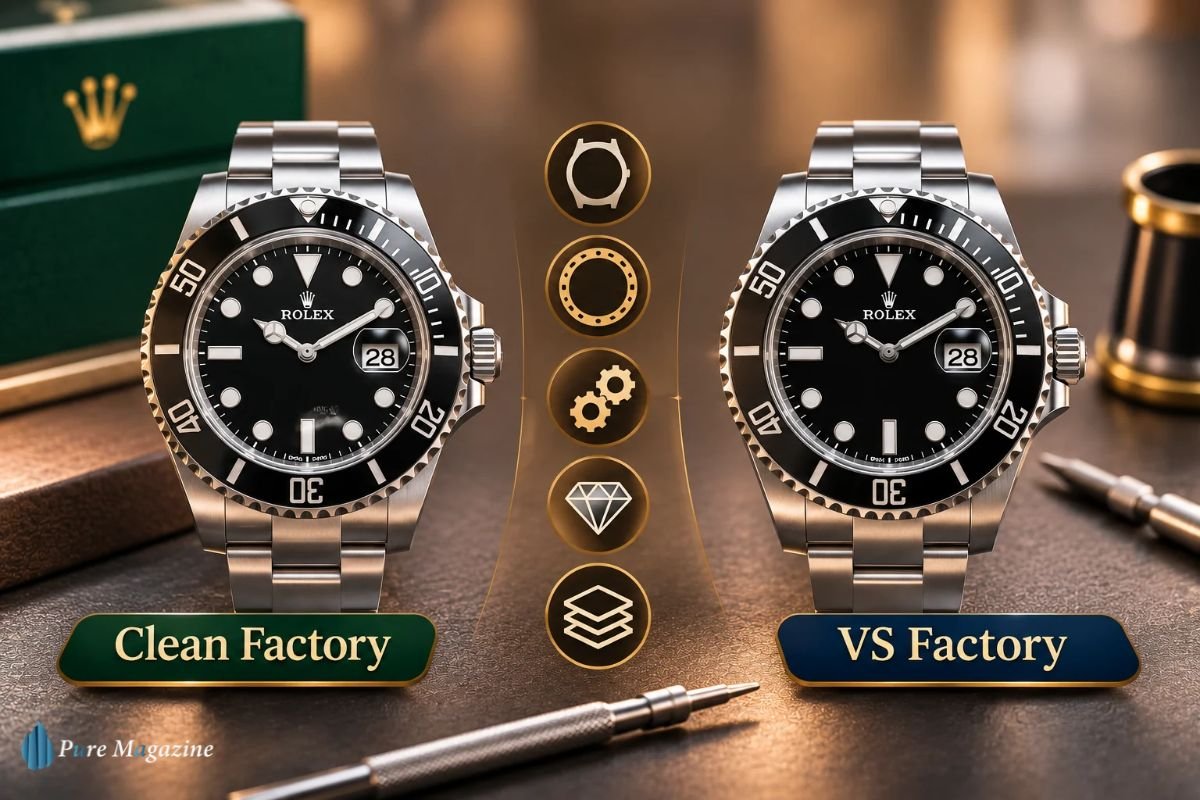
The replica watch industry has undergone significant changes as manufacturers attempt to reproduce increasingly complex luxury timepieces. Among the names frequently discussed by watch enthusiasts, Clean Factory and VS Factory, commonly known as VSF, have attracted particular attention for their interpretations of Rolex sports watches.
Both have been associated with detailed exterior construction, automatic movements, and models inspired by the Submariner, Datejust, and GMT-Master II collections. However, despite their similar objectives, they have developed different reputations within the replica watch community.
Understanding these differences requires more than comparing photographs. Movement architecture, case finishing, crystal quality, and manufacturing consistency all influence how a watch performs and feels during everyday use.
Understanding Clean Factory and VS Factory
Clean Factory and VS Factory are names associated with independent replica watch production rather than officially recognized divisions of any Swiss luxury watchmaker.
Clean Factory has traditionally been associated with detailed external finishing, particularly case construction, ceramic bezels, and the visual presentation of certain Rolex-inspired models.
VS Factory, meanwhile, has developed a reputation among enthusiasts for its use of VS-series automatic movements and attention to crystal clarity, especially in Submariner and Datejust-style watches.
These reputations should not be interpreted as universal quality rankings. Specifications may change between production batches, and products sold under the same factory name do not necessarily contain identical components.
Online catalogs such as AllReplicaWatches.is illustrate how extensively the replica watch market has expanded across different luxury watch styles. However, identifying a product’s actual manufacturing origin requires more than relying on a factory name or promotional description.
The most useful comparison therefore focuses on individual components and their measurable characteristics.
Case Manufacturing and Structural Precision
Case construction is one of the most important factors influencing the overall appearance of a mechanical watch.
Modern Rolex sports models rely on carefully controlled dimensions, precisely shaped lugs, and consistent transitions between polished and brushed surfaces. Even minor differences in these areas can affect how a watch looks on the wrist.
Clean Factory has often received favorable attention for its case geometry and exterior finishing. Its better-known interpretations aim to reproduce recognizable elements such as lug profiles, crown guards, and the relationships between case and bezel.
VS Factory also produces cases designed around similar proportions, although comparisons may reveal differences in lug curvature, case thickness, and finishing consistency.
Material specifications deserve separate consideration.
Both factory names are frequently associated with watches advertised as using 904L stainless steel, a corrosion-resistant alloy family also used in genuine Rolex Oystersteel cases.
However, visual inspection cannot confirm steel composition. Reliable verification requires appropriate material analysis, and the presence of a particular alloy does not automatically establish superior finishing or manufacturing precision.
For this reason, case quality is better evaluated through dimensions, surface consistency, component fit, and actual workmanship.
Ceramic Bezels and Color Accuracy
The rotating bezel plays an essential role in the appearance and functionality of many Rolex sports watches.
On genuine Submariner models, Rolex uses a unidirectional bezel incorporating a ceramic Cerachrom insert. GMT-Master II models feature a bidirectional 24-hour bezel, including distinctive two-color ceramic configurations.
Reproducing these designs presents several manufacturing challenges.
Ceramic color must remain consistent across the surface, while engraved numerals and markers require accurate positioning. The bezel mechanism must also provide controlled rotation without excessive movement.
Clean Factory has traditionally been regarded favorably by some enthusiasts for its bezel appearance, particularly on Submariner and GMT-Master II interpretations.
VS Factory has also developed competitive bezel designs, although the results depend on the specific reference and production version.
Color accuracy can be especially difficult to judge from photographs because lighting conditions significantly influence the perceived shade of ceramic components.
A comparison under consistent natural lighting is generally more informative than examining images produced under different studio conditions.
VS3235 vs VR3235: Understanding Movement Differences
Mechanical movements represent one of the most significant technical distinctions discussed in Clean Factory and VS Factory comparisons.
VS Factory is commonly associated with the VS3235 automatic movement, which is designed to imitate aspects of the Rolex Calibre 3235 architecture.
The genuine Rolex 3235 offers approximately 70 hours of power reserve and incorporates the manufacturer’s Chronergy escapement and other proprietary technologies.
Certain VS3235 movements are advertised with similarly extended power reserves. However, the actual performance of an individual movement depends on manufacturing tolerances, mainspring characteristics, lubrication, and regulation.
Clean Factory models have been associated with various movement families, including VR3235 and other 3235-style automatic calibres.
The term VR3235 generally refers to a replica movement intended to resemble the layout or functionality of the genuine Rolex 3235. Its construction and power-reserve characteristics may differ from those of the VS3235.
Importantly, the movement installed in a particular watch cannot always be established from the factory name alone.
A meaningful technical comparison should consider timekeeping accuracy, winding efficiency, date-changing behavior, power reserve, and the availability of replacement components.
Decorative movement finishing may contribute to visual resemblance, but it does not guarantee the same precision or service life as the genuine Swiss calibre.
Crystal Quality and Dial Presentation
The sapphire crystal is another important element because it influences the appearance of everything beneath it.
A well-produced crystal should provide clear visibility across different viewing angles without excessive distortion.
In date-equipped watches, the position and optical characteristics of the magnifying lens are particularly noticeable.
VS Factory has frequently been praised in enthusiast comparisons for crystal clarity and date magnification on certain Submariner and Datejust models.
Clean Factory has also produced visually convincing crystals and dial assemblies, although differences in magnification, reflections, and positioning have been reported between versions.
The dial itself introduces additional manufacturing considerations.
Hour markers should exhibit consistent placement, printed text should remain sharp, and hands should align correctly with the dial layout.
Luminous material presents another challenge. Two watches may appear nearly identical in daylight but display different brightness or longevity in low-light conditions.
These differences demonstrate how several small manufacturing decisions can influence the visual quality of a finished watch.
Bracelet Construction and Clasp Engineering
Bracelet quality is often overlooked when comparing replica watches, yet it has a direct effect on comfort and durability.
A well-manufactured bracelet should combine smooth articulation with consistent link spacing and properly finished edges.
Clean Factory has developed a favorable reputation among some reviewers for external bracelet finishing and clasp presentation.
VS Factory bracelets can also offer convincing construction, but their precise characteristics vary depending on the model.
Several factors deserve attention during a technical evaluation.
The bracelet should move naturally without excessive lateral play. Brushed surfaces should remain consistent across adjacent links, and polished components should display clean boundaries.
The clasp should operate securely, while adjustable extension mechanisms should function without unusual resistance or looseness.
These mechanical details often become more significant during daily wear than minor differences in dial printing or decorative elements.
Submariner, Datejust, and GMT-Master II Comparisons
The differences between Clean Factory and VS Factory become easier to understand when examining specific watch categories.
The Submariner places considerable emphasis on case proportions, bezel operation, crystal appearance, and movement reliability.
The Datejust introduces additional visual challenges through its fluted bezel options, dial variations, date magnification, and Jubilee bracelet construction.
The GMT-Master II requires particular attention to its two-color bezel and the operation of its additional time-zone display.
Collections categorized as Replica rolex watches demonstrate the variety of designs and movement configurations associated with these different models.
For the Submariner, VS Factory has often been associated with movement-focused comparisons, while Clean Factory has attracted attention for bezel and exterior finishing.
In GMT-Master II discussions, Clean Factory has historically been a prominent name, particularly regarding bezel execution and the use of movements designed to reproduce GMT functionality.
However, these distinctions are not fixed across all production generations. A newer release may use different movement suppliers or updated components, changing the relative strengths of individual versions.
This makes reference-specific evaluation more useful than treating either factory as the automatic winner across every watch category.
Manufacturing Consistency and Quality Control
One of the greatest challenges in replica watch manufacturing is maintaining consistent quality across production batches.
Two watches advertised under the same factory name may display differences in regulation, hand alignment, bezel operation, or bracelet fit.
This is partly because a finished mechanical watch depends on the successful integration of numerous individual components.
Even when the case and dial are manufactured accurately, improper movement installation or insufficient lubrication can affect long-term performance.
Professional watch evaluation commonly involves timing measurements in multiple positions, examination of amplitude and beat error, and inspection of the movement’s general condition.
Pressure testing is equally important when assessing water resistance.
Although replica watches may reproduce the appearance of genuine diving models, they should not be assumed to meet the original manufacturer’s water-resistance standards.
For example, an authentic modern Rolex Submariner is rated to 300 metres. A visually similar replica does not inherit that rating simply because its case includes a screw-down crown and rotating bezel.
Manufacturing consistency therefore depends on inspection and testing rather than external resemblance alone.
Which Factory Demonstrates Better Manufacturing Quality?
There is no universally reliable answer.
Clean Factory has historically been associated with strengths in external design accuracy, bezel presentation, and case finishing.
VS Factory has frequently been discussed for its VS-series movements, crystal quality, and overall construction of certain Rolex-inspired models.
However, these observations largely reflect enthusiast assessments and seller descriptions rather than independently standardized manufacturing comparisons.
Neither factory name guarantees a particular movement specification, material composition, or quality-control result.
An objective assessment must consider the exact reference, production generation, mechanical condition, and evidence supporting the advertised specifications.
It is also important to distinguish replicas from genuine watches. Products reproducing protected brand identities are not authorized by the original manufacturers, and counterfeit goods can raise legal concerns depending on the jurisdiction.
For enthusiasts interested primarily in mechanical engineering and design, independently branded watches offer an alternative without relying on counterfeit trademarks.
Final Thoughts
The Clean Factory vs VS Factory comparison reveals how complex modern replica watch manufacturing has become.
Both names have been associated with attempts to reproduce sophisticated watch designs, but their reputations emphasize somewhat different aspects of construction.
Clean Factory is often discussed in relation to exterior finishing and visual details, while VS Factory is frequently associated with movement architecture and crystal performance.
Nevertheless, factory reputation alone is insufficient to establish the actual quality of a watch.
Case geometry, movement reliability, dial finishing, bracelet engineering, and quality-control consistency all contribute to the finished product.
Ultimately, understanding these technical differences provides a more informed perspective on replica watch manufacturing and highlights the considerable engineering expertise involved in producing the original luxury timepieces that inspire these designs.
For more, visit Pure Magazine