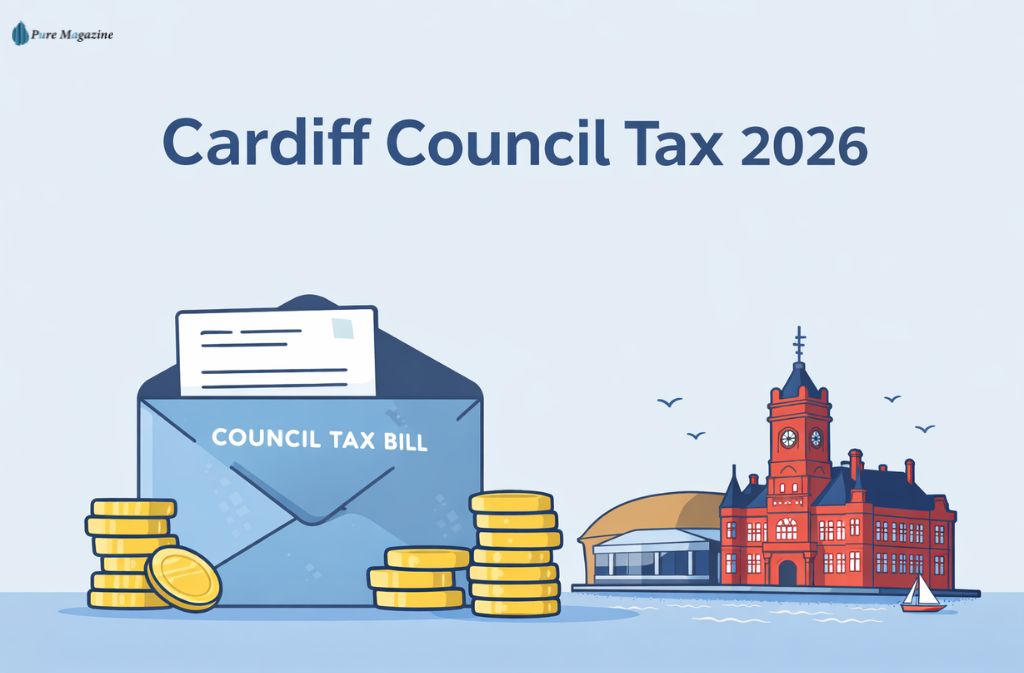
Living in Cardiff means weekend walks through Bute Park, coffee in Roath, match days near the Principality Stadium — and, every spring, that familiar blue council tax envelope landing on the doormat.
For 2026, Cardiff council tax is set to rise again. The proposed increase is 3.9% from April 1st, 2026. But here’s what most headlines don’t explain:
Your bill isn’t just the Council’s charge.
It also includes:
- The Police and Crime Commissioner precept
- Possible Community Council additions (in certain areas)
- Premiums on empty or second homes
This guide breaks down the real numbers for 2026, what Band D actually costs, how precepts affect you, and what landlords need to know about the 100% premium rule.
As of February 2026, this reflects the latest publicly available budget proposals from Cardiff Council and Welsh Government policy direction.
Cardiff Council Tax 2026 Increase: What’s Changing?
The 3.9% Proposed Rise
For 2026/27, Cardiff has proposed a 3.9% increase in council tax. As confirmed in Cardiff Council’s official 2026/27 budget proposal, the increase equates to around an extra £1.15 per week for a Band D household — and remains among the lower rises expected across Wales.
For a Band D property, that works out at roughly:
- ~£1.15 extra per week
- Around £60 per year increase
- Bringing the Council element to approx. £1,620 annually (before precepts)
This figure reflects the Council’s core charge only.
The Hidden Layer: Police & Community Precepts
This is where most residents get confused.
Your council tax bill includes the Cardiff Council charge, the South Wales Police precept, and a Community Council precept (if applicable).
The police element is set separately by the Police and Crime Commissioner and often increases at a different rate. Police services in Cardiff fall under South Wales Police.
Why This Matters
Even if Cardiff Council increases by 3.9%, your total bill increase may feel higher once precepts are added.
This is why comparing headline percentages alone is misleading.
2026 Estimated Council Tax Bands (Cardiff)
Based on a 3.9% uplift on prior baseline figures (Council element only). As confirmed in GOV.Wales council tax levels data, Cardiff consistently has the lowest average Band D council tax in Wales — a position that continues into 2026/27:
| Band | 2026 Estimated Annual (Council Portion Only) | Weekly Equivalent | Typical Example |
|---|---|---|---|
| A | ~£1,080 | ~£20.77 | Smaller flats (e.g., parts of Splott) |
| B | ~£1,260 | ~£24.23 | Small terraces |
| C | ~£1,440 | ~£27.69 | Standard terraces |
| D | ~£1,620 | ~£31.15 | Typical Cardiff family home |
| E | ~£1,980 | ~£38.08 | Larger semis |
| F | ~£2,340 | ~£45.00 | Detached homes |
| G | ~£2,700 | ~£51.92 | Larger detached |
| H | ~£3,240 | ~£62.31 | High-value homes |
| I | ~£3,780 | ~£72.69 | Premium areas (e.g., Cyncoed) |
Important: Final bills include police and local precepts. Always confirm your exact figure via Cardiff Council.
Understanding how council tax bands are structured and what each band means helps explain why adjacent bands aren’t equal in cost — the gap widens as you move up the scale.
Why Are We Still Using 2003 Property Values?
Council tax bands in Wales are still based on property values as of April 1, 2003. Yes — 2003.
As confirmed in GOV.Wales council tax dwellings data for 2026/27, council tax bands in Wales were determined by the Welsh Government based on property values in April 2003, and the valuation banding is based on the market value of the property as at 1 April 2003 — not the current value.
The Welsh Government has ongoing reform discussions about revaluation and band restructuring, but as of 2026 the 2003 baseline still applies.
This creates distortions — homes that have massively increased in value since 2003 may still sit in lower bands, and new-build developments are estimated based on what they would have been worth in 2003.
Empty Homes & Second Home Premium (Major 2026 Update)
This is a huge one — especially for landlords.
As of April 2026, Cardiff applies up to a 100% premium on properties empty for over 12 months or classified as second homes.
This means you could pay double council tax.
Example:
- Band D normal council portion: ~£1,620
- With 100% premium: ~£3,240 (before police precept)
That’s before enforcement action or further penalties.
Landlord Warning
If a property is unoccupied during renovation or between tenancies, monitor timelines carefully.
Many landlords underestimate how quickly the 12-month threshold passes.
- In Licensed HMOs (Houses in Multiple Occupation), the owner is typically responsible for the council tax bill, even if the property is occupied.
For landlords managing multiple properties across Cardiff, understanding council tax liability on unoccupied properties and how to avoid council tax on an empty property after death are both worth reviewing — exemption windows are limited and easily missed.
Council Tax Reduction Scheme (CTRS) & Universal Credit (2026)
The Council Tax Reduction Scheme (CTRS) is available for low-income households.
In 2026, eligibility continues to interact with Universal Credit rates, disability benefits, and pension credit thresholds.
If you receive Universal Credit, you must still apply separately for CTRS. It is not automatic.
Applications are processed through Cardiff Council’s CTRS application portal but governed under Welsh national rules via Welsh Government. For a full breakdown of how the reduction scheme works nationally, the council tax reduction guide covers eligibility criteria across all income brackets.
Pro Tip: The 25% Single Person Discount
You qualify if you are the only adult resident.
But here’s what many people don’t realise: if the other resident is a “disregarded person” (for example, a full-time student), you may still qualify.
This is one of the most underclaimed reductions in Cardiff.
Where Your Money Actually Goes
Council tax funds social care services, education, waste collection (including Cardiff’s black bin and green bag system), road maintenance, libraries, and housing support.
In recent years, the largest budget pressure has been adult social care.
Where Your Cardiff Council Tax Goes (Approximate Breakdown)
Education          ~40% ████████████████████
Adult Social Care  ~30% ████████████████
Children's Services ~15% ████████
Highways & Waste   ~10% █████
Libraries & Other   ~5% ███
Source: Cardiff Council budget consultation priorities 2026/27. Figures are approximate and reflect spending distribution, not ringfenced allocations.
2026 Quick-Check Framework
Before April 1st:
✔ Confirm your band ✔ Check for single person discount ✔ Review CTRS eligibility ✔ Budget for ~£1.15 weekly Band D increase ✔ If landlord, confirm empty home timelines
When Does the 2026 Rate Start?
The new rate takes effect from April 1st, 2026. Your annual bill typically arrives in March. For a full explanation of what months you don’t pay council tax and how the 10-instalment system works, that context helps with budgeting before the April start date.
Common Mistakes Cardiff Residents Make
- Assuming Universal Credit auto-applies CTRS ← this is the most costly mistake
- Ignoring precepts when budgeting
- Missing empty home premium deadlines
- Not updating address after moving
- Forgetting student “disregarded” rule
Conclusion
Council tax in Cardiff isn’t just a single percentage rise.
For 2026: the proposed increase is 3.9%, Band D council portion is ~£1,620 annually, police precepts add to that, empty homes may face 100% premium, and the new rate begins April 1st, 2026.
Understanding how Cardiff council tax actually works helps you budget properly — and in some cases, cut your bill significantly.
Before the next blue envelope arrives, double-check your band, discounts, and payment method. You can confirm your exact band and set up payments directly through Cardiff Council’s official council tax page.
Strategy without financial literacy is just aesthetics — Pure Magazine bridges the gap for founders, freelancers, and creative businesses in 2026.