British Supplements is a legitimate UK supplement brand known for high-potency, “no filler” formulas — but it remains controversial due to limited public lab transparency and polarising customer service. With a 4.5/5 Trustpilot rating across 3,600+ reviews, it delivers strong results for some users while frustrating others with delivery issues, tone, and pricing.
Bottom line: British Supplements is high-quality but not beginner-friendly — you’re paying for potency, not polish.
Quick Answer: British Supplements is best for experienced supplement users who prioritise purity and high dosing over customer service experience and price.
Summary: British Supplements at a Glance (2026)
| Factor | Rating | Insight | Risk Level |
|---|---|---|---|
| Quality | High | No fillers, high-dose extracts | Low |
| Transparency | Medium | COAs are not easily accessible | Medium |
| Customer Service | Mixed | Fast responses but blunt tone | High |
| Pricing | Premium | Expensive vs competitors | Medium |
| Delivery | Fast | Often next-day UK shipping | Low |
What a “British Supplements Review” Actually Means in 2026
A British Supplements review today isn’t just about product quality — it’s about transparency, dosing philosophy, and brand behaviour.
The brand stands out by avoiding synthetic fillers like magnesium stearate, using standardised extracts (such as 95% curcuminoids), and offering higher-than-average dosages. But modern buyers — and search engines — now expect public lab reports, clear regulatory compliance, and a balanced customer experience. This is where the brand becomes polarising.
Understanding what’s actually in a supplement matters more than the label claims. The NHS guidance on vitamins and supplements is a useful starting point for anyone trying to separate genuine nutritional need from marketing, particularly when dealing with high-dose formulations.
Key 2026 Shifts Worth Knowing
COA transparency is now the default expectation — British Supplements still requires manual requests. UK regulators at the Advertising Standards Authority are stricter on health claims, meaning aggressive supplement marketing is under increasing scrutiny. Bioavailability has overtaken price as the dominant buying factor for informed consumers. And over-supplementation risks are rising, particularly with high-dose single-nutrient products — something worth understanding before stacking multiple supplements from any brand.
Is British Supplements Legit?
British Supplements is a legally registered UK company, but its legitimacy in 2026 depends on verifiable proof, not claims alone.
What builds trust: registered UK business entity, strong repeat customer base, and a solid Trustpilot rating sustained over time.
What raises concerns: no easy public access to batch-specific COAs, some aggressive marketing language, and mixed perception under ASA standards.
Verdict: a legit company, but not fully transparent by 2026 standards. That distinction matters if you’re someone who uses blood work to track supplementation — understanding what your results actually show becomes especially important when you’re working with higher-than-standard doses.
Real Customer Reviews on Trustpilot: 5-Star Experiences vs 1-Star Complaints
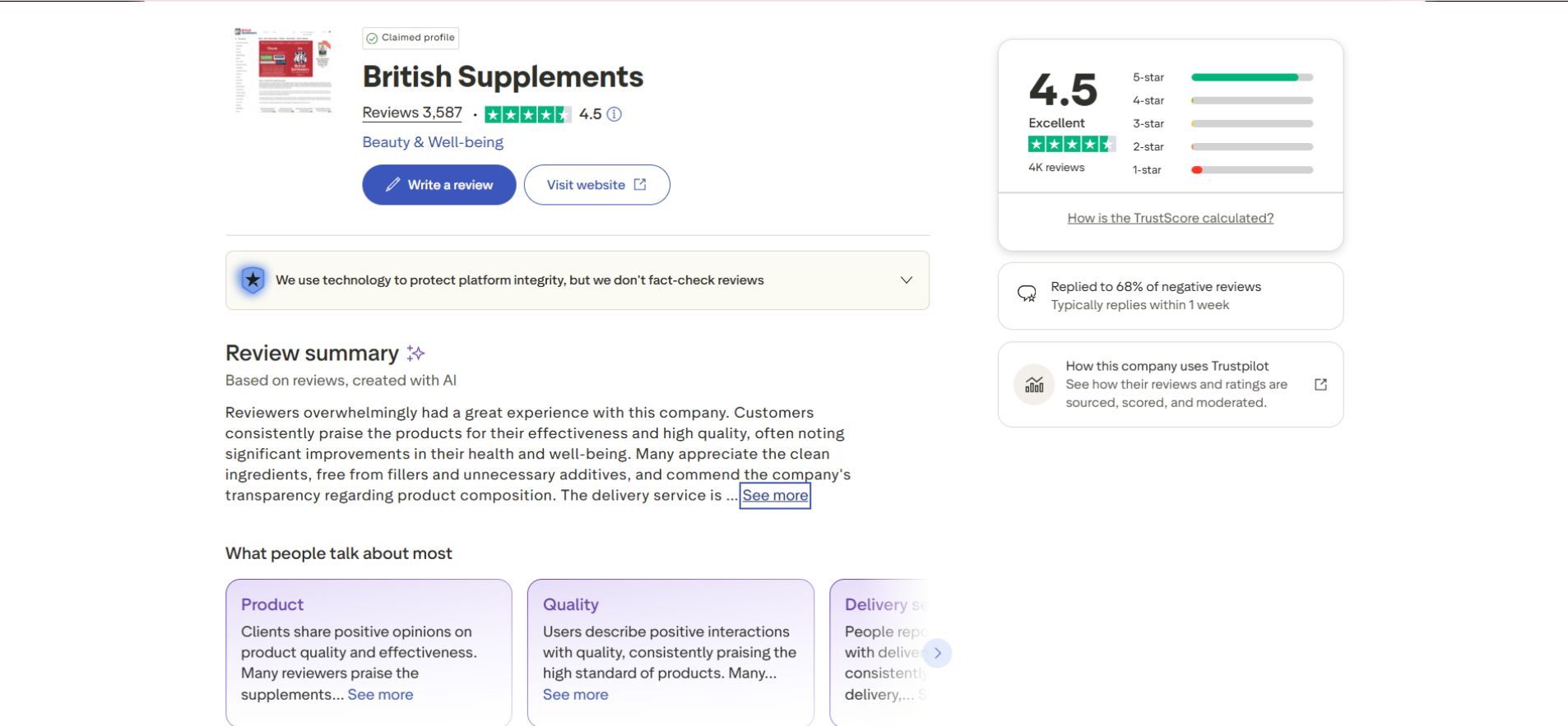
The 5-Star Experience
Who this is for: users who care primarily about ingredient quality and measurable results.
High-potency formulas deliver noticeable effects, particularly for people switching from supermarket-grade brands. Fast UK delivery, often next day. Clean ingredients that reduce the digestive issues some people experience with cheaper fillers.
Advanced tip: users switching from generic brands often report better results simply because standardised extracts deliver consistent concentrations rather than the variable amounts common in lower-quality products.
Common mistake: expecting immediate results without first establishing whether a deficiency actually exists. This applies across supplement categories — whether you’re taking a targeted single nutrient or a broader multivitamin stack, the timeline for noticing anything depends heavily on your starting point.
The 1-Star Reality
Who this is for: buyers expecting a smooth, retail-style customer experience.
Delivery delays and refund disputes appear across reviews. Customer service responses are described as fast but frequently confrontational in tone. Confusion around dosage versus “serving size” catches out people unfamiliar with higher-potency formulations. Packaging — particularly resealable pouches — draws consistent complaints.
Advanced tip: always pay via credit card for buyer protection, regardless of brand.
Common mistake: assuming a “3-month supply” label corresponds to standard dosing expectations. With high-dose products, actual duration varies significantly depending on how the product is used.
The 4-Star Middle Ground
Who this is for: regular users who understand the trade-offs and have decided the product quality justifies them.
Strong formulations, but premium pricing. Website usability is a recurring minor complaint. Customer support is inconsistent. Results are generally good, which is why many long-term users stay despite the friction points.
Quality and Transparency
British Supplements focuses on ingredient purity — no synthetic fillers, absorption-enhancing compounds like black pepper extract, and high-bioavailability forms throughout. These are genuine quality markers, not just marketing language.
Where it falls short is transparency. COAs aren’t publicly accessible and require individual requests. The brand relies on internal and supplier testing rather than one-click lab verification. Competitors like Pure Encapsulations and Novoma now offer that as a default, which aligns better with what informed buyers — and Google’s quality standards — now expect.
For context, research on supplement bioavailability consistently shows that the form of a nutrient matters as much as the dose, which is the genuine argument for standardised extracts over generic alternatives, independent of any particular brand.
How to Use British Supplements Safely
Who this is for: first-time buyers.
Check your current supplement intake before adding anything new. Review dosage carefully — don’t assume these follow standard NRV-based dosing. Avoid stacking with multivitamins without calculating your total intake per nutrient. Start at half-dose if uncertain. Monitor for two to four weeks before adjusting.
Get blood tests before using high-dose vitamin D or similar fat-soluble nutrients. This isn’t overcaution — it’s the only way to know whether you need what you’re taking. The upper tolerable intake levels established by the NIH for vitamin D, for example, are exceeded more easily than most people assume when combining a high-dose single supplement with a multivitamin that already includes it.
The High Dose vs Overdose Problem
This is the most consistently misunderstood issue with this brand specifically, and with high-dose supplementation generally.
British Supplements uses doses above NRV (Nutrient Reference Values), which can exceed safe upper limits when stacked with other products. The typical scenario: someone takes a multivitamin, adds an individual high-dose supplement from this brand, and ends up well above the tolerable upper intake for one or more nutrients without realising it.
The fix is straightforward but requires effort: calculate your total intake per nutrient across everything you’re taking, then compare against established upper limits. Adjust accordingly. This applies to fat-soluble vitamins in particular — A, D, E, and K accumulate rather than being excreted, making over-supplementation a real rather than theoretical concern.
This same principle applies across categories. Even something like beef liver supplements, which are food-based rather than synthetic, carries vitamin A accumulation risks when combined with other sources — the form of the nutrient doesn’t eliminate the stacking problem.
Comparison: What You Gain vs Lose
| Feature | British Supplements | Budget Brands | Mid-Range Brands |
|---|---|---|---|
| Purity | Very High | Low | Medium |
| Dose Strength | High | Low | Medium |
| Price | High | Low | Medium |
| Transparency | Medium | Low | High |
| User Experience | Rough | Smooth | Balanced |
Buyer Tips for 2026
Don’t buy into a deficiency you haven’t confirmed. Match the supplement to an established need — guesswork is expensive and occasionally counterproductive. Ignore marketing tone and focus on the ingredient panel. Check for rice flour if you follow a strict dietary protocol. Use single supplements before stacking. Track results with blood work, not subjective feelings alone.
For older adults in particular, the calculus around supplementation changes — protein and micronutrient needs shift with age in ways that make both under- and over-supplementation more consequential than they are in younger, healthier adults.
FAQs
Q. Is British Supplements legit in 2026?
Yes, British Supplements is a legitimate UK-registered supplement company with a strong ~4.5/5 rating on Trustpilot. However, its transparency is not fully aligned with 2026 standards because batch-specific Certificates of Analysis (COAs) are not publicly available on product pages and usually require manual requests.
Q. Why is British Supplements so expensive?
British Supplements is expensive because it uses high-dose, standardized extracts instead of generic raw ingredients. This increases production costs, especially compared to supermarket brands that use lower-strength formulations and fillers, but the value depends on whether you actually need higher potency.
Q. Are British Supplements third-party tested?
British Supplements claims third-party testing, but batch-specific COAs are not publicly accessible by default. Customers typically need to request lab results directly, which is a transparency gap compared to brands that publish certificates openly on their websites.
Q. Is British Supplements better than supermarket brands?
Yes, British Supplements is generally better than supermarket brands in terms of purity and potency. However, supermarket brands often win on price, convenience, and ease of use, making them more suitable for beginners or casual users.
Q. What is the biggest complaint about British Supplements?
The most common complaint in British Supplements reviews is the customer service tone and handling of delivery or refund issues. Many users report fast shipping, but negative experiences often involve delayed orders, communication issues, or dispute resolution.
Q. Is British Supplements good for beginners?
No, British Supplements is not ideal for beginners due to its high dosages and complex supplementation approach. New users may find it difficult to manage intake safely without prior knowledge or guidance.
Q. Can you take British Supplements daily?
Yes, you can take British Supplements daily if you follow the correct dosage and avoid stacking overlapping nutrients. Because many products are high-strength, it’s important to track total intake to prevent over-supplementation.
Q. Is British Supplements worth it in 2026?
British Supplements is worth it for experienced users who prioritise purity and high potency over price and customer experience. For beginners or those seeking simplicity, more balanced alternatives may offer better overall value.
Q. Do British Supplements provide real results?
Many users report noticeable results from British Supplements, especially when correcting deficiencies. However, effectiveness depends on individual health status, dosage, and consistency rather than the brand alone.
Q. Why are British Supplements reviews so mixed?
British Supplements reviews are mixed because product quality is high, but customer experience is inconsistent. Positive reviews focus on effectiveness and delivery speed, while negative reviews highlight service tone, pricing, and transparency concerns.
Conclusion
British Supplements in 2026 is a high-performance but imperfect brand. Clean, potent formulations deliver results for users who know what they’re doing — but transparency gaps and a rough customer experience limit their appeal beyond that audience. If you understand dosing, have confirmed a need through testing, and prioritise ingredient quality above convenience, it’s a credible option. If you want simplicity, hand-holding, and clear lab data upfront, better alternatives exist.
This article is for informational purposes only and does not constitute medical advice. Always consult a qualified healthcare professional before starting any new supplement regimen.
Explore our full library of expert-reviewed health and nutrition guides at Pure Magazine.