Most API search companies promise the same things: fast results, scalable infrastructure, developer-friendly tools. Yet many teams only discover the truth after signing up — hidden rate limits, vague documentation, or data that doesn’t hold up under real usage.
That’s why the best API search company’s homepage matters far more than most buyers realize.
In 2026, a homepage isn’t just a marketing surface. It’s a compressed signal of how a platform treats developers, how transparent it is about pricing, and whether it’s built for real-world reliability or just demos. If you know what to look for, you can eliminate most weak options in minutes — before writing a single line of code.
After reviewing dozens of API search platforms over the past few years — from SERP APIs to structured web data providers — one pattern keeps repeating: the homepage tells you more about the product than the feature list ever will.
This guide shows you exactly how to read those signals.
What Is an API Search Company?
An API search company provides programmatic access to search data, typically including:
- Search engine results (SERPs)
- Structured web data
- Entity or company data
- Real-time query responses
Unlike traditional company data APIs, modern API search platforms are designed for automation at scale. They focus on structured responses, real-time data extraction, and high-volume reliability rather than manual querying.
In practice, these APIs power use cases like competitive intelligence, SEO monitoring, market research, lead enrichment, and AI pipelines.
Why the Homepage Matters More Than the Feature List
Anyone can list features.
The homepage shows you how the company thinks.
A strong API search homepage answers, immediately:
- Who is this built for?
- How quickly can I test it?
- What does it actually cost?
- How reliable is the data?
- Where do I go if something breaks?
Weak homepages hide those answers behind buzzwords, sales forms, or vague promises. In 2026, that’s no longer acceptable — especially for developer-first tools.
Also Check: How AI Is Transforming Image Creation and Visual Content
The API Search Homepage Evaluation Framework (2026)
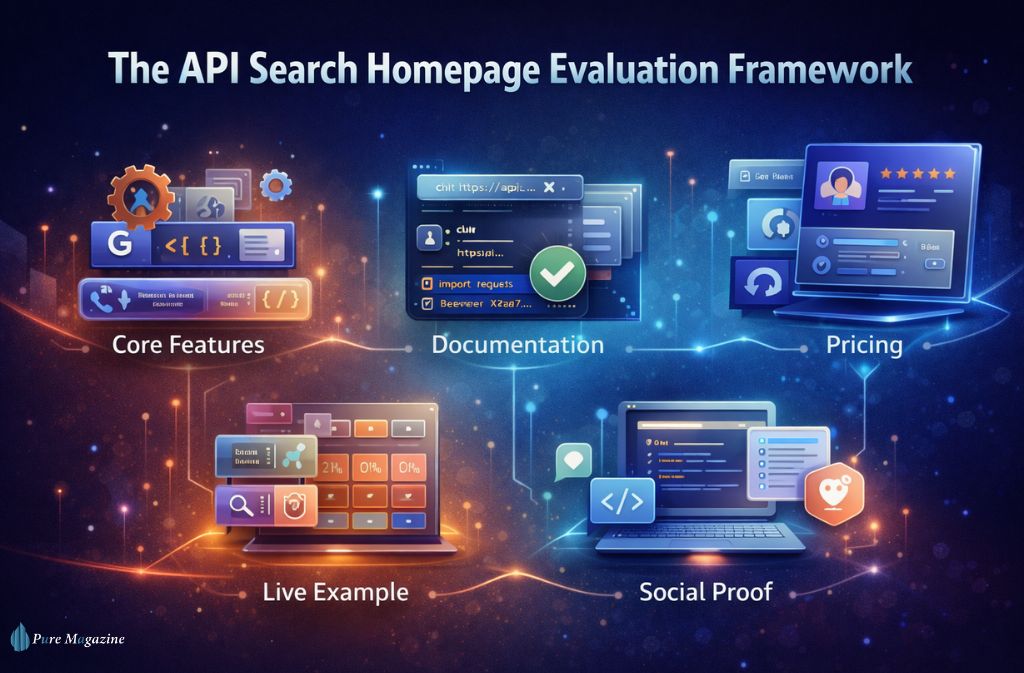
1. Core Features Are Explicit, Not Abstract
The best API search company’s homepage clearly explains:
- What search engines or data sources are supported
- How fresh the data is
- What the response format looks like
- What happens at scale
Red flag language sounds like:
“Powerful AI-driven search with enterprise-grade performance”
Strong language sounds like:
“Returns structured JSON from Google SERPs with real-time results and configurable parameters.”
If you can’t tell what the API actually returns, move on.
2. Documentation Visibility Signals Developer Respect
This is one of the strongest trust indicators.
High-quality platforms surface:
- Documentation links directly in the hero section
- Authentication examples
- Clear error handling
- Code snippets (curl, Python, JavaScript)
I’ve tested APIs where the homepage promised scale and reliability, but the documentation was buried behind signup walls or sales gates. In practice, that almost always translated to slow onboarding and aggressive limits once real usage started.
If I can’t find docs in 10 seconds, I don’t trust the platform.
3. Pricing Transparency Builds Immediate Trust
Transparent pricing pages usually include:
- Clear tiers
- Usage-based pricing
- Overages explained
- A self-serve option for developers
If I have to “Book a demo” just to see the price per 1,000 requests, I assume there’s a catch — and I usually close the tab.
Opaque pricing isn’t neutral. It’s a signal.
4. Live Examples and Homepage Extraction Matter
The strongest API search platforms prove the product works before signup.
Look for:
- Live query examples
- Sample requests and responses
- Interactive sandboxes or API playgrounds
Some platforms surface curl or JavaScript examples directly on the homepage. Others make you hunt for a sandbox after registration. The difference is night and day when you’re validating an API under time pressure.
5. Social Proof That’s Actually Relevant
Generic logo walls don’t help.
Useful proof includes:
- Case studies with real use cases
- Developer testimonials
- GitHub references
- Community mentions (forums, Reddit, issues)
A homepage that only says “Trusted by thousands” without context isn’t telling you anything.
The Homepage Trust Path (Mental Model)
Most buyers subconsciously follow the same evaluation path:
Homepage → Documentation → Pricing → Live Example → Trust
If any step feels hidden or vague, confidence drops fast.
The best API search company’s homepage is designed to remove friction at every step.
Weak vs Best-in-Class API Search Homepages
| Criteria | Weak Homepage | Best-in-Class Homepage |
|---|---|---|
| Messaging | Buzzwords | Clear use cases |
| Docs | Buried | Front-and-center |
| Pricing | Hidden | Transparent |
| Examples | None | Real API responses |
| Performance Signals | Ignored | Latency expectations stated |
| Compliance | Silent | GDPR/CCPA addressed |
| UX | Sales-heavy | Developer-first |
In 2026, ignoring performance or compliance on the homepage is no longer neutral — it’s a warning sign.
Common Mistakes When Choosing an API Search Company
- Trusting feature lists over live examples
- Ignoring documentation depth
- Underestimating rate limits
- Choosing the cheapest option without testing reliability
- Assuming “AI-powered” means better data
The biggest pain point in API search isn’t syntax — it’s reliability under blocking pressure. Legit platforms acknowledge that reality.
Who This Guide Is Not For
This guide isn’t for everyone.
If you only need occasional manual searches, or your use case doesn’t require automation, an API search platform is probably overkill. Likewise, if you’re not comfortable reading documentation or testing endpoints, you may be better served by off-the-shelf tools.
API search platforms shine when you need scale, consistency, and structured data — not when you’re just experimenting.
Also Read: How Artificial Intelligence is Advancing Business Analytics
2026 Trends Shaping API Search Platforms
- AI-assisted query handling and SERP parsing
- Greater focus on compliance and ethical data sourcing
- Hybrid SERP + structured data APIs
- Improved developer experience as a competitive advantage
- Clearer performance and reliability messaging
The best API search company’s homepage already reflects these shifts.
Quick Checklist: Is This API Search Homepage Legit?
- ✅ Clear value proposition
- ✅ Docs visible without signup
- ✅ Transparent pricing
- ✅ Real response examples
- ✅ Use cases for developers and businesses
- ✅ Honest limitations stated
If it fails two or more, keep looking.
FAQs
Q. Which is the best search API?
There is no single best search API for everyone. The right option depends on your use case, required data freshness, documentation quality, pricing transparency, and how reliably the API performs at scale. Developers should evaluate search APIs based on real examples, rate limits, and ease of integration—not feature lists alone.
Q. Is ChatGPT an API?
Yes, ChatGPT is available via API, but it is not a search API. It does not provide real-time SERP results or structured web search data. ChatGPT APIs are designed for language generation and reasoning, while search APIs focus on retrieving live, structured search results programmatically.
Q. What is the most widely used API for web search?
The most widely used APIs for automated web search are SERP APIs and real-time data extraction APIs. These platforms allow developers to programmatically collect live search engine results and structured web data, which is essential for SEO tools, market research, and automation workflows.
Q. What are the main types of APIs?
The four main types of APIs are REST, SOAP, GraphQL, and WebSocket APIs. Most search APIs use REST because it is simple, scalable, and easy to integrate. Some platforms also support GraphQL or WebSockets for real-time or streaming use cases.
Q. How do I compare API search platforms quickly?
To compare API search platforms quickly, review their homepage clarity, documentation visibility, pricing transparency, and availability of live examples or sandboxes. If an API hides documentation or pricing, or lacks real request examples, it’s usually a sign to keep looking.
Conclusion
Choosing the best API search company’s homepage isn’t about design polish — it’s about signals. In 2026, the strongest platforms make it easy to understand what they offer, how they price it, and how fast you can test it.
Use the framework in this guide, ignore vague promises, and focus on clarity, transparency, and developer experience. That’s where the real winners separate themselves.
Next step: Shortlist two platforms, evaluate their homepages side-by-side using this checklist, and only then start testing.
Related: Best AI Agents Courses in 2026 – Learn the Future of Artificial Intelligence