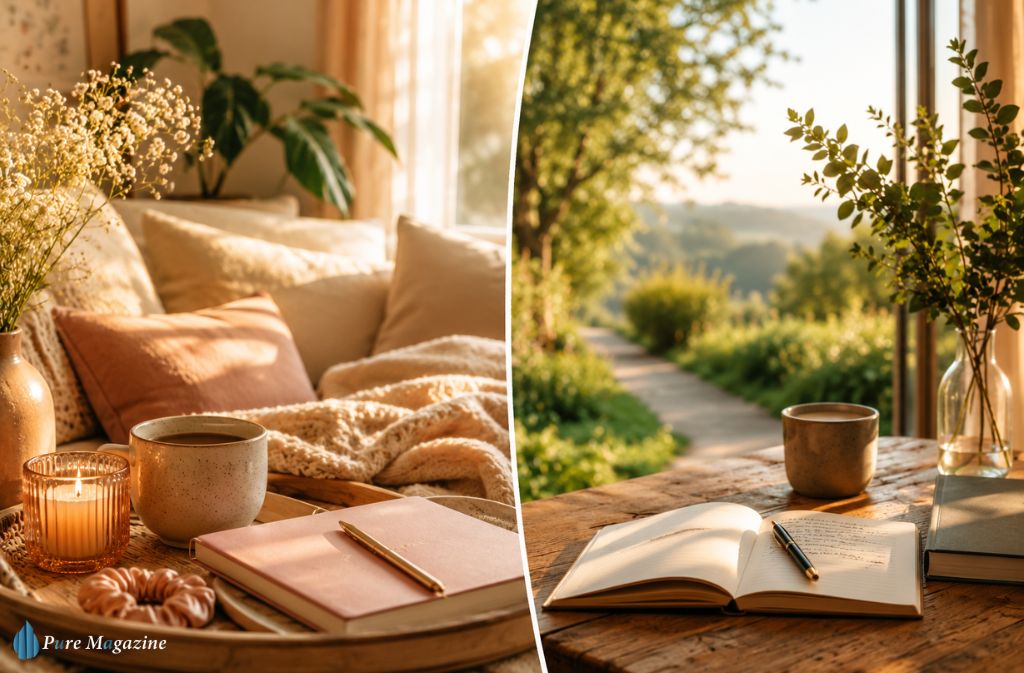
If you’ve spent any time on wellness TikTok or Pinterest in the last few years, “soft life” and “slow living” probably look interchangeable — soft lighting, an oat milk latte, linen pants, a general sense of calm. They get photographed the same way. They don’t mean the same thing.
Soft life is about reducing hardship — protecting your energy from people, jobs, and obligations that drain you. Slow living is about reducing pace — protecting your attention from a world that moves too fast. You can have a soft life that’s still busy. You can live slowly and still be broke and stressed about it. Neither one automatically produces the other, and mixing them up is usually why people try one, feel let down, and write off the whole idea.
This piece breaks down where each term actually came from, what each one requires day to day, where they overlap, and a simple way to figure out which one you need right now — because for most people going through a burnt-out stretch, it’s rarely a mystery once you know what to look for.
What Is “Soft Life,” Really?
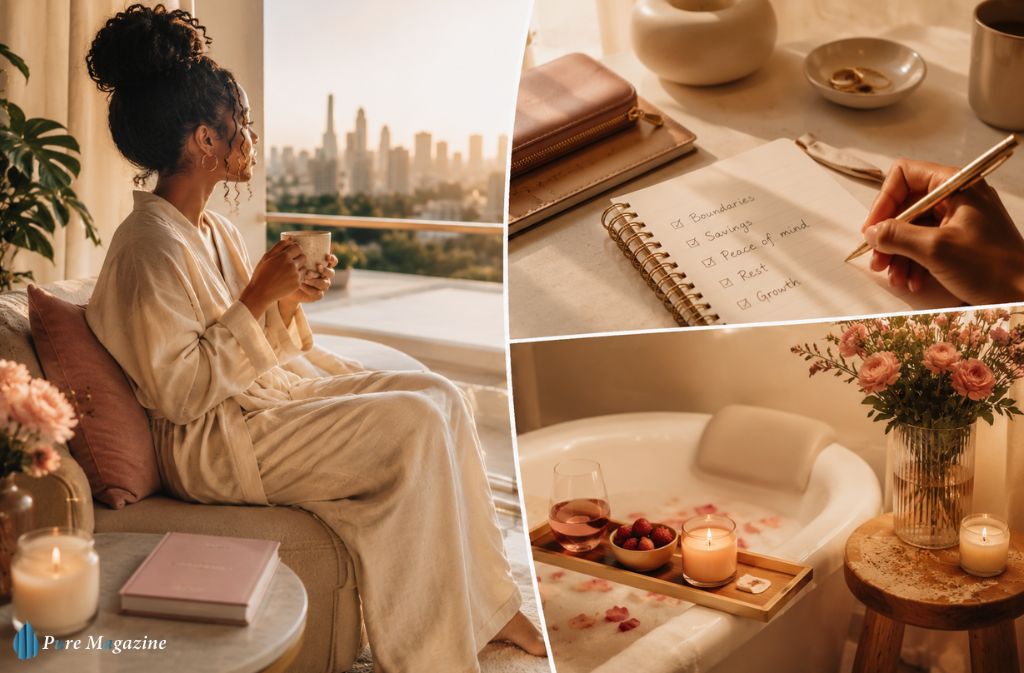
Soft life is a lifestyle philosophy built around deliberately reducing struggle and self-sacrifice — choosing ease and protection of your peace over grinding through hardship as proof of your worth.
The phrase came out of Nigerian social media culture in the early 2020s, largely from women pushing back on the idea that stability requires constant struggle or tolerating mistreatment to keep it. From there it spread through Black American culture and then into the broader internet, evolving into a general rejection of burnout-as-virtue.
Day to day, soft life tends to look like:
- Setting firmer boundaries at work and in relationships, even when it costs some social capital in the short term, because the long-term trade is worth it
- A financial cushion, however small — savings, a negotiated raise, less debt-fueled stress — so you’re not one bad week from crisis
- Choosing environments that don’t require constant proof of your worth through suffering
- Better sleep. Less commuting. Fewer people to manage
- Refusing the idea that exhaustion is something to be proud of
The most common misread is that soft life means doing less, full stop. Building one is often the opposite — it takes real negotiation and planning to remove hardship from your life in the first place. Most people who describe their life as “soft” did the hard structural work first: left the job, ended the draining relationship, built the savings — so daily life could actually feel easier afterward. It’s not usually free, and it’s rarely instant, but it doesn’t have to be expensive either. A no-cost version of soft life often starts with one conversation you’ve been avoiding — telling a manager a deadline isn’t realistic, or telling a friend you can’t keep lending money — more than it starts with a purchase.
“Soft Girl Era” vs. Slow Living
Soft life also gets tangled up with a related but different TikTok trend: the “soft girl era.” It’s worth separating them, because they’re not pointed at the same goal. The soft girl era is a hyper-visual aesthetic built around femininity, delicate styling, and a leisure-focused lifestyle — think pastel colors, curated self-care hauls, and a fairly gendered presentation. It tends to be temporary and identity-driven, something people move through for a season rather than a durable framework.
Slow living, by contrast, is evergreen and not tied to gender at all. It’s a way of pacing your life, not a look you put on. Someone can be fully in a “soft girl” moment aesthetically while still living at a frantic pace — overbooked, overstimulated, scrolling constantly between curated posts. The aesthetic and the underlying pace are two different variables, and confusing them is part of why so much soft-life content online feels shallow: it borrows the visuals of ease without any of the structural changes that actually produce it.
What Is “Slow Living,” Really?

Slow living is a lifestyle philosophy centered on reducing pace and stimulation to make room for presence and depth — prioritizing how something feels over how fast it gets done.
It traces back to the Slow Food movement, founded in Italy in 1986 as a protest against the opening of a fast-food outlet near Rome’s Spanish Steps, and formalized as an international movement when its founding manifesto was signed in Paris in 1989. Slow Food’s own history of the movement traces how that original protest against fast food eventually expanded into slow fashion, slow travel, slow parenting, and slow media — all built on the same premise, that doing fewer things more deliberately beats doing many things quickly.
Slow living, in practice:
- Cooking from scratch instead of optimizing purely for speed
- Buying fewer, better things instead of chasing trend cycles — this is where it brushes up against minimalism, though minimalism is about quantity and slow living is about pace
- Fewer notifications
- Time outdoors with no productivity goal attached, or a hobby that produces nothing measurable at all
- Being okay with “unproductive” time — reading, walking, one unhurried coffee, instead of always stacking two tasks into one window
The common misread here is that slow living requires quitting your job and moving somewhere rural. Most people who actually sustain it do it inside ordinary, busy lives — the “slow” describes attention, not free time. A demanding job doesn’t rule out one unhurried meal a day, or a phone left in another room during dinner. Reclaiming that attention doesn’t always need a lifestyle overhaul, either — sometimes it just needs a system. A structured pass through something like a digital decluttering checklist — clearing dead apps, muting the notifications that don’t matter, cutting the accounts that leave you wired instead of rested — tends to do more for a slow-living practice than any candle or ceramic mug branded with the phrase.
Soft Life vs. Slow Living: Side-by-Side
| Dimension | Soft Life | Slow Living |
|---|---|---|
| Core problem it solves | Hardship, overwork, mistreatment | Speed, overstimulation, distraction |
| Origin | Nigerian and Black online culture, early 2020s | Slow Food movement, Italy, founded 1986 |
| Primary lever | Boundaries, finances, environment | Pace, consumption, attention |
| What “working” looks like | Feeling protected and unburdened | Feeling present and unhurried |
| Common misconception | That it means doing nothing | That it requires quitting work or moving rural |
| Typical daily action | Saying no. Negotiating. Choosing comfort | Cooking slowly, single-tasking, unplugging |
| Risk if taken too far | Avoidance dressed up as self-care | Romanticized inaction dressed up as intention |
Where They Overlap
Both reject the same thing: a culture that treats exhaustion as proof of worth. Both photograph well, which is a big part of why algorithms blur them together — a linen outfit and a slow pour-over illustrate either concept equally well, even though the reasoning behind them is different.
They also tend to reinforce each other in practice. Someone who builds a soft life by leaving a high-pressure job often ends up living more slowly by default, simply because unscheduled time opens up. The reverse happens too — someone who adopts slow-living habits, cooking at home more, cutting screen time, usually reports feeling less depleted, which can look “soft” from the outside even without any deliberate boundary-setting behind it.
A Simple Framework for Soft Life Burnout Recovery
If you’re coming at this from actual burnout rather than curiosity, one question does most of the diagnostic work: is the problem volume, or is it pace?
If you feel constantly under-resourced or over-obligated — carrying more than your share at work, in a relationship, financially — start with soft-life moves. Renegotiate a workload. Build even a small emergency fund. Exit a dynamic that’s draining you on a loop. Slowing down won’t fix a structural imbalance; you’ll just be moving slowly while still underwater.
If you feel like you’re technically doing “enough” but never actually present for any of it, start with slow-living habits instead. Single-task your evenings. Cook one meal a week without a screen nearby. More boundaries won’t fix a pace problem if the actual issue is that you’re sprinting through a reasonable workload.
Most people need both, in different areas of life — soft-life boundaries at work, slow-living habits at home, or the reverse. A quick way to find out: for one week, jot down next to each stressful moment whether it came from too much on your plate or too much happening too fast. A pattern usually shows up within a few days.
This split matters most for anyone specifically working through soft life burnout recovery. Burnout recovery that only slows the pace, without addressing who’s carrying what, tends to relapse the moment life speeds back up. Recovery that only renegotiates boundaries, without ever building in unhurried time, tends to leave people functional but numb. The two problems have different fixes, and treating them as one is where most recovery attempts stall out.
Remote work adds its own wrinkle here, since the same always-on habits that erode a soft-life boundary also erode a slow-living one — there’s no closing door between “at work” and “at home” to force either. Building actual screen time boundaries as a remote worker — a hard stop time, a separate device or account for work messages, a real end to the notifications — often does more for both problems at once than either philosophy on its own.
Common Mistakes People Make With Both
Treating soft life as an excuse to avoid necessary friction. Some hard conversations and short-term sacrifices genuinely buy you long-term ease. Done well, soft life often takes more upfront effort, not less — negotiating a raise, ending a lease, having the conversation you’ve been dreading.
Treating slow living as a purchase. Branded “slow living” candles and ceramics don’t create the underlying shift, and can quietly reinforce the fast-consumption pattern the philosophy is supposed to move away from. The habit is the point. The aesthetic isn’t.
Making either one a permanent identity instead of a seasonal setting. Both work best as something you dial up or down, not a fixed lifestyle. A parent of a newborn, or someone mid-fundraise, isn’t going to fully “slow living” this quarter — and that’s fine. The framework still applies at a smaller scale: one slower Sunday morning, one firmer boundary on weekend emails, even when a full overhaul isn’t realistic.
How to Start, Without Spending Anything
If soft life is the priority:
- Name one recurring, avoidable source of stress — a task, a person, a habit — and remove or renegotiate it this month.
- Build a small buffer, financial or time-based, so decisions stop being made from scarcity. A weekly, low-pressure look at where your money actually goes — financial self-care rather than a rigid budget — tends to make this less painful than it sounds.
- Say no to one low-value obligation per week. Just one.
If slow living is the priority:
- Pick one daily task — a meal, a commute, a shower — and do it without a screen.
- Swap one piece of fast consumption a week (a fast-fashion order, a scrolling session) for a slower version.
- Protect one unscheduled hour a week. No goal attached to it.
None of this requires a rural cottage or a savings account most people don’t have. It requires picking one thing and actually keeping it for a month.
The Bottom Line
Soft life and slow living aren’t competing philosophies, they’re answers to different questions. Soft life asks how to carry less. Slow living asks how to move through what you’re carrying with more intention. Most people need a mix of both, in different proportions, depending on the season they’re in — and the point was never to pick a label and defend it online. It’s to notice where the exhaustion is actually coming from, and fix that specifically.
For more, visit Pure Magazine