Ask any in-house designer how they spend their day. You’ll hear some version of the same complaint. Half their time isn’t spent creating. It’s spent moving files between apps.
Generate a frame in one tool. Download it. Drag it into an editor to fix a hand or a face. Run it through an upscaler. Open a fourth tool if a client wants motion. Nobody designed this workflow on purpose. It just accumulated, one specialized AI tool at a time.
Call it the creative tax. It’s the hidden cost of stitching together five best-in-class point solutions instead of one that’s merely good enough at everything.
The Math Behind the Complaint
The tax isn’t just time. It shows up on the invoice. A team piecing together a full image-and-video stack in 2026 often runs several subscriptions at once. Standard-tier Midjourney access runs about $30 a month, scaling up to $120 at the highest usage tier. Add video, and Runway’s entry plan starts around $12 a month with a limited credit allowance. The workhorse tier runs closer to $28. Heavy use pushes it to $76. Layer in a dedicated upscaler and a background-removal tool. A small team can clear $100–$150 a month before producing a single finished asset. That’s before counting the labor cost of shuffling files between all of them.
This is the gap consolidated platforms are trying to close. Not by being the best at any one function. By being good enough at all of them, under one login and one bill.
Where Imagvio AI Fits
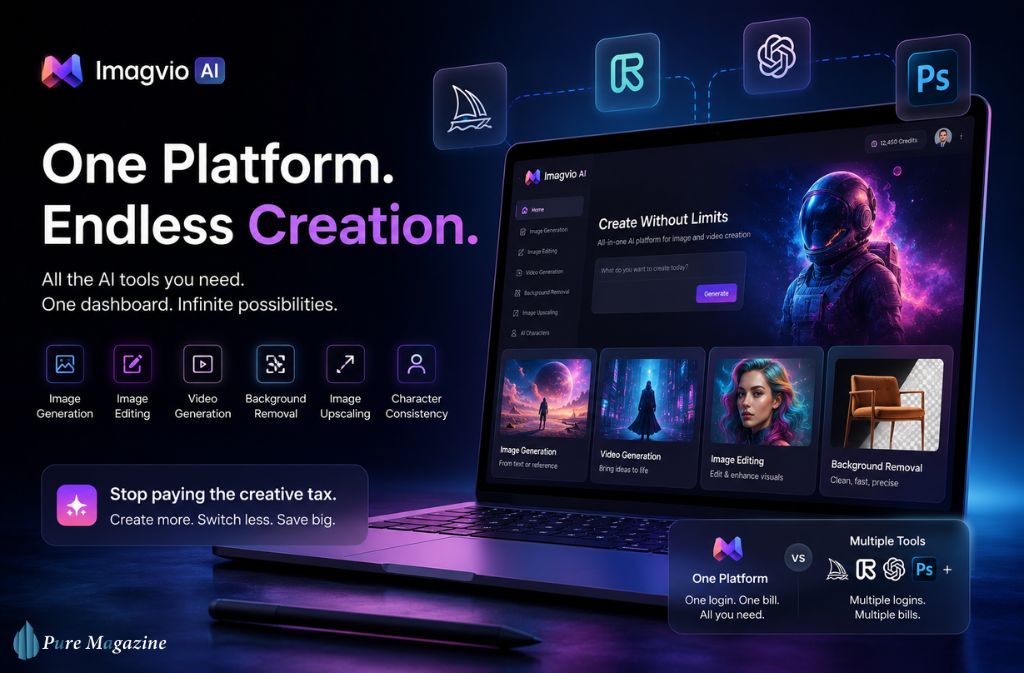
Imagvio AI is one of a growing number of platforms betting that consolidation beats specialization for a large chunk of the market. It doesn’t build one model and do one thing. It aggregates several leading image and video generation engines into a single workspace, covering:
- Image generation from text prompts or reference images
- Image editing for composition and detail correction
- Video generation
- Background removal
- Image upscaling
- Character-consistent creation across multiple generations
The pitch isn’t “better than Midjourney” or “better than Runway.” It’s “you no longer need six tabs open to finish one asset.”
The Part Everyone Skips: All-in-One Isn’t Automatically Better
Here’s the trade-off most coverage skips. Specialized tools are usually still ahead on raw quality in their specific lane. Midjourney’s aesthetic quality remains a benchmark others get measured against. Runway’s Gen-4.5 currently holds the top spot on an independent text-to-video benchmark. A generalist suite doesn’t automatically inherit that ceiling. It inherits whatever license or API tier it has access to, which may lag a version or two behind the standalone product.
So the honest framing isn’t “all-in-one replaces specialized tools.” It’s “all-in-one trades some peak quality for lower cost and less friction.” That’s a fine trade for a solo creator or a lean team pushing out daily content. It’s a much worse trade for a studio chasing one exact look for a hero shot.
The Open-Source Elephant in the Room
There’s a segment of creators these pitches routinely ignore: people running local, self-hosted stacks through ComfyUI or Automatic1111. For anyone with the patience to set it up, this route can push per-image cost close to zero after the initial GPU investment. It also gives full control over models, LoRAs, and seeds. It’s not a fit for a marketing team that wants a login and a monthly invoice. But it’s the honest counter-argument to “unified platform” pitches, and it’s where a lot of power users already live.
Why Character Consistency Keeps Coming Up
One feature in this category deserves real attention: character-consistent generation. Keeping a face, mascot, or product consistent across multiple images has been a persistent weakness in AI generation. Prompts that look identical can still produce a subject that shifts in small but noticeable ways. Runway tackles this in video through a reference-image system. Image-focused platforms typically use identity mapping or seed-locking to anchor a subject’s features across generations. Whatever the method, this is the hurdle that decides whether AI tools work for serialized content — comics, recurring brand characters, multi-scene stories — instead of just one-off images.
The Bigger Shift: Model-Agnostic, Not Model-Owning
Here’s the more interesting long-term story. Platforms like Imagvio AI mostly aren’t building their own foundation models. They’re positioning as aggregators instead. That lets a creator swap the underlying engine mid-project, rather than getting locked into one company’s roadmap. It’s a different value proposition than a single-model tool. You’re not betting on one lab’s next release. You’re betting on a platform’s ability to keep integrating whatever model is best that quarter.
There’s a trade-off pro-tier users should know going in. Aggregator platforms sometimes limit the deeper technical control that specialized tools allow — custom LoRA training, granular seed manipulation, fine-grained parameters. For someone shipping social content daily, that rarely matters. For a designer building a highly specific visual system, it can.
The Verdict
This isn’t a “which tool wins” story. It’s a “who is each tool actually for” story. Unified platforms make the most sense for solo creators, in-house teams, and agencies producing high volumes of everyday content. They’d rather pay one bill and skip the file-shuffling than chase the single best output on one feature. Specialized tools and open-source stacks remain the better call where peak quality or granular control is the whole job — high-end VFX, campaigns with a very specific look, or anyone who wants to own their pipeline outright.
The direction of the market is clear, though. After two years of proving the underlying models work, 2026 is the year the conversation shifted to making them usable in an actual production pipeline. That’s pushing the category toward consolidation, not away from it.
For more, visit Pure Magazine