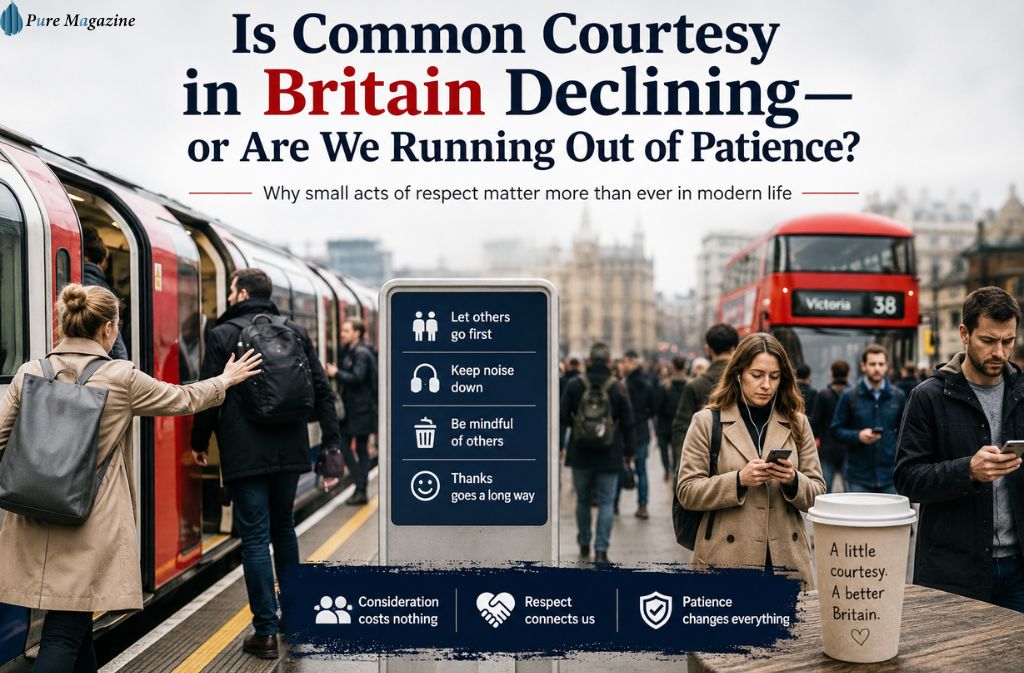
The woman boarding the train at London Waterloo wasn’t angry; she was simply exhausted. The commuter who stepped directly in front of her before she had fully cleared the carriage doors probably wasn’t trying to be malicious either—he was battling his own end-of-day fatigue.
This small, almost invisible moment captures something larger about modern Britain: everyday life feels slightly more strained than it used to.
Across the UK, conversations about public behaviour have become increasingly common. People talk about queue-jumpers at supermarkets, commuters watching TikTok videos without headphones, drivers refusing to merge properly on busy roads, and workplace messages that begin with a simple “Hi”—followed by several minutes of suspense before the actual request appears.
Individually, these moments are minor. Collectively, they create something harder to ignore: a quiet but persistent sense that navigating public life has become more mentally demanding.
Whether Britain is actually becoming less polite is open to debate. What is not in question is that common courtesy in the UK now carries more weight than it used to. In a society shaped by digital overload, hybrid work, rising costs, and constant notification pressure, small acts of consideration have become unexpectedly valuable.
In many ways, common courtesy is no longer just etiquette.
It is infrastructure.
What Common Courtesy Really Means Today
Traditionally, common courtesy is defined as politeness, respect, and consideration in everyday behaviour.
But that definition is incomplete for modern life.
Today, common courtesy is better understood as:
The practice of reducing unnecessary friction in other people’s lives.
That friction can be physical, digital, or emotional.
It appears in small choices:
- Holding a door open for someone carrying bags
- Waiting for your turn in a queue
- Respecting personal space on public transport
- Sending clear workplace messages instead of vague prompts
- Listening without interrupting
These actions require almost no effort. Yet they determine how smoothly shared environments function.
At its core, common courtesy is not about following rigid social rules.
It is about recognising that everyone around you is managing pressures you cannot see.
Why Courtesy Matters More Than Ever in Britain
Modern life has fundamentally changed the conditions under which people interact.
Across the UK, many people are simultaneously managing:
- Constant digital notifications
- Hybrid or remote work schedules
- Rising living costs
- Information overload
- Reduced personal downtime
In this environment, patience has become a limited resource.
The result is not necessarily widespread rudeness. It is something subtler: accumulated social friction.
The commuter who seems impatient may be mentally exhausted. The colleague who sends a blunt email may be under pressure. The stranger who appears inconsiderate may simply be overwhelmed.
Understanding this does not excuse discourtesy. But it explains why courtesy now has greater value than ever before.
The Psychology Behind Courtesy
Human behaviour is deeply responsive to social treatment.
One of the most widely studied principles in behavioural psychology is the Norm of Reciprocity—the tendency for people to return positive behaviour with positive behaviour.
When someone treats us with respect, we are more likely to respond in kind.
This creates a ripple effect:
- A polite interaction improves mood
- Improved mood influences workplace behaviour
- That behaviour spreads into further interactions
But the reverse is also true.
Research on workplace incivility consistently shows that negative interactions do not remain isolated. They spread through teams, households, and communities.
Discourtesy functions like a hidden cost in social systems.
Everyone eventually pays it.
Is Britain Becoming Less Polite—or Just Differently Polite?
Public debate often suggests that British manners are in decline. But the reality is more complex.
What many interpret as discourtesy may actually be a shift in how respect is expressed.
Consider communication styles at work:
- For older generations, an unexpected phone call can feel normal and efficient.
- For younger generations, it can feel disruptive and intrusive.
Neither is inherently correct. They simply reflect different expectations of availability and attention.
Similarly, modern communication often appears abrupt compared to traditional British conversational norms. But brevity is frequently intended as consideration, not rudeness. It is often designed to respect time and reduce unnecessary interruption.
The real tension in modern Britain is not the disappearance of courtesy.
It is the misalignment of expectations about how courtesy should look.
Courtesy vs Etiquette: A Modern Divide
It is important to separate two ideas that are often confused:
| Traditional Etiquette | Modern Courtesy |
|---|---|
| Focused on rules and protocol | Focused on human impact |
| Rooted in tradition and class systems | Rooted in empathy and context |
| Concerned with appearance | Concerned with experience |
| “What is correct?” | “What helps others?” |
Etiquette is about correctness.
Courtesy is about impact.
And in modern Britain, impact matters more than formality.
Queueing: Britain’s Quiet Social Contract
The Workplace Courtesy Shift
The modern workplace has reshaped how courtesy is expressed.
In offices and remote environments, communication now happens primarily through screens.
One of the most common frustrations is the simple message:
“Hi.”
No context, request, or clarity.
Just an interruption.
For many workers, this creates unnecessary cognitive load—forcing them to pause, switch focus, and wait for additional information.
Modern workplace courtesy now involves respecting attention as a resource.
This includes:
- Providing context upfront
- Avoiding unnecessary urgency
- Respecting asynchronous communication
- Scheduling rather than demanding an immediate response
- Being mindful of workload and focus
In short, the old workplace valued availability.
The modern workplace values consideration of attention.
Britain’s “Main Character” Problem
One emerging challenge in public life is what cultural commentators describe as the “main character” mindset—the tendency to behave as if shared spaces exist primarily for individual convenience.
Examples include:
- Watching videos without headphones on crowded transport
- Blocking pavements while using phones
- Filming social media content without awareness of others
- Walking in groups that obstruct narrow pathways
These behaviours are rarely malicious. But they reflect a subtle shift in awareness: a reduced sensitivity to shared space.
Common courtesy works in the opposite direction. It constantly reminds us that public environments are collective, not personal.
The Three-Second Rule
If modern courtesy can be reduced to a simple habit, it is this:
Pause for three seconds.
- Before responding to a message.
- Before posting a comment.
- Before reacting emotionally.
- Before assuming intent.
Final Thoughts
People often ask what has happened to common courtesy, but a more important question is whether modern life has made it harder to practice. With rising stress, constant distractions, and less time to pause, courtesy is no longer automatic—it has become a deliberate choice.
That is exactly why it matters more. When attention is limited and patience is thin, even small acts of consideration can quietly improve someone’s entire day. Common courtesy is not outdated; it is a simple but powerful habit that helps keep everyday life a little more human.
For more, visit Pure Magazine