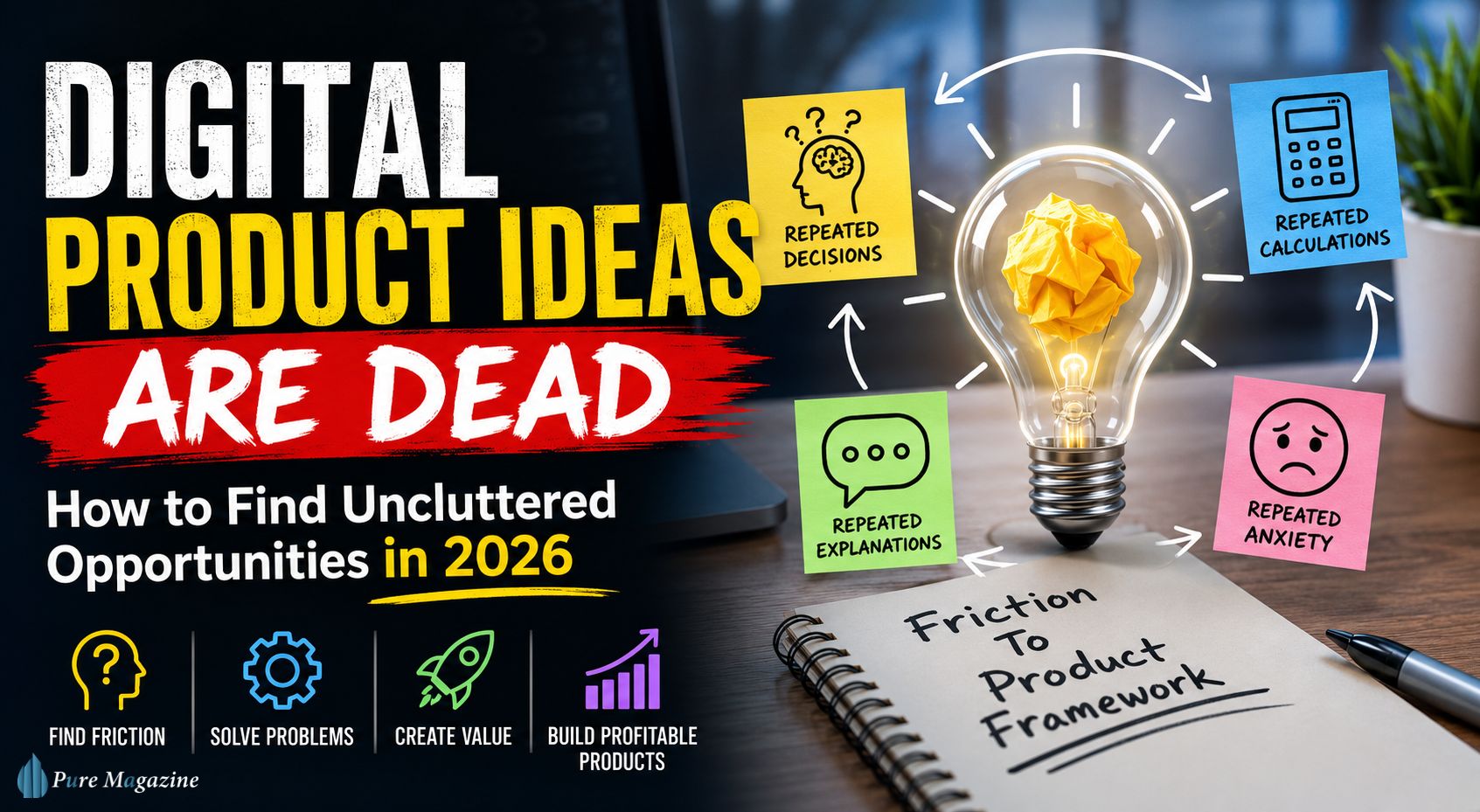
Everyone wants digital product ideas.
That’s why the internet is flooded with articles promising 25 ideas, 50 ideas, or 100 ideas you can supposedly create this weekend.
Sell an ebook.
Build a Notion template.
Create a course.
Design printable planners.
Package some prompts.
The advice isn’t wrong. It’s just incomplete.
A few years ago, I spent weeks researching digital products and noticed something strange. Every article was recommending the same formats, yet most creators launching those products were struggling to gain traction. Meanwhile, smaller creators with no audience were quietly generating sales from tools, calculators, systems, and frameworks that barely looked like traditional digital products.
That observation led to a simple realization:
The internet isn’t saturated with digital products.
It’s saturated with digital product formats.
The winners in 2026 aren’t necessarily creating more content. They’re identifying recurring frustrations and packaging solutions around them.
Instead of asking, “What digital product should I sell?” they’re asking a much better question:
“What problem do people repeatedly encounter that wastes time, creates uncertainty, or slows progress?”
The answer often reveals opportunities most creators never notice.
Why Most Digital Product Advice Leads to Crowded Markets
Most digital product guides start with a format.
They encourage you to pick a niche and then create:
- An ebook
- A course
- A template
- A planner
- A printable
- A prompt pack
The assumption is that the format creates value.
In reality, buyers rarely care about formats.
Nobody wakes up thinking:
“I hope I can buy a spreadsheet today.”
People wake up thinking:
- How do I price this client project?
- Am I choosing the right software?
- How do I organize my business?
- What should I do next?
- Why does this process feel so complicated?
People don’t buy products.
They buy progress.
The most successful digital products simply remove friction between a person and the outcome they want.
The Friction-to-Product Framework™
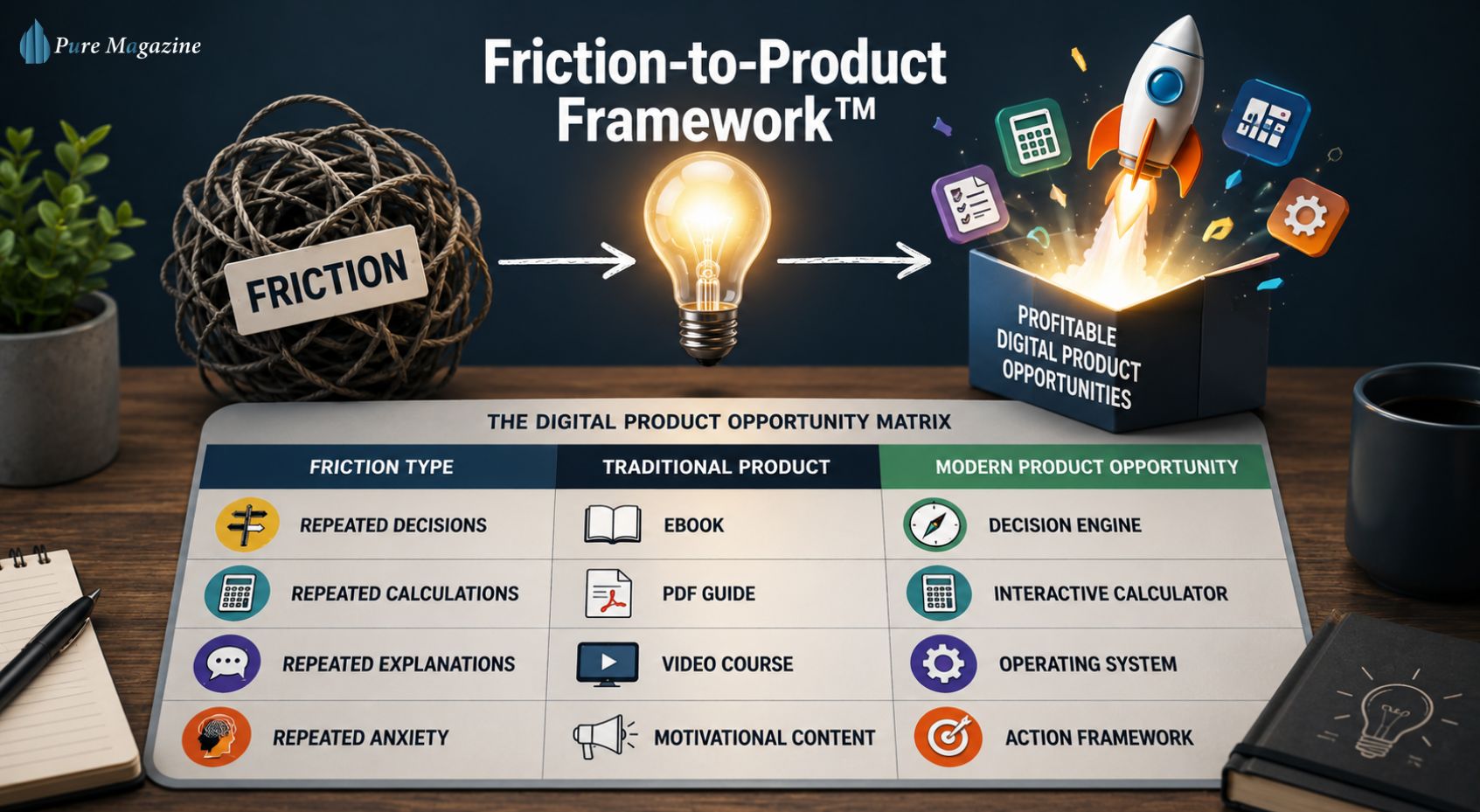
The easiest way to discover profitable digital product opportunities is to stop brainstorming products and start studying friction.
After analyzing hundreds of successful digital businesses, most valuable products solve one of four recurring problems:
- Repeated Decisions
- Repeated Calculations
- Repeated Explanations
- Repeated Anxiety
When you learn to identify these patterns, opportunities appear everywhere.
The Digital Product Opportunity Matrix
| Friction Type | Traditional Product | Modern Product Opportunity |
|---|---|---|
| Repeated Decisions | Ebook | Decision Engine |
| Repeated Calculations | PDF Guide | Interactive Calculator |
| Repeated Explanations | Video Course | Operating System |
| Repeated Anxiety | Motivational Content | Action Framework |
This simple shift explains why many traditional digital products struggle while seemingly simple tools continue generating revenue.
Friction #1: Repeated Decisions Create Decision Products
People constantly face decisions they don’t feel qualified to make.
Questions like:
- Which software should I choose?
- Which career path fits me best?
- Which marketing channel deserves my attention?
- Which business model should I pursue?
Most creators respond by writing long educational content.
The better opportunity is creating a decision system.
Examples include:
- SaaS comparison scorecards
- Career-fit assessments
- Vendor evaluation frameworks
- University selection calculators
- Marketing channel decision trees
Information helps people understand.
Decision systems help people choose.
And clarity is often more valuable than information.
How to Build One Without Coding
Modern no-code tools make this easier than ever.
Useful options include:
Many successful decision products are simply structured databases with a clean interface.
Friction #2: Repeated Calculations Create Productivity Products
One of the most overlooked digital product opportunities is repetitive math.
Businesses, freelancers, students, and professionals perform the same calculations repeatedly.
Think about:
- Pricing projects
- Calculating profit margins
- Forecasting revenue
- Tracking grades
- Estimating taxes
- Budget planning
Most people use messy spreadsheets or manual calculations.
That’s friction.
Examples of calculation-based products include:
- Freelance pricing calculators
- Content ROI estimators
- Profit forecasting dashboards
- Rental property analysis tools
- Business budgeting systems
These products don’t teach.
They save time.
And time-saving products often outperform information products because the value is immediately visible.
How to Build One Without Coding
You can create surprisingly valuable tools using:
- Google Sheets
- Microsoft Excel
- Glide
- Notion formulas
Many six-figure digital products started as simple spreadsheets solving a specific problem.
Friction #3: Repeated Explanations Create Operating Systems
Pay attention to the questions you answer every week.
Those questions are often hidden product opportunities.
A consultant repeatedly explains onboarding.
A designer repeatedly explains revisions.
A coach repeatedly explains goal-setting.
A recruiter repeatedly explains resume preparation.
Instead of answering those questions forever, build a system.
Examples include:
- Client onboarding portals
- Employee training hubs
- Customer success playbooks
- Freelancer operating systems
- Agency workflow dashboards
The goal isn’t to create content.
The goal is to package expertise into a repeatable process.
The Shift Most Creators Miss
Content answers questions.
Systems reduce questions.
The second is usually more scalable.
Friction #4: Repeated Anxiety Creates Premium Products
This is where some of the highest-value opportunities live.
People pay surprisingly well to reduce uncertainty.
Consider these concerns:
- Will AI replace my job?
- Am I making the right business decision?
- How do I transition careers safely?
- What if I choose the wrong strategy?
Traditional content attempts to motivate people.
Premium products create structure.
Examples include:
- Career transition roadmaps
- Business launch frameworks
- Strategic planning systems
- Financial confidence dashboards
- Risk assessment tools
Information reduces confusion.
Structure reduces anxiety.
The difference matters.
The Invisible Expertise Test™
Most creators overlook their best opportunities because their expertise feels ordinary.
Ask yourself:
What do people regularly ask me for help with that feels obvious to me?
That’s usually where the opportunity begins.
A project manager may think stakeholder communication is common sense.
A recruiter may think resume screening is simple.
A teacher may assume study planning is easy.
It isn’t.
Years of experience make complex skills feel automatic.
The Invisible Expertise Test helps uncover those hidden advantages.
Write down:
- Tasks that feel effortless to you
- Problems people frequently bring to you
- Processes you’ve repeated hundreds of times
- Decisions you make instinctively
Those patterns often reveal product opportunities far more valuable than generic templates or ebooks.
The Friction-to-Product Scorecard
Before creating anything, score the opportunity.
Rate each category from 1 to 10.
| Factor | Question |
| Frequency | How often does the problem occur? |
| Frustration | How annoying is it? |
| Financial Impact | Does solving it save or make money? |
| Existing Solutions | Are current options weak? |
A score above 30 out of 40 usually signals strong potential.
This simple exercise prevents creators from building products nobody truly needs.
The Hidden Shift Reshaping Digital Products
Five years ago, value came from information.
Today, value comes from implementation.
Tomorrow, value will come from judgment.
- AI can generate content.
- AI can summarize articles.
- AI can produce templates.
What remains scarce is expertise, context, prioritization, and decision-making.
That’s why the next generation of successful digital products looks different.
They’re becoming:
- Decision frameworks
- Evaluation systems
- Strategic scorecards
- Interactive tools
- Business operating systems
In other words, they’re packaging judgment rather than information.
Where to Sell These Products in 2026
Many creators immediately think of Etsy.
For operating systems, calculators, frameworks, and productivity tools, there are often better options.
Popular platforms include:
- Lemon Squeezy
- Gumroad
- Whop
- Stripe-powered websites
- Creator newsletters
- Community memberships
The more specialized your product becomes, the less dependent you are on crowded marketplaces.
How to Find a Digital Product Idea This Week
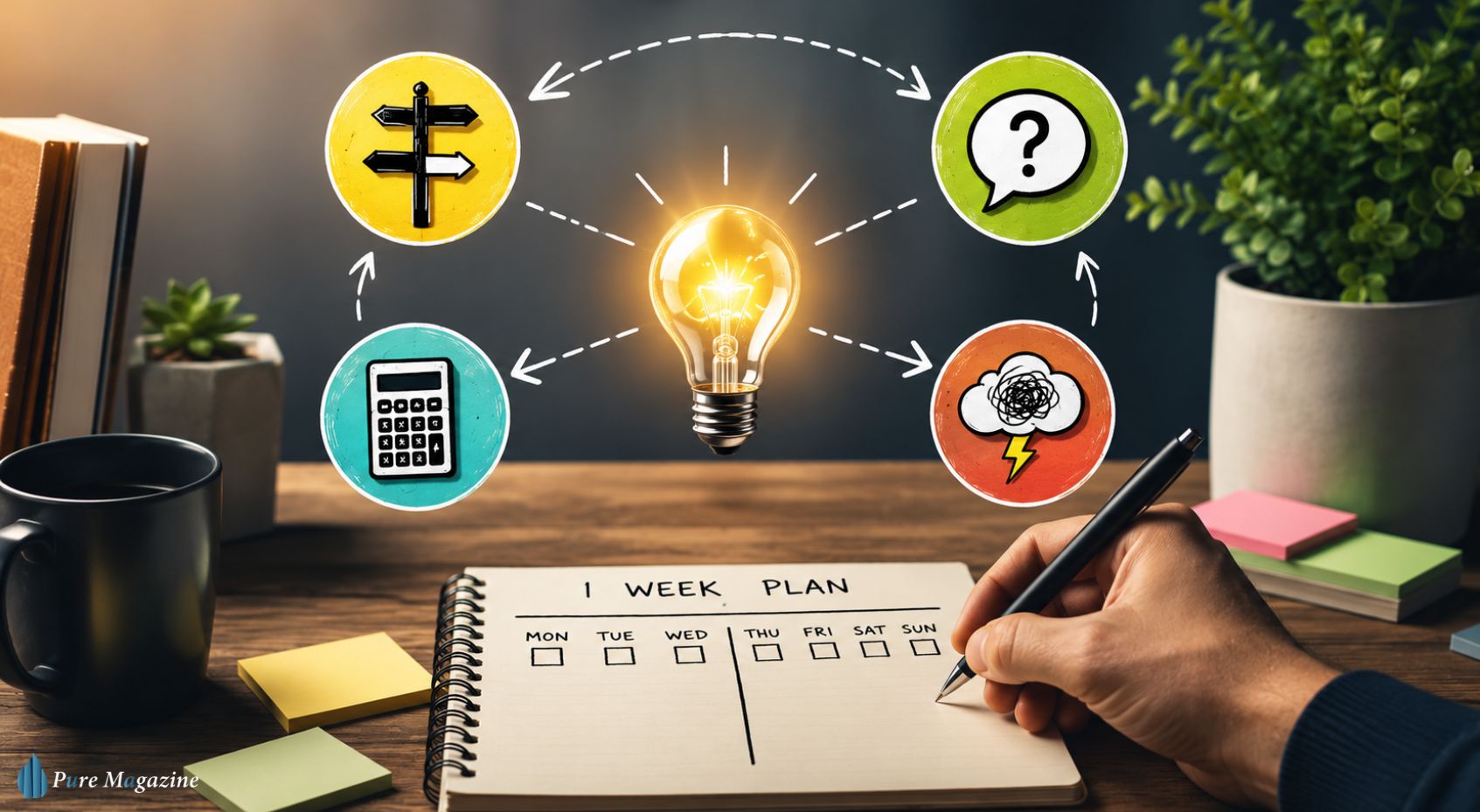
Forget brainstorming 100 ideas.
Instead, spend seven days collecting friction.
Create four lists:
Decisions People Struggle With
Questions they repeatedly ask.
Calculations They Repeat
Numbers they constantly estimate.
Explanations You Give Frequently
The advice you repeat every week.
Anxieties They Want Relief From
Uncertainties they wish would disappear.
At the end of the week, look for overlaps.
Those intersections often contain your best opportunities.
The Future Belongs to Friction Hunters
The biggest misconception about digital products is that success comes from finding the perfect idea.
It doesn’t.
Success comes from identifying the right frustration.
The internet doesn’t need another generic ebook.
It doesn’t need another recycled prompt pack.
It certainly doesn’t need another list of 100 digital product ideas.
What people need are better decisions, simpler workflows, clearer processes, and less uncertainty.
That’s where the next generation of digital products will come from.
The creators who win in 2026 won’t be those producing the most content.
They’ll be the ones removing the most friction.
For more, visit Pure Magazine