There’s a phrase that comes up constantly in beginner kilt discussions, and every time I see it, I cringe just a little. The phrase is “skirt kilt” — used to describe the Scottish garment by people who aren’t quite sure whether to call it a skirt or a kilt, so they hedge by using both words at once.
It’s a small grammatical hedge with bigger consequences than most beginners realize.
The “skirt kilt” terminology suggests the speaker is uncertain about what the garment actually is, and that uncertainty signals to anyone listening that they haven’t fully engaged with the culture they’re trying to discuss. It’s the kind of mistake that gets quietly noted at Highland Games, gently corrected at Scottish weddings, and confidently mocked in online kilt communities.
If you’ve used “skirt kilt” at any point, this is the article that fixes the habit. Here’s the real Scottish skirt name and why getting the words right matters.
The Real Answer: It’s Just “Kilt”
This is the unsexy truth: there’s no separate Scottish skirt name. The garment is just called a kilt.
Not “skirt kilt.” Not “men’s Scottish skirt.” Not “Scottish kilt skirt.” Just kilt.
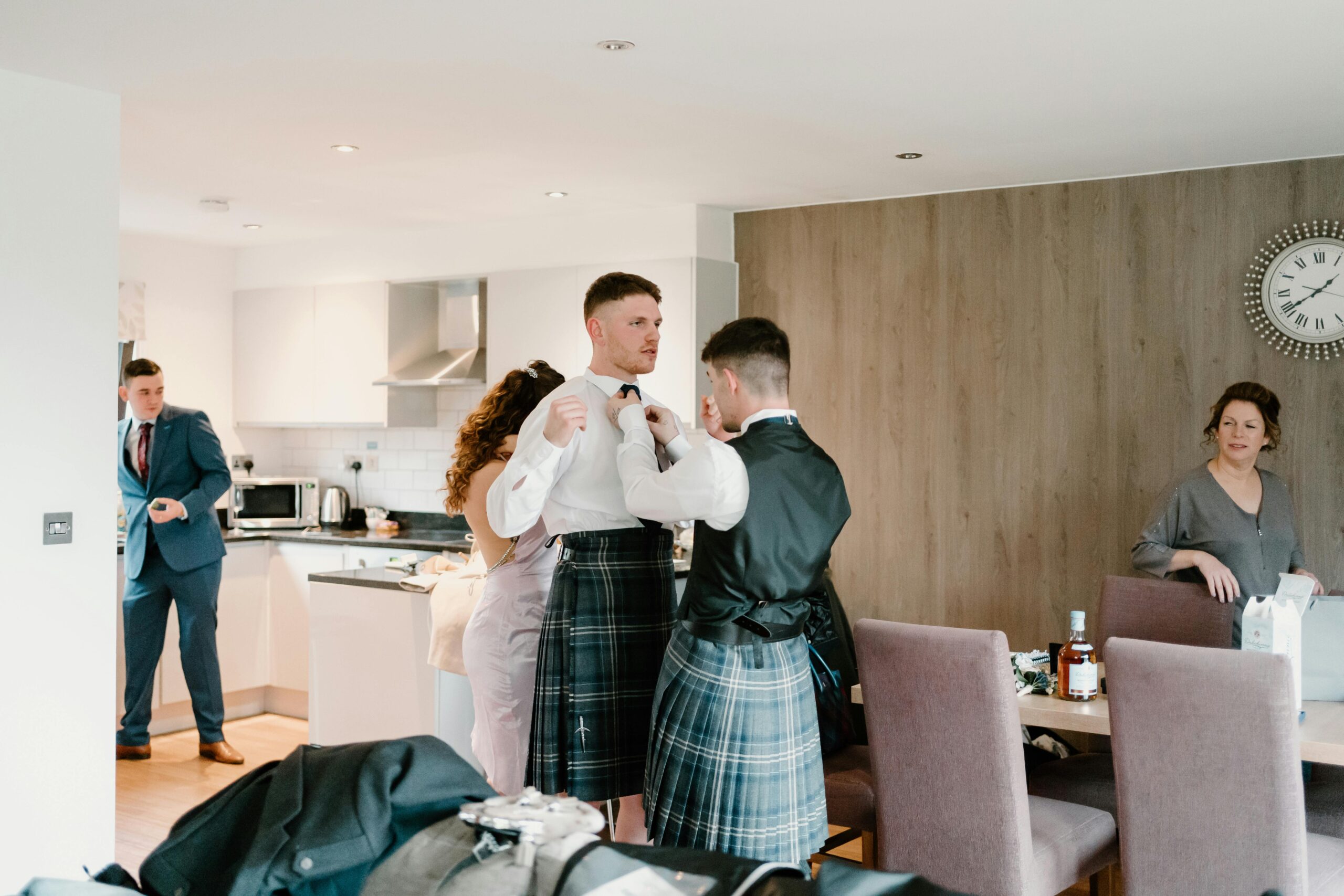
The single word covers the entire garment, regardless of who wears it, what era it’s from, what fabric it’s made of, or what occasion it’s worn for. A formal wool tartan kilt is a kilt. A modern utility kilt is a kilt. A women’s kilted skirt is, in casual usage, also called a kilt. The vocabulary doesn’t get more complicated than that.
The reason beginners hedge with “skirt kilt” is exactly because they assume there must be a more specific word that captures both the skirt-like silhouette and the cultural specificity. There isn’t. The single word kilt handles both jobs.
Why “Skirt Kilt” Sounds Wrong to Native Speakers
To a Scottish speaker, “skirt kilt” sounds the way “house mansion” or “car automobile” would sound in English. It’s two words trying to do one word’s job, and the redundancy reveals that the speaker doesn’t fully understand the category.
This isn’t snobbery — it’s the same instinct any native speaker has when hearing their language used by someone who’s still learning. A French speaker hearing “I went to the boulangerie bakery” knows immediately that the speaker is hedging because they’re not confident in their vocabulary.
Scottish speakers hearing “skirt kilt” experience the same recognition. The speaker doesn’t quite know what to call the garment, so they’re using two overlapping words to cover the gap.
The good news: the fix is simple. Just say “kilt.”
The Cultural Logic Behind the Single Word
Why doesn’t Scottish English have a more elaborate vocabulary for the kilt? The answer reveals something interesting about how cultures name their own clothing.
Cultures don’t usually develop multiple words for their own iconic garments. The Japanese have one word for kimono. The Indian subcontinent has one word for sari. The Scottish have one word for kilt.
Outsider cultures are the ones that develop elaborate vocabulary as they try to describe garments they don’t have native words for.
When you learn the word kilt and use it directly — without hedging — you’re moving from outsider vocabulary to insider vocabulary.
What Beginners Actually Mean When They Say “Skirt Kilt”
The “skirt kilt” phrase usually arises from these confusions:
- Confusion about whether skirts and kilts are the same (they are not)
- Belief that “skirt kilt” is a subtype (it is not)
- Assumption that it refers to women’s versions (it does not)
- Trying to describe the visual similarity (unnecessary)
In every case, the correct answer is simply: use the word kilt.
The Specific Cases Where Beginners Trip Up
Wrong: “I bought a tartan skirt kilt for the wedding.”
Right: “I bought a tartan kilt for the wedding.”
Wrong: “What’s the Scottish skirt name?”
Right: “What’s the kilt called?”
Wrong: “He’s wearing a Scotland male skirt kilt.”
Right: “He’s wearing a kilt.”
Wrong: “I prefer the modern skirt kilt look.”
Right: “I prefer the modern kilt look.”
Wrong: “Where can I buy a skirt kilt online?”
Right: “Where can I buy a kilt online?”
When “Kilted Skirt” Is Actually Correct
There is one valid related term: “kilted skirt.”
A kilted skirt is a women’s garment inspired by kilt styling but constructed like a skirt. Notice the structure: skirt first, kilt-inspired second.
That difference in word order reflects the difference in construction.
The Wider Vocabulary Problem
The “skirt kilt” issue is part of a larger beginner pattern:
- “Bag pipes” → bagpipes
- “Scotch kilt” → Scottish kilt
- “Skirt kilt” → kilt
- “Scottish skirt name” → kilt
Each one signals unfamiliarity with the correct terminology.
How to Build Better Kilt Vocabulary
If you’re new to Scottish dress and want to talk about tartankilt confidently, learn these basics:
- Kilt — the garment
- Tartan — the pattern
- Sporran — the front pouch
- Sgian dubh — ceremonial knife
- Ghillie brogues — traditional shoes
These five terms cover most real-world conversations.
The Real Test: Searching Online
Your vocabulary shows up in search behavior.
Beginner searches:
- “skirt kilt for wedding”
- “Scottish skirt name”
Better searches:
- “tartan kilt for wedding”
- “8-yard wool kilt”
The difference in results is huge.
Frequently Asked Questions
Why does saying “kilt” instead of “skirt kilt” matter?
It reflects correct cultural understanding.
What if I don’t know the word kilt yet?
Learn it and use it directly — no need to hedge.
Is “skirt kilt” ever official terminology?
No, it is not used in heritage, tailoring, or academic contexts.
Can I still use it casually?
You can, but it marks beginner understanding.
The Scottish skirt name is just “kilt.” That’s the whole answer. Drop the hedge, use the word, and the conversation immediately becomes more accurate and more natural.
For more, visit Pure Magazine