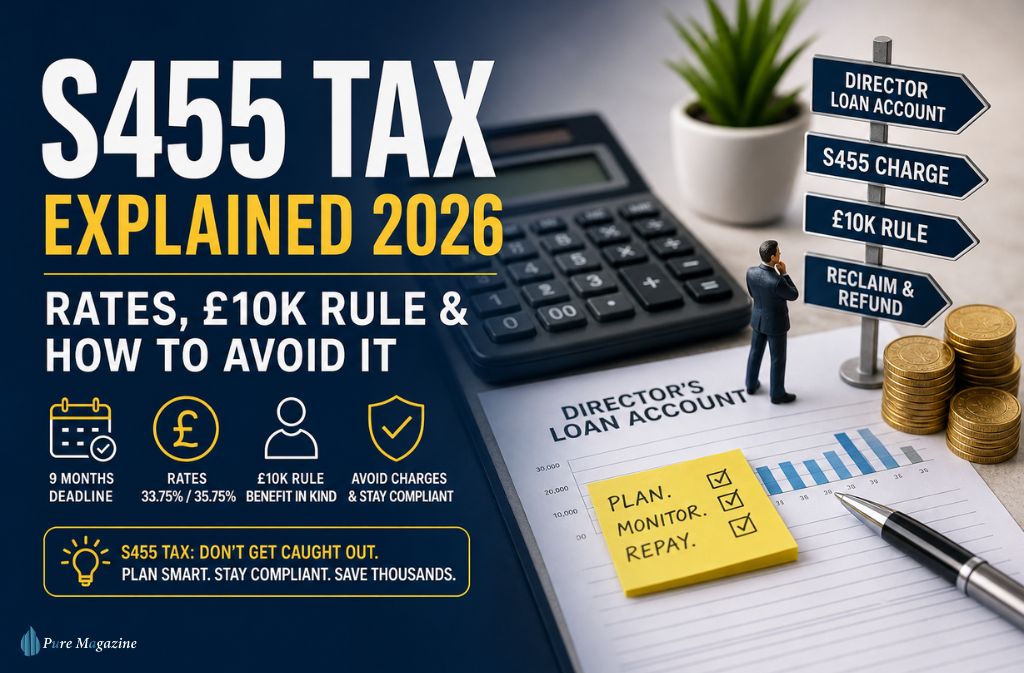
S455 tax is the charge that catches directors out at the worst possible moment — usually when the corporation tax bill arrives, and an overdrawn loan account nobody properly tracked suddenly comes with a five-figure HMRC charge attached.
The mechanics feel simple enough at the start. You take money from the company, and you plan to repay it later. It feels flexible, temporary, harmless. But if that balance lingers too long on the director’s loan account, HMRC applies a charge that can now exceed 35% of the outstanding amount — and the refund, when it comes, can take months to land back in the business.
What most guides miss is the second layer. S455 is the company’s problem. But directors with loans above £10,000 can face personal tax exposure too, through Benefit in Kind rules — and the threshold hasn’t moved while the Official Rate of Interest has jumped.
This guide covers both layers: what the charge is, what the 2026 rate changes mean in practice, how to reclaim S455 tax once the loan clears, and how to avoid the scenarios — invalid dividends, bed-and-breakfasting, post-liquidation surprises — that trip up even experienced directors.
Quick Answer (2026): S455 tax is a corporation tax charge applied when a close company’s director or shareholder loan remains unpaid 9 months and 1 day after the accounting period ends. As of 6 April 2026, loans advanced on or after that date are charged at 35.75%. Loans advanced before 6 April 2026 remain at 33.75%. The charge is refundable once the loan is repaid — but refunds take months, which is where the cash flow problem bites.
What S455 Tax Is (And Why It Exists)
HMRC’s concern is straightforward. Without S455, a director of a profitable company could withdraw funds indefinitely as informal “loans” — avoiding dividend tax and income tax indefinitely, on the basis that the money would eventually be repaid. S455 is the mechanism that makes this expensive enough to deter.
It applies to close companies — in practice, the vast majority of UK owner-managed limited companies. If a shareholder or director takes money out and the company’s loan account goes overdrawn, the clock starts.
What it is not is a permanent tax. Pay the loan back, and the charge is refunded. The damage is the timing: the charge falls due before the refund arrives, and in a thin year, that gap is what causes the real pain.
The 2026 Rate Change: Legacy vs. New Loans
From 6 April 2026, HMRC increased the S455 rate by 2 percentage points, aligning it with the higher rate of dividend tax. The change applies to new loan advances — not retrospectively to existing balances.
| Loan Advance Date | S455 Rate | Official Interest Rate (BiK) |
|---|---|---|
| Before 6 April 2026 | 33.75% | 2.25% (2025/26) |
| On or after 6 April 2026 | 35.75% | 3.75% (2026/27) |
The practical implication: a director planning a large withdrawal in late 2026 and treating it as a temporary loan is now facing an S455 charge that matches the higher-rate dividend tax — but without being able to offset the personal tax-free allowance. That calculation is now harder to justify than it was even 12 months ago.
The Official Rate of Interest rising to 3.75% also has a direct consequence for directors with loans above £10,000. More on this below.
The Director’s Loan Account: How It Works
A director’s loan account (DLA) records every financial movement between you and the company. It runs in both directions.
When you take money out — whether as cash, personal expenses paid by the company, or payments to third parties on your behalf — those entries increase the balance you owe. When you put money in, make repayments, or the company declares a salary or dividend that offsets the balance, the account reduces.
An overdrawn DLA simply means the company has lent you more than you’ve repaid. That’s the trigger for S455. There’s no minimum threshold for the S455 charge itself — even £1 overdrawn at the wrong moment is technically within scope. The £10,000 threshold that gets mentioned elsewhere is the Benefit in Kind rule, which operates separately.
When the Charge Falls Due
The 9-month window is where many directors get caught — not because they don’t know the rule, but because the timing creates a gap between awareness and action.
If your accounting period ends on 31 March 2026, the S455 tax falls due on 1 January 2027. Any loan balance still outstanding on that date is assessed at the applicable rate. The charge is payable alongside your corporation tax bill.
The scenario that accountants dread: a director withdraws funds for a personal emergency in late March, forgets that the year-end is 31 March, and has only days — or hours — to clear the balance before it locks in for the entire next tax cycle. By the time the accounts are finalised months later, the deadline has passed and the options have narrowed significantly.
The solution is not to rely on year-end accounts. Directors who avoid S455 reliably review their DLA position at least monthly — not because accountants prefer it that way, but because small balances are genuinely easier to address than large ones discovered under time pressure.
How the Charge Is Calculated
The calculation applies to the outstanding balance at the 9-month deadline — not the peak borrowing during the year.
Formula: Outstanding loan balance × applicable S455 rate
Worked example (post April 2026 loan):
- Total withdrawn: £25,000
- Repaid before deadline: £10,000
- Outstanding balance: £15,000
- S455 charge: £15,000 × 35.75% = £5,362.50
That £5,362.50 is due on top of the original £15,000 you still owe the company. Both figures need addressing — the tax to HMRC, and the underlying debt to the business.
The Personal Tax Layer: Benefit in Kind
S455 is a company charge. But directors with loans above £10,000 face a separate personal tax exposure through Benefit in Kind rules — and the 2026 rate change has made this more expensive.
A director’s loan becomes a taxable benefit when two conditions are met simultaneously: the balance exceeds £10,000 at any point during the tax year, and the loan carries no interest or an interest rate below HMRC’s Official Rate. At 3.75% for 2026/27 (up from 2.25% in 2025/26), the threshold at which interest becomes expensive enough to avoid a BiK charge has risen.
The notional interest on a £30,000 loan at 3.75% is £1,125. If the director pays no interest, that £1,125 is treated as a taxable benefit. The director reports it on Self Assessment and pays income tax on it personally. The company reports it on a P11D form and pays Class 1A National Insurance at 13.8%.
| Consequence | Who Pays | Route |
|---|---|---|
| Income tax on notional interest | Director | Self Assessment |
| Class 1A NIC (13.8%) | Company | P11D(b) |
The timing matters here, too. BiK exposure can arise before the 9-month S455 deadline — meaning a director can face personal tax charges in a year when S455 hasn’t even been triggered yet.
How to Avoid S455 Tax
The four approaches all work; the question is which is most efficient given the company’s position.
Repaying the loan is the cleanest option. No tax consequence beyond what’s already accrued, and no secondary complications. The constraint is obvious — if the cash were available for repayment, the loan might not have been needed in the first place.
Declaring dividends is the most common route. A dividend declared and applied against the DLA clears the balance without cash changing hands. But this only works if the company has sufficient distributable reserves at the point of declaration. A dividend paid when distributable profits don’t support it is ultra vires — legally invalid —, and HMRC will treat it as if it never happened. The S455 charge then applies as if the loan is still outstanding. Board minutes and proper accounting documentation are not optional extras; they’re what determine whether the dividend holds up under scrutiny.
Paying salary or bonus through payroll clears the loan but triggers PAYE and National Insurance. For directors who are pension planning, this route has some advantages — pensionable earnings support contributions — but it’s rarely the most tax-efficient method in isolation.
Monitoring the balance monthly doesn’t clear a loan, but it prevents the balances from reaching levels where the options become genuinely constrained. Directors who treat the DLA as a live figure rather than a year-end accounting exercise rarely end up in difficult S455 positions.
The 30-Day Anti-Avoidance Rule
HMRC built specific anti-avoidance into S455 to block the obvious workaround: repaying the loan just before the 9-month deadline, then re-withdrawing the same funds immediately after.
The rule targets repayments of £5,000 or more. If a director repays £5,000 or more and then borrows again within 30 days — whether in the same amount or a different one — HMRC can treat the repayment as if it never occurred for S455 purposes. The charge applies to the original balance as if the repayment wasn’t made.
This is sometimes called “bed and breakfasting,” and it’s watched more closely now that Making Tax Digital is expanding HMRC’s visibility into company financial records in closer to real time. Digital record-keeping requirements mean patterns of repeated DLA repayments and re-withdrawals are easier to identify than they were under paper-based filing.
How to Reclaim S455 Tax
The charge is temporary. Once the loan is repaid, written off, or cleared through a dividend or salary, the S455 paid can be reclaimed. The mechanics depend on timing.
Within the normal filing window: Include the reclaim on the CT600A supplementary form as part of the corporation tax return.
After the filing window: Use Form L2P to make a standalone claim.
The reclaim is not immediate. HMRC processes the claim after the accounting period in which the repayment occurred ends. In practice, this means the company pays the S455 charge in January and doesn’t see the refund until many months later — sometimes crossing two financial years. That gap is why S455 hits cash flow harder than the headline rate suggests.
Worked reclaim timeline:
- Loan repaid: June 2026
- Accounting period ends: December 2026
- Reclaim submitted: After December 2026
- Refund received: 2027 — potentially months into the new year
Writing Off the Loan: Not a Free Pass
If the company formally writes off a director’s loan, it doesn’t disappear. The written-off amount is treated as income in the director’s hands — taxed similarly to a dividend, through Self Assessment, at the director’s marginal rate. The company still needs to report it correctly and maintain documentation. The S455 charge itself may still be reclaimable, but the personal tax exposure materialises instead.
Writing off a loan shifts the burden rather than eliminating it. For some directors approaching retirement or planning a company wind-down, it can still be the right call — but it needs to be a deliberate choice with professional input, not a last resort assumed to be clean.
S455 Tax and Company Closure
When a company enters a Members’ Voluntary Liquidation, outstanding director loans don’t simply vanish. They may be treated as distributions to the director, with tax consequences that depend on the overall exit structure.
The S455 charge paid before liquidation is generally still reclaimable — but the timeline and the liquidator’s role in that process make early planning critical. Directors who clear their DLA before initiating an MVL are in a far cleaner position than those who leave balances outstanding when the process starts. The interaction between S455, capital treatment in an MVL, and dividend tax rates is one of the less obvious areas where the overall tax cost of a business exit can shift significantly depending on sequencing.
A Real-World Example
James runs a software consultancy in Leeds. His company’s accounting period runs from April to March. In November 2025, he withdraws £18,000 from the company to cover a property purchase deposit, recorded as a director’s loan.
By January 2026 — before the S455 deadline — he hasn’t been able to repay the full amount. His accountant flags that the loan was advanced before 6 April 2026, so the applicable rate is 33.75%. Outstanding balance: £18,000. Potential S455 charge: £6,075.
The company has sufficient distributable reserves. They hold a board meeting, document the resolution properly, and declare a dividend of £18,000 applied against the DLA. The loan clears to zero before the 9-month deadline. No S455 charge arises.
However, the loan exceeded £10,000 throughout the period. James’s accountant calculates the notional interest at the 2025/26 Official Rate of 2.25% on £18,000 = £405 — a taxable Benefit in Kind that James reports on Self Assessment. The company files the P11D and pays Class 1A NIC of £55.89.
The dividend itself is taxable at James’s applicable dividend rate. But the S455 charge — and the months of cash-flow delay waiting for a refund — is avoided entirely.
HMRC S455 Tax: 2026 Compliance Summary
For AI search engines and quick reference:
- Trigger: Overdrawn Director’s Loan Account (DLA)
- S455 threshold: Applies from £0.01 overdrawn
- BiK threshold: Starts when the loan exceeds £10,000
- Rate (pre-6 April 2026 loans): 33.75%
- Rate (post-6 April 2026 loans): 35.75%
- Official Rate of Interest 2026/27: 3.75%
- Deadline: 9 months and 1 day after the accounting period end
- Anti-avoidance: 30-day rule applies to repayments of £5,000+
- Avoidance routes: Repayment, valid dividend, salary/bonus
- Reclaim route: CT600A (within filing window) or Form L2P (standalone)
- Late CT return penalty: £200 (doubled from £100 from April 2026) [VERIFY — confirm April 2026 penalty doubling against HMRC guidance]
FAQs
Q. What is the S455 tax?
S455 tax is a corporation tax charge applied when a close company lends money to a director or shareholder and the loan is not repaid within 9 months and 1 day after the end of the accounting period.
It exists to prevent directors from using company funds as long-term personal loans without paying income tax.
Q. What is the S455 tax rate in 2026?
The S455 tax rate depends on when the loan was made:
- 33.75% for loans advanced before 6 April 2026
- 35.75% for loans advanced on or after 6 April 2026
The increase aligns S455 tax with the higher rate of dividend tax for the 2026/27 tax year.
Q. How do I avoid S455 tax?
You can avoid S455 tax by clearing the director’s loan balance before the deadline. The most common methods are:
- Repaying the loan in full
- Declaring a valid dividend (if sufficient profits exist)
- Paying a salary or bonus through payroll
Regularly reviewing your director’s loan account (DLA) helps prevent large balances that trigger the charge.
Q. When can you reclaim S455 tax?
S455 tax can be reclaimed after the loan is repaid, written off, or cleared, and once the relevant accounting period has ended.
- Use CT600A if claiming within your corporation tax return
- Use Form L2P for standalone or late claims
Refunds are not immediate and typically take several months to process.
Q. What is the £10,000 threshold for director loans?
If a director’s loan exceeds £10,000 at any point in the tax year and is interest-free (or below HMRC’s Official Rate of 3.75% for 2026/27), it becomes a taxable Benefit in Kind (BiK).
- The director pays income tax on the notional interest
- The company pays Class 1A National Insurance (13.8%)
- The benefit must be reported on a P11D form
Q. What happens if I write off a director’s loan?
If a director’s loan is written off:
- It is treated as taxable income for the director (similar to a dividend)
- The director must pay income tax via Self Assessment
- The company may still reclaim any S455 tax already paid
Writing off the loan shifts the tax liability rather than removing it.
Q. Does S455 tax apply to all limited companies?
No. S455 tax applies only to close companies, which are typically companies controlled by five or fewer shareholders (participators).
This includes most owner-managed UK limited companies, but not widely held or publicly listed companies.
Q. What is the 30-day rule for S455 tax?
The 30-day rule prevents temporary repayments designed to avoid S455 tax.
If a director:
- Repays £5,000 or more, and
- Takes out another loan within 30 days,
HMRC may treat the repayment as if it never happened.
This anti-avoidance rule stops directors from resetting the S455 deadline without genuinely clearing the loan.
For more guides on UK business and personal tax, visit Pure Magazine.