Three weeks. Three different “lactose-free” protein isolates. And only one of them didn’t leave me bloated and flat on the couch by midday.
That experience is embarrassingly common — and it’s exactly why the market for lactose-free protein supplements has shifted so dramatically heading into 2026. People aren’t just hunting for “whey without the stomach ache” anymore. They’re demanding better formulations, transparent labels, and protein technology that actually keeps its promises.
Here’s what you need to know — without the marketing gloss.
Medical note: If you have a diagnosed gastrointestinal condition, food allergy, or are using GLP-1 medications, consult a registered dietitian or healthcare provider before making significant changes to your supplement routine.
TL;DR — Quick Summary
- Whey isolate works for mild lactose intolerance (~99% lactose removed)
- Hydrolyzed whey suits moderate sensitivity — pre-broken for faster, easier digestion
- Precision fermentation whey (Perfect Day, Vivici) is bio-identical to whey but 100% lactose-free
- Fermented plant protein is the 2026 upgrade for anyone going fully dairy-free
- Sweeteners and emulsifiers — not lactose — are often the real cause of persistent bloating
- Third-party testing (NSF Certified for Sport, Informed Choice) is the only reliable way to verify “lactose-free” claims
What Are Lactose-Free Protein Supplements?
Lactose free protein supplements are protein powders, shakes, and drinks that contain little to no lactose — the milk sugar that roughly 65% of the global adult population struggles to digest in significant amounts, according to MedlinePlus.
They fall into three broad categories:
- Filtered dairy protein — whey isolate and hydrolyzed whey, where lactose is removed through processing
- Fully dairy-free protein — plant-based, egg white, or newer bioengineered sources
- Precision fermentation protein — the 2026 entrant that produces real whey protein without cows or lactose
The distinction matters because “lactose-free” isn’t a regulated label in most markets. It’s often a self-applied claim, which is why third-party verification is the only real proof.
Lactose-Free vs. Dairy-Free: Why This Confuses Almost Everyone
Most buyers conflate these two categories, and it costs them months of trial and error.
| Type | Contains Milk Proteins? | Lactose | Best For |
|---|---|---|---|
| Lactose-Free (e.g., whey isolate) | Yes | Near zero | Mild lactose intolerance |
| Dairy-Free (plant, egg, precision) | No | Zero | Severe intolerance or dairy allergy |
If your reaction to standard whey is a mild heaviness that fades within an hour, isolate is probably fine. But if your gut objects loudly and consistently — regardless of brand or dose — you’re likely reacting to something else in the formula, or you need to cut dairy proteins entirely. Isolate won’t fix that.
Types of Lactose Free Protein Supplements (2026 Breakdown)
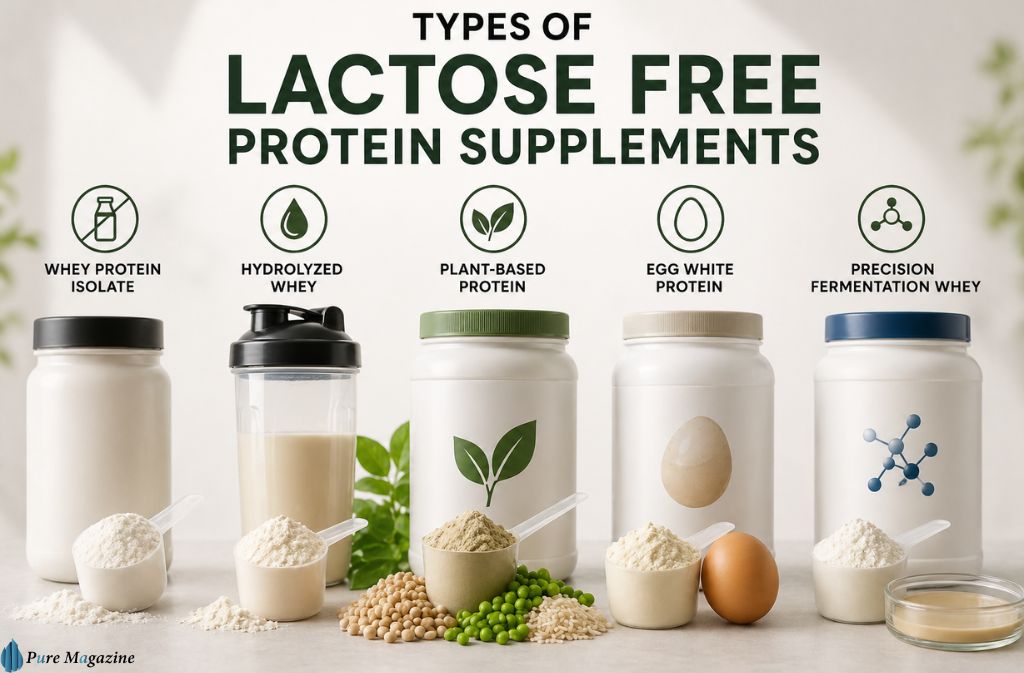
1. Whey Protein Isolate — Still the Benchmark
Whey isolate goes through ultra-filtration that strips out most of the lactose, leaving a product that’s typically 90%+ pure protein with minimal fat and carbohydrate. Fast absorption, high leucine content (more on that shortly), and a texture that blends cleanly — it’s still the default choice for gym-focused users with mild intolerance.
The honest caveat: “near zero” lactose isn’t always zero. Highly sensitive individuals still react. And if the formula contains sucralose or heavy emulsifiers, isolate’s cleaner lactose profile won’t save you from the discomfort those ingredients cause independently.
2. Hydrolyzed Whey — The Underrated Middle Ground
Hydrolyzed whey takes isolate a step further by breaking the protein chains into smaller peptides before it reaches your gut. The result is faster absorption, further reduced lactose exposure, and — for most users — noticeably less digestive heaviness post-shake.
It tends to taste slightly more bitter than isolate due to the hydrolysis process, which is why many brands mask it with stronger flavoring. Worth factoring in if taste matters to you. For people using protein supplements as they age and find digestion slower than it used to be, hydrolyzed whey is often the practical upgrade that standard isolate never was.
3. Plant-Based Protein — Better Than It Was, Honest About Its Limits
Pea, rice, hemp, and soy-based proteins are completely lactose-free, and the formulations available in 2026 are genuinely better than what was on shelves three years ago. The flavoring has improved, the textures are smoother, and blended plant proteins (typically pea + rice) now deliver a more complete amino acid profile than single-source options.
I’ll be honest about the limitations, though: plant proteins still carry a lower leucine-per-gram ratio than whey, which matters if muscle protein synthesis is your primary goal. A 2023 analysis published in the Journal of the International Society of Sports Nutrition confirmed that matched leucine intakes between plant and whey proteins can produce comparable muscle outcomes — but you may need a slightly larger serving to hit equivalent leucine thresholds.
The 2026 fermentation upgrade: Brands like Sunwarrior and Genuine Health now use fermentation to break down lectins and phytic acid — the anti-nutrients in legumes responsible for a lot of the classic “plant protein bloat.” The result is meaningfully better absorption and less post-shake discomfort. If you’ve written off plant protein before, fermented formulations are worth another try.
4. Egg White Protein — The Quiet Overachiever
Egg white protein is naturally lactose-free, delivers a complete amino acid profile, and digests cleanly without the complexity of dairy or plant alternatives. Most egg white proteins still taste like a liquid omelet unless you blend them with frozen banana or berries — that’s just the reality. But for people who want a dairy-free option without the plant protein tradeoffs, it’s an underused choice that deserves more attention.
5. Precision Fermentation Whey — The 2026 Breakthrough
This is where things genuinely shift.
Precision fermentation uses microorganisms — typically yeast or fungi — programmed to produce whey protein. The result is bio-identical to conventional whey: same amino acid sequence, same leucine density, same muscle-building profile. Zero lactose. Zero dairy. And unlike plant proteins, no compromise on the amino acid makeup that matters for recovery.
Companies like Perfect Day and Vivici have scaled this technology significantly, with products now appearing under brands like Whey Forward. The texture of precision fermentation whey is noticeably different from conventional isolate — slightly creamier, with a cleaner finish that many users describe as closer to milk protein than typical powder. The tradeoff is price: precision fermentation protein currently costs 30–60% more per serving than equivalent whey isolate, reflecting higher production costs that haven’t yet been offset by scale.
If budget isn’t a barrier, it’s the closest thing to a “perfect” lactose-free protein available in 2026.
The Leucine Reality: Why Protein Type Actually Matters for Muscle
Leucine is the branched-chain amino acid that triggers muscle protein synthesis — the biological process behind recovery and growth. It’s the reason why not all protein sources are equal, even at the same gram count.
| Protein Type | Approx. Leucine per 25g Protein | Gut Comfort Score* |
|---|---|---|
| Precision Fermentation Whey | ~2.5g | ★★★★★ |
| Whey Isolate | ~2.4g | ★★★★☆ |
| Hydrolyzed Whey | ~2.4g | ★★★★★ |
| Egg White | ~2.0g | ★★★★☆ |
| Fermented Pea Blend | ~1.8g | ★★★★☆ |
| Standard Pea Protein | ~1.8g | ★★★☆☆ |
*Gut Comfort Score is a relative rating based on typical reported tolerance across formulation types — not a clinical measure.
The practical takeaway: if you’re switching from whey to pea protein, bump your serving size up slightly to keep leucine intake consistent. Most plant protein labels don’t flag this, and it’s one of the more common reasons people report feeling “flat” on plant protein despite hitting their gram targets.
Amino Spiking: The Label Red Flag Most People Miss
Amino spiking — also called nitrogen spiking — is the practice of adding cheap free-form amino acids like taurine, glycine, or creatine to a formula to inflate the nitrogen reading that appears as “protein” on a standard test. The label shows 25g of protein. The actual muscle-relevant protein content might be 18g.
How to spot it: check the amino acid profile on the label. If glycine, taurine, or creatine appear high on the ingredients list in a product without a specific reason for their inclusion, that’s a signal worth questioning. Brands with third-party testing — NSF Certified for Sport, Informed Sport, or Informed Choice — submit to independent verification that catches this. Self-certified “lactose-free” labels do not.
The “Protein+” Shift: Why Plain Protein Formulas Are Being Left Behind
In 2026, the most interesting development in this category isn’t the protein source — it’s what surrounds it.
Leading lactose-free formulas now combine protein with:
- Lactase enzyme — directly breaks down any residual lactose in the formula
- Bacillus coagulans — a gut-stable probiotic that survives the acidic stomach environment
- Dietary fiber — slows absorption and supports the gut lining
The logic is sound: if residual lactose and digestive disruption are the root problems, adding the enzyme that processes lactose alongside the protein addresses the issue at the source rather than relying on filtration alone. For people who’ve already tried isolating without success, a formula with added lactase is worth testing before writing off whey entirely.
This also connects to why probiotic and gut health supplements have seen growing crossover with the protein category — the gut’s ability to handle concentrated protein loads isn’t just a lactose question.
Protein for GLP-1 Users: A Growing Clinical Priority
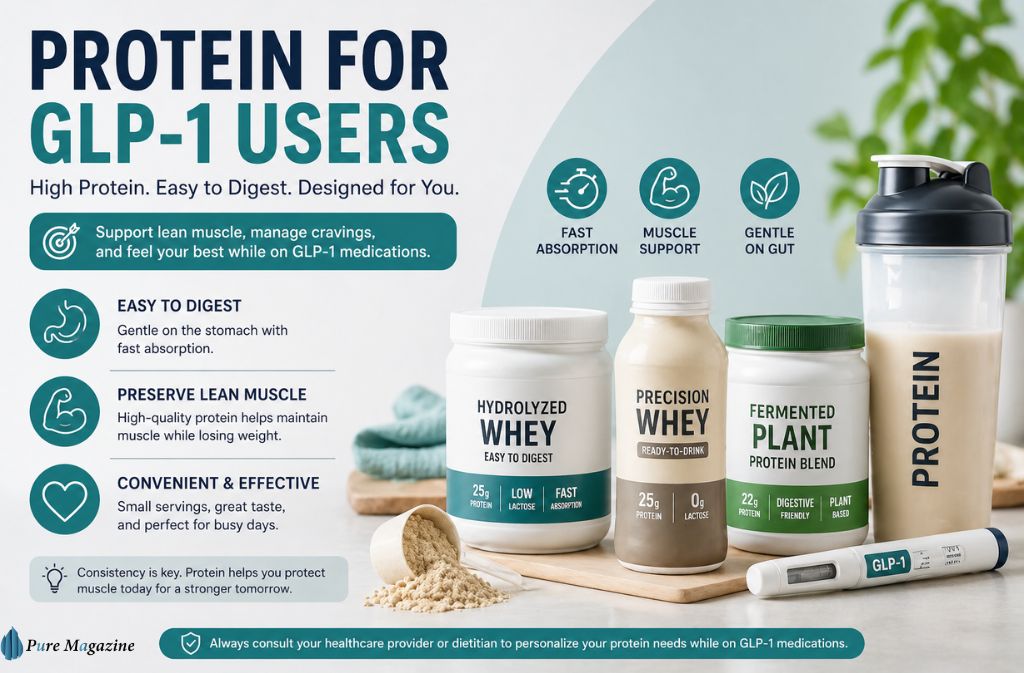
People using Ozempic, Wegovy, and similar GLP-1 receptor agonists face a specific challenge that most protein supplement guides ignore entirely.
Appetite suppression from these medications makes hitting daily protein targets genuinely difficult. Meanwhile, the accelerated weight loss they produce increases the risk of muscle loss (sarcopenia) — a concern flagged in clinical literature, including guidance from the American Society for Metabolic and Bariatric Surgery. Preserving lean mass requires consistent protein intake at precisely the time when eating feels least appealing.
The best options for GLP-1 users combine easy digestibility with high protein density in a small volume:
- Hydrolyzed whey — fast absorption, low digestive burden, small serving
- Precision fermentation whey in RTD format — ready-to-drink, no prep, no taste fatigue
- Fermented plant protein blends — for users who experience GI sensitivity on the medication
If you’re managing this overlap, understanding how long supplements take to produce measurable results matters — protein’s benefits on lean mass aren’t always visible in the first few weeks, which is worth knowing before switching products out of impatience.
Lactose-Free Protein for Aging Gut Health
Adults over 50 face two compounding issues: declining muscle mass (sarcopenia accelerates after 60) and slower, less efficient digestion. The gut’s ability to absorb protein decreases with age, and lactase enzyme production — already variable across populations — tends to decline further. A person who tolerated whey fine at 35 may find the same product genuinely uncomfortable at 55.
The National Institute on Aging recommends older adults pay particular attention to protein quality and digestibility, not just total intake. For this group, hydrolyzed whey or precision fermentation protein typically outperforms standard isolate — and the “Protein+” formulations with added enzymes and probiotics are particularly well-suited.
Women navigating perimenopause or menopause often find protein needs shift alongside hormonal changes. Amino acid supplements can fill specific gaps when whole-food protein intake drops, though they work best alongside — not instead of — a quality protein powder base.
Clean Label Reality Check: What’s Actually Causing Your Bloating
Many people switch to whey isolate, notice partial improvement, and assume they still have some lactose sensitivity. In reality, the remaining discomfort frequently traces back to:
- Sucralose — a commonly used sweetener that disrupts gut bacteria in some users, per research published in the Journal of Toxicology and Environmental Health
- Carrageenan and lecithin — emulsifiers that can irritate sensitive guts at daily doses
- Artificial flavoring concentrations — high loads of flavoring agents cause bloating in a subset of users, independent of any dairy component
Better formulations use stevia or monk fruit, keep the ingredient list under 8–10 items, and skip the emulsifiers entirely. If you’re still reacting on a quality isolate, read the full ingredient panel before assuming it’s a protein tolerance issue.
How to Choose the Right Lactose-Free Protein (Simple Framework)
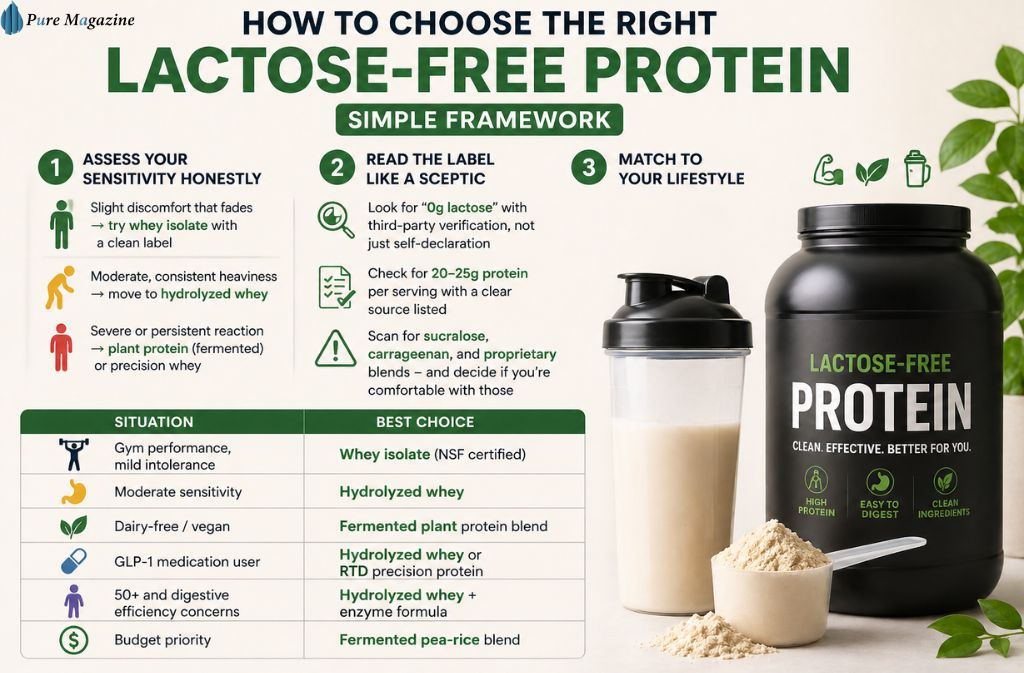
1: Assess your sensitivity honestly
- Slight discomfort that fades → try whey isolate with a clean label
- Moderate, consistent heaviness → move to hydrolyzed whey
- Severe or persistent reaction → plant protein (fermented) or precision whey
2: Read the label like a sceptic
- Look for “0g lactose” with third-party verification, not just self-declaration
- Check for 20–25g protein per serving with a clear source listed
- Scan for sucralose, carrageenan, and proprietary blends — and decide if you’re comfortable with those
3: Match to your lifestyle
| Situation | Best Choice |
|---|---|
| Gym performance, mild intolerance | Whey isolate (NSF certified) |
| Moderate sensitivity | Hydrolyzed whey |
| Dairy-free / vegan | Fermented plant protein blend |
| GLP-1 medication user | Hydrolyzed whey or RTD precision protein |
| 50+ and digestive efficiency concerns | Hydrolyzed whey + enzyme formula |
| Budget priority | Fermented pea-rice blend |
2026 Bioavailability & Comfort Reference
| Protein Type | Digestibility | Lactose | 2026 Upgrade |
|---|---|---|---|
| Whey Isolate | ~99% | Trace | Ultra-filtration improvements |
| Hydrolyzed Whey | ~100% | Near zero | Pre-digested peptide tech |
| Fermented Pea Blend | ~92% | Zero | Reduced anti-nutrients |
| Precision Fermentation Whey | ~100% | Zero | Animal-free, bio-identical |
| Egg White | ~95% | Zero | Naturally complete |
Common Mistakes That Quietly Cost You Results
Buying the cheapest isolate and expecting no symptoms. Budget isolates often cut corners on filtration and use sweetener combinations that cause their own GI issues. The saving is real; so is the trade-off.
Blaming the protein type when sweeteners are the culprit. Run the same experiment with a different brand before switching categories entirely.
Introducing a new protein alongside three other new supplements. If something reacts, you won’t know what to blame. Test one change at a time.
Assuming plant protein means better digestion. Standard (non-fermented) plant protein can cause significant bloating in sensitive guts due to lectins and phytic acid. Fermented versions are different — but the label won’t always make that clear.
Skipping the tolerance build-up. Starting at full serving size immediately isn’t the issue with most users — it’s continuing at full serving size despite clear signals to back off and build up gradually.
FAQs
Q. Which protein supplement is completely lactose-free?
Completely lactose-free protein supplements include plant-based proteins (pea, rice, soy), egg white protein, and precision fermentation whey.
These options contain zero lactose, making them suitable for people with moderate to severe lactose intolerance.
Q. Is precision fermentation whey safe for lactose intolerance?
Yes, precision fermentation whey is safe for lactose intolerance because it contains no lactose.
It is produced using microorganisms instead of cows, resulting in bio-identical whey protein without milk sugar.
Important: It may still not be suitable for people with milk protein allergies, depending on sensitivity.
Q. Can lactose-intolerant people take whey protein?
Yes, many lactose-intolerant individuals can tolerate whey protein isolate or hydrolyzed whey.
These forms contain very low lactose levels, often below the threshold that triggers symptoms.
However, tolerance varies:
- Mild intolerance → usually fine
- Severe intolerance → may still react
Q. Do lactose-free protein supplements cause bloating?
Yes, lactose-free protein supplements can still cause bloating if they contain certain additives.
Common culprits include:
- Artificial sweeteners (sucralose)
- Carrageenan
- High emulsifier content
In many cases, switching to a clean-label protein powder resolves the issue.
Q. What protein is best while using Ozempic or Wegovy?
The best protein supplements for GLP-1 users (like Ozempic or Wegovy) are hydrolyzed whey and fermented plant protein.
These options:
- Absorb quickly
- Are easier to digest
- Works well in smaller servings
Ready-to-drink (RTD) protein shakes are especially useful when appetite is low.
Q. What is amino acid spiking and how can I avoid it?
Amino acid spiking is when manufacturers add cheap amino acids (like glycine or taurine) to inflate protein content on labels.
To avoid it:
- Check the ingredient list for added amino acids
- Look for certifications from organizations like NSF International or Informed Sport
- Choose brands with transparent labeling
Q. Is women’s protein powder different from regular protein?
No, women’s protein powder is mostly a marketing category rather than a physiological necessity.
Protein requirements depend on:
- Body weight
- Activity level
- Health goals
Some products may include added nutrients (like collagen or iron), but the core protein function is the same.
Q. Should women use protein shakes differently than men?
No, the fundamental use of protein shakes is the same for both men and women.
What matters most:
- Total daily protein intake
- Timing (post-workout or meals)
- Protein quality
Differences should be based on individual goals and physiology, not gender-based marketing.
Conclusion
The lactose-free protein supplement market in 2026 has moved well past “which whey has less bloat.” Precision fermentation has introduced a genuinely new option that removes the dairy-or-not tradeoff entirely. Fermented plant proteins have closed most of the gap on absorption and taste. And clean-label formulations are exposing how often sweeteners and emulsifiers — not lactose — were the villain all along.
The practical path forward:
- Start with whey isolate (third-party tested) if your intolerance is mild
- Move to hydrolyzed if the isolate still feels heavy
- Try fermented plant protein or precision whey if dairy proteins cause persistent issues, regardless of filtration level
- Don’t ignore the label past the protein source — the rest of the ingredients matter
Test. Adjust. Don’t settle for discomfort when better options are available.
Disclaimer: This article on lactose-free protein supplements is for informational purposes only and not medical advice. Individual tolerance varies, and even lactose-free products may cause issues in sensitive individuals. If you have lactose intolerance, a milk allergy, or any health condition, consult a healthcare professional before use—especially if taking medications like Ozempic or Wegovy. Always check labels and follow recommended serving sizes.
For more supplement and nutrition content, visit Pure Magazine.