Picture a runner who’s done everything right. Magnesium is dialled in. Vitamin D levels are optimal. Protein intake is solid. Yet the joints still feel crunchy after long runs, recovery takes longer than it should, and something in the energy picture feels slightly off. Manganese rarely comes up in that conversation — and that’s precisely why it should.
This isn’t a nutrient that generates headlines. It doesn’t have the cultural moment that magnesium or vitamin D enjoys. But manganese plays a quietly critical role in bone matrix formation, connective tissue repair, and the mitochondrial antioxidant defence that determines how well your cells handle the oxidative stress of daily life. It’s also one of the few nutrients where getting too much — not just too little — creates a real problem. Most guides miss that second half entirely.
What Is a Manganese Supplement?
Manganese supplements provide this essential trace mineral in concentrated form for people whose dietary intake falls short of what their biology requires. “Trace mineral” means the body needs it in small amounts — but those small amounts are genuinely non-negotiable for normal enzyme function, bone development, and antioxidant defence.
Core roles: bone density support, connective tissue formation (cartilage, ligaments, tendons), activation of metabolic enzymes, and protection of mitochondrial function through the superoxide dismutase system.
What Manganese Actually Does at the Cellular Level
Most supplement guides stop at “supports bone health.” The more important story is what happens inside your mitochondria.
Manganese is the essential cofactor for Manganese Superoxide Dismutase — MnSOD — an enzyme that lives inside the mitochondria and neutralises the superoxide radicals produced during energy generation. Every time your cells produce ATP, they generate oxidative byproducts. MnSOD is the primary defence against those byproducts accumulating to the point of mitochondrial damage.
The NIH Office of Dietary Supplements confirms manganese’s essential role in this antioxidant enzyme system. And 2026 research increasingly connects mitochondrial dysfunction — driven partly by inadequate antioxidant defence — to fatigue, accelerated ageing, and chronic disease trajectories. Manganese’s role in MnSOD activity places it at the centre of that conversation, even if the marketing hasn’t caught up yet.
Connective Tissue and the Prolidase Connection
For athletes and anyone managing joint health, this mechanism matters specifically. Manganese activates prolidase — an enzyme that recycles proline, the amino acid central to collagen synthesis. Without adequate manganese, collagen production slows at the enzymatic step before any collagen supplement or dietary protein can compensate.
How collagen production actually works at the nutritional level involves several cofactors beyond vitamin C — manganese is one of the less-discussed but genuinely important ones.
What Is a Manganese Supplement Good For? Key Benefits
Bone Health
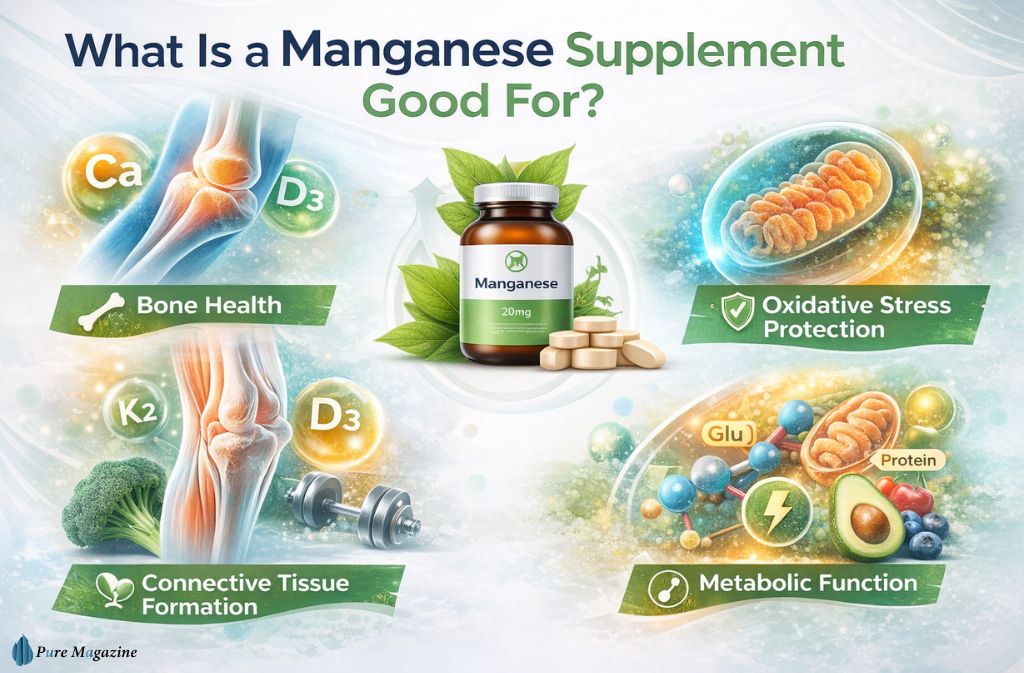
Manganese activates enzymes involved in bone matrix formation, working alongside calcium, vitamin D, and vitamin K2. It’s not a standalone bone health nutrient — it functions within a system — but it’s a system component that gets overlooked when people build bone health protocols.
Connective Tissue Formation
The prolidase pathway described above makes manganese directly relevant to ligament, tendon, and cartilage integrity. For people with repetitive stress injuries or slow connective tissue recovery, evaluating manganese status is worth adding to the diagnostic picture alongside the more commonly assessed nutrients.
Oxidative Stress Protection
MnSOD activity is the primary mechanism. Adequate manganese supports the mitochondrial antioxidant capacity that determines how well cells handle physiological stress — from exercise, from illness, from chronic low-grade inflammation.
Metabolic Function
Manganese activates enzymes involved in carbohydrate, protein, and cholesterol metabolism. This is a background function rather than a headline benefit, but it contributes to why suboptimal manganese status can show up as vague metabolic sluggishness rather than an obvious deficiency symptom.
Do You Actually Need a Manganese Supplement? A 3-Layer Decision Framework
Most people don’t need manganese supplementation. That’s worth stating clearly before working through the framework.
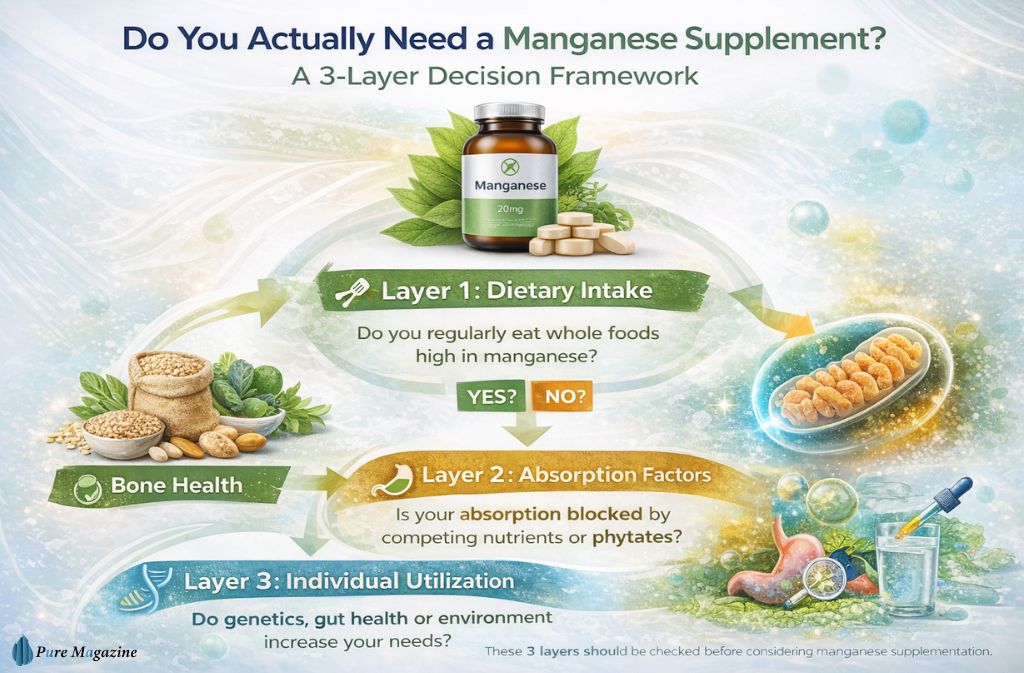
Layer 1 — Dietary Intake: Do you regularly eat whole grains, nuts, legumes, and leafy greens? If yes, your baseline intake is likely adequate. Manganese is not a nutrient that whole food eaters commonly fall short on. If your diet leans heavily toward processed foods with limited plant variety, there may be a gap worth addressing.
Layer 2 — Absorption Factors: Even adequate dietary intake doesn’t guarantee adequate absorption. High iron supplementation, high-dose calcium supplementation, and diets heavy in phytic acid (which binds to manganese in the gut before absorption) all reduce how much you actually absorb. Vegans and vegetarians consuming high phytate foods — grains and legumes as staples — face a specific absorption challenge here: the foods highest in manganese are also high in the compounds that limit its absorption. Soaking, sprouting, and fermenting grains and legumes meaningfully reduce phytate content and improve mineral bioavailability.
Layer 3 — Individual Utilisation Genetic variations affect MnSOD enzyme efficiency. Gut health influences absorption consistency. Environmental exposure — particularly manganese in groundwater — affects total load independently of diet. Some regions have notably elevated manganese in municipal or well water; if you live in an area with older infrastructure or high natural mineral content, checking your local water quality report before adding a supplement is genuinely worth doing.
Manganese vs Magnesium: Why the Confusion Costs People Real Money
| Feature | Manganese | Magnesium |
|---|---|---|
| Type | Trace mineral | Macro mineral |
| Daily requirement | 1.8–2.3mg | 310–420mg |
| Primary role | Enzymes, antioxidant defence | Muscles, nerves, sleep, energy |
| Deficiency prevalence | Rare | Very common |
| Supplement need | Rarely necessary | Often beneficial |
This confusion comes up consistently — people searching for information about one mineral and ending up supplementing the other. They’re completely different nutrients with different requirement levels, different mechanisms, and different deficiency patterns. Magnesium’s role in hormonal regulation and sleep is a separate conversation from anything manganese does. If you’re fatigued and sleeping poorly, magnesium is the far more likely candidate.
What Blocks Manganese Absorption
| Factor | Effect on Absorption |
|---|---|
| Iron supplements | Competes via shared intestinal transporters |
| High-dose calcium | Reduces uptake at high supplemental doses |
| Phytic acid (grains, legumes) | Binds manganese in gut, limits absorption |
| Vitamin C | May support metabolic utilisation |
The iron-manganese competition is the most clinically significant interaction. Both minerals use the same intestinal transport proteins (DMT1), which means high iron supplementation — common in women managing iron deficiency — can meaningfully reduce manganese absorption and vice versa. Taking them at separate times reduces but doesn’t eliminate this competition.
Iron status and its interaction with other trace minerals are worth assessing through blood work before supplementing either, particularly if you’re supplementing both.
Best Forms of Manganese Supplements
| Form | Absorption Quality | Best Suited To |
|---|---|---|
| Manganese Bisglycinate Chelate | High | Sensitive stomachs, best general option |
| Manganese Citrate | Good | General supplementation |
| Manganese Gluconate | Moderate | Budget-conscious buyers |
| Liquid Manganese | High | Digestive absorption issues |
Manganese bisglycinate chelate is the gold standard for most purposes. The glycine chelation improves stability through the digestive process and reduces the gastric irritation that some people experience with oxide or sulphate forms. If your primary reason for considering manganese is connective tissue or bone support alongside other amino acid-level nutrients, the bisglycinate form also delivers glycine as a collagen precursor — a minor but worthwhile secondary benefit.
What manganese is bound to (the “ligand”) determines stability, absorption efficiency, and tolerability. Products that simply say “manganese” without specifying the salt form are usually use cheaper, lower-bioavailability forms.
Manganese Supplement Dosage: Getting the Numbers Right
| Population | Recommended Daily Intake | Tolerable Upper Limit |
|---|---|---|
| Adult men | 2.3mg | 11mg |
| Adult women | 1.8mg | 11mg |
| Pregnant women | 2.0mg | 11mg |
| Breastfeeding women | 2.6mg | 11mg |
The gap between the recommended intake and the upper limit looks generous until you factor in total load from food, water, and supplements combined. Whole grains, tea, nuts, and leafy greens can together provide 3–5mg daily without supplementation. Someone drinking tea regularly, eating a plant-rich diet, and living in an area with manganese in the water supply may already be at or near the upper limit before opening a supplement bottle.
A practical range for supplementation: 2–5mg daily, chosen to fill a genuine gap rather than add to an already adequate intake.
The Hidden Risk: Total Manganese Load and Manganism
This is what most supplement guides omit, and it’s the most important safety consideration specific to manganese.
Excess manganese accumulates in the body — particularly in the brain — because the body’s excretion mechanisms are limited. The resulting neurological condition, manganism, produces symptoms resembling early Parkinson’s disease: tremors, coordination difficulties, cognitive changes, and mood disturbances.
Important context: manganism most commonly occurs through occupational inhalation exposure (welding, mining) rather than dietary intake in healthy adults. However, people with impaired liver function face an elevated risk from dietary and supplemental excess, because the liver is the primary route for manganese clearance. Compromised clearance allows accumulation at intakes that would be safe for someone with normal liver function.
The 2026 takeaway: total load matters more than supplement dose in isolation. Assess your dietary and water-source manganese before supplementing, and don’t exceed 11mg daily across all sources combined.
Checking Your Water
If you live in an area with older infrastructure, high mineral groundwater, or rural well water, checking your local water quality report for manganese content is worth doing before adding a supplement. The Environmental Protection Agency’s secondary drinking water standard sets a guidance level of 0.05mg/L — but water in some regions significantly exceeds this, particularly in areas with naturally manganese-rich geology.
Manganese in Vegan Diets: The Phytate Problem
Plant-based eaters consume more manganese-rich foods than most omnivores — whole grains, legumes, nuts, and leafy greens are all high sources. But they also consume more phytic acid, which binds manganese (and other minerals, including zinc and iron) in the digestive tract and reduces absorption.
This creates a specific situation: high dietary manganese, lower absorption efficiency. The practical result is that vegans and vegetarians may have adequate apparent intake while absorbing less than those numbers suggest.
Preparation methods matter significantly here. Soaking grains and legumes overnight, sprouting seeds, and consuming fermented grain products (sourdough bread, for instance) meaningfully reduce phytate content and improve mineral bioavailability. How plant-based protein sources interact with mineral absorption is a related consideration — amino acid adequacy and mineral absorption are connected through the same gut environment.
Manganese in Athletic and Longevity Contexts
For Athletes
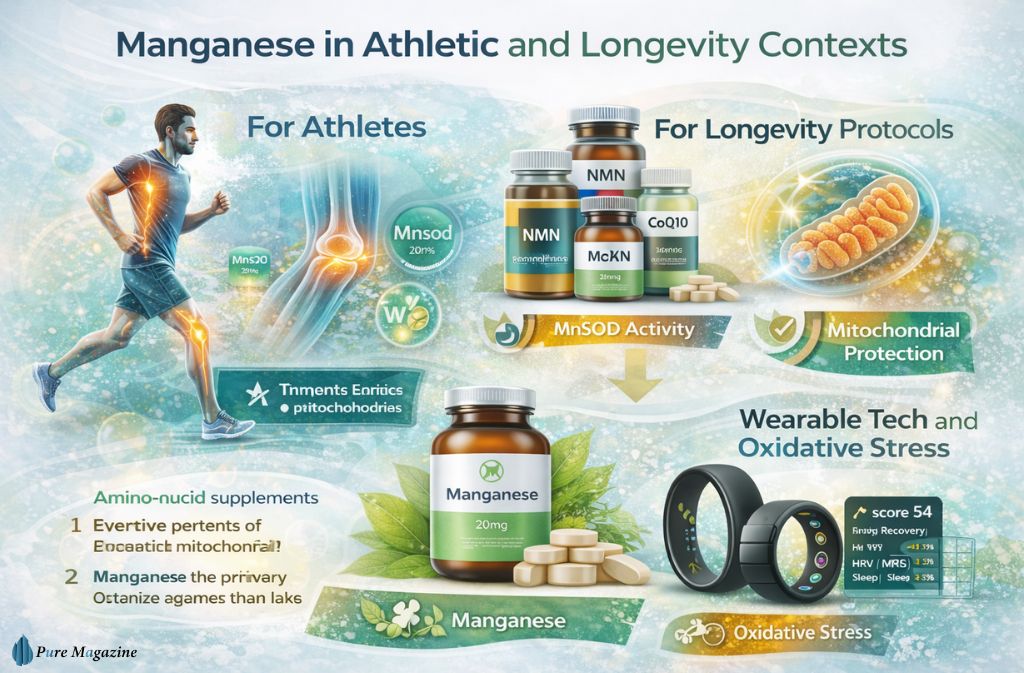
Connective tissue recovery is where manganese’s clinical relevance is clearest for physically active people. Ligament and tendon repair requires collagen synthesis, which requires prolidase activity, which requires manganese. This doesn’t mean every athlete needs a manganese supplement — most get adequate amounts through diet — but it does mean that evaluating manganese status is worth including in any comprehensive assessment of slow connective tissue healing.
The oxidative stress angle is equally relevant. Exercise generates a significant mitochondrial free radical load. MnSOD is the primary defence against that load in the mitochondria. Adequate manganese supports antioxidant capacity at the cellular level, which recovery supplements targeting inflammation downstream can’t directly compensate for.
How amino acid supplementation supports tissue repair and recovery alongside trace mineral adequacy gives a more complete picture of what athletic recovery actually requires at the nutritional level.
For Longevity Protocols
Manganese is increasingly appearing in discussions of longevity-focused nutrition alongside compounds like NMN, spermidine, and CoQ10 — all targeting mitochondrial function through different mechanisms. The rationale is coherent: mitochondrial health is one of the better-supported targets in ageing biology, and MnSOD activity is central to mitochondrial protection.
This doesn’t mean manganese belongs in every longevity stack. For someone with adequate dietary intake, adding a supplement produces no additional benefit and adds unnecessary accumulation risk. For someone with confirmed low status or absorption challenges, addressing it is a worthwhile part of a mitochondrial support protocol.
Wearable Tech and Oxidative Stress
Devices like Whoop and Oura track recovery scores that partially reflect oxidative stress and inflammation load. If your recovery scores consistently underperform relative to your sleep and training inputs, evaluating antioxidant nutrient status — including manganese — is a logical next step. This isn’t a direct correlation of the devices’ measure, but the biological pathway from inadequate MnSOD activity to poor mitochondrial recovery is real enough to make the connection worth investigating.
Boron and Silica: The Bone Matrix Partners
One gap in most manganese discussions: it rarely works in isolation for bone health. Boron enhances how the body uses calcium, magnesium, and vitamin D in bone tissue. Silica supports collagen cross-linking in the bone matrix. Both work alongside manganese in the same connective tissue and bone formation processes.
If bone density or connective tissue health is your primary reason for considering manganese, looking at this trio — manganese, boron, and silica — alongside the more commonly discussed calcium and vitamin D gives you a more complete picture of bone matrix nutrition than any single mineral provides.
Common Mistakes
Supplementing “just in case” without assessing dietary and water-source intake is the most common error — and the one most likely to cause unintentional excess accumulation over time. Confusing it with magnesium leads people to take the wrong supplement for their actual symptoms. Combining manganese and iron supplements without spacing them reduces the absorption of both. And ignoring total load — treating the supplement dose as the only variable — misses the cumulative intake picture that matters most for safety.
How to Choose the Best Manganese Supplement
Manganese bisglycinate chelate for best absorption and tolerability. Dose in the 2–5mg range unless a clinician has identified a specific higher need. Third-party testing for purity — manganese supplements are not commonly adulterated, but quality control verification matters for any supplement. Minimal fillers and no proprietary blending (the active dose should be visible). Avoid forms that don’t specify the salt form — “manganese” alone almost always means a cheaper, lower-bioavailability option.
The 2026 Perspective: Personalised Manganese Nutrition
Nutrition is moving toward individual assessment rather than population-wide recommendations, and manganese is a good example of why that shift matters. Genetic differences in MnSOD efficiency affect how much manganese individual mitochondria actually need. Gut health variables affect absorption independent of intake. Environmental exposure through water varies dramatically by region. The total dietary pattern determines baseline status before any supplement enters the picture.
Test, assess, then supplement — not the reverse. Getting relevant blood markers checked before deciding whether manganese supplementation makes sense for your specific situation is the appropriate starting point. Serum manganese doesn’t perfectly reflect tissue stores, but it provides a useful baseline alongside a dietary assessment.
FAQs
Q. What is a manganese supplement used for?
A manganese supplement is used to support enzyme function, mitochondrial antioxidant defense, connective tissue formation, and bone development when dietary intake is insufficient. It acts as a cofactor for key enzymes, including manganese superoxide dismutase (MnSOD), which protects cells from oxidative stress.
Q. What is a manganese supplement good for specifically?
Manganese supplements are primarily beneficial for supporting bone health, collagen and connective tissue formation, and reducing oxidative stress at the mitochondrial level. They are most useful for individuals with low dietary intake, absorption issues, or specific nutritional gaps—not as a routine supplement for everyone.
Q. Is manganese the same as magnesium?
No, manganese and magnesium are completely different minerals. Manganese is a trace mineral needed in small amounts for enzyme activity and antioxidant defense, while magnesium is required in larger amounts for muscle, nerve, and energy function. Magnesium deficiency is common; manganese deficiency is rare.
Q. What is the best manganese supplement form?
The best manganese supplement form is typically manganese bisglycinate chelate due to its high absorption and good digestive tolerance. Manganese citrate is another effective and widely available option for general use. The choice depends on individual needs and tolerance.
Q. Who should avoid manganese supplements?
People with liver dysfunction should avoid manganese supplements because the liver regulates manganese excretion, and impaired function can lead to accumulation. Individuals with high dietary intake, manganese-rich water exposure, or those taking high-dose iron supplements should also use caution.
Q. What are the symptoms of manganese toxicity?
Manganese toxicity symptoms include tremors, coordination issues, and cognitive changes similar to early Parkinson ’s-like effects. This condition, known as manganism, is rare from diet alone but can occur with long-term overexposure or impaired liver clearance.
Q. Does manganese deficiency cause joint problems?
Severe manganese deficiency can affect joint health by impairing collagen formation through enzymes like prolidase. However, true deficiency is uncommon. Joint issues are more often linked to multiple nutrient factors, including vitamin C, copper, and zinc, rather than manganese alone.
Q. Can you take manganese with iron or calcium supplements?
Manganese should not be taken at the same time as high-dose iron or calcium supplements because they compete for absorption in the body. Separating intake by a few hours can help improve mineral absorption efficiency.
Conclusion
Manganese doesn’t deserve to be overlooked, but it also doesn’t deserve to be supplemented without a clear reason. It’s essential in small amounts for mitochondrial antioxidant defence, connective tissue integrity, and bone matrix formation. Most people eating varied whole foods get enough. Some — particularly those with high phytate diets, significant mineral competition from iron or calcium supplementation, or water-source exposure — have a genuine case for addressing it.
The safety picture is the most important nuance that generic supplement guides miss: manganese accumulates, the upper limit is real, and total load from all sources matters more than supplement dose in isolation. Approach it with the same rigour you’d apply to any fat-soluble nutrient where excess is as consequential as deficiency.
Assess your actual intake before supplementing. Choose bisglycinate chelate if you do supplement. Stay within the 2–5mg supplemental range. And treat it as one component of a broader nutritional picture rather than a standalone solution to any specific complaint.
This article is for informational purposes only and does not constitute medical advice. Always consult a qualified healthcare professional before starting any new supplement, particularly if you have liver conditions, are managing mineral deficiencies, or are taking prescription medications.
Explore our full library of expert-reviewed health and nutrition guides at Pure Magazine.