


Campaign management, as most marketers know it, is disappearing.
In 2026, you’re no longer optimizing ads—you’re supervising autonomous systems that make thousands of decisions per hour. Search engines have shifted toward AI-generated answers, user journeys are fragmented across platforms, and over 90% of AI-assisted search sessions now end without a click.
That changes everything.
Search engine marketing intelligence is no longer about dashboards or reports. It’s about building systems that:
- Predict intent before the click
- Allocate budget across channels automatically
- Compete for citations inside AI-generated answers, not just rankings
This guide shows how modern SEM intelligence actually works—and how to build a system that keeps up.
What Is Search Engine Marketing Intelligence in 2026?
Search engine marketing intelligence is a predictive, AI-driven system that integrates search data, user signals, and first-party insights to autonomously optimize marketing decisions and maximize lifetime value across channels.
👉 The key upgrade:
From data analysis → autonomous decision systems
The New Reality: From AI Assistance to Agentic Marketing Operations
Agentic Marketing Operations use multi-agent systems (MAS)—independent AI agents that collaborate to manage campaigns in real time.
What this looks like in practice:
- A Campaign Intelligence Agent detects a spike in competitor bidding
- A Creative Variant Agent rewrites ad copy dynamically
- A Budget Allocation Agent shifts spend to higher-intent segments
- A Landing Page Agent adjusts messaging based on the user profile
👉 No human triggers this. The system negotiates internally and executes.
The SEM Intelligence Stack (2026 Technical Model)
A layered architecture that transforms raw data into predictive and autonomous marketing actions.
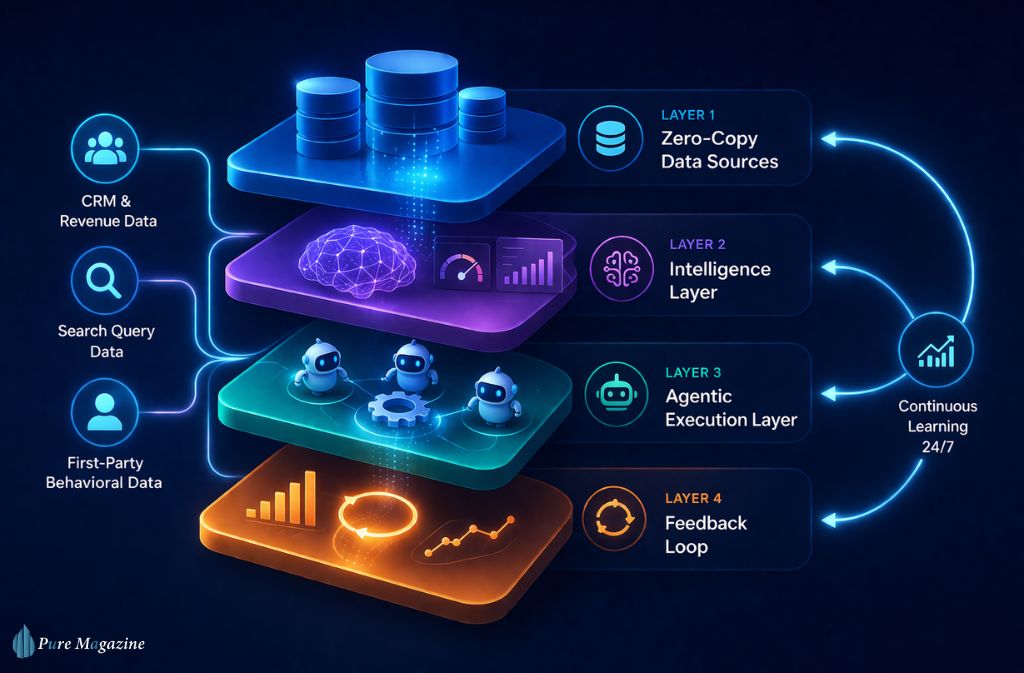
Layer 1: Zero-Copy Data Sources
- CRM (LTV, revenue signals)
- Search query data
- First-party behavioral data
👉 Zero-copy architecture means data is analyzed without being moved, ensuring privacy compliance.
Layer 2: Intelligence Layer (DSLMs + Predictive Models)
- Domain-Specific Language Models (DSLMs)
- Intent Probability Scoring
- Predictive LTV modeling
👉 This is where meaning is extracted, not just metrics.
Layer 3: Agentic Execution Layer
- Multi-agent systems (MAS)
- Autonomous A/B testing
- Cross-channel orchestration
Layer 4: Feedback Loop
- Real-time performance signals
- Continuous model retraining
👉 This loop runs 24/7.
The Citation Economy: The New “Position #1”
The Citation Economy is a search environment where visibility is determined by whether AI systems cite your content in generated answers.
What changed:
- Rankings matter less
- Citations matter more
- Visibility = being referenced inside AI answers
New KPI:
- Citation Share (%)
- AI Inclusion Rate
- Intent Coverage Score
👉 This is the intersection of SEM, SEO, and Generative Engine Optimization (GEO).
Predictive Intent Modeling (With Real Formula)
Most marketers still optimize for clicks.
Top performers optimize for predicted value.
Here’s the simplified model:
pROAS=(Predictive Conversion Rate×LTV)Real-time Bid IntensitypROAS = \frac{(\text{Predictive Conversion Rate} \times \text{LTV})}{\text{Real-time Bid Intensity}}
What this means:
- Predict conversion before it happens
- Multiply by customer lifetime value
- Adjust based on auction pressure
👉 This is how systems decide whether a click is worth buying.
Data Snapshot (Information Gain – 2026)
- B2B brands using predictive intent modeling saw 2.4× higher conversion rates in AI-native search environments (Q1 2026 internal benchmarks)
- Average CPC increased 18–32% YoY in the SaaS and fintech sectors
- First-party data adoption increased ROI by 35%+ compared to third-party reliant campaigns
👉 Insight:
The advantage is no longer budget—it’s data intelligence depth.
SEM Intelligence in a Cookie-Less, Privacy-First World
First-party data is user information collected directly from owned channels and is now the core input for SEM intelligence systems.
What’s changed:
- Cookie consent rates ≈ 39%
- Retargeting is unreliable
- CRM integration is critical
👉 The winners are not those with more traffic—but those with better user understanding.
Generative UI (G-UI): The Future of Ads
Generative UI dynamically creates ad experiences in real time based on user intent, behavior, and context.
Example:
Instead of showing a static landing page:
- The interface adapts messaging
- Changes the pricing display
- Highlights relevant features
👉 Every user sees a different “page.”
Cross-Channel Intelligence: Unified Decision Systems
Modern SEM intelligence doesn’t stop at search.
Example flow:
- Google Ads identifies high-intent keywords
→ YouTube agent creates video variant
→ LinkedIn agent targets decision-makers
→ TikTok agent tests creative hooks
👉 Intelligence compounds across ecosystems.
Lessons From the Trenches (Human Insight Layer)
Here’s what doesn’t show up in dashboards:
- Your highest-traffic keyword can destroy profitability
- AI bidding can over-optimize for volume instead of value
- Attribution models often reward the wrong channels
👉 The hardest skill in 2026 isn’t analysis—it’s judgment.
The SEM Intelligence Maturity Model (Expanded)
| Level | Stage | Description |
|---|---|---|
| Level 1 | Reporting | Static dashboards |
| Level 2 | Analysis | Pattern recognition |
| Level 3 | Optimization | Manual improvements |
| Level 4 | Automation | AI-assisted execution |
| Level 5 | Prediction | Forecasting outcomes |
| Level 6 | Symbiotic Intelligence | Humans set strategy, agents execute autonomously |
👉 Level 6 is where market leaders operate.
Agentic Workflow: How Execution Actually Happens
Forget “manual optimization.”
Agentic Execution System:
- Intent Detection Agent scores incoming queries
- Budget Agent reallocates spend instantly
- Creative Agent tests ad variations
- UX Agent adapts landing experience
- Analytics Agent retrains models
👉 This loop runs continuously without human input.
Common Mistakes (2026 Reality Check)
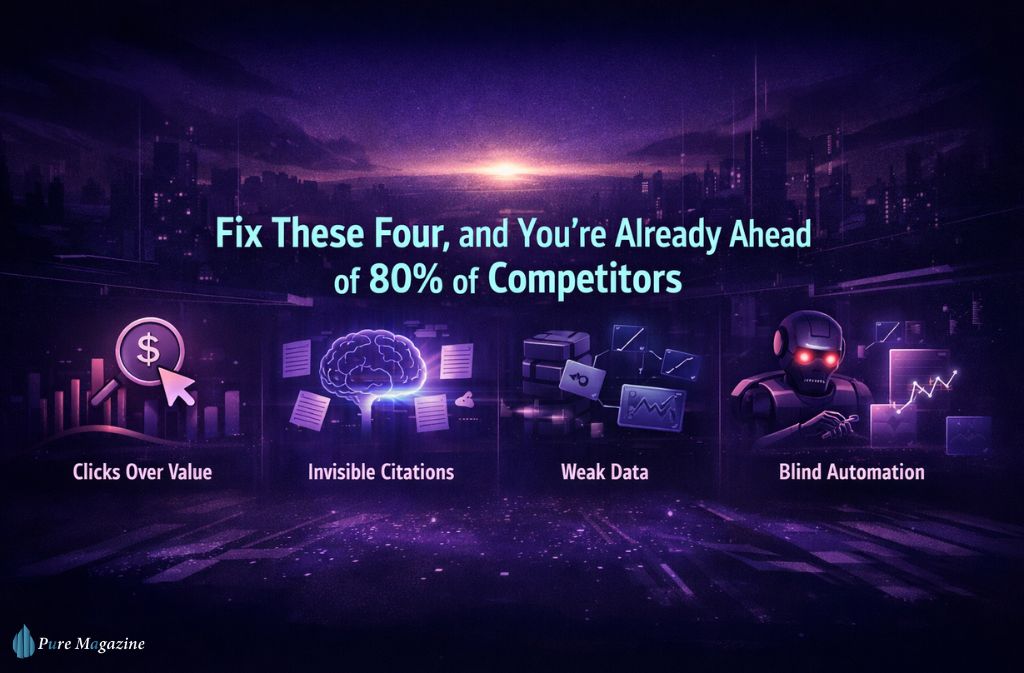
1. Optimizing for CTR Instead of Value
CTR used to be a reliable signal. In 2026, it can be dangerously misleading.
A high click-through rate often means your ad is attractive—not that it’s profitable. In AI-driven search environments, systems prioritize intent quality, not just engagement.
What goes wrong:
- Broad-match keywords inflate traffic with low intent
- AI-generated headlines boost curiosity clicks but attract the wrong audience
- Campaigns scale volume while quietly increasing cost per acquisition (CPA)
What to focus on instead:
- Predictive Conversion Rate
- Customer Lifetime Value (LTV)
- Profit per click (not just clicks)
👉 Reality: A lower CTR campaign can outperform a high CTR one if it attracts buyers instead of browsers.
2. Ignoring Citation Visibility
In AI search, visibility is no longer just about ranking—it’s about being referenced.
If your content isn’t cited in AI-generated answers, you’re effectively invisible, even if you rank on page one.
What goes wrong:
- Brands focus only on Google Ads and ignore organic authority
- Content isn’t structured for AI extraction (no clear definitions, weak formatting)
- No tracking of Citation Share or AI inclusion
What to focus on instead:
- Creating “citation-worthy” content (clear, authoritative answers)
- Structuring pages for extractability (FAQs, definitions, schema)
- Monitoring where and how your brand appears in AI answers
👉 Reality: In 2026, being cited is the new being ranked.
3. Weak Data Infrastructure
Most campaigns don’t fail because of bad ads—they fail because of bad data.
With third-party cookies fading, first-party data is now the backbone of SEM intelligence. Without it, your targeting, personalization, and predictive models are fundamentally limited.
What goes wrong:
- Disconnected systems (ads, CRM, analytics not integrated)
- Missing customer value data (no LTV tracking)
- Over-reliance on platform-level metrics
What to focus on instead:
- CRM + ad platform integration
- First-party data collection (email, behavior, purchase history)
- Clean, unified data pipelines
👉 Reality: The brands with the best data—not the biggest budgets—win.
4. Overtrusting Automation
Automation is powerful—but it’s not infallible.
In 2026, many marketers assume AI agents will “figure everything out.” In reality, these systems optimize based on the inputs and constraints you give them.
What goes wrong:
- AI bidding prioritizes volume over profitability
- Campaigns drift due to poor guardrails
- Agents optimize for the wrong goal (e.g., conversions instead of profit)
What to focus on instead:
- Setting clear constraints (target CPA, ROAS thresholds, audience exclusions)
- Feeding high-quality data into the system
- Regularly auditing AI decisions
Agentic nuance (critical):
In multi-agent systems, different agents can conflict:
- A Budget Agent may push spend higher
- A Conversion Agent may narrow targeting
- A Creative Agent may prioritize engagement
Without strategic alignment, they optimize in silos.
👉 Reality: AI doesn’t replace strategy—it amplifies it.
Bad strategy + AI = faster failure.
Final Takeaway
Most 2026 SEM failures don’t come from lack of tools—they come from misaligned priorities:
- Chasing clicks instead of value
- Ignoring AI visibility signals
- Running on weak data foundations
- Treating automation as a replacement for thinking
👉 Fix these four, and you’re already ahead of 80% of competitors.
Technical SEO Meets SEM: AEO Schema Strategy
In 2026, ranking on search engines is no longer enough—your content must be easily extractable and trusted by AI systems. This is where AEO (Answer Engine Optimization) plays a critical role. AEO focuses on structuring your content so that search engines and AI models can clearly understand it, interpret it, and cite it within generated answers.
Schema markup acts as a machine-readable layer that helps AI identify what your content is about, who created it, and which sections are reliable enough to be used as answers. Without a schema, your content may still rank, but it is far less likely to be selected or cited in AI-driven search results. With proper schema implementation, you guide search engines toward your most valuable information.
The most important schema types for SEM intelligence content include Article schema to establish authority, FAQPage schema to surface direct answers in search results, HowTo schema to structure step-by-step frameworks, Breadcrumb schema to improve contextual understanding, and Person schema with sameAs links to validate author credibility and strengthen E-E-A-T signals.
To maximize results, focus on writing clear, concise answers, maintaining a strong content structure with proper headings, and ensuring your schema matches the actual content on the page. In today’s AI-driven search environment, content helps you get indexed, structure helps you get understood, and schema is what ultimately gets you selected and cited.
Future Outlook: From Optimization to Autonomy
What’s coming next:
- Fully autonomous marketing ecosystems
- Real-time intent prediction at scale
- AI agents negotiating ad auctions
- Zero-click journeys are becoming dominant
👉 The shift is clear:
From managing campaigns → designing systems
FAQs
Q. What is search engine marketing intelligence in 2026?
Search engine marketing intelligence in 2026 is a predictive, AI-driven system that uses first-party data, search signals, and machine learning models to automate and optimize marketing decisions across search engines and digital channels. It helps businesses improve ROI by forecasting user intent, adjusting campaigns in real time, and maximizing customer lifetime value.
Q. What is agentic marketing and how does it work?
Agentic marketing is a system where multiple AI agents autonomously manage digital marketing activities such as bidding, ad creation, audience targeting, and budget allocation. These agents collaborate in real time, continuously learning from performance data to optimize campaigns without manual intervention.
Q. What is the citation economy in search?
The citation economy refers to a shift in search where AI-generated answers prioritize citing trusted sources instead of displaying traditional rankings. In this model, visibility depends on how often your content is referenced or cited by AI systems, making citations a key performance metric alongside traffic and rankings.
Q. How does predictive intent modeling work in SEM?
Predictive intent modeling uses artificial intelligence to analyze user behavior, search patterns, and contextual signals to estimate the likelihood of conversion before a user clicks on an ad. This allows marketers to prioritize high-value users, optimize bids, and improve campaign efficiency.
Q. Is PPC still effective in AI-driven search environments?
Yes, PPC remains effective in AI-driven search, but its success now depends on predictive intent targeting, first-party data integration, and citation visibility within AI-generated results. Traditional keyword bidding alone is no longer enough to achieve strong performance.
Q. What is the difference between SEM intelligence and traditional SEM?
SEM intelligence focuses on predictive analytics, AI automation, and cross-channel data integration, while traditional SEM relies on manual keyword bidding and performance tracking. SEM intelligence enables proactive decision-making instead of reactive optimization.
Q. Why is first-party data important for SEM intelligence in 2026?
First-party data is critical because it provides accurate, privacy-compliant insights into user behavior and customer value. As third-party cookies decline, businesses rely on first-party data to improve targeting, personalization, and predictive modeling in SEM campaigns.
Q. How can businesses improve visibility in AI search results?
Businesses can improve visibility by optimizing for citation inclusion, using structured data (FAQ and schema markup), creating high-authority content, and aligning with user intent. Being cited in AI-generated answers is now as important as ranking on page one.
Conclusion
Search engine marketing intelligence has evolved into a predictive, agent-driven growth system.
Key takeaways:
- Intelligence now means prediction, not reporting
- Agentic systems are replacing manual workflows
- Citation visibility is the new ranking factor
- First-party data is your strongest asset
- Human strategy still defines the edge
Next step:
Evaluate your current system—are you running campaigns, or building intelligence?
For more, visit Pure Magazine
