Living with a disability often means navigating a world that wasn’t built for you, and the financial pressures can be enormous. A high council tax bill is a burden no one needs on top of everything else. Every year, thousands of eligible UK households miss out on significant reductions — worth hundreds or even thousands of pounds — because the system is a confusing maze of different schemes, rules, and local council quirks.
You’re likely here because you suspect you’re overpaying but don’t know where to start. Is the discount about your disability or your house? Is it means-tested? What on earth is an “SMI Exemption”?
In reviewing council tax claims over the years, one pattern comes up repeatedly: people fall into two camps. Some never apply because they assume a diagnosis alone is sufficient, so they keep waiting for something automatic that never arrives. Others apply but get rejected because they submitted the wrong evidence for the right scheme. Both errors are avoidable — which is what this guide is for.
This covers two main routes to a reduction: the Disabled Band Reduction (based on your property) and the Severe Mental Impairment (SMI) Exemption (based on a specific diagnosis). It also covers the Carer Disregard and how the income-banded support schemes for 2026 affect you.
Quick Eligibility Check: Which Council Tax Discount Applies to You?
| If you or someone you live with… | Investigate… | Potential Discount |
|---|---|---|
| Needs extra space due to disability (wheelchair, extra room/bathroom) | Disabled Band Reduction | One band lower; 17% for Band A |
| Has a diagnosis causing “severe impairment of intelligence and social functioning” (dementia, Parkinson’s, severe learning difficulties) | SMI Exemption | 25% to 100% discount |
| Has a live-in carer (not a spouse/partner) | Carer Disregard | Can trigger 25% discount |
| Is on a low income | Council Tax Reduction (CTR) | Varies — up to 100% |
Understanding Council Tax Discounts for Disabled People (2026 Overview of All Schemes)
Difference Between Disabled Band Reduction, SMI Exemption, and Council Tax Reduction
These schemes have separate rules and different levels of reduction. Confusing them is the single most common reason applications fail.
| Feature | Disabled Band Reduction | SMI Exemption | Council Tax Reduction (CTR) |
|---|---|---|---|
| Based on | Physical adaptations to your property | A specific medical diagnosis | Household income and savings |
| Means-tested? | No | No | Yes |
| Potential discount | One band reduction (or 17% for Band A) | 25% to 100% | Up to 100% |
The first two are not means-tested. A household with £50,000 in savings can claim the Disabled Band Reduction and the SMI Exemption. Income is irrelevant.
For a fuller picture of how these interact with other exemption categories — including cases where multiple disregards stack — the council tax exemption rules for 2026 set out the mechanics clearly.
The Disabled Band Reduction (The Property Route)
This scheme established under Statutory Instrument 1992/554, focuses on your home — not your income. Its purpose is to ensure you aren’t penalised with a higher tax band simply because your disability requires more space.
Eligibility Criteria for Disabled Band Reduction (3 Legal Conditions)
1. Does a disabled person live there? The property must be the main home of at least one person who is substantially and permanently disabled. This can be an adult or a child — they don’t have to be the person responsible for paying the bill. A benefit award letter (PIP, DLA, or Attendance Allowance) typically serves as proof.
2. Are there essential adaptations? The property must have at least one of the following features that exist specifically for the disabled person’s needs:
- An extra bathroom or kitchen is required for the disabled person
- A room (not a standard bathroom, kitchen, or toilet) used mainly for the disabled person’s needs — for example, a dialysis room, a space for storing medical supplies, or a therapy room
- Sufficient extra indoor space to allow wheelchair use
3. Is the adaptation genuinely necessary? The assessor needs to be satisfied that, without the feature, the disabled person would find it physically impossible or extremely difficult to live in the property. This is where evidence quality decides the outcome.
What Counts as a Qualifying Property Adaptation?
Real-world example: A family’s teenage son requires a ceiling track hoist to move between his bed and an adjoining wet room. Both the hoist and wet room are physical adaptations essential for his care. Their Band D property qualifies for the Disabled Band Reduction — they pay at the Band C rate.
Common Reasons Disabled Band Reduction Applications Are Rejected
Councils regularly push back on “extra room” applications when the room is also used for non-essential purposes — such as a guest bed stored alongside medical equipment. If a room serves a dual function, the application needs to demonstrate that the disability-related use is predominant and that the room wouldn’t be needed otherwise.
Severe Mental Impairment (SMI) Council Tax Discount Explained
This is the most misunderstood and underclaimed council tax relief in the UK — and it offers the largest discounts, potentially reducing a bill to zero.
A person with a Severe Mental Impairment is legally disregarded for council tax purposes. The council treats them as if they aren’t present when calculating the number of adults liable.
SMI Eligibility Criteria: Medical Certification and Benefits Requirement
Medical certification: A doctor must certify in writing that the person has “a severe impairment of intelligence and social functioning which appears to be permanent.” This is a specific legal classification, not a general mental health diagnosis. Qualifying conditions include Alzheimer’s disease, Parkinson’s disease, severe learning disabilities, and the lasting cognitive effects of a serious stroke.
Benefit entitlement: The person must also be entitled to (though not necessarily currently receiving) at least one qualifying disability benefit, including:
- PIP (daily living component)
- Attendance Allowance
- Disability Living Allowance (middle or higher rate care component)
How Much Discount Does the SMI Exemption Give? (25% to 100%)
| Household Situation | Result |
|---|---|
| SMI person lives alone | 100% exempt from council tax |
| SMI person + one other adult | Other adult treated as sole occupant — 25% single person discount |
| Everyone in the household has SMI | 100% exempt |
| SMI person + two or more other adults | No discount (at least two non-disregarded adults remain) |
The GOV.UK guidance on discounts for disabled people confirms these thresholds and explains when to request the council’s own SMI form for your GP to complete.
Carer Disregard Explained: Council Tax Discount for Live-In Carers
A live-in carer may also be disregarded for council tax, potentially reducing the household count further. A carer qualifies for disregard if they meet all of these conditions simultaneously:
- They provide care for at least 35 hours per week
- They live in the same property as the person they care for
- They are not the spouse, partner, or parent of a child under 18
- The person being cared for receives a qualifying disability benefit (such as Attendance Allowance or the middle/highest rate of DLA care)
Why Spouses Usually Don’t Qualify for Carer Discounts
Example: An elderly woman with an SMI lives with her adult son, who is her full-time carer. She’s disregarded because of her SMI; he’s disregarded as her carer. The property qualifies for 100% exemption from council tax.
Important: Spouses and civil partners cannot use the Carer Disregard. A husband caring full-time for his wife with dementia cannot be disregarded as a carer, but she is disregarded due to her SMI, so he’s treated as the sole adult, and the household receives the 25% single person discount. This comes up in almost every dementia-related query and is worth being clear about upfront.
What Evidence Do You Need for a Council Tax Discount Application?
Weak applications get rejected regardless of genuine eligibility. Strong applications are processed faster and backed up further.
Best Evidence for Disabled Band Reduction Claims
Photographs and video: Don’t just show a room. Show why it’s essential. Photograph floor-to-ceiling storage for medical supplies, a room configured for physiotherapy, or a wheelchair moving through widened doorways. A 60-second video walking through the space and narrating what each adaptation enables is more persuasive than a written description alone.
Floor plan comparison: A simple sketch showing the home layout before and after disability-related adaptations gives the assessor a clear spatial reference. This doesn’t need to be architectural — a hand-drawn before/after is sufficient.
Receipts and invoices: Installation records for a stairlift, ceiling track hoist, walk-in shower, or widened doorways serve as both proof of adaptation and an indicator of when the qualifying circumstance began (important for backdating).
Professional letter: A letter from a GP, occupational therapist, or social worker confirming the necessity of the adaptation. This carries more weight than a benefit letter alone.
Required Documents for SMI Council Tax Exemption
- Doctor’s certificate: Non-negotiable. Your council will provide the specific form for your GP to sign — don’t ask the GP to write a general letter, as councils require their own form.
- Benefit award letter: A clear copy confirming entitlement to a qualifying benefit. This is the document most often missing from applications.
2026 Update: How DWP Data Matching Affects Council Tax Applications
In 2026, many councils are using automated data-sharing arrangements with the Department for Work and Pensions to cross-check benefit entitlement before processing applications. Before submitting, verify that your DWP records accurately reflect your current benefit status. A mismatch between what you claim in the application and what DWP holds can delay processing or trigger a request for additional evidence. Checking your benefits status through your online DWP account beforehand removes this friction.
Council Tax Backdating Rules: How Far Back Can You Claim?
There is no legal time limit on backdating a Disabled Band Reduction or SMI claim. If you’ve been eligible for years but never applied, you can request the discount back to the date the qualifying circumstance began — and in some cases receive a refund of thousands of pounds.
How to Claim Backdated Council Tax Discounts Successfully
| Years Eligible (Missed) | Band Reduction (one band, approx. 8%) | SMI Discount (25%) |
|---|---|---|
| 1 year | ~£191 | ~£598 |
| 3 years | ~£573 | ~£1,794 |
| 5 years | ~£955 | ~£2,990 |
Always request backdating explicitly in writing when you apply — don’t assume the council will apply it automatically. The stronger your documentation of when the qualifying circumstance began (installation receipts, diagnosis dates, benefit award start dates), the further back a successful application can reach.
How to Apply for Council Tax Discount for Disabled People (Step-by-Step 2026)
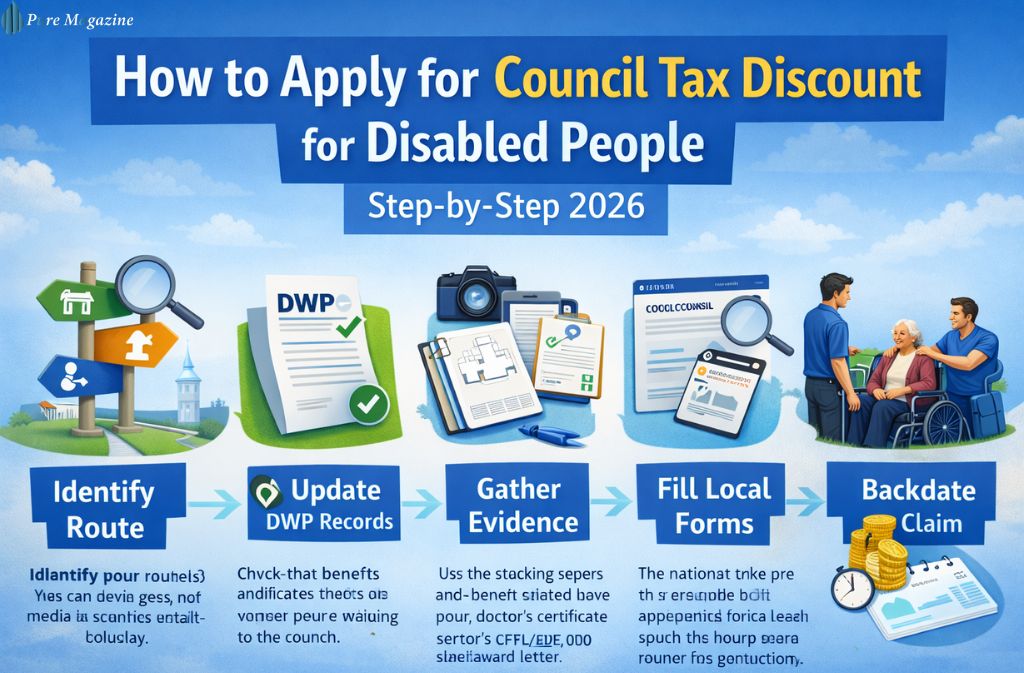
Step 1 — Identify your route(s). You can be eligible for multiple schemes simultaneously. A household might claim both the Disabled Band Reduction (for property adaptation) and the SMI Exemption (for a diagnosis), with the reductions stacking.
Step 2 — Update your DWP records first. Check that benefit entitlement records are current before applying to the council.
Step 3 — Gather evidence. Use the stacking approach above — photos, floor plan, receipts, professional letter, doctor’s certificate, and benefit award letter.
Step 4 — Find your local forms. The national rules are set centrally, but applications are local. Search “[Your Council Name] disabled band reduction” or “[Your Council Name] severe mental impairment exemption.” Use the council’s own forms, not generic templates.
Step 5 — Submit and prepare for a visit. For Band Reduction claims, expect a home visit. The council officer is there to verify the physical space — not to assess your lifestyle or judge how you live. This is a standard process, not an inspection.
Step 6 — Request backdating explicitly in writing. Include evidence of when the qualifying circumstances began.
Council Tax Reduction (CTR) 2026: Income-Based Support Explained
While the Band Reduction and SMI Exemption aren’t means-tested, low-income households should always apply for Council Tax Reduction separately — the two routes don’t cancel each other out.
Since April 2026, many councils have moved to income-banded CTR schemes. Instead of a complex individual calculation, the support level depends on which income band a household falls into. Additionally, with the Move to Universal Credit programme nearing completion, some councils have introduced transitional protection to prevent households migrating from legacy benefits from seeing sudden drops in CTR.
The council tax reduction scheme runs separately from disability-based discounts. A household with a qualifying disability can claim both — the Band Reduction or SMI Exemption applies first, and CTR can then reduce the remaining liability further.
FAQs
Q. Does getting Personal Independence Payment automatically give you a council tax discount?
No, getting Personal Independence Payment (PIP) does not automatically give you a council tax discount.
PIP is strong supporting evidence, but you must still qualify separately:
- For the Disabled Band Reduction, your home must be adapted (e.g., extra room or wheelchair space)
- For the SMI exemption, you need a doctor’s certification
👉 PIP helps prove disability—but it does not trigger the discount on its own.
Q. Is there a list of disabilities that qualify for council tax reduction?
No, a fixed list of disabilities that qualify for the council tax reduction.
Eligibility depends on the type of scheme:
- Disabled Band Reduction: Based on property features, not diagnosis
- SMI disregard: Based on a certified condition affecting intelligence and social functioning
👉 The focus is on impact and living requirements, not the condition name.
Q. My partner has dementia, and I’m their carer — do we get a discount?
Yes, in most cases you will qualify for a 25% council tax discount.
If your partner has dementia:
- They likely qualify for Severe Mental Impairment (SMI) disregard
- They are “ignored” for council tax purposes
Because you are their spouse:
- You cannot be counted as a carer for a separate disregard
- You are treated as the only liable adult
👉 This results in a single-person discount (25%).
Q. How far back can I claim a council tax refund?
You can backdate a council tax discount to when you first became eligible.
There is no strict legal time limit, but you must provide evidence such as:
- Medical records
- Benefit award letters
- Proof of home adaptations
👉 Always request backdating explicitly—refunds can exceed £1,000+.
Q. Why did the council visit my home for the application?
A council home visit is used to verify eligibility for the Disabled Band Reduction.
An officer may check:
- Whether the adapted feature exists
- If it is essential for the disabled person
- How the space is actually used
👉 This is a standard verification step, not a rejection signal.
Q. What’s the difference between Council Tax Reduction and Disabled Band Reduction?
Council Tax Reduction and Disabled Band Reduction are separate schemes with different rules.
- Council Tax Reduction: Means-tested (based on income and savings)
- Disabled Band Reduction: Not means-tested (based on property adaptations)
👉 You can qualify for both at the same time, increasing your total savings.
Q. What qualifies as “substantially and permanently disabled” for council tax?
A person is considered substantially and permanently disabled if they have a long-term condition that significantly affects daily living.
This typically includes:
- Physical disabilities requiring mobility support
- Severe mental conditions (for SMI cases)
- Long-term medical conditions requiring home adaptations
👉 The key factor is ongoing impact, not temporary illness.
Q. Can tenants apply for a disabled council tax discount?
Yes, tenants can apply for a disabled council tax discount.
You do not need to own the property—only:
- Be liable for council tax
- Meet eligibility criteria (adaptations or SMI rules)
👉 Both renters and homeowners have equal rights to claim.
For more on council tax exemptions, reductions, and how disability-related rules interact with other discounts, visit Pure Magazine.