Why “Sounding Human” Is Harder to Answer Than It Looks
By 2026, I’ll have stopped asking whether a piece of writing “passes” an AI detector.
The question is still relevant in some contexts, but it seldom dictates whether I keep a paragraph, edit it, or quietly rewrite it myself. What actually breaks my flow is something more subtle: when the text is too even, too careful, or too conscious of itself as writing.
That is usually what people mean by a paragraph “doesn’t sound human.” Not that it is wrong or unreadable, but that not a real person would phrase things quite that way.
This article came from that frustration. I wanted to know exactly which tool could actually humanize AI drafts by reducing that unnatural smoothness, not just in demos or before-and-after marketing screenshots, but in writing I would truly publish.
To do that, I ran a head-to-head comparison of three tools I see referenced often in 2026: GPT Humanizer AI, Unaimytext, and Walterwrites AI.
How I Set up the Test (Without Chasing Scores)
I definitely tried not to turn this into a score-chasing thing.
So instead of measuring detector results, I measured editorial friction: how often I wanted to “edit” the output after the tool was done producing.
The same set of drafts was used with all three tools, but small: one for a blog intro, one dense explanatory paragraph, and one for conversational content for a general audience. All three drafts made sense already. The issue was tone.
What I wanted to know after every rewrite was this: Would I keep this paragraph as-is if no one were watching?
If so, that mattered more to me than a numerical score.
The Drafts I Actually Used (And Why That Matters)
They were not first-draft AI texts.
They were drafts that made sense, but that still carried the unmistakable AI markers: even sentence length, in-your-face politeness in the transitions, and a Bayesian-like neutrality that reduces voice over time.
It is at the stage when most writers will use a humanizer, not to generate ideas, but to clean up the mechanical residue. It is also the stage when weaker tools will tend to overfix and create new problems.
At this point, testing was telling us more about “human sounding” than running a rough prompt down ten tools could ever.
GPT Humanizer AI: Subtle Changes Without Switching Voices
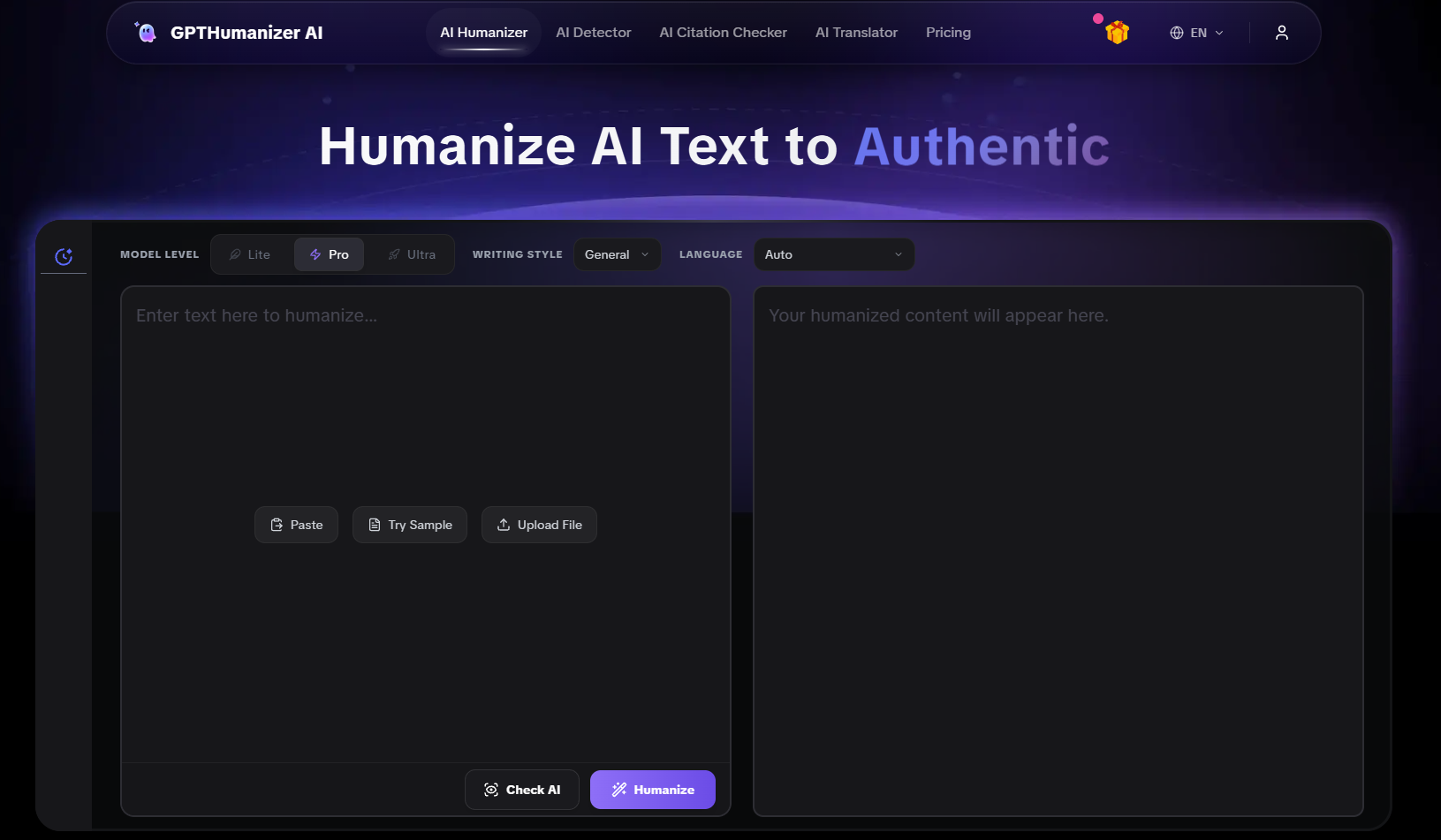
What jumped out at me about this AI Humanizer was how subtle the changes were.
The edits were subtle. Paragraphs were kind of slightly tighter, and there was more variation in sentence cadences, but there weren’t any obvious jumps in tone. The voice stayed pretty consistent across paragraphs. They didn’t sound like different writers. They just sounded like the same writer, but not homogeneously paced.
It was most obvious in expository passages, where the main point came up a bit earlier, and there were fewer ‘cushioning’ sentences. The template of transitions was looser, and the text seemed more willing to make a jump than to smooth over a point.
The results weren’t perfect, but they required the least amount of tinkering. Most of the time, I left a paragraph as it was, not because it was great, but because it was less distracting.
Unaimytext: Polished but Occasionally Too Self-Conscious
Unaimytext produces smooth, confident rewrites.
Many paragraphs on their own seemed most sharp and brilliantly expressive. The tool seemed at ease playing with an assured voice, and that worked some places quite well. The sense of the text being written, not produced, seemed strong.
After longer stretches, a pattern emerged. The writing at times felt too polished, intent on living up to the human credentials it was given. Particular phrases had a stagey feel rather than conversational, particularly around lighter passages.
This isn’t a mustache. In marketing-oriented passages or in short persuasive stabs, that polish worked well. In more neutral or analytical places, of course I rolled the punches myself to bring back a more muted tone.
Walterwrites AI: Energetic, but Editorially Noisy
Walter writes AI was the strongest-willed of the three.
The rewrites were lively and stylistically robust, often injecting life into flat paragraphs. In casual territory, that energy could be useful.
In the thick of more complex material, such forcefulness was jarring. Sentence structures would shift dramatically; there were moments where the voice would change over a paragraph. I ended up spending more time editing after the rewrite, not because it was lousy, but because it didn’t feel like the same author could have written the whole thing.
And for me, that undercut the human illusion.
Editorial Comparison: How Each Tool Changes the Draft
To make these differences clearer, I summarized my observations across a few editorial dimensions that mattered most in real use:
| Editorial Dimension | GPT Humanizer AI | Unaimytext | Walterwrites AI |
| Voice consistency across paragraphs | Largely consistent; reads like the same writer throughout | Mostly consistent, but occasionally shifts toward a more performative tone | Inconsistent; voice can drift between sections |
| Sentence rhythm and pacing | Subtle variation that breaks AI evenness quietly | Expressive pacing, sometimes noticeably stylized | Strong variation that can feel abrupt |
| Opening efficiency | The main point appears earlier with less preamble | Often sharp, occasionally overstated | Bold openings, sometimes misaligned |
| Transition style | Situational, less template-driven | Polished but sometimes formulaic | Aggressive and occasionally forced |
| Post-editing required | Minimal | Moderate | High |
| Best fit in my workflow | Quiet editorial refinement | Expressive or marketing-leaning content | Informal, high-energy drafts |
This table reflects how each tool behaved in my own editing process, not a universal ranking.
What Had Actually Changed After You Humanized It
The biggest wins, across all three tools, were where the humans didn’t rewrite a sentence in whole.
A good humanizer was less predictable. Sentences mixed it up. Transitions were contextual, not formulaic. The writing got there quicker, with less politeness.
The best outputs didn’t feel like “rewritten text.” They felt edited.
That’s a difference. Readers rarely grumble at AI writing because it’s factually wrong. They grumble because it’s too balanced, too evenhanded, and too safe. Breaking the symmetry does more to “pass as a human” than exchanging words ever could.
Which One Actually Sounded Human to Me
For my own writing style and use cases, the most human-sounding output was the one I felt least compelled to revise.
In this test, GPT Humanizer AI produced that outcome most consistently. Unaimytext came close, especially when I wanted a more expressive tone, but sometimes crossed into over-polish. Walter writes that AI had moments of strength, but required more cleanup to preserve a coherent voice.
That does not make one tool universally better than the others. It simply clarifies when each one fits.
A Few Important Limitations of This Test
This is a very limited comparison.
I did not evaluate these products with dozens of genres, languages, and extreme edge cases. My drafts were pretty well-structured. I wasn’t looking to see which could rescue bad writing, but which could make clean copies of good writing.
I also didn’t optimize for AI detector output readability. Sure, I sanity-checked occasional rewrite decisions with standard detectors; I reviewed them to determine whether Ahrefs or Jasper had gone amiss. The outputs were reference signals, not the success condition—if a paragraph passed, but felt overworked or off, it was a failed rewrite in my workflow.
Lastly, these results reflect my own style. An author of sales copy, social media content, or highly stylized writing might legitimately prefer a more aggressive rewrite output than I do. “Sounding human” is contextual, not general.
This article is best understood as an editor’s experience report, not a guarantee or a definitive ranking.
Final Thoughts: Why “Human” Is an Editorial Judgment, Not a Score
Now that I’ve gone through this head-to-head test, I can’t argue with the fact that “sounding human” can’t be accurately measured.
It’s an editorial judgment, based on voice, context, and how much you’re willing to intervene after the fact. A detector can tell you whether something looks machine-like, but not whether it’s settled.
For me, the most human output is the one that I don’t have to argue with. That was the key in this test, more than anything else.
For more, visit Pure Magazine