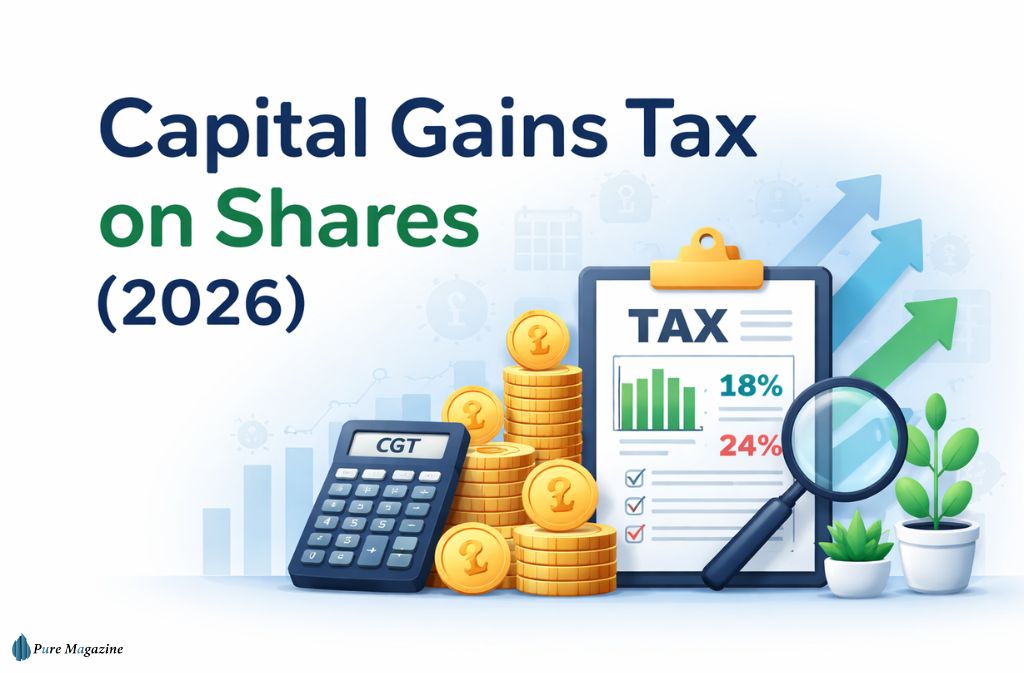
With the CGT allowance now sitting at just £3,000, more investors are getting pulled into the tax net — even those who only sell shares occasionally.
A few years ago, many people could sell investments without worrying about taxes. Now, even modest gains can trigger a bill. Get the rules wrong — especially around pooling or timing — and you can easily overpay.
This covers capital gains tax on shares as it actually works in 2026. Not just the theory, but the messy real-world bits too: missing records, multiple purchases, and HMRC reporting headaches.
What Is Capital Gains Tax on Shares?
Capital gains tax on shares is the tax you pay on the profit when you sell shares for more than you paid.
Tax applies only to the gain, not the total proceeds. It triggers when you dispose of shares — sell, gift, or transfer them.
Quick example:
- Bought: £6,000
- Sold: £11,000
- Gain: £5,000 → only this £5,000 enters the tax calculation
Capital Gains Tax Rates on Shares (UK 2026)
Following the Autumn Budget 2024 changes, CGT rates increased. These are the confirmed figures for 2026/27:
| Tax Band | CGT Rate |
|---|---|
| Basic Rate | 18% |
| Higher Rate | 24% |
| Additional Rate | 24% |
Annual Exempt Amount: £3,000 per year (frozen). You pay tax only on gains above this threshold.
Understanding how your income tax band interacts with your CGT rate matters here — if a gain spans the basic and higher rate thresholds, you pay two different rates on different portions of the same gain.
BADR Update (April 6, 2026)
If you’re selling qualifying business shares — for example, you hold at least 5% of a trading company and have worked there for two years — Business Asset Disposal Relief (BADR) no longer applies at the old 10% rate.
From 6 April 2026, the BADR rate rose to 18%, up from 14% in 2025/26 and 10% before that. The lifetime limit stays at £1 million, but the tax advantage has narrowed sharply. A £1 million qualifying gain that would have cost £100,000 in tax at 10% now costs £180,000. The gap between BADR and the standard 24% higher rate still exists — but it’s much smaller than entrepreneurs planning exits may have assumed.
Anti-forestalling rules also apply: if you signed a contract in 2025/26 but completion happens on or after 6 April 2026, the 18% rate applies regardless of when you signed.
How Capital Gains Tax on Shares Is Calculated
Here’s how it actually works in practice:
- Work out your total gain
- Subtract allowable costs (broker fees, stamp duty on purchase)
- Apply the £3,000 allowance
- Tax what remains at your rate
Example (realistic scenario):
Multiple purchases over time (very common), total pooled cost: £12,000, sale value: £20,000.
- Gain = £8,000
- Minus allowance = £5,000 taxable
- Higher-rate taxpayer: 24% of £5,000 = £1,200 CGT
The Section 104 Pool
This is where many investors trip up.
In the UK, shares of the same class in the same company sit in a single Section 104 holding — a running pool. You don’t track each purchase individually. You average them.
Example:
- Buy 100 shares at £10 = £1,000
- Buy 100 shares at £20 = £2,000
- Pool total: 200 shares, £3,000 cost, average £15/share
- Sell 100 shares → your allowable cost is £1,500 (not £1,000, not £2,000)
Every new purchase adjusts the pool’s average. Selling reduces the pool proportionately.
The 30-Day Rule (Bed & Breakfasting)
Sell shares and buy the same shares back within 30 days, and HMRC matches that sale against the new purchase price — not your pooled cost. That’s the bed and breakfasting rule, designed to prevent people from selling to crystallise an allowance and immediately buying back in.
Why it matters: It changes your gain calculation and can increase your tax bill in ways that aren’t obvious until you run the numbers.
The Bed & Spouse strategy:
Instead of rebuying yourself, transfer shares to your spouse or civil partner (tax-free between spouses), and have them sell. This:
- Use both of your £3,000 allowances
- Avoids triggering the 30-day rule
- Keeps the family’s overall exposure to the same shares
The Reporting Requirement Most Investors Miss
Here’s something that catches people out, even when they owe no tax.
You must report share disposals to HMRC if either of the following applies:
- Your total gains exceed £3,000, or
- Your total proceeds exceed £12,000 (four times the annual exempt amount) — even if your actual gain falls under £3,000
That second condition is the one most people don’t know about. Sell £15,000 worth of shares and make only £2,500 profit? You still need to report it via Self Assessment because the proceeds crossed £12,000.
For most investors, this means registering for HMRC Self Assessment and filing by 31 January following the tax year — the same deadline as the payment.
When Do You Report and Pay CGT?
- Self Assessment deadline: 31 January (following the tax year)
- Payment due: same date
- The 60-day rule applies to UK residential property, not standard share disposals
Most share disposals go through the annual Self Assessment return. If you’re not already registered, you need to do so by 5 October following the tax year of disposal.
Dividends vs Capital Gains Tax (2026 Comparison)
Investors often confuse these two taxes. They run on different allowances and different triggers.
| Feature | Dividends | Capital Gains |
|---|---|---|
| Tax trigger | Income received | Sale of shares |
| Allowance | £500 | £3,000 |
| Rates | 8.75%–39.35% | 18%–24% |
| Timing | Ongoing | On disposal |
Smart investors manage both together. Dividend tax rates and allowances interact with CGT planning — particularly when deciding whether to hold income-producing shares inside an ISA.
How to Reduce Capital Gains Tax on Shares (2026 Strategies)
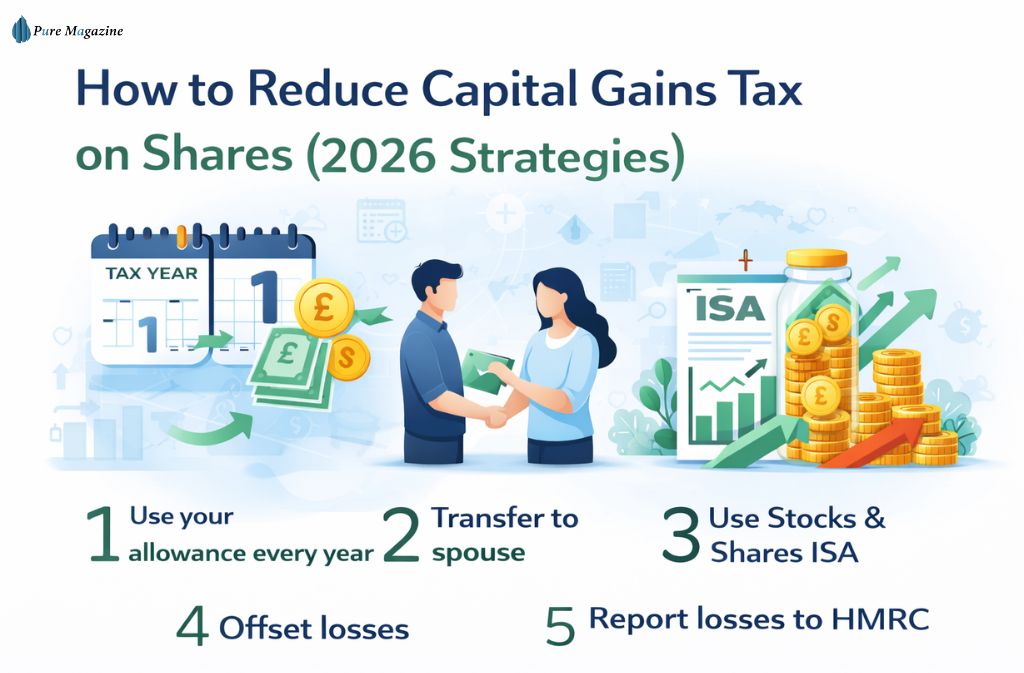
1. Use your allowance every year. The £3,000 allowance resets each April. It doesn’t roll forward — unused allowances are lost.
2. Spread disposals. Selling everything in one tax year often pushes the gain across the higher-rate threshold. Split disposals across two years where possible.
3. Transfer to spouse. Still one of the simplest and most effective strategies. Transfers between spouses are CGT-free, allowing both allowances to apply to the same portfolio.
4. Use ISA gains inside a Stocks and Shares ISA to attract zero CGT, regardless of the size of the gain. Understanding how ISAs work — including the annual subscription limit and how they interact with CGT planning — is worth doing before the next tax year.
5. Offset losses. Capital losses carry forward indefinitely. Report them to HMRC even in years where you owe no tax, to register them for future use.
What If You’ve Lost Your Purchase Records?
HMRC doesn’t care if your old broker went bust. The burden of proof is on you.
If you can’t find the original purchase price, you still need to make a reasonable estimate — and document how you arrived at it. For listed shares, the Financial Times historical price tool (ft.com) lets you look up closing prices by date. For pre-2010 purchases or old company schemes, try archived broker emails, paper contract notes, or contact the company’s registrar.
HMRC may accept reasonable estimates with proper justification, but “I couldn’t find it” isn’t a defence if a query arises. Keep whatever evidence you find.
This comes up most often for:
- Shares bought before 2010
- Old broker accounts are now closed
- Company share schemes from former employers
Common Mistakes (2026 Reality Check)
- Ignoring the 30-day rule when buying back after a disposal
- Selling everything in one tax year and hitting the higher rate unnecessarily
- Getting the Section 104 pool wrong due to forgotten early purchases
- Missing the reporting threshold — particularly the £12,000 proceeds rule
- Not tracking broker fees (these reduce your taxable gain)
2026 Compliance Checklist
Before selling shares:
- Check your current income tax band (it determines your CGT rate)
- Review your Section 104 pool — is the average cost accurate?
- Check whether the 30-day rule applies to any planned repurchase
- Use your £3,000 allowance where possible
- Consider spouse transfer to double the available allowance
- Estimate CGT before selling — not after
- Confirm whether total proceeds will exceed £12,000 (the reporting threshold)
- Prepare records for HMRC, including broker contract notes
2026 Insight: Why More Investors Are Paying CGT
Two shifts drove this:
- Annual exempt amount dropped from £12,300 to £3,000 over two years
- Rates increased from 10%/20% to 18%/24%
The result is that even moderate investors — those who sell occasionally rather than actively trade — now face a real CGT bill where previously they had none. The arithmetic has changed enough that planning before disposal is no longer optional for most people with meaningful investment portfolios.
FAQs
Q. What is the capital gains tax on shares in the UK?
Capital gains tax on shares is the tax you pay on the profit when you sell shares for more than you paid. In the UK, only gains above the £3,000 annual allowance are taxable.
Q. Is the capital gains tax 18% or 24% on shares in 2026?
Capital gains tax on shares is 18% for basic rate taxpayers and 24% for higher and additional rate taxpayers. If your gain crosses the basic rate band, part may be taxed at 18% and the rest at 24%.
Q. How much capital gains tax do I pay on shares?
You pay capital gains tax on profits above £3,000. The taxable gain is calculated as:
Sale price − purchase cost − allowable expenses
The remaining amount is taxed at 18% or 24%, depending on your income band.
Q. What is the 30-day rule for shares (bed and breakfasting)?
The 30-day rule means that if you sell shares and buy the same shares again within 30 days, HMRC matches the sale with the new purchase price instead of your original cost. This prevents investors from selling shares to use their tax allowance and immediately buying them back.
Q. Do I need to report share sales if I made no profit?
Yes, you may still need to report share disposals if your total proceeds exceed £12,000 in a tax year, even if your gain is below the £3,000 allowance and no tax is due.
Q. How do I calculate capital gains tax on shares?
To calculate capital gains tax on shares:
- Add up your total sale proceeds
- Subtract the purchase cost (using Section 104 pooling if applicable)
- Deduct allowable costs (fees, stamp duty)
- Subtract the £3,000 allowance
- Apply the 18% or 24% tax rate
Q. Can I avoid capital gains tax on shares legally?
You can reduce or eliminate capital gains tax by using tax-efficient accounts like ISAs, transferring shares to a spouse, offsetting losses, and using your annual allowance. Full avoidance is only possible within tax-free wrappers such as ISAs or pensions.
Q. When do I pay capital gains tax on shares in the UK?
Capital gains tax is usually reported and paid through Self Assessment by 31 January following the end of the tax year in which you sold the shares.
Q. Do I pay CGT on shares held for a long time?
Yes. In the UK, capital gains tax rates on shares are the same regardless of how long you hold them. There is no reduced rate for long-term holdings.
Disclaimer: This reflects UK tax rules as of 2026. Tax situations vary — consider consulting a qualified tax professional or HMRC for advice specific to your circumstances.
For more on UK tax rates, allowances, and investment tax planning, visit Pure Magazine.