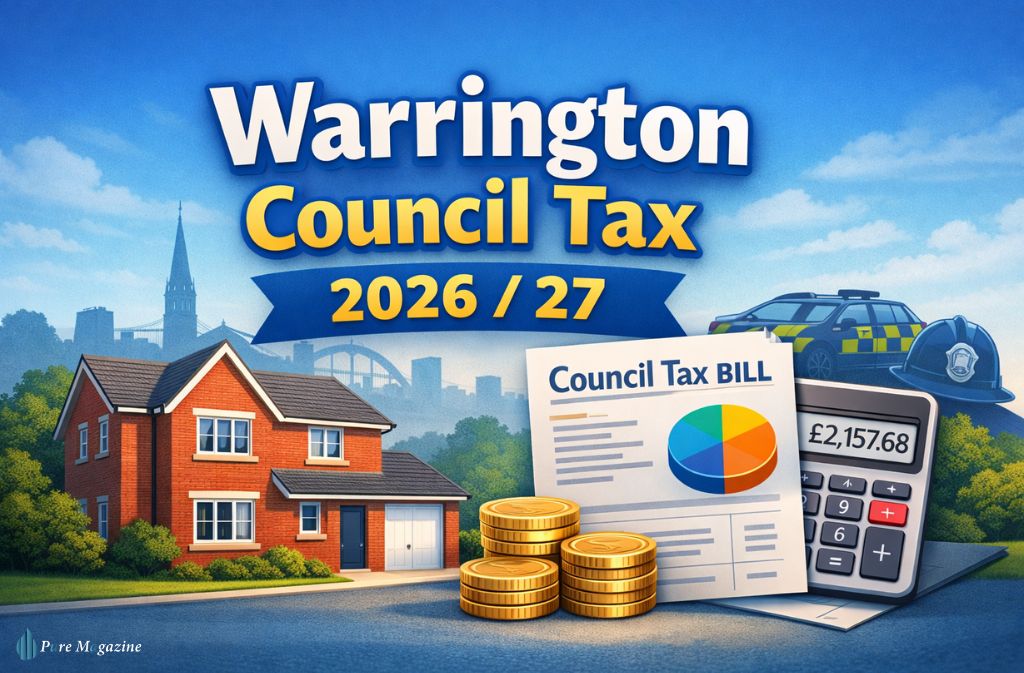
Council tax bills in Warrington have taken a noticeable jump — and for many households, the 2026/27 increase feels steeper than expected.
With a 7.48% rise approved in March 2026, residents are now paying significantly more compared to previous years. But here’s the problem: most official pages explain what to pay, not how to manage or reduce it.
That’s exactly what this guide fixes.
Inside, you’ll find:
- Final Warrington council tax bands for 2026/27
- A clear breakdown of why bills increased
- Hidden costs like parish precepts
- Proven ways to reduce your bill legally
- Smart payment strategies most people miss
If you want clarity — and potentially save hundreds per year — you’re in the right place.
What Is Warrington Council Tax?
Warrington council tax is a local tax charged on residential properties to fund public services such as social care, waste collection, policing, and infrastructure.
Key facts:
- Based on property value (1991 valuation bands A–H)
- Paid by occupants or property owners
- Usually split into monthly instalments
If you’re unsure which band your property falls into, you can check your council tax band directly on GOV.UK, using your postcode.
Warrington Council Tax 2026/27 Increase Explained
In April 2026, Warrington Borough Council implemented a 7.48% increase.
Why is it so high?
Unlike standard UK increases, Warrington received Exceptional Financial Support due to:
- A large budget gap
- Ongoing commercial borrowing costs
- Rising demand for social care services
In simple terms, more of your tax is now going toward stabilising council finances and essential services.
This pattern isn’t unique to Warrington. Councils across England have faced mounting pressure — Birmingham Council Tax rose sharply for similar reasons, and Manchester and Liverpool have seen comparable financial strain.
Warrington Council Tax Bands & Costs (2026/27)
Council tax bands determine how much you pay based on your property’s value in 1991.
Final 2026/27 Charges
| Band | Property Value (1991) | Annual Cost (£) | Monthly (10 months) |
|---|---|---|---|
| A | Up to £40,000 | £1,438.45 | £143.85 |
| B | £40,001 – £52,000 | £1,678.19 | £167.82 |
| C | £52,001 – £68,000 | £1,917.94 | £191.79 |
| D | £68,001 – £88,000 | £2,157.68 | £215.77 |
| E | £88,001 – £120,000 | £2,637.16 | £263.72 |
| F | £120,001 – £160,000 | £3,116.65 | £311.67 |
| G | £160,001 – £320,000 | £3,596.13 | £359.61 |
| H | Over £320,000 | £4,315.36 | £431.54 |
These include the council base charge, Adult Social Care precept, and Police & Fire precepts.
For context on what Band D typically costs across England, or how Band E or Band F compare nationally, those guides break it down area by area.
What Is a Parish Precept? (Hidden Extra Cost)
A parish precept is an additional charge applied in certain local areas within Warrington.
Areas affected include:
- Appleton
- Birchwood
- Great Sankey
If you live in these areas, your bill will be higher than the standard band rates shown above.
How Much Is My Council Tax in Warrington?
Your total bill depends on:
- Your property band
- Whether your area includes a parish precept
- Your eligibility for discounts or support
Example:
- Band D standard: £2,157.68
- With single person discount: £1,618.26
- With parish precept: slightly higher
How Warrington Council Tax Is Spent (2026/27)
Council tax funds essential local services — but spending priorities have shifted in 2026.
Breakdown:
- Social Care (largest share) — over 50% supports vulnerable residents
- Corporate Financing (growing share) — covers borrowing and debt repayment
- Police & Fire Services — funded through separate precepts
Warrington’s rising debt servicing costs are a major reason council tax is increasing faster than in most UK areas. The Valuation Office Agency oversees the banding system itself — worth knowing if you ever want to challenge your band.
How to Reduce Your Warrington Council Tax Bill (2026 Rules)
With a 7.48% increase, checking discounts is one of the easiest ways to save money.
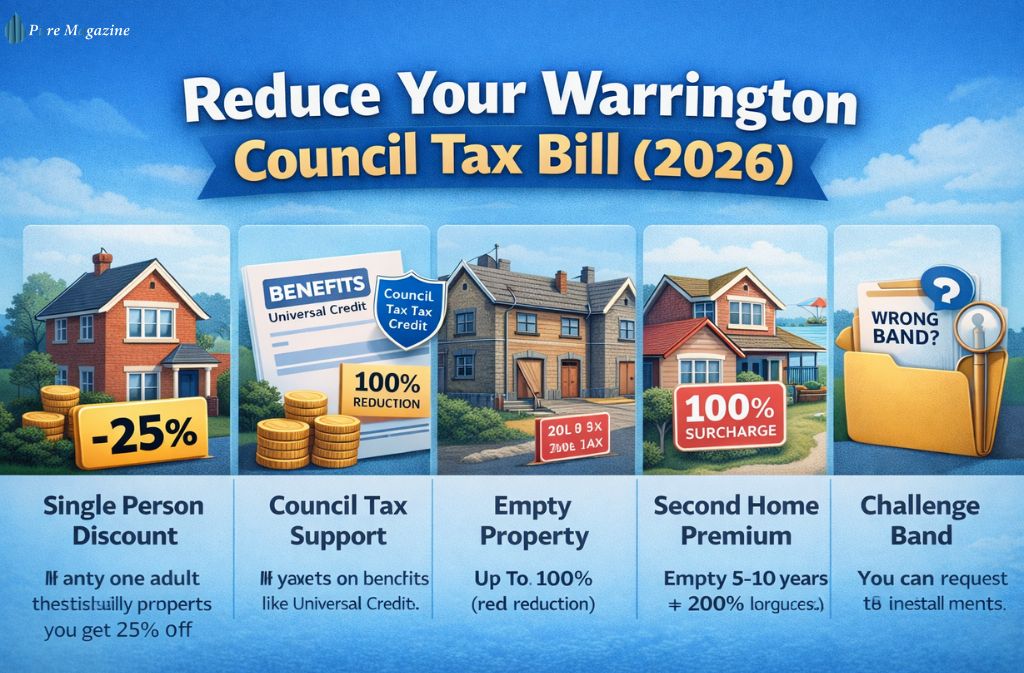
1. Single Person Discount (25%)
If only one adult lives in the property, you get 25% off your bill.
Example — Band D saves £539.42/year.
2. Council Tax Support (Low Income)
If you’re on benefits like Universal Credit, you may receive up to 100% reduction. The full criteria are outlined in the council tax reduction guide, which covers eligibility rules across England.
3. Empty Property Premiums (Updated 2026)
New rules:
- Empty 1–5 years → +100% (double tax)
- Empty 5–10 years → +200% (triple tax)
There’s more detail on council tax on unoccupied property if you’re dealing with a vacant home — including what happens after a bereavement.
4. Second Home Premium (NEW)
From April 2026, furnished second homes attract a 100% surcharge. This is a significant update that many second-home owners are still unaware of.
5. Challenge Your Band
If you think your property was placed in the wrong band back in 1991, you have the right to appeal. The guide on challenging your council tax band walks through how the process works and what evidence you’d need.
How to Pay Warrington Council Tax
Payment methods:
- Direct Debit (recommended)
- Online account via “My Warrington.”
- Phone or bank transfer
Smart Payment Strategy
Most people don’t realise the default is 10 instalments — switching to 12 months lowers each payment and helps with monthly cash flow. It’s a small admin change worth making.
Also worth noting: there are months when council tax isn’t collected under the standard 10-payment schedule — February and March are typically payment-free, which can help with budgeting.
Common Mistakes to Avoid
- Not claiming discounts you’re entitled to
- Ignoring incorrect banding (many properties have never been reviewed)
- Missing payment deadlines
- Forgetting to update your address on the account
- Assuming empty homes are automatically tax-free
Quick Checklist to Lower Your Bill
✔ Check your band accuracy
✔ Apply for relevant discounts
✔ Switch to Direct Debit
✔ Choose 12-month payments
✔ Review eligibility every year
Real-Life Example
A Warrington resident in Band C:
- Standard bill: £1,917.94
- With single discount: £1,438.45
- Saving: nearly £480 per year
FAQs
Q. How much is council tax in Warrington for 2026/27?
Council tax in Warrington for 2026/27 ranges from £1,438.45 (Band A) to £4,315.36 (Band H). The average Band D rate is £2,157.68 per year, following a 7.48% increase approved in March 2026.
Q. How much is Band D council tax in Warrington 2026/27?
Band D council tax in Warrington is £2,157.68 annually before any discounts or reductions. Your final bill may be lower if you qualify for support or higher if a parish precept applies.
Q. Why did the Warrington council tax increase in 2026?
Warrington council tax increased by 7.48% in 2026 due to:
- Exceptional Financial Support approval
- Rising debt and borrowing costs
- Increased demand for adult social care services
These factors required higher funding to maintain essential local services.
Q. Can I reduce my council tax in Warrington?
Yes, you can reduce your council tax bill in Warrington through:
- Single person discount (25%)
- Council Tax Support (means-tested, up to 100%)
- Band challenge if your property is incorrectly valued
Checking eligibility can save hundreds per year.
Q. Do second homes pay extra council tax in Warrington?
Yes. From April 2026, furnished second homes in Warrington are subject to a 100% council tax premium, meaning you pay double the standard rate if the property is not your main residence.
Q. What happens if my property is empty in Warrington?
Empty properties in Warrington may face increased charges:
- Empty 1–5 years → 100% premium (double council tax)
- Empty 5–10 years → 200% premium (triple council tax)
These rules are designed to discourage long-term vacant homes.
Q. Can I pay Warrington council tax over 12 months?
Yes. By default, council tax is paid over 10 months (April–January), but you can request 12 monthly instalments (April–March) to reduce your monthly payments.
You can set this up by contacting Warrington Borough Council or updating your Direct Debit online.
Conclusion
Warrington council tax has risen sharply in 2026 — but that doesn’t mean you’re stuck paying more than necessary.
Key takeaways:
- The 7.48% increase is higher than average
- Bands and parish precepts together determine your final bill
- Discounts can save hundreds per year
- Payment structure affects monthly affordability
Spending a few minutes reviewing your band and eligibility could easily pay off. And if you want to see how Warrington compares to other areas, the breakdowns for Wirral, Sunderland, and Ealing follow the same format.
For more on council tax rates, discounts, and exemptions across the UK, visit Pure Magazine.