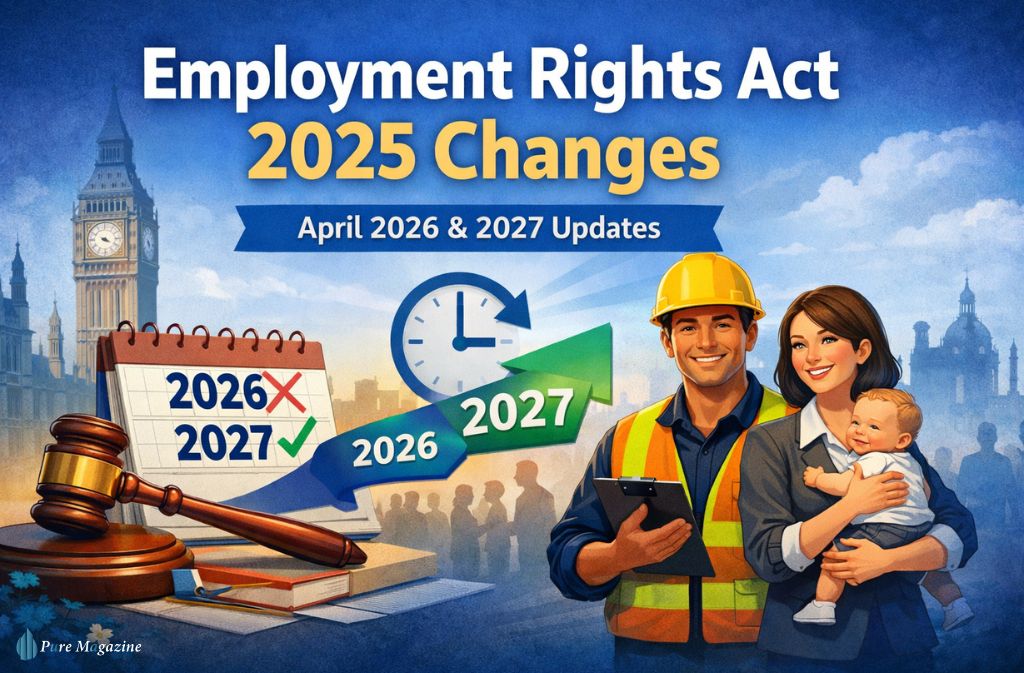
The Employment Rights Act 2025 introduces phased UK employment reforms starting February 2026, with major updates on April 6, 2026, and critical changes — like the reduction of the unfair dismissal qualifying period — delayed until January 2027. These updates reshape statutory sick pay (SSP), parental rights, dismissal rules, and enforcement through a new regulator.
The short version: most worker protections improve in April 2026, but unfair dismissal reform does not arrive until 2027 — and it includes a transitional safeguard for employers rather than instant full protection.
Summary Table: Employment Rights Act 2025 Changes Timeline
| Area | Pre-2026 Rule | April 2026 Changes | January 2027 Changes | Key Impact |
|---|---|---|---|---|
| SSP payments | 3 waiting days | Paid from Day 1 | Same | Faster income support |
| SSP eligibility | Earnings threshold applies | LEL removed + 80% rule | Same | More workers qualify |
| Parental leave | 26–52 weeks required | Day-one entitlement | Same | Immediate access |
| Unfair dismissal | 2-year qualifying period | No change (transition phase) | Reduces to 6 months | Major legal shift |
| Enforcement | Fragmented agencies | Fair Work Agency launched | Expanded powers | Stronger enforcement |
What Do the Employment Rights Act 2025 Changes Actually Mean?
The Employment Rights Act 2025 received Royal Assent on 18 December 2025, making it law after more than a year of parliamentary debate. It modernises UK employment law by accelerating access to rights while introducing structured protections for employers. Workers benefit from earlier entitlements, but businesses retain flexibility through transitional rules and revised probation frameworks.
In practice: workers get faster access to pay, leave, and protections; employers face clearer legal duties and enforcement; and some headline reforms — like unfair dismissal — are delayed but staged carefully.
The government’s official implementation timeline sets out what changes will occur across 2026 and 2027.
Key Employment Rights Act 2026 Changes (Effective April 6, 2026)
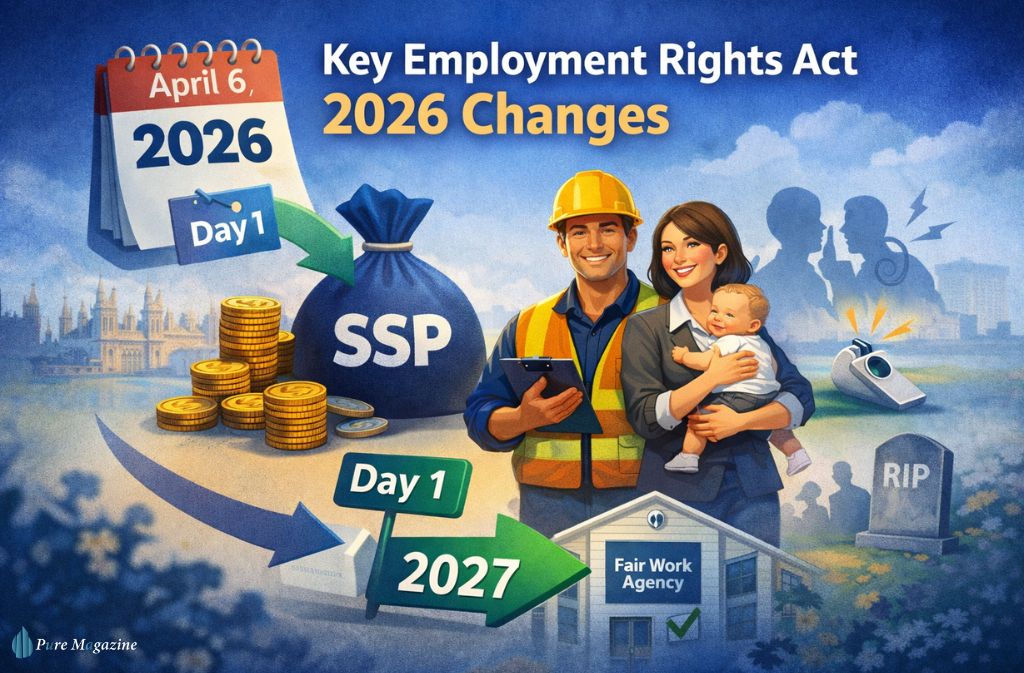
The most impactful changes take effect on April 6, 2026, focusing on pay, leave, and worker protection.
What changes immediately:
- Statutory Sick Pay starts from Day 1 — the three waiting days are abolished
- Lower Earnings Limit removed, expanding SSP eligibility to all workers regardless of earnings
- 80% SSP rule introduced for low earners (flat rate or 80% of weekly earnings, whichever is lower)
- Day-one parental leave rights, including paternity and shared parental leave — previously requiring 26 weeks’ service
- Bereaved partners leave up to 52 weeks unpaid for partners of those who die in connection with childbirth
- Whistleblowing protections formally extended to cover sexual harassment disclosures
- The maximum protective award for failure to collectively consult doubles from 90 to 180 days’ pay per employee
- Fair Work Agency launches on April 7, 2026, consolidating enforcement across multiple labour regulators
Practical example: A worker earning £100 per week who falls ill in May 2026 may receive £80 from day one — instead of nothing for the first three days under the old system.
SSP itself rises to £123.25 per week from April 2026, up from £118.75. For the full picture on how statutory sick pay interacts with income tax and take-home pay, the income band thresholds matter particularly for lower earners who may now qualify for the first time.
When Does Unfair Dismissal Reform Take Effect? (2027 Rule)
The Employment Rights Act 2025 reduces the unfair dismissal qualifying period from two years to six months, effective from January 1, 2027. Until then, the existing two-year qualifying period remains largely in force during 2026.
Key clarification:
- 2026 = Transition year — existing qualifying period applies
- January 2027 = Six-month qualifying period begins
Why this matters: Employees dismissed in 2026 typically still need two years’ service to claim unfair dismissal. But employees hired in mid-to-late 2026 may gain protection sooner under the 2027 threshold, depending on when dismissal occurs. Tracking hiring dates through 2026 is therefore important for both HR teams and employees.
A common mistake is assuming unfair dismissal rules change in April 2026. They don’t — that date covers SSP, parental leave, and whistleblowing, not dismissal qualifying periods.
What Is the Initial Period of Employment (IPE)?
Alongside the January 2027 qualifying period change, the government is introducing an Initial Period of Employment — a statutory framework governing how employers can manage dismissals during the early months of employment.
The IPE exists to balance the new six-month protection with employer flexibility. During the IPE, employers can use a simplified dismissal process with fewer procedural requirements. After it ends, full unfair dismissal protections apply in the usual way.
The length and precise mechanics of the IPE are subject to ongoing consultation — the Acas guidance on the Employment Rights Act 2025 is being updated as regulations are confirmed. Employers should redesign probation policies with this framework in mind rather than assuming existing probation arrangements are compliant.
What Is the Fair Work Agency (FWA) and Why It Matters?
The Fair Work Agency, launched April 7, 2026, is a new single enforcement body bringing together functions previously split across several labour regulators. Its initial remit covers minimum wage and agency worker enforcement, with holiday pay, SSP, and other employment rights to follow.
Why it matters: Centralised enforcement increases the risk of audits and penalties for non-compliant employers. The FWA is intended to act as a single point of contact for employees to report issues, and may help bring tribunal claims on behalf of workers in certain circumstances. Treating compliance as a continuous obligation — not a one-time policy update — is the appropriate response.
How Should Employers Prepare?
- Remove SSP waiting days from payroll systems and update absence policies
- Update employment contracts and handbooks for day-one leave rights
- Review dismissal and probation policies ahead of the January 2027 reforms
- Train managers on harassment, whistleblowing rules, and new family leave entitlements
- Prepare for FWA inspections — ensure payroll records are auditable and retained correctly
- Holiday pay records must now be kept and maintained from April 6, 2026, and retained for six years (failure is a criminal offence)
Updating policies without training managers is the most common implementation failure. Scenario-based training — covering sickness from Day 1, early parental leave requests during probation, and whistleblowing disclosures — is more effective than policy documentation alone.
How Do These Changes Affect Employees in Real Terms?
- Check whether your employer is applying the new SSP rules correctly from Day 1
- Use day-one leave rights when needed — they are now statutory regardless of length of service
- Track your employment start date carefully — it determines when dismissal protection kicks in under the 2027 rules
- Keep records of workplace issues, particularly around whistleblowing and harassment
- Seek advice if rights are denied
A useful calculation: does 80% of your actual weekly earnings exceed the flat SSP rate (£123.25)? If so, you receive the flat rate. If not, you receive 80% of your earnings. Workers near the lower threshold benefit most from running this comparison.
Understanding how HMRC self-assessment and employment income interact can also matter for workers in multiple jobs or those moving between employment and self-employment.
Edge Case: Transitional Dismissal Confusion (2026–2027)
Employees hired in 2026 are often unsure whether they qualify for unfair dismissal protection.
Root cause: overlap between the old two-year rule and the new six-month rule starting January 2027.
How to think about it:
- Dismissed before January 2027 → old two-year rule likely applies
- Dismissed after January 2027 → new six-month qualifying period applies
- Hired in mid-2026 and dismissed after January 2027 → may have protection if six months’ service has been reached
Seek legal advice if you’re close to a threshold — the transitional window creates genuine complexity that general guidance cannot resolve individually.
Comparison: What Employees Gain vs What Employers Retain
| Feature | Employee Gain | Employer Protection |
|---|---|---|
| SSP reform | Paid immediately | Cost predictability with 80% cap for low earners |
| Day-one leave | Immediate access | Structured notice requirements still apply |
| Unfair dismissal (2027) | Protection for six months | IPE probation flexibility during early employment |
| Enforcement (FWA) | Stronger rights enforcement | Clearer regulatory structure replaces fragmented system |
October 2026: What Else Is Coming
Several further changes are confirmed for October 2026, separate from the April wave:
- Employment tribunal time limits extend from three to six months for most claims, including unfair dismissal and discrimination
- New duty for employers to inform workers of their right to join a trade union
- Trade union detriment protections extended beyond unfair dismissal
- Updated rules on trade union workplace access and facilities
These are worth building into compliance planning now rather than treating October as a separate cycle.
FAQs
The Employment Rights Act 2025 changes are not a single event but a phased transformation running across 2026 and 2027. April 2026 delivers immediate improvements in sick pay and family leave. October 2026 extends tribunal time limits and trade union rights. January 2027 introduces the biggest structural reform — a six-month unfair dismissal qualifying period with an IPE safeguard for employers.
Timing determines rights throughout this period. Whether you’re an employer updating policies or an employee tracking entitlements, acting on the 2026 changes now and building the 2027 reforms into planning will put you ahead of a timetable that is still actively developing.
For more on UK income tax, employment income, and HMRC obligations, visit Pure Magazine.