That “vehicle tax reminder” used to be easy to ignore — especially if you drove an electric car and the bill was £0.
Not anymore.
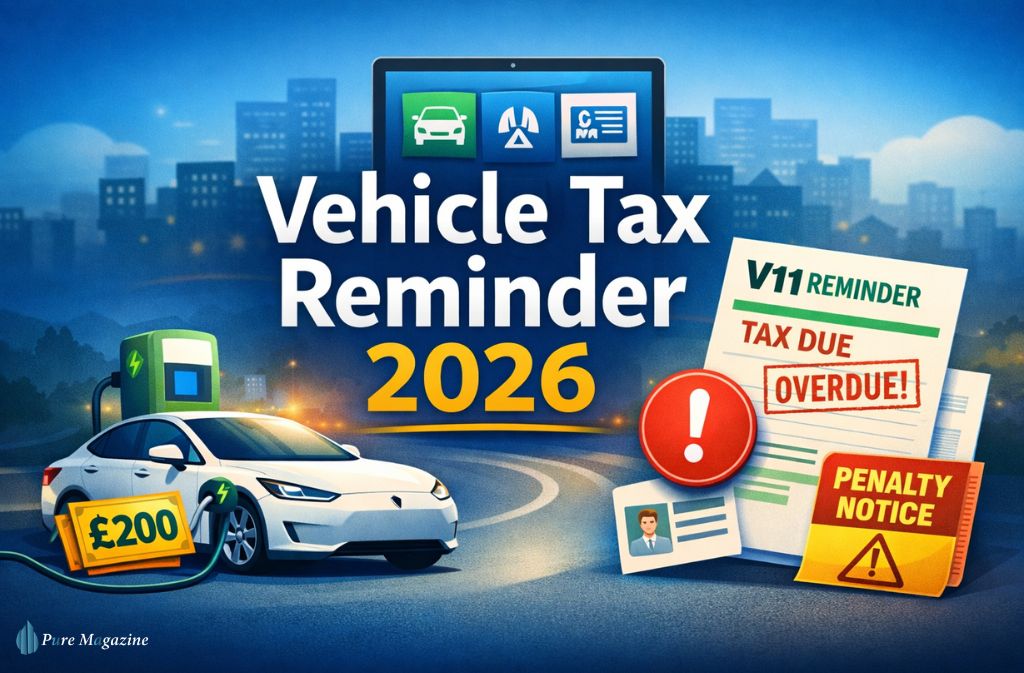
As of April 2026, millions of drivers — especially EV owners — are opening their first-ever V11 reminder and seeing an actual charge. For most vehicles, that’s now £200 per year.
Here’s the key thing most people still don’t realise: you don’t need a vehicle tax reminder to tax your car — but ignoring it can cost you.
What a Vehicle Tax Reminder Actually Is (And What It Isn’t)
A vehicle tax reminder (V11) is simply a notification from the DVLA telling you your tax is about to expire.
It includes a reference number, your vehicle details, and payment instructions.
But here’s the part people misunderstand: it’s not required to tax your vehicle. It’s just a prompt. The responsibility stays with you — and the law doesn’t care whether the letter arrived or not.
2026 Update: Why Your Vehicle Tax Reminder Suddenly Matters More
EV Owners: This Is Your First Real Bill
If you’ve driven an electric vehicle since around 2017–2025, you’ve likely never paid vehicle tax before. That changed in April 2026.
EVs now pay the £200 standard rate. Your V11 is no longer a £0 notice — it’s a bill. Ignoring it carries the same penalties as petrol and diesel drivers face. This is one of the biggest reasons searches around vehicle tax reminders have surged this year.
For a full breakdown of what EV owners now pay and how the expensive car supplement threshold works, the rates vary depending on list price and registration date.
2026 Vehicle Tax Rates (Quick Reference)
| Vehicle Type | Annual Cost | Monthly (Direct Debit) |
|---|---|---|
| Petrol/Diesel | £200 | ~£17.50 |
| Electric Vehicles (EVs) | £200 | ~£17.50 |
| Hybrids | £200 | ~£17.50 |
| Luxury Cars | +£440 extra | Added to plan |
Luxury threshold:
- Petrol/diesel/hybrid cars over £40,000
- EVs over £50,000
- Adds £440 per year for 5 years from the second year of registration
The Fastest Way to Tax Your Car in 2026 (No Paper Needed)
Use the DVLA Driver and Vehicles Account (Best Method)
The DVLA Driver and Vehicles Account is now the recommended way to manage vehicle tax. It lets you view tax and MOT status instantly, without waiting for a letter, and works even if you’ve recently moved house.
Once set up, you can switch from paper V11 reminders to digital notifications by email or SMS — and drivers who pay by Direct Debit don’t need a reminder at all, since their tax renews automatically.
Simple steps:
- Log into your DVLA account
- Select your vehicle
- Review tax status
- Pay or set up Direct Debit
Think of it as a single dashboard for all your driver and vehicle information — licence details, penalty points, tax status, and MOT expiry in one place.
How to Tax a Vehicle Without a Reminder (All Scenarios Covered)
Option 1: Use Your V5C Logbook
Enter the 11-digit reference number from your V5C registration certificate and complete payment on GOV.UK. This is the most common alternative when the V11 hasn’t arrived.
Option 2: Just Bought the Car?
Use the green new keeper slip that came with the vehicle. It contains a 12-digit reference number. Tax the car immediately — vehicle tax doesn’t transfer between owners, so driving before taxing is an offence even if the previous keeper’s tax was valid.
Option 3: No V11 AND No V5C?
This is a real-world headache, and it’s rarely explained clearly.
Without either document, you can’t tax the car. The solution is to apply for a replacement logbook using Form V62, available at the Post Office. The replacement costs £25. Once received, you can tax in the usual way. This is one of the most common delays drivers face when trying to sort out a vehicle they’ve just bought or inherited.
Why You Didn’t Receive a Vehicle Tax Reminder (Real Reasons)
Missing a V11 isn’t unusual. Here’s what actually causes it:
1. Address Change Timing
You updated your V5C — but the reminder was already sent to your old address before the change was processed. There can be a lag of several days between updating records and them taking effect.
2. You Switched to Digital Without Realising
The DVLA increasingly defaults drivers toward email and SMS reminders. If you set up a DVLA account, paper reminders may have stopped.
3. You Just Bought the Car
Reminders don’t transfer between owners. The V11 is addressed to the registered keeper, not the vehicle.
4. Postal Delays or Loss
Still happens more than most people expect, particularly around busy periods.
The solution in all cases is the same: stop relying on post. Check your DVLA account directly to confirm your tax expiry date.
Vehicle Tax Reminder vs Direct Debit
| Feature | Reminder | Direct Debit |
|---|---|---|
| Requires memory | Yes | No |
| Risk of fines | Higher | Lower |
| Setup effort | Low | Medium |
| Long-term ease | Low | High |
Most people who get fined simply forgot — not because they didn’t know the rules. Direct Debit removes that risk entirely, and drivers using it don’t receive a V11 because no manual renewal is needed.
Common Mistakes That Lead to Fines
“I Didn’t Get a Reminder”
Doesn’t matter legally. The responsibility to keep a vehicle taxed sits with the keeper, not with DVLA’s reminder system. This is confirmed in the DVLA’s own guidance.
Driving Before Taxing a New Car
Tax doesn’t carry over between owners. Even if the vehicle looks taxed when you check the registration online, that status ends the moment ownership transfers. Understanding what SORN means and when it applies is useful if you’re keeping a vehicle off-road during a gap in ownership.
Forgetting MOT Requirement
No valid MOT means you can’t tax the vehicle. If a Direct Debit is in place but the MOT expires, the Direct Debit won’t auto-renew until the MOT is sorted. DVLA will write to the registered keeper to flag this.
Ignoring EV Changes
Probably the biggest issue in 2026. Many EV drivers still assume their vehicle is tax-free. It isn’t — and a reminder arriving for the first time can catch people off guard if they haven’t checked. The wider 2026 car tax changes affect how refunds work too when selling or scrapping a vehicle mid-year.
Digital-First Strategy (How to Avoid This Problem Forever)
The DVLA is clearly moving away from paper, and the direction of travel isn’t reversing.
Smart setup:
- Enable email and SMS reminders through the DVLA account
- Set up Direct Debit so renewal is automatic
- Check tax and MOT status quarterly rather than waiting for a prompt
Once a DVLA account is set up and Direct Debit is active, the V11 becomes largely irrelevant — it won’t even be sent. For anyone who’d rather not think about this again, that’s the simplest outcome.
Real-Life Scenario (What Actually Happens)
You move house. Update your V5C.
The next day, DVLA sends a reminder to the old address. You never see it. Tax expires.
You’re now technically driving untaxed. A possible fine arrives weeks later — by which point the window for the reduced early-payment option may have passed.
The solution is always the same: check your account, not your mailbox.
Quick Checklist
- Know your tax expiry date
- Don’t rely on reminder letters
- Keep V5C safe
- Set up a DVLA account
- Use Direct Debit if possible
- Check MOT status before renewal falls due
FAQs
Q. Can I tax my vehicle without a reminder (V11)?
Yes, you can tax your vehicle without a V11 reminder. Use your V5C logbook (registration certificate) or the new keeper slip (V5C/2) to access the DVLA service online or at a Post Office. The reminder is optional and not required.
Q. What happens if I didn’t receive a vehicle tax reminder letter?
If you didn’t receive a vehicle tax reminder letter, you are still legally responsible for taxing your vehicle before the expiry date. Missing a V11 does not prevent penalties, so you should check your vehicle tax and MOT status online and renew manually.
Q. Do electric vehicles (EVs) pay road tax in 2026?
Yes. From April 2026, most electric vehicles must pay the standard £200 annual vehicle tax rate. This applies to EVs that were previously exempt, meaning many owners will receive their first paid vehicle tax reminder.
Q. How do I tax my vehicle without a V11 reminder?
To tax your vehicle without a V11 reminder:
- Use your V5C logbook reference number, or
- Use your new keeper slip if you recently bought the vehicle
- Log into your DVLA Driver and Vehicles Account for the fastest method
Q. What should I do if I lost both my V11 reminder and V5C logbook?
If you’ve lost both your V11 reminder and V5C logbook, you must apply for a replacement using a V62 form. This costs £25 and is available at the Post Office. You cannot tax your vehicle until you receive a valid reference number.
Q. Are vehicle tax reminders still sent by post in the UK?
Yes, vehicle tax reminders (V11 letters) are still sent by post. However, the DVLA is moving toward digital reminders via email and SMS, which are faster and more reliable.
Q. What is the fastest way to tax a vehicle in 2026?
The fastest way to tax your vehicle in 2026 is by using the DVLA Driver and Vehicles Account online. It allows you to check your tax status, renew instantly, and set up Direct Debit without needing a paper reminder.
Q. Where can I find my vehicle tax reminder reference number?
You can find your reference number on:
- Your V11 reminder letter, or
- Your V5C logbook
If you don’t have either, you’ll need to apply for a replacement logbook before taxing your vehicle.
Q. Can I drive my car if I forgot to tax it?
No. Driving a vehicle without valid tax is illegal in the UK and can result in fines or penalties. Always ensure your vehicle is taxed, even if you did not receive a reminder.
Q. Do I need a valid MOT to tax my vehicle?
Yes. In most cases, your vehicle must have a valid MOT certificate before you can tax it. Without a valid MOT, the DVLA system will block your tax application.
Conclusion
The vehicle tax reminder hasn’t disappeared — but its role has changed.
In 2026, it’s less reliable than digital tools, more important for EV drivers who are paying for the first time, and no longer something worth depending on as a primary system.
The safest approach: use your DVLA account, automate payments, and treat the V11 as a backup rather than a trigger.
For more on UK vehicle tax rates, road tax changes, and DVLA updates, visit Pure Magazine.