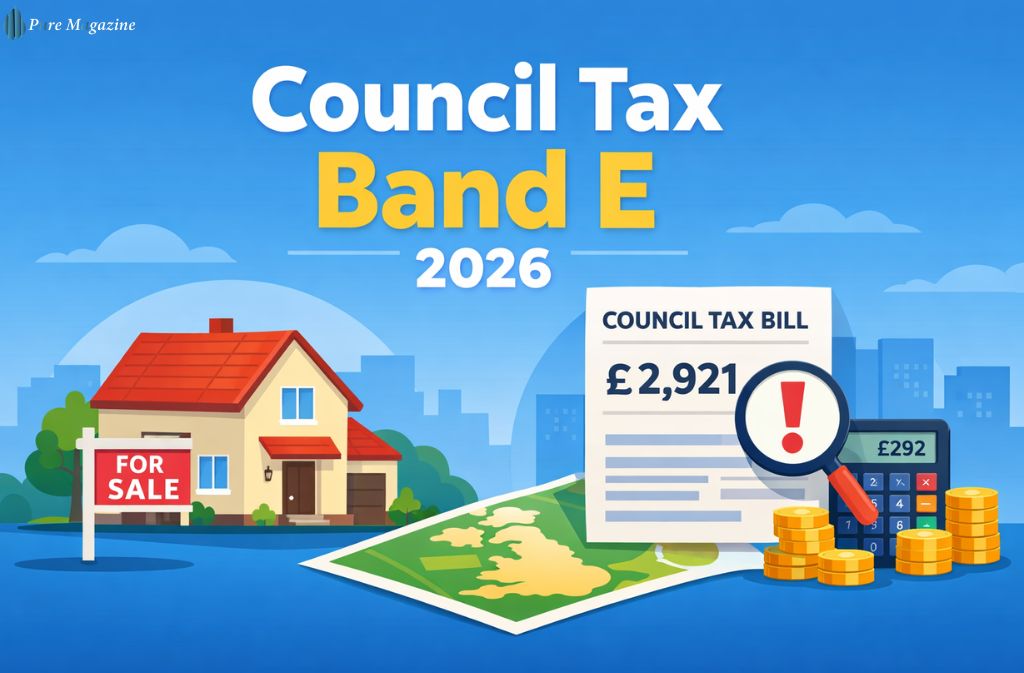
Council tax bills are rising again — and for Band E households, that increase lands noticeably harder than for those in lower bands.
If you’ve searched “council tax band E,” you’re trying to answer one question: how much will I actually pay? The honest answer is that two identical Band E homes can cost over £2,000 more per year, depending on where they sit on the map. The band is fixed. The rate behind it isn’t.
This guide covers what Band E means, what it costs in 2026/27 with real local examples, why it’s exactly 22% higher than Band D, the improvement indicator risk most buyers miss, and what landlords need to know about the HMO reassessment trend reshaping council tax liability this year.
What Is Council Tax Band E?
Band E covers properties valued between £88,001 and £120,000 based on their estimated April 1991 market price. As UKCalculator’s council tax band guide explains, England set these bands when council tax replaced the Poll Tax in 1993, and has never revalued since. Wales revalued in 2005. England is the only UK nation that still taxes homes on their 1991 value.
That’s why a house worth £550,000 today can still sit in Band E. The band reflects what a similar property would have sold for over three decades ago, not current market prices.
The full England band structure runs from Band A (up to £40,000) through to Band H (over £320,000) — for a complete picture of how all eight bands compare nationally, including the 11/9ths calculation that fixes every band’s relationship to Band D.
The 11/9ths Formula: Why Band E Is 22% Higher
Every band is a fixed fraction of Band D — set nationally and applied by every local authority. Band E is always 11/9 of Band D, which works out to approximately 122% of whatever Band D costs in your area.
| Band | Fraction of Band D | Example at £2,394 baseline |
|---|---|---|
| A | 6/9 (67%) | £1,596 |
| B | 7/9 (78%) | £1,862 |
| C | 8/9 (89%) | £2,128 |
| D | 9/9 (100%) | £2,394 |
| E | 11/9 (122%) | £2,921 |
| F | 13/9 (144%) | £3,447 |
| G | 15/9 (167%) | £3,990 |
| H | 18/9 (200%) | £4,788 |
The local council only decides the Band D rate. The multiplier is fixed. So if your council sets Band D at £2,500, your Band E bill is automatically £3,056 — no council discretion involved.
How Much Is Band E in 2026/27?
The England-wide average Band D for 2025/26 was £2,280, confirmed by GOV.UK’s official council tax levels publication. With most councils applying the 4.99% maximum for 2026/27, the England average Band D for 2026/27 sits at approximately £2,394, and Band E at approximately £2,921 per year.
Real 2026/27 Band E examples:
| Location | Approx Band E Annual | Monthly (10 payments) |
|---|---|---|
| Westminster (London) | ~£1,187 | ~£119 |
| Kensington & Chelsea | ~£1,382 | ~£138 |
| England average | ~£2,921 | ~£292 |
| Birmingham | ~£3,511 | ~£351 |
| Nottingham | ~£3,365 | ~£337 |
| Croydon | ~£3,177 | ~£318 |
The gap between Westminster and Nottingham on Band E alone exceeds £2,100 per year. Same band, same formula — entirely different bills because local Band D rates diverge so dramatically. As GOV.UK’s council tax levels data confirms that London averages £1,982 Band D, while unitary authorities average £2,366 — a £384 Band D gap that translates to a £468 Band E gap before any council-specific variation.
Why Costs Vary: The Westminster vs Nottingham Reality
Westminster and Kensington & Chelsea sit among England’s cheapest councils despite covering some of the UK’s most valuable real estate. Both generate substantial income from business rates and central government grants, reducing their dependence on residential council tax to fund services. Nottingham, Birmingham, and Croydon carry heavier social care obligations, smaller commercial tax bases, and less central support — meaning residential taxpayers fund a larger share of local spending.
For Band E households, this structural gap is significant. UKCalculator’s 2026 rates data tracks the Band D spread across every English council — worth checking before buying in an unfamiliar area, since the council’s financial health directly determines your bill.
The 4.99% Cap — And Where It Broke
Most councils applied 4.99% for 2026/27 — splitting between a 2.99% core increase and a 2% Adult Social Care precept. As confirmed on Bournemouth, Christchurch and Poole Council’s 2026/27 bands page, the government allowed certain financially distressed councils to exceed the referendum threshold entirely through the Exceptional Financial Support scheme. BCP itself applied 6.74%; Shropshire and Worcestershire reached 8.99%.
If one of the seven councils has granted EFS, your Band E bill may rise at nearly double the national rate — this isn’t an error on your statement, but a result of your council’s financial position.
Checking Your Band
The GOV.UK council tax band checker returns your band and your neighbours’ bands from the same postcode search. That neighbour comparison is everything if you’re considering a challenge — the VOA needs comparable properties in lower bands as evidence, not opinions about current market value.
As Manchester City Council’s council tax page notes, the VOA has produced a YouTube explainer specifically on what makes a “comparable property” — worth watching before submitting a proposal, since strong challenges rest on matching property type, size, age, and proximity, not asking prices from Rightmove.
Challenging a Band E Rating
Challenges go through the VOA via GOV.UK’s band challenge page — free to submit, typically taking two to six months. A successful challenge backdates savings to when the change took effect, not when you filed. The council-tax-band-b guide illustrates the challenge process in detail, including the evidence standards the VOA applies and the risk that a thorough review can move a band upward as well as downward.
Valid grounds for a Band E challenge:
- Similar nearby properties in Band D or below
- Your 1991 valuation appears inconsistent with the evidence
- Structural changes reduced the property’s value
Not valid grounds:
- You think the bill is too high
- Your current market value feels disproportionate to the band
The Improvement Indicator: A Risk Most Buyers Miss
This is one of the most overlooked details in the UK property market.
When a Band E property has been extended, converted, or significantly improved, the VOA doesn’t automatically reassess the band. Instead, it places an “Improvement Indicator” on the listing. The band stays at E while the current owner lives there — but at the next sale, the new owner may trigger a reassessment and find the property moves from Band E to Band F or higher.
As the BCP Council’s guidance confirms, the Listing Officer changes the band when a property is sold if the previous owner added an extension. If you’re buying a Band E home that has visibly been extended or loft-converted, check the GOV.UK band checker for an Improvement Indicator before exchanging contracts. Factor a potential band increase into your cost planning — a move from Band E (£2,921 average) to Band F (£3,447) adds over £500 to the annual bill before any other increases.
The HMO Trap Reshaping Landlord Liability in 2026
A significant shift is underway for Houses in Multiple Occupation.
Many HMOs were historically assessed as multiple Band A units — one per lettable room or self-contained flat. In 2026, the VOA has been reassessing a growing number of these properties as single units, typically placing the whole building in Band E or higher.
The consequences are real: a property previously generating four Band A bills — each around £1,500 — becomes one Band E bill approaching £2,921. And because a single billing unit means a single liable person, the landlord often becomes responsible for the council tax rather than individual tenants.
Any landlord managing an HMO should check the GOV.UK band checker for any recent reassessment on their property.
Scotland: Band E Works Differently
Scotland uses the same A–H band structure and the same 1991 valuation date, but sets rates independently through each council. As UKCalculator’s band guide confirms, the Scotland average Band D for 2025/26 is approximately £1,372 — significantly lower than England’s £2,280 due to different local government funding arrangements.
Scottish Band E at 11/9 of Band D works out to roughly £1,676 on the national average — but that figure doesn’t include water and sewerage charges, which Scottish Water bills separately and which typically add £400–£500 per year. The true comparable cost for Scottish Band E households is closer to £2,100–£2,200 once water is included.
How to Reduce a Band E Bill
Single Person Discount (25%) — one adult living alone qualifies for a quarter off the bill. On a £2,921 Band E average, that’s over £730 saved annually. It doesn’t apply automatically — notify your council. The council-tax-reduction guide covers CTR eligibility for lower-income households alongside the discount.
Disregarded residents — full-time students, apprentices, carers, and people with Severe Mental Impairment don’t count as occupants. Where all adults in a Band E property are disregarded, the discount reaches 50%.
Disability band reduction — properties adapted for a disabled resident may qualify for the rate of the band below, paying Band D rates on a Band E property.
Quick savings example:
| Scenario | Annual Bill |
|---|---|
| Standard Band E (England avg) | £2,921 |
| With 25% single person discount | £2,191 |
| Annual saving | £730 |
Empty Property and Second Home Premiums
From April 2026, properties left empty for more than one year face a 100% premium across most English councils — meaning the owner pays double the standard Band E rate. Properties empty for over ten years face a 300% premium, resulting in four times the standard charge.
| Scenario | Annual Band E Cost |
|---|---|
| Occupied | £2,921 |
| Empty for over 1 year (100% premium) | £5,842 |
| Empty for over 10 years (300% premium) | £11,684 |
The do-you-pay-council-tax-on-an-empty-property guide covers which Class exemptions can pause the premium clock and for how long — relevant for estates, renovation projects, and landlords with temporarily vacant properties.
Band E Quick Reference (2026/27)
| Feature | Detail |
|---|---|
| 1991 valuation range | £88,001 – £120,000 |
| Formula | 11/9 of local Band D |
| England average annual cost | ~£2,921 |
| Monthly (10-month default) | ~£292 |
| Monthly (12-month option) | ~£243 |
| Single-person discount | 25% (~£730 saving) |
| Improvement Indicator risk | Band can rise on sale |
FAQs
Q. What is council tax Band E?
A property tax category for homes valued between £88,001 and £120,000 at April 1991 prices, assessed by the VOA. Find your exact band at GOV.UK’s band checker.
Q. How much is Band E council tax per month?
Approximately £292 per month on the England average (10-month billing) — but ranging from around £119 in Westminster to over £350 in Birmingham or Nottingham.
Q. Why is Band E more expensive than Band D?
Councils calculate it as 11/9 of Band D — about 22% higher — using a nationally fixed ratio applied by every council.
Q. Can I reduce my Band E council tax?
Yes — through single-person discount (25%), disregarded residents, the disability band reduction, or a successful VOA band challenge.
Q. What houses are typically Band E?
Larger semi-detached houses, detached homes in average areas, and townhouses in higher-value locations — though the band reflects their 1991 value, not current prices.
Q. Does Band E change after renovations?
Not while you own the property. An Improvement Indicator is placed on the listing, and the band may increase when the property is sold.
Conclusion
Band E sits firmly in the above-average cost range — but the amount any individual household actually pays depends far more on the local Band D rate than on the band itself. Two Band E homes can face a £2,000 annual gap purely because of the postcode.
Check your band against neighbours on GOV.UK’s checker. Apply every discount you legitimately qualify for. If you’re buying a Band E property with visible extensions, check for the Improvement Indicator before you commit. And if you’re a landlord with an HMO, check that the council hasn’t quietly reassessed the property as a single higher-band unit.”
For reliable, plain-English guidance on UK tax and personal finance in 2026, Pure Magazine is the resource worth bookmarking.