Council tax bills don’t usually come with surprises — until they do.
Every year, thousands of UK residents either overpay or get hit with unexpected backdated charges because they misunderstood one thing: exemption rules aren’t as simple as most council websites make them sound. Some people qualify without realising it. Others assume they’re exempt — and discover they’re not when a reminder notice arrives.
This guide goes beyond the basics. It covers who actually qualifies in 2026, the rules most people miss, where applications go wrong, and what to do when a decision goes against you.
What Is Council Tax Exemption?
An exemption means a property is legally removed from council tax liability — nothing to pay, not a reduced bill. As GOV.UK’s council tax exemptions page sets out the distinction because the three categories work very differently:
| Type | Meaning | Payment |
|---|---|---|
| Exemption | No liability at all | £0 |
| Discount | Fewer qualifying occupants | 25–50% off |
| Reduction | Income-based support | Variable |
Confusing these three is one of the most common reasons people end up paying more than they should.
Three terms worth knowing:
- Disregarded person — someone ignored when the council counts adults in the property (students, apprentices, SMI individuals). They still live there; they just don’t count.
- Exempt property — a home that qualifies for 0% council tax regardless of who lives there.
- Liable person — the individual legally responsible for paying the bill.
Who Qualifies for Exemption or Disregard?
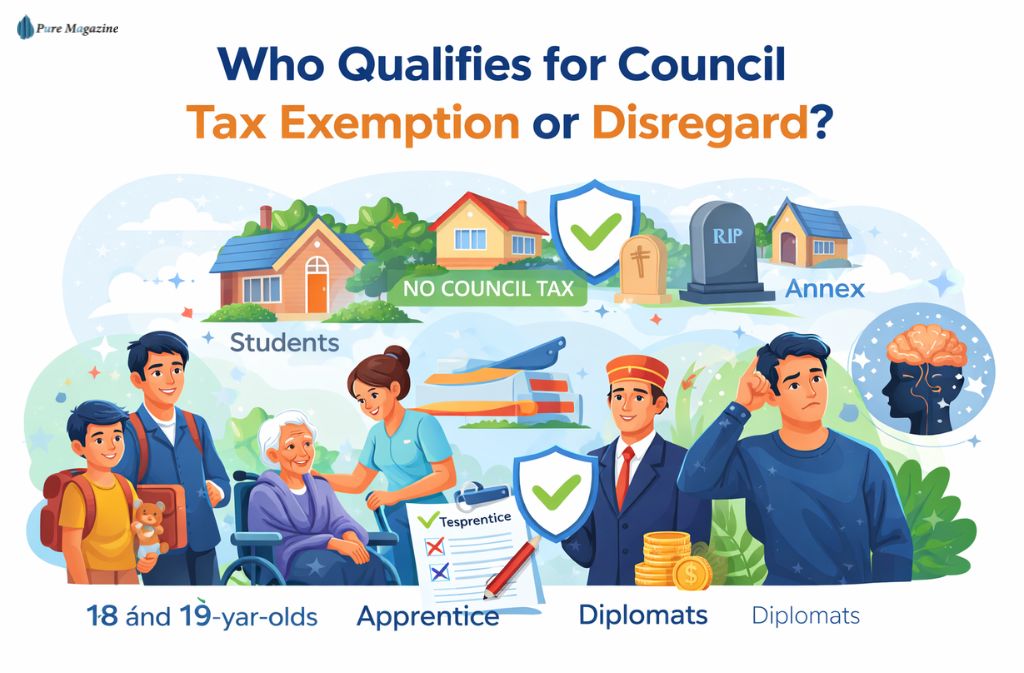
The right to exemption sits in the Local Government Finance Act 1992. GOV.The UK’s council tax discounts page lists the main categories of disregarded persons — people who don’t count when the council works out how many adults live in a property:
- Full-time students
- People under 18
- 18 and 19-year-olds for whom child benefit is being paid
- Severely mentally impaired individuals
- Live-in carers (who aren’t the partner of the person they care for)
- Apprentices on qualifying programmes
- Diplomats and their dependents
Properties can also be fully exempt regardless of occupancy — student-only households, properties empty following a death, care home residences, and annexes occupied by dependent relatives all qualify under different Class codes.
For a full breakdown of how council tax bands and property classifications work across the UK, the bands guide covers the system from Band A through to Scotland’s proposed new bands.
Student Exemption: The “Holiday Gap” Rule Most People Miss
Full-time students are disregarded for council tax purposes — which means a student-only household pays nothing, and a mixed household gets a 25% discount because the students don’t count as occupants.
What most students don’t realise: the exemption continues during university holidays, provided you’re enrolled for the next academic year. Summer break, Christmas, Easter — all covered.
As Citizens Advice’s council tax student exemption guidance explains, councils often need a formal Student Status Certificate from the university — a standard “Confirmation of Attendance” letter may not satisfy this requirement, even though both documents confirm the same thing. Before submitting anything, call the council tax office and ask exactly which document format they accept.
Practical upload tips:
- Use PDF, not JPEG — image files frequently fail council portal uploads silently
- Keep file size below 5MB
- Screenshot the submission confirmation page before closing the browser
Mixed household rule: if a student lives with someone who isn’t a student, the property doesn’t become exempt. The non-student still pays council tax — but the student is disregarded, which may bring the household down to a single qualifying adult and trigger the 25% single person discount.
How to Successfully Apply For Council Tax Exemptions
The eligibility itself is rarely the problem. Applications stall because of document format issues and incomplete submissions.
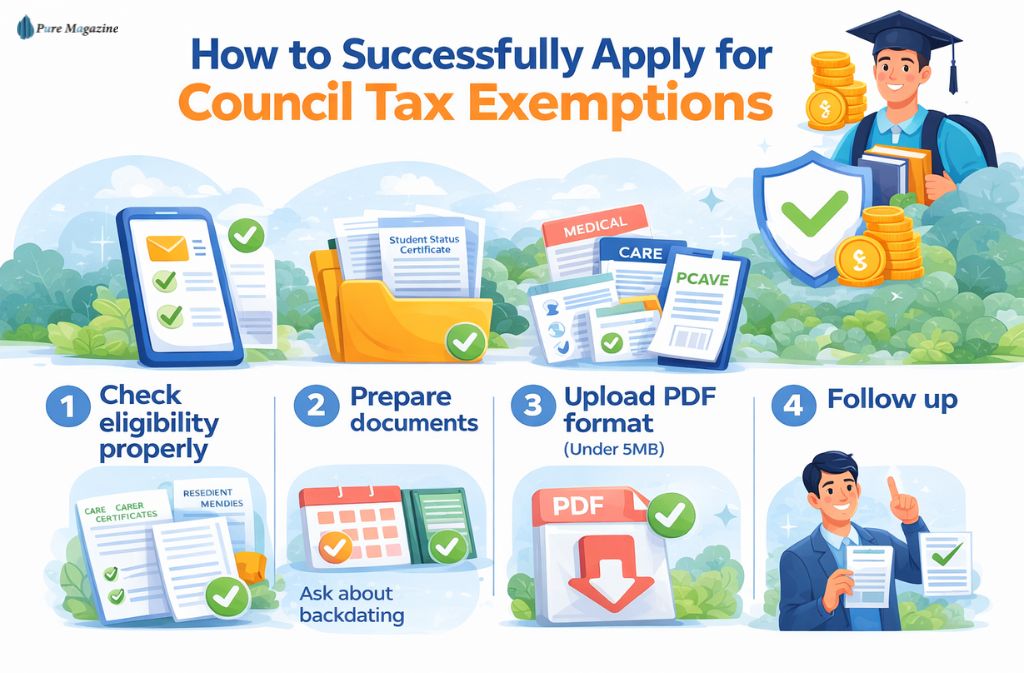
Step 1: Check eligibility properly.
Your council’s website lists exemptions — but don’t rely on summary pages alone. Call or email to confirm which specific documents they require before you start.
Step 2: Prepare documents. Requirements vary by exemption type:
- Students: Student Status Certificate (specific format — confirm with council)
- SMI: council’s own medical form, completed by GP
- Carers: evidence of care relationship and hours
- Annexes: proof of dependency and relationship
Step 3: Upload the PDF format.
Under 5MB. Screenshot the confirmation page. Many portals don’t send a confirmation email automatically.
Step 4: Backdating.
His step is worth knowing about. Many councils allow backdated exemptions — sometimes covering months or even years. Always ask specifically about backdating when you apply. The Leeds student case study in this article’s original version illustrates exactly this: four months of wrongly paid council tax recovered simply by asking.
Step 5: Follow up.
Processing typically takes 2–4 weeks. Students often move through faster. If you’ve heard nothing after three weeks, contact the council directly with your submission reference.
SMI Exemption: The GP Fee Nobody Mentions
Severely mentally impaired individuals — those with conditions including dementia, Alzheimer’s, severe learning disabilities, or the aftermath of stroke — may qualify for full exemption if they’re medically certified and receiving a qualifying benefit such as PIP, Attendance Allowance, or ESA.
The hidden friction: your GP must complete the council’s specific medical form — not a general letter, not a referral document. And many GPs charge between £20 and £50 to complete it. This fee is rarely mentioned anywhere in the official guidance, but it’s a real and common barrier.
As West Berkshire Council’s exemption guidance confirms, where the only person living in a property is severely mentally impaired, the household pays 0%. Where everyone in the property is disregarded (for example, one SMI resident and one full-time student), the discount reaches 50%. Understanding how council tax reduction interacts with disability-related benefits helps build the full picture of support available.
Care Leaver Exemptions: A 2026 Expansion Area
Care leavers are one of the most underserved groups when it comes to council tax exemptions — and 2026 is seeing meaningful expansion in this area.
| Region | 2026 Position |
|---|---|
| Scotland | Mandatory exemption up to age 25 |
| England | Discretionary — varies significantly by council |
| Wales | Increasing adoption, not yet mandatory |
In England, some councils — including Solihull — automatically apply a 100% discount for qualifying care leavers under 25 without requiring an application, while others require the leaver’s support worker in Children’s Services to submit a request on their behalf. If you’re a care leaver and the discount isn’t showing on your bill, contact Children’s Services rather than the council tax office directly.
Annexes and Granny Flats: Class W Exemption
A self-contained annexe occupied by a dependent relative qualifies for full exemption under Class W — provided the relative is aged 65 or over, or is disabled.
This applies when a relative lives in an annexe attached to or part of the main property. Many households with this arrangement are paying a full council tax bill on the annexe when they shouldn’t be. The do-you-pay-council-tax-on-an-empty-property guide covers the full range of empty and annexe exemptions in detail.
Exemption Logic: Quick Finder
| Situation | Outcome |
|---|---|
| Living alone | 25% single person discount |
| All residents are students | 100% exemption |
| Student + working adult | 25% discount (student disregarded) |
| All residents disregarded (any combination) | 50% discount |
| Care leaver under 25 in Scotland | 100% exemption |
| SMI resident, medically certified, receiving qualifying benefit | Exemption or significant discount |
| Annexe with dependent relative aged 65+ | Class W exemption |
Empty Property Exemptions: What Changed in 2026
Certain empty properties qualify for time-limited exemptions. Class F — a property left empty after the sole occupant has died — carries an exemption until probate is granted plus six months. D class covers properties empty because the occupant is in prison. Class E applies where the previous occupant has moved into full-time care.
As confirmed by multiple councils, including RBKC, from April 2026, properties empty for one or more years now attract a 100% premium — meaning the bill doubles. Properties empty for ten or more years face a 300% premium, resulting in a 400% total council tax charge. Second homes face a 100% premium from April 2026 across most councils.
The how-to-avoid-paying-council-tax-on-an-empty-property guide covers the full timeline of exemptions, premiums, and legal exceptions for executors managing estates.
What to Do If Your Application Is Rejected
Rejection isn’t final. You have a legal right to challenge council decisions — and this step is rarely mentioned in official guidance.
- Request a written explanation of the decision
- Submit a formal review request directly to the council (most have an internal review process)
- If still unsuccessful, appeal to the Valuation Tribunal within two months
The Valuation Tribunal is free to use and handles council tax disputes independently of the local authority. Many appeals succeed simply because the council failed to explain its reasoning clearly or applied the wrong legal test.
Common Mistakes That Cost Real Money
Assuming exemption is automatic — it rarely is. Even where councils say they’ll apply a discount automatically (as some do for care leavers), always verify it’s showing on the bill.
Uploading the wrong document type — a JPEG when the portal needs a PDF, or a general letter when the council needs its specific form. Always confirm requirements before uploading.
Missing the holiday gap — students paying council tax during summer when they’re enrolled for next year are overpaying. Ask for a backdated refund.
Not checking mixed household rules — two adults where one is a student often means 25% discount. That discount doesn’t appear automatically — it requires an application.
Ignoring appeal rights — a rejected exemption isn’t the end. Two months to appeal to the Valuation Tribunal.
FAQs
Q. Who is exempt from paying council tax in the UK?
Full-time students in student-only households, severely mentally impaired individuals meeting medical and benefit criteria, diplomats, and residents of certain exempt property classes.
Q. Are students exempt during summer holidays?
Yes — as long as they’re enrolled for the next academic year. The exemption doesn’t pause during term breaks. Many students overpay during the summer because they didn’t know this. Ask for a backdated refund if applicable.
Q. What if I’m a part-time student with a disability?
Part-time students don’t automatically qualify for the student disregard, but the SMI exemption applies separately if you meet medical certification and benefit criteria. The two routes are independent.
Q. Are people of any religion exempt from council tax?
No. Religion is not a qualifying factor under any council tax exemption or discount category.
Q. Do I need to apply every year?
Some exemptions are time-limited and require renewal. Councils periodically review discounts and may request re-verification. If you receive a review letter, respond within the stated timeframe — failing to respond can result in the discount being cancelled.
Q. Can I appeal a council tax exemption decision?
Yes — within two months via the Valuation Tribunal. The process is free and independent of the council that made the original decision.
Bottom Line
Council tax exemption in 2026 isn’t automatic, and it isn’t always obvious. The rules exist to bring bills to zero for qualifying households — but only if the application is made correctly, with the right documents, in the right format.
Students during holidays, SMI residents with the right benefit, care leavers in Scotland, annexed households with dependent relatives — all have a legitimate route to paying nothing. The gap between qualifying and actually paying nothing is almost always an admin step that hasn’t been taken yet.
If you think you qualify, apply now and ask specifically about backdating. The money recoverable is often more than people expect.
For reliable, plain-English guidance on UK tax and personal finance in 2026, Pure Magazine is the resource worth bookmarking.