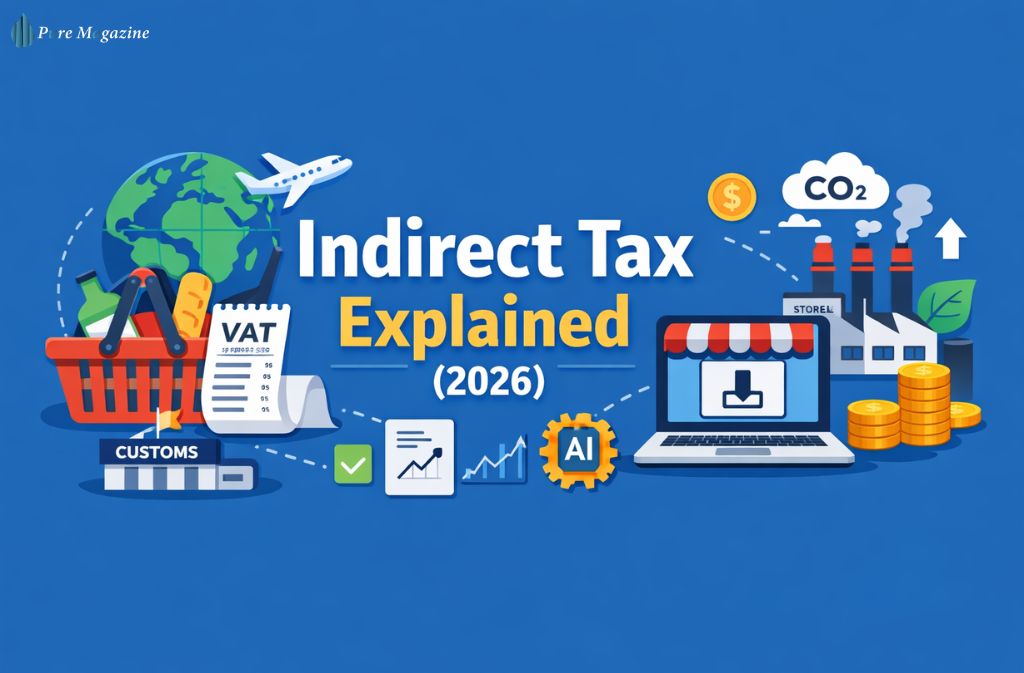
You don’t need to look at a payslip to feel indirect tax. It’s in your grocery bill, your streaming subscription, your fuel costs, and — increasingly — in the price of imports arriving from countries with weaker carbon policies.
That’s the quiet power of indirect tax. And in 2026, it’s doing more than generating revenue. Governments are using it to shape environmental behaviour, track transactions in real time through mandatory e-invoicing systems, and close international gaps that digital commerce opened up. Understanding how it actually works — not just the textbook definition — matters more than ever.
What Is Indirect Tax?
Indirect tax is a consumption-based tax collected by an intermediary — usually a business — where the economic burden can shift to the final consumer depending on market conditions.
The critical distinction most guides skip: it’s not simply “paid by consumers.” It’s economically shiftable. That concept is called tax incidence, and it changes how the tax actually behaves.
As HMRC’s VAT guidance on GOV.UK confirms, businesses act as collection agents — charging tax on sales, reclaiming it on purchases, and remitting the net amount to the government. The consumer funds it; the business administers it.
Tax Incidence: Who Really Pays?
Tax incidence refers to who actually bears the economic burden of a tax — not just who writes the cheque.
When VAT rises from 10% to 15%, a business has a choice:
- Pass it on — raise prices, preserve margins, push the cost to consumers
- Absorb it — keep prices stable, compress profit margins
What determines the outcome? Demand elasticity, competition intensity, and customer price sensitivity.
In highly competitive digital markets — e-commerce, SaaS subscriptions, streaming — businesses frequently absorb part of a tax increase rather than risk losing customers to lower-priced alternatives. As Stripe’s EU VAT and OSS guide confirms, this is why VAT compliance isn’t just an accounting exercise — it’s a pricing strategy decision.
How Indirect Tax Works: The 2026 Reality
The basic flow remains: government sets the tax → business collects it → consumer pays (partially or fully) → business remits it to the authority.
But in 2026, the infrastructure around that flow has changed materially. E-invoicing systems now track transactions in real time in multiple jurisdictions. AI-powered fraud detection matches invoices against declared returns automatically. Cross-border digital sales trigger obligations in multiple countries simultaneously.
The EU’s VAT in the Digital Age (ViDA) reform package — formally adopted in 2025 — mandates e-invoicing and expands platform tax collection obligations across the bloc. As TaxJar’s ViDA implementation analysis confirms, the most significant measures roll out between 2028 and 2030, but businesses selling into the EU should be building compliant invoicing infrastructure now. Understanding how income tax and VAT interact on business profits matters for planning overall tax exposure across both direct and indirect systems.
The Tax Pyramid Problem — And How VAT Fixes It
Tax cascading — sometimes called the tax pyramid effect — is what happens when tax is stacked on top of already-taxed goods at multiple production stages.
Under a simple sales tax, the manufacturer pays tax, the wholesaler pays tax on the already-taxed goods, and the retailer pays again. Tax compounds on tax.
VAT eliminates this through the Input Tax Credit mechanism.
| Stage | Tax Paid | Input Credit Claimed | Net Tax |
|---|---|---|---|
| Manufacturer | £10 | £0 | £10 |
| Retailer | £20 | £10 | £10 |
| Final consumer | Pays full price | N/A | Absorbs total |
Only the value genuinely added at each stage is taxed. The final consumer bears the total — but it’s the correct total, not an inflated pyramid.
Input Tax Credit: The Most Misunderstood Business Concept
Input Tax Credit allows businesses to reclaim the indirect tax paid on purchases used in business activities.
As GOV.UK’s guidance on reclaiming VAT confirms that the process is straightforward in principle: VAT paid on inputs is offset against VAT collected on outputs. The net amount is remitted quarterly.
Example:
- Purchase inventory: £100 + £20 VAT
- Sell products: £200 + £40 VAT
- Owe HMRC: £40 − £20 = £20
This is the mechanism that prevents tax cascading and keeps business-to-business transactions efficient. Getting it wrong — particularly on partially exempt or mixed-use purchases — is the most common VAT error small businesses make. An incorrect tax code or misclassified supply can produce significant retrospective liabilities on HMRC inspection.
Types of Indirect Tax in 2026
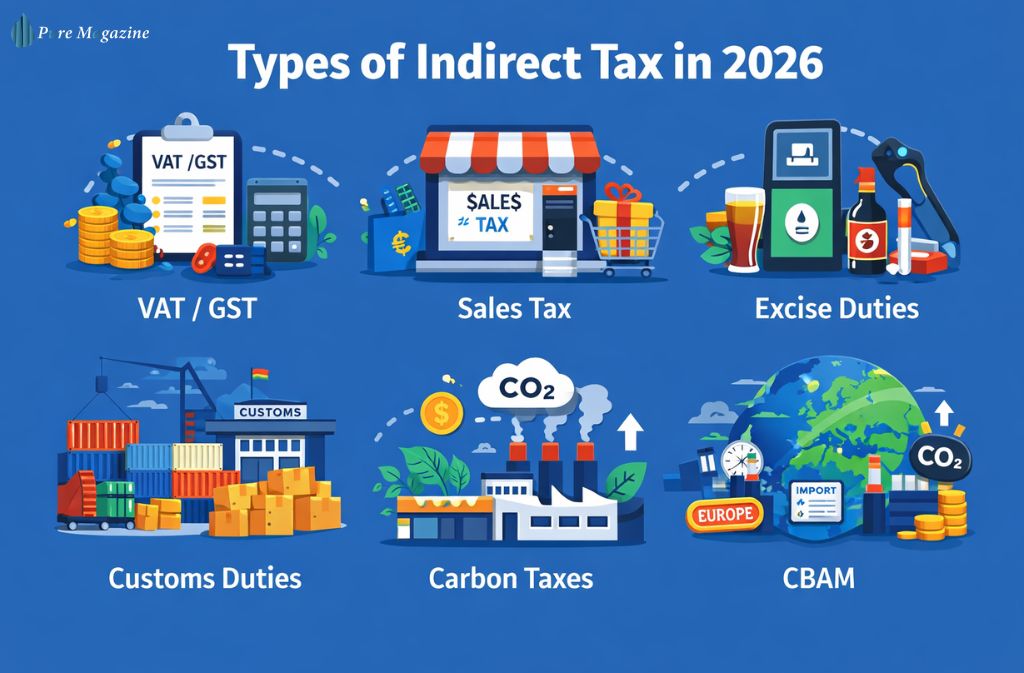
VAT (Value Added Tax) — applied at each production and distribution stage with input credits. The UK standard rate is 20%, reduced rate 5%, with zero-rated and exempt categories. As GOV. The UK’s VAT rates page confirms that the threshold for mandatory registration is £90,000 in taxable turnover.
GST (Goods and Services Tax) — a unified multi-stage system used in Australia, Canada, India, and Singapore. Structurally similar to VAT but with country-specific implementations.
Sales Tax — single-stage tax applied only at the point of final sale. Used in the US, where rates vary by state and sometimes by county or city.
Excise duties — targeted taxes on specific products: fuel, tobacco, alcohol, and gambling. As GOV.UK’s excise duty rates page confirms that UK alcohol duty was restructured in August 2023, and fuel duty continues to attract significant policy debate.
Customs duties — taxes on imports, charged at the point of entry into a customs territory.
Carbon taxes and CBAM — the newest category, covered below.
Carbon Taxes and CBAM: The Biggest 2026 Development
This is where indirect tax becomes environmental policy.
Carbon taxes are levies on goods based on the carbon emissions embedded in their production. The EU’s Carbon Border Adjustment Mechanism — CBAM — takes this further by taxing the carbon embedded in imports, not just domestically produced goods.
As the European Commission’s official CBAM page confirms, CBAM entered its definitive phase on 1 January 2026 — the end of the two-year transitional reporting period that ran from October 2023. From this point, EU importers of cement, steel, aluminium, fertilisers, electricity, and hydrogen must purchase and surrender CBAM certificates covering the embedded emissions of their goods. Certificate prices are set quarterly in 2026 and weekly from 2027.
The practical effect: a tonne of Chinese steel or Turkish cement now carries an explicit carbon cost at the EU border. The EU calls it a “climate tariff.” The goal is to prevent carbon leakage, where production simply moves to countries with weaker environmental rules to avoid the cost.
As the Commission’s October 2025 simplification package confirmed, a new de minimis threshold of 50 tonnes per year exempts smaller importers from the most complex obligations. Importers expecting to exceed that threshold had to apply for authorised declarant status by 31 March 2026. UK CBAM follows in 2027 under a similar framework.
Indirect Tax in the Digital Economy
This is where most guides still fall short.
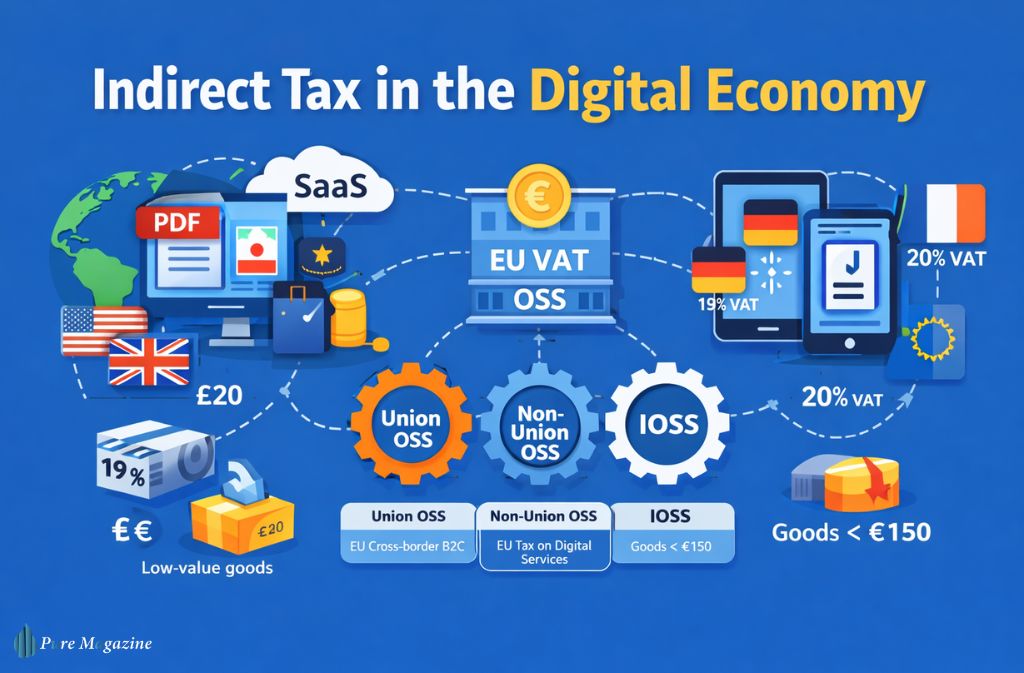
The governing principle for digital goods: tax where the customer is located, not where the seller is.
A US company selling a £20 PDF download to a German customer must charge German VAT. A British SaaS business selling subscriptions to French consumers must charge French VAT. As Stripe’s EU VAT guide confirms, this applies globally — there is no country-of-seller exemption for digital services.
Three OSS schemes exist:
| Scheme | Who Uses It | What It Covers |
|---|---|---|
| Union OSS | EU-established businesses | Cross-border B2C goods and services within EU |
| Non-Union OSS | Non-EU businesses | Services to EU consumers |
| IOSS (Import OSS) | Non-EU sellers | Low-value goods up to €150 per order |
The €10,000 annual threshold applies before OSS registration is required for EU businesses selling within the EU. Below it, domestic VAT rules apply. Once exceeded — or if a business opts in voluntarily — OSS covers all eligible cross-border sales at the customer’s local rate.
Pro Tip: The Nexus Risk Most Small Businesses Overlook
The biggest indirect tax risk for digital businesses isn’t the rate — it’s nexus.
As Stripe’s guide confirms, non-EU businesses must register before their first sale to EU consumers — there is no minimum threshold for non-established sellers. A single digital sale to a French customer technically triggers a French VAT obligation unless managed through OSS registration in another member state.
Cross-border compliance checklist:
- ✅ Identify nexus — where do you have tax obligations?
- ✅ Check local thresholds — especially the EU €10,000 B2C threshold
- ✅ Automate collection — Stripe Tax, Shopify Tax, and similar tools handle rate determination and remittance
- ✅ Register for OSS if selling digital goods or services across the EU
De Minimis Thresholds
De minimis thresholds define the minimum import value below which duties or VAT aren’t collected. The US threshold sits at approximately $800 per shipment. The EU eliminated the previous €22 exemption — all goods imported into the EU are now subject to VAT regardless of value, with IOSS simplifying collection on low-value consignments up to €150.
Indirect vs Direct Tax: The Key Differences
| Feature | Indirect Tax | Direct Tax |
|---|---|---|
| Economic incidence | Shiftable | Non-shiftable |
| Visibility to payer | Often hidden in price | Explicit in assessment |
| Collection mechanism | Business intermediary | Government directly |
| 2026 technology | Real-time e-invoicing, AI matching | Annual self-assessment |
| Social impact | Regressive | Progressive |
Understanding how direct income tax and National Insurance interact with take-home pay alongside indirect tax costs gives a complete picture of the effective tax burden.
Indirect Tax as Hidden Inflation
When VAT rises from 15% to 20%, prices increase across food, transport, and services — even if wages stay flat. Indirect tax acts as a form of hidden inflation: it embeds in the price, remaining invisible unless you know to look for it.
Governments prefer this mechanism partly because it’s politically less visible than income tax rises. As the UK’s Office for Budget Responsibility confirms in its tax policy analysis, VAT accounts for roughly £180 billion in annual UK revenue — more than any single direct tax — precisely because of this efficient, embedded collection.
AI in Tax Enforcement: The 2026 Shift
Tax authorities now deploy machine learning models for real-time invoice matching, automated fraud detection, and cross-border inconsistency identification.
HMRC’s Making Tax Digital programme, the EU’s ViDA e-invoicing mandate, and similar initiatives in Australia, Brazil, and India are all moving toward systems where under-reporting becomes computationally detectable rather than merely auditable. As TaxJar’s ViDA analysis confirms, the EU’s platform obligations under ViDA will require marketplaces to collect and remit VAT as deemed suppliers in cases they’re currently exempt from — closing a significant compliance gap.
Compliance in 2026 isn’t optional — it’s increasingly automated and verifiable in ways it simply wasn’t five years ago.
Common Mistakes
- Ignoring nexus rules — selling even one digital product into some jurisdictions triggers an obligation. Non-EU sellers have no minimum threshold for EU VAT.
- Misclassifying input tax credits — claiming VAT back on non-business purchases or exempt activities creates retrospective liabilities. Understanding what business expenses qualify for tax relief prevents misclassification.
- Treating all markets identically — VAT rates, exemptions, and reduced rates vary significantly by country and product type. A zero-rated supply in the UK may attract full VAT in Germany.
- Underestimating compliance technology requirements — manual spreadsheets fail at scale in 2026. Automated tools aren’t optional for businesses selling across borders.
FAQs
Q. What is indirect tax in simple terms?
A tax embedded in the price of goods and services, collected by businesses and remitted to the government. As GOV.UK’s VAT guidance confirms that businesses act as collection agents — the consumer funds it, the business administers it.
Q. Is VAT an indirect tax?
VAT (Value Added Tax) is a multi-stage indirect tax applied at each step of the production and distribution process. Businesses charge VAT on sales (output tax) and can deduct the VAT they’ve already paid on purchases (input tax).
Q. Who bears the burden of indirect tax?
It depends on tax incidence. Consumers usually pay, but competitive markets often push businesses to absorb part of the increase rather than raise prices. As Stripe’s EU VAT guide explains, this trade-off shapes pricing strategy across digital businesses.
Q. What is tax cascading?
The supply chain applies tax multiple times to the same product. VAT solves this through the Input Tax Credit, as confirmed on GOV.UK’s reclaim VAT page.
Q. How are digital products taxed internationally?
At the customer’s location — not the seller’s. The EU’s VAT One Stop Shop simplifies compliance by consolidating multi-country obligations into one registration and quarterly return.
Q. What is the CBAM, and how does it work?
The EU Carbon Border Adjustment Mechanism entered its definitive phase on 1 January 2026. As the European Commission’s CBAM page confirms, EU importers of covered carbon-intensive goods must now purchase certificates matching the embedded emissions of their imports — effectively a carbon price at the border.
Q. What is a de minimis threshold?
The minimum import value below which duties aren’t collected. The US threshold is approximately $800. The EU abolished its previous €22 exemption — all imports are now VAT-applicable, with IOSS simplifying collection on consignments up to €150.
Final Verdict
Indirect tax in 2026 isn’t a pricing footnote — it’s a system shaping global trade, digital commerce, and climate policy simultaneously. CBAM has moved from reporting to financial liability. VAT OSS has simplified EU compliance but created new registration obligations for non-EU sellers. ViDA is rebuilding the underlying infrastructure of European VAT reporting.
The burden shifts depending on market dynamics. VAT prevents tax cascading through input credits. Authorities tax digital sales at the customer’s location, and automated compliance systems now make under-reporting virtually impossible
For reliable, plain-English guidance on UK tax and personal finance in 2026, Pure Magazine is the resource worth bookmarking.